personality-tests
Big Five Personality Traits and Salary Earnings
Discover which Big Five personality traits predict higher salary and earnings, backed by meta-analyses covering over 100 studies and 70,000 workers worldwide.
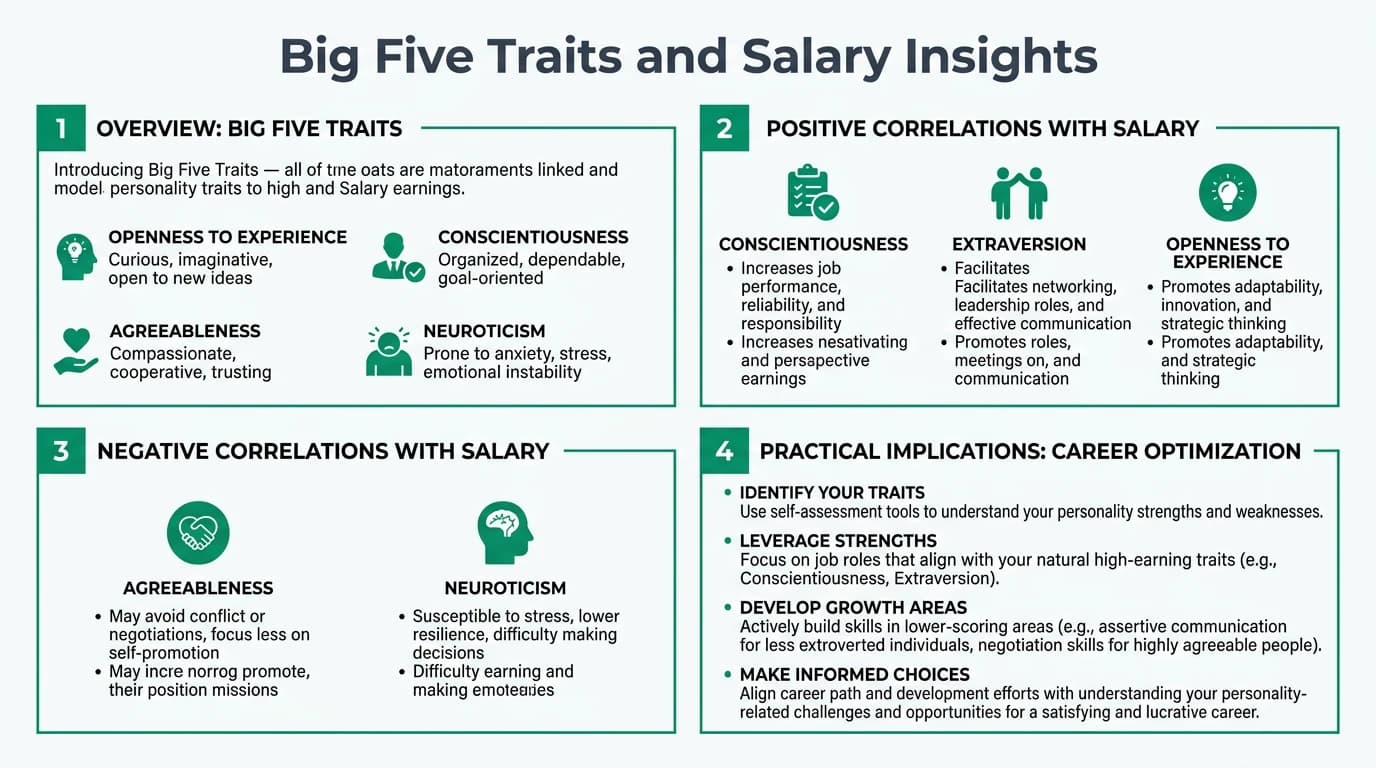
Quick answer
Which Big Five traits predict higher earnings?
Conscientiousness and extraversion are the two strongest positive predictors of salary, while agreeableness carries a consistent wage penalty. A 2023 meta-analysis of 134 estimates found conscientiousness linked to 2–8 percent higher earnings per standard deviation increase, with effects compounding across a career.
Source: Alderotti et al., 2023 — British Journal of Industrial Relations
Key Takeaways
- Conscientiousness is the most robust personality predictor of higher earnings across industries and countries.
- Extraversion provides a salary premium, especially in sales, leadership, and client-facing roles.
- Agreeableness carries a measurable wage penalty — agreeable workers earn 3–7 percent less on average.
- Neuroticism predicts lower earnings through reduced job stability and weaker negotiation behavior.
- Openness to experience shows mixed results, boosting earnings in creative and entrepreneurial roles but offering little advantage in routine occupations.
- Gender and employment type moderate every trait–salary link.
The bottom line: Personality traits are not destiny, but they exert a real, measurable pull on lifetime earnings. Knowing your profile lets you compensate for vulnerabilities and leverage strengths during negotiations and career planning.
Disclaimer: This guide summarizes peer-reviewed research on personality and income for educational purposes. Salary outcomes depend on many factors beyond personality, including education, industry, location, and systemic inequalities.
How Personality Shapes Earnings
Traditional career advice focuses on skills and credentials. A growing body of economic and psychological research shows that personality traits independently predict salary — even after controlling for education, cognitive ability, and work experience12.
- The Alderotti et al. (2023) meta-analysis pooled 134 regression estimates and found statistically significant effects for four of the five traits1.
- Personality operates through at least four channels: job performance, occupational sorting, negotiation behavior, and career persistence.
| Channel | How It Affects Pay | Most Relevant Traits |
|---|---|---|
| Job performance | Higher output leads to raises and promotions | Conscientiousness, emotional stability |
| Occupational sorting | Trait-matched workers enter higher-paying fields | Extraversion, openness |
| Negotiation behavior | Willingness to ask for more money | Low agreeableness, extraversion |
| Career persistence | Staying employed continuously compounds earnings | Conscientiousness, low neuroticism |
Understanding these channels explains why two equally qualified professionals can end up at very different salary levels. For a broader career-planning perspective, see our career choice guide for job seekers.
Conscientiousness: The Strongest Earnings Predictor
Conscientiousness is the trait most consistently linked to higher salary in nearly every large-scale study123.
- Job performance: Meta-analyses rank conscientiousness as the top personality predictor of job performance (r = 0.22), which directly drives pay increases.
- Career continuity: Conscientious workers show lower absenteeism and longer job tenure, both of which increase cumulative earnings.
- Educational attainment: Higher conscientiousness predicts completing more years of education, which compounds into higher starting salaries.
| Conscientiousness Facet | Mechanism | Salary Impact | Evidence Strength |
|---|---|---|---|
| Industriousness | Works harder and longer | 4–8 percent premium | Strong (multiple meta-analyses) |
| Orderliness | Meets deadlines, reduces errors | Moderate positive | Moderate |
| Self-discipline | Resists workplace distractions | Moderate positive | Moderate |
| Deliberation | Makes careful career decisions | Positive long-term | Moderate |
| Achievement striving | Pursues promotions actively | Strong positive | Strong |
| Dependability | Earns trust from managers | Moderate positive | Moderate |
The MIDUS longitudinal study tracked over 3,000 Americans for 18 years and found that baseline conscientiousness predicted a steeper income trajectory, with the gap widening as careers progressed3.
Practical strategies for low conscientiousness:
- Use structured goal-setting frameworks (quarterly objectives with measurable targets).
- Automate routine tasks to reduce reliance on self-discipline.
- Seek roles with built-in accountability structures — project management, for example.
- Track career milestones to stay motivated during long-term planning.
For a deeper understanding of this trait, explore our complete conscientiousness guide.
Extraversion and the Salary Premium
Extraversion is the second most reliable predictor of higher earnings, with effects concentrated in roles requiring social interaction14.
- Leadership roles: Extraverts disproportionately occupy management positions, which carry pay premiums.
- Networking: Larger professional networks translate into better job offers and promotion opportunities.
- Self-employment: The extraversion premium is even larger among entrepreneurs, where client acquisition depends on social assertiveness4.
| Extraversion Facet | Employment Type | Salary Effect | Typical Role |
|---|---|---|---|
| Assertiveness | Wage employment | 3–5 percent premium | Sales manager |
| Sociability | Wage employment | 2–4 percent premium | Account executive |
| Excitement-seeking | Self-employment | 5–10 percent premium | Startup founder |
| Positive emotions | Both | Moderate positive | Team leader |
| Activity level | Self-employment | High positive | Business development |
Cubel et al. (2016) studied earnings across European countries and found that the extraversion premium was strongest in occupations requiring interpersonal skills and weakest in solitary technical roles4.
Practical strategies for introverts:
- Focus on one-on-one networking rather than large events.
- Develop written communication skills to substitute for verbal assertiveness in negotiations.
- Target roles where deep expertise commands a premium, such as engineering or research.
- See our extraversion guide for more trait-development techniques.
The Agreeableness Wage Penalty
Agreeableness is the trait most consistently associated with lower earnings — a pattern so robust it has been called the "agreeableness wage penalty"125.
- Negotiation avoidance: Agreeable workers accept initial offers more readily and negotiate less aggressively.
- Conflict aversion: They avoid salary disputes, performance-based confrontations, and competitive promotions.
- Role selection: High agreeableness predicts entry into lower-paying helping professions (teaching, social work, nonprofit).
| Agreeableness Level | Average Wage Penalty | Primary Mechanism | Gender Difference |
|---|---|---|---|
| Very high (top 20 percent) | 5–7 percent lower | Negotiation avoidance | Larger penalty for men |
| Moderately high | 2–4 percent lower | Conflict aversion | Moderate |
| Average | Baseline | — | — |
| Low | 2–5 percent premium | Assertive negotiation | Smaller gap |
Judge et al. (2012) found that the agreeableness penalty was larger for men than for women, suggesting that cultural expectations amplify the economic cost of male agreeableness5.
Practical strategies for highly agreeable workers:
- Practice salary negotiation scripts before conversations — preparation reduces anxiety.
- Reframe negotiation as advocacy for your value, not conflict.
- Research market rates before interviews using salary benchmarking tools.
- Read our negotiation style guide for trait-specific techniques.
Neuroticism and Earnings Instability
Neuroticism — or its inverse, emotional stability — predicts both lower average earnings and greater income volatility136.
- Job turnover: High neuroticism increases voluntary and involuntary job changes, disrupting income continuity.
- Stress response: Neurotic workers perform worse under pressure, which limits advancement in high-stakes roles.
- Financial behavior: Higher neuroticism correlates with poorer financial decisions and lower wealth accumulation.
| Neuroticism Facet | Earnings Mechanism | Effect Size | Mitigation |
|---|---|---|---|
| Anxiety | Avoids high-stakes negotiations | Moderate negative | Negotiation coaching |
| Depression | Reduces workplace engagement | Moderate negative | Mental health support |
| Self-consciousness | Undervalues own contributions | Moderate negative | Performance tracking |
| Vulnerability | Leaves jobs under moderate stress | Strong negative | Stress management training |
| Impulsiveness | Makes impulsive career switches | Moderate negative | Career planning frameworks |
The MIDUS study found that baseline neuroticism predicted a flatter (and sometimes declining) income trajectory over 18 years, even after controlling for education and occupation3.
Practical strategies for high neuroticism:
- Build an emergency fund to reduce financial anxiety that compounds career decisions.
- Use cognitive behavioral techniques to manage workplace stress.
- Prioritize roles with predictable environments and clear expectations.
- See our job interview performance guide for managing anxiety during high-stakes conversations.
Openness to Experience: A Mixed Picture
Openness shows the least consistent relationship with salary, with effects depending heavily on occupation and industry12.
- Creative fields: Openness predicts higher earnings in design, marketing, research, and entrepreneurial roles.
- Routine occupations: In highly structured jobs, openness may even carry a small penalty — open individuals grow bored and disengage.
- Innovation premium: In knowledge-economy jobs, openness drives idea generation that can lead to patents, publications, and performance bonuses.
| Industry Sector | Openness Effect on Salary | Mechanism | Example Role |
|---|---|---|---|
| Creative and design | Strong positive | Innovation drives value | UX designer, architect |
| Technology startups | Moderate positive | Adaptability to change | Product manager |
| Traditional manufacturing | Neutral to slight negative | Routine work undervalues novelty | Assembly supervisor |
| Academia and research | Moderate positive | Curiosity drives output | Research scientist |
| Finance and accounting | Slight negative | Conformity rewarded | Auditor |
Practical strategies:
- High openness: Channel creativity into high-value-added roles where novel thinking is monetized.
- Low openness: Leverage reliability and consistency as competitive advantages in structured environments.
Gender Differences in Trait-Salary Links
The relationship between personality and pay is not gender-neutral. Several studies find that the same trait produces different salary effects for men and women145.
- Agreeableness penalty: Larger for men. Society expects men to be assertive, so agreeable men face a steeper economic cost.
- Extraversion premium: Roughly equal across genders.
- Conscientiousness premium: Slightly larger for women, possibly because conscientiousness signals reliability in contexts where women face higher scrutiny.
| Trait | Male Salary Effect | Female Salary Effect | Gap Explanation |
|---|---|---|---|
| Conscientiousness | Moderate positive | Strong positive | Women rewarded more for reliability signals |
| Extraversion | Moderate positive | Moderate positive | Roughly equivalent |
| Agreeableness | Strong negative | Moderate negative | Gender role expectations penalize agreeable men more |
| Neuroticism | Moderate negative | Moderate negative | Roughly equivalent |
| Openness | Mixed | Mixed | Occupation-dependent for both |
These patterns suggest that personality-based career advice must be calibrated to the individual — generic trait recommendations miss important contextual factors.
Wage Employment vs. Self-Employment
Personality traits reward different behaviors depending on whether you work for an employer or run your own business4.
| Trait | Wage Employment Effect | Self-Employment Effect | Why the Difference |
|---|---|---|---|
| Conscientiousness | Strong positive | Moderate positive | Employers reward reliability; self-employed need broader skills |
| Extraversion | Moderate positive | Strong positive | Client acquisition is critical for business owners |
| Agreeableness | Negative | Strong negative | Self-employed must negotiate every contract |
| Neuroticism | Negative | Strong negative | Entrepreneurship demands high stress tolerance |
| Openness | Mixed | Moderate positive | Innovation drives competitive advantage |
Entrepreneurs face amplified personality effects because there is no organizational buffer — no HR department to negotiate on your behalf, no structured promotion ladder to reward conscientiousness passively.
Practical Framework: Maximizing Trait-Based Earnings
Use the following framework to translate personality insights into career and salary strategy.
| Step | Action | Trait Focus | Expected Outcome |
|---|---|---|---|
| 1. Assess | Take a validated Big Five assessment | All five traits | Baseline personality profile |
| 2. Identify leverage | Match high traits to high-paying role features | Conscientiousness, extraversion | Better career targeting |
| 3. Address vulnerabilities | Build skills to compensate for low-earning traits | High agreeableness, high neuroticism | Reduced wage penalties |
| 4. Negotiate strategically | Use trait awareness in salary conversations | Agreeableness, extraversion | Higher starting offers |
| 5. Monitor trajectory | Track income growth against personality-matched benchmarks | All five traits | Course correction over time |
Conclusion
Personality traits exert a measurable, evidence-based influence on salary outcomes. Conscientiousness and extraversion consistently predict higher earnings, agreeableness carries a reliable wage penalty, and neuroticism undermines income stability. These effects compound across decades of career progression. The most actionable insight is not to change your personality but to understand your profile and make strategic career decisions accordingly.
Salary optimization action checklist
- Complete a validated Big Five personality assessment.
- Identify which traits help and which hurt your earning potential.
- Research market salary rates for your role and experience level.
- Practice negotiation scripts if you score high on agreeableness.
- Build stress management habits if you score high on neuroticism.
- Target roles that reward your strongest traits (e.g., leadership for extraverts).
- Track your income trajectory annually and adjust your career strategy.
- Consider entrepreneurship if you combine high extraversion with low agreeableness.
FAQ
How much does conscientiousness increase salary?
Why do agreeable people earn less?
Does extraversion help in salary negotiations?
How does neuroticism affect career earnings over time?
Is the personality-salary link the same for men and women?
Do personality effects on salary persist after controlling for education?
Are personality traits more important for salary than cognitive ability?
Should I try to change my personality to earn more?
Notes
Primary Sources
| Source | Type | URL |
|---|---|---|
| Alderotti et al. (2023) — British Journal of Industrial Relations | Meta-analysis (134 estimates) | Wiley Online Library |
| Judge et al. (2012) — Journal of Personality and Social Psychology | Empirical study | APA PsycNet |
| MIDUS Longitudinal Study — University of Wisconsin | 18-year longitudinal study | MIDUS |
| Cubel et al. (2016) — Economic Journal | Laboratory and survey evidence | EconStor |
| Nyhus & Pons (2005) — Journal of Economic Psychology | Panel data study | RePEc |
Footnotes
-
Alderotti, G., Rapallini, C., & Traverso, S. (2023). The Big Five personality traits and earnings: A meta-analysis. British Journal of Industrial Relations, 61(2), 282–308. ↩ ↩2 ↩3 ↩4 ↩5 ↩6 ↩7 ↩8
-
Nyhus, E. K., & Pons, E. (2005). The effects of personality on earnings. Journal of Economic Psychology, 26(3), 363–384. ↩ ↩2 ↩3 ↩4
-
Strickhouser, J. E., & Sutin, A. R. (2020). Personality traits and the balance between work and other life domains across 18 years. MIDUS Longitudinal Study, University of Wisconsin. ↩ ↩2 ↩3 ↩4
-
Cubel, M., Nuevo-Chiquero, A., Sanchez-Pages, S., & Vidal-Fernandez, M. (2016). Do personality traits affect productivity? Evidence from the laboratory. Economic Journal, 126(592), 654–681. ↩ ↩2 ↩3 ↩4 ↩5
-
Judge, T. A., Livingston, B. A., & Hurst, C. (2012). Do nice guys — and gals — really finish last? The joint effects of sex and agreeableness on income. Journal of Personality and Social Psychology, 102(2), 390–407. ↩ ↩2 ↩3
-
Viinikainen, J., Kokko, K., Pulkkinen, L., & Pehkonen, J. (2010). Personality and labour market income: Evidence from longitudinal data. Labour, 24(2), 201–220. ↩