personality-tests
Extraversion: Big Five Social Energy Guide
Understand extraversion in the Big Five model, its six facets, biological roots, workplace effects, and evidence-based strategies for every score range.
Quick answer
What is extraversion in the Big Five?
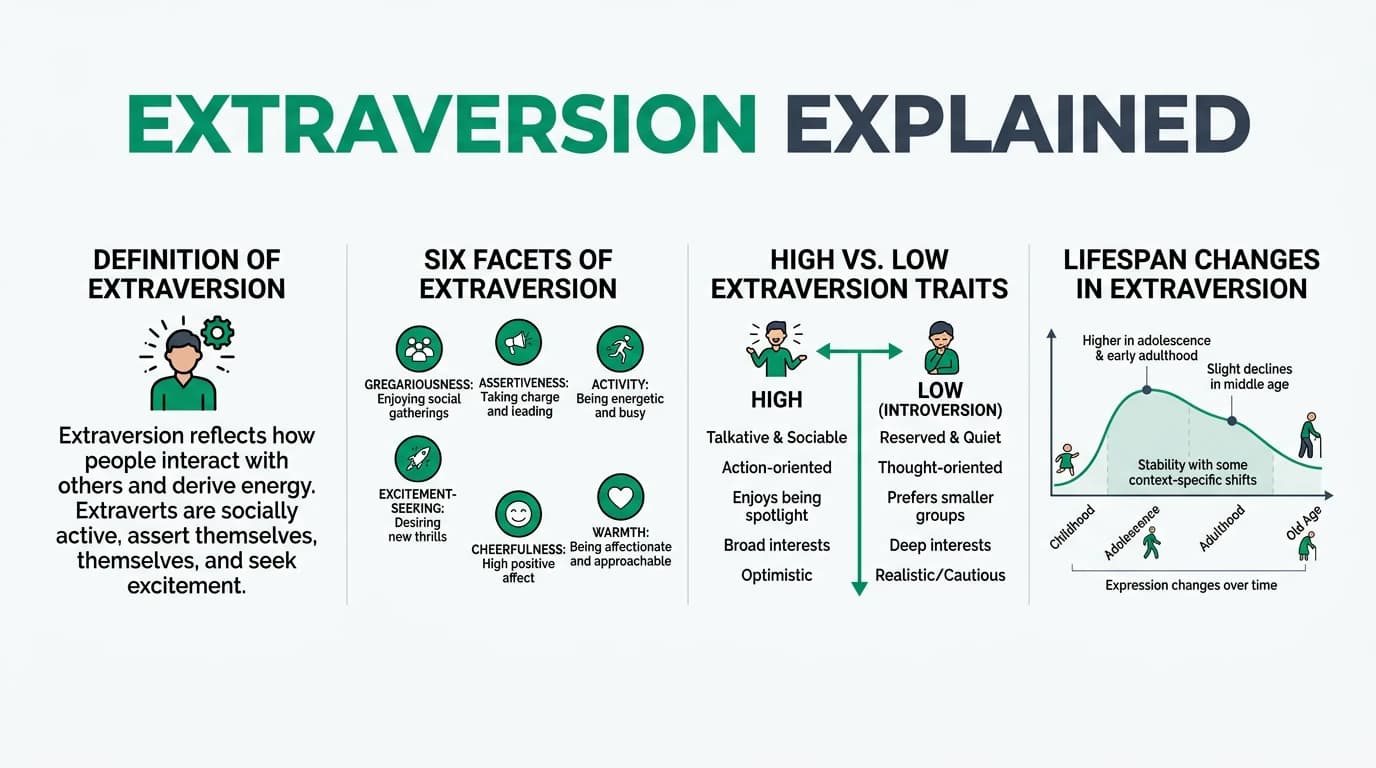
Extraversion is one of five core personality dimensions in the Big Five (OCEAN) model. It measures social energy, assertiveness, and preference for external stimulation on a continuum from low (introversion) to high.
Source: APA Dictionary of Psychology
Executive Summary
Extraversion is a dimensional trait in the Big Five personality framework. It describes how much energy a person draws from social interaction, stimulation, and outward activity 1.
Scoring high does not mean "always talking," and scoring low does not mean "shy." The trait operates on a spectrum, and most people fall somewhere in the middle.
Key takeaway: Extraversion affects career fit, relationship style, health habits, and daily energy management. Use your score as a guide for designing environments, not as a label.
Important: Low extraversion is a preference for lower stimulation, not a social deficit. Avoid equating introversion with shyness or social anxiety.
What Extraversion Actually Measures
Extraversion captures the degree to which a person is energized by external activity. The construct includes several overlapping qualities:
- Social energy: Preference for group settings versus solitary work.
- Positive affect: Tendency toward enthusiasm, excitement, and optimism.
- Assertiveness: Comfort with leading, speaking up, and directing others.
- Stimulation-seeking: Desire for novelty, activity, and sensory input.
The Big Five treats extraversion as a continuum rather than a binary category. For a full framework overview, see our Big Five personality test guide.
| Dimension | High Extraversion | Low Extraversion |
|---|---|---|
| Energy source | External interaction | Solitary reflection |
| Social preference | Large groups, events | One-on-one or small groups |
| Communication style | Thinks out loud | Processes internally first |
| Risk tolerance | Higher novelty-seeking | Prefers familiar routines |
| Emotional tone | Expressive, enthusiastic | Reserved, measured |
The Six Facets of Extraversion
The NEO PI-R model breaks extraversion into six facets, each capturing a distinct behavioral pattern 2. Understanding facets explains why two people with the same overall score can behave very differently.
- Warmth: Affection and friendliness in interpersonal contact.
- Gregariousness: Preference for the company of others.
- Assertiveness: Social dominance, leadership initiative.
- Activity: Pace of life, busyness, and vigor.
- Excitement-seeking: Need for stimulation and thrill.
- Positive emotions: Tendency to experience joy, happiness, and laughter.
| Facet | High-Score Behavior | Low-Score Behavior | Workplace Example |
|---|---|---|---|
| Warmth | Quickly builds rapport | Maintains professional distance | Client-facing roles vs. technical roles |
| Gregariousness | Seeks group settings | Prefers working alone | Open-plan teams vs. remote work |
| Assertiveness | Takes charge naturally | Defers to consensus | Project lead vs. individual contributor |
| Activity | Fast-paced, multitasks | Steady, deliberate pace | Startup culture vs. research labs |
| Excitement-seeking | Pursues novel challenges | Values predictability | Sales development vs. quality assurance |
| Positive emotions | Openly enthusiastic | Calm and understated | Motivational roles vs. analytical roles |
A person can score high on assertiveness but low on gregariousness. This nuance matters when interpreting results. Learn more about communication patterns in our workplace communication styles guide.
High Extraversion: Strengths and Blind Spots
People scoring in the upper range of extraversion tend to gain energy from social settings. They often gravitate toward leadership, sales, and collaborative roles.
Common strengths:
- Build professional networks quickly.
- Energize teams during brainstorming and kickoff meetings.
- Adapt to new social environments with minimal friction.
Potential blind spots:
- May dominate conversations, reducing input from quieter colleagues.
- Risk burnout from over-scheduling social commitments.
- Can undervalue solitary deep-work tasks.
| Scenario | High-E Response | Potential Risk | Mitigation Strategy |
|---|---|---|---|
| Team meeting | Volunteers to lead, speaks first | Overshadows introverted teammates | Use round-robin formats |
| Networking event | Initiates multiple conversations | Superficial connections | Schedule follow-up one-on-ones |
| Remote work day | Feels drained, seeks video calls | Distraction from focused tasks | Block deep-work windows |
| Conflict situation | Addresses issues verbally and immediately | Escalates before reflecting | Pause-and-draft approach |
Low Extraversion: Strengths and Blind Spots
People scoring in the lower range prefer fewer, deeper interactions. They are often effective in roles requiring sustained focus and careful analysis.
Common strengths:
- Excel at deep work and independent research.
- Listen actively and observe group dynamics before contributing.
- Build strong, long-lasting one-on-one relationships.
Potential blind spots:
- May miss informal networking opportunities.
- Can be overlooked for leadership roles despite high competence.
- Risk isolation if solitary habits become rigid.
| Scenario | Low-E Response | Potential Risk | Mitigation Strategy |
|---|---|---|---|
| Team meeting | Listens, contributes targeted insights | Ideas go unheard | Pre-submit written points |
| Networking event | Has two deep conversations | Smaller professional network | Follow up via email or LinkedIn |
| Open-plan office | Feels overstimulated | Reduced productivity | Use noise-canceling headphones |
| Performance review | Understates achievements | Under-recognition | Prepare a written highlight list |
For detailed workplace strategies, see our introversion workplace guide.
Biological and Neurological Basis
Extraversion is not merely a behavioral preference. It has documented biological correlates that help explain individual differences 3.
- Dopamine reward sensitivity: Extraverts show greater activation in dopaminergic pathways when anticipating rewards.
- Cortical arousal baseline: Introverts tend to have higher resting cortical arousal, making them more sensitive to external stimulation (Eysenck's arousal theory).
- Brain structure: Research links higher extraversion to increased grey matter volume in the medial orbitofrontal cortex and the ventral striatum.
| Biological Factor | Finding | Key Study |
|---|---|---|
| Dopamine reactivity | Extraverts show stronger reward-circuit activation | Depue and Collins, 1999 3 |
| Cortical arousal | Introverts have higher resting arousal | Eysenck, 1967 4 |
| Grey matter volume | Correlates with gregariousness and positive emotion facets | DeYoung et al., 2010 5 |
| Heritability estimate | Approximately 50 percent of variance is genetic | Jang et al., 1996 6 |
These findings confirm that extraversion has a substantial genetic component. However, environment, life events, and deliberate practice also shape where someone lands on the spectrum.
How Extraversion Changes Across the Lifespan
Personality is relatively stable but not fixed. Longitudinal research reveals predictable patterns in how extraversion shifts with age 7.
- Adolescence to early adulthood: Social vitality peaks; assertiveness rises steadily.
- Mid-adulthood (30s-50s): Slight overall decline in social energy; assertiveness remains high.
- Older adulthood (60+): Activity and excitement-seeking decline; warmth often stays stable.
| Age Range | Social Vitality | Assertiveness | Activity Level | Practical Impact |
|---|---|---|---|---|
| Teen to 20s | High and rising | Increasing | High | Social exploration, career experimentation |
| 30s to 40s | Stable to slight decline | Peaks | Moderate | Leadership consolidation, mentoring |
| 50s to 60s | Gradual decline | Stable | Declining | Selective socializing, deeper relationships |
| 70+ | Lower | Stable | Lower | Preference for familiar social circles |
These trends are averages. Individual trajectories vary based on health, life transitions, and cultural context.
Extraversion in the Workplace
Extraversion is one of the most studied traits in organizational psychology. Its influence varies significantly by job type and organizational culture 8.
Where high extraversion helps:
- Roles requiring persuasion, networking, and public speaking.
- Team-based environments with frequent collaboration.
- Positions with high client or stakeholder interaction.
Where low extraversion helps:
- Roles demanding sustained concentration and analytical depth.
- Positions requiring careful listening and observation.
- Independent contributor roles with minimal meeting load.
| Job Category | Optimal Extraversion Level | Supporting Evidence |
|---|---|---|
| Sales and business development | Higher | Barrick and Mount, 1991 8 |
| Software engineering | Lower to moderate | Preference for deep focus and asynchronous communication |
| Management and team leadership | Moderate to higher | Judge et al., 2002 9 |
| Research and data science | Lower to moderate | Independent analytical work |
| Customer success | Moderate to higher | Relationship management demands |
| Creative writing | Varies widely | Depends on collaboration model |
Explore how personality intersects with digital behavior in our social media behavior guide.
Extraversion and Relationships
Extraversion influences how people form, maintain, and experience close relationships.
- Network size: High extraversion predicts larger social networks and more frequent social contact.
- Relationship satisfaction: Extraverted partners tend to express positive emotions more openly, which can increase mutual satisfaction.
- Conflict style: Extraverts often prefer direct, verbal conflict resolution; introverts may prefer written or reflective approaches.
| Relationship Domain | High-E Pattern | Low-E Pattern |
|---|---|---|
| Friendship formation | Many acquaintances, broad network | Few close friends, deep bonds |
| Romantic attachment | Expressive, initiates plans | Thoughtful, values quality time |
| Family dynamics | Organizes gatherings, verbal affirmation | Prefers small family events, written notes |
| Professional relationships | Leverages networking, visible in organizations | Builds trust through reliability and competence |
Measuring Extraversion: Tools and Accuracy
Several validated instruments measure extraversion as part of the Big Five framework.
- NEO PI-R: Gold standard for research; 240 items covering all facets.
- BFI-2: 60-item inventory with strong psychometric properties 10.
- IPIP-NEO: Free, open-source alternative with good reliability.
- Mini-IPIP: 20-item ultra-short version for screening.
| Instrument | Items | Facet Detail | Best Use Case | Reliability (alpha) |
|---|---|---|---|---|
| NEO PI-R | 240 | Full six facets | Clinical and research | 0.89-0.93 |
| BFI-2 | 60 | Three facets per domain | Organizational and academic | 0.84-0.89 |
| IPIP-NEO | 120 or 300 | Full facet detail | Research (open-source) | 0.85-0.92 |
| Mini-IPIP | 20 | Domain-level only | Quick screening | 0.70-0.78 |
For a comparison of personality assessment methods, see our conscientiousness guide.
Practical Strategies by Score Range
Regardless of where you fall on the extraversion spectrum, evidence-based strategies can help you perform at your best.
For higher scorers:
- Schedule daily deep-work blocks without social interruption.
- Practice active listening by counting to three before responding.
- Balance networking with follow-through on existing relationships.
For lower scorers:
- Prepare talking points before meetings to reduce social friction.
- Use asynchronous communication tools when possible.
- Build recovery time into days with heavy social demands.
For mid-range scorers (ambiverts):
- Alternate between collaborative and solo work throughout the week.
- Monitor energy levels and adjust social exposure accordingly.
- Leverage flexibility as a strength in diverse team environments.
Extraversion optimization checklist
- Identify your extraversion score and facet profile using a validated instrument.
- Audit your current work environment for energy alignment.
- Design your weekly schedule with intentional social and solitary blocks.
- Communicate your work-style preferences to your team or manager.
- Review and adjust every quarter based on energy and performance patterns.
FAQ
What is the difference between extraversion and extroversion?
Both spellings are used in psychology. "Extraversion" is the original Latin-derived term used by Eysenck and in the NEO PI-R. "Extroversion" is a common alternative. They refer to the same construct 1.
Can an introvert become more extraverted?
Research shows that people can shift their behavior in extraverted directions through deliberate practice, though the underlying trait remains relatively stable. Behavioral interventions can increase social confidence without changing core preferences 7.
Is extraversion linked to happiness?
Multiple studies find a positive correlation between extraversion and subjective well-being, partly mediated by positive affect and social engagement. However, introverts can achieve equal life satisfaction through different pathways 3.
How does extraversion affect leadership?
Meta-analyses show a moderate positive correlation between extraversion and leadership emergence. However, the relationship is weaker for leadership effectiveness, where conscientiousness plays a larger role 9.
What are the six facets of extraversion?
The NEO PI-R defines six facets: warmth, gregariousness, assertiveness, activity, excitement-seeking, and positive emotions. Each captures a distinct component of the broader trait 2.
Is extraversion genetic?
Twin studies estimate that roughly 50 percent of individual differences in extraversion are attributable to genetic factors, with the remainder influenced by non-shared environmental experiences 6.
Does extraversion decline with age?
Longitudinal studies show a modest decline in social vitality across adulthood, while assertiveness tends to peak in midlife and remain stable. The overall pattern is one of gradual rather than dramatic change 7.
Can extraversion predict job performance?
Extraversion predicts performance best in jobs requiring social interaction, such as sales and management. For roles demanding independent concentration, the relationship is weak or negligible 8.
Notes
Primary Sources
| Source | Type | URL |
|---|---|---|
| APA Dictionary - Extraversion | Institutional definition | dictionary.apa.org/extraversion |
| Costa and McCrae (1992), NEO PI-R Manual | Foundational instrument manual | doi.org/10.1037/t03907-000 |
| Barrick and Mount (1991) | Meta-analysis of personality and job performance | doi.org/10.1111/j.1744-6570.1991.tb00688.x |
| Roberts, Walton, and Viechtbauer (2006) | Lifespan personality development meta-analysis | doi.org/10.1037/0033-2909.132.1.1 |
| Soto and John (2017), BFI-2 | Modern instrument validation | doi.org/10.1037/pspp0000092 |
Conclusion
Extraversion shapes how you gain energy, communicate, and navigate social environments. Whether you score high, low, or somewhere in between, the key is to design your habits and environments to work with your trait profile rather than against it.
Use validated instruments to understand your facet-level profile, then apply the strategies in this guide to optimize your work, relationships, and well-being.
Footnotes
-
Costa, P. T., & McCrae, R. R. (1992). Revised NEO Personality Inventory (NEO PI-R) and NEO Five-Factor Inventory professional manual. Psychological Assessment Resources. ↩ ↩2
-
McCrae, R. R., & Costa, P. T. (2008). The five-factor theory of personality. In O. P. John, R. W. Robins, & L. A. Pervin (Eds.), Handbook of Personality: Theory and Research (3rd ed., pp. 159-181). Guilford Press. ↩ ↩2
-
Depue, R. A., & Collins, P. F. (1999). Neurobiology of the structure of personality: Dopamine, facilitation of incentive motivation, and extraversion. Behavioral and Brain Sciences, 22(3), 491-517. ↩ ↩2 ↩3
-
Eysenck, H. J. (1967). The Biological Basis of Personality. Charles C. Thomas. ↩
-
DeYoung, C. G., Hirsh, J. B., Shane, M. S., Papademetris, X., Rajeevan, N., & Gray, J. R. (2010). Testing predictions from personality neuroscience: Brain structure and the Big Five. Psychological Science, 21(6), 820-828. ↩
-
Jang, K. L., Livesley, W. J., & Vernon, P. A. (1996). Heritability of the Big Five personality dimensions and their facets. Journal of Personality, 64(3), 577-591. ↩ ↩2
-
Roberts, B. W., Walton, K. E., & Viechtbauer, W. (2006). Patterns of mean-level change in personality traits across the life course: A meta-analysis of longitudinal studies. Psychological Bulletin, 132(1), 1-25. ↩ ↩2 ↩3
-
Barrick, M. R., & Mount, M. K. (1991). The Big Five personality dimensions and job performance: A meta-analysis. Personnel Psychology, 44(1), 1-26. ↩ ↩2 ↩3
-
Judge, T. A., Bono, J. E., Ilies, R., & Gerhardt, M. W. (2002). Personality and leadership: A qualitative and quantitative review. Journal of Applied Psychology, 87(4), 765-780. ↩ ↩2
-
Soto, C. J., & John, O. P. (2017). The next Big Five Inventory (BFI-2): Developing and assessing a hierarchical model with 15 facets. Journal of Personality and Social Psychology, 113(1), 117-143. ↩