professional-development
Personality and Negotiation: How Big Five Traits Shape Your Style and Outcomes
Evidence-based guide on how Extraversion, Agreeableness, Conscientiousness, and other traits influence negotiation approach, conflict resolution, and deal outcomes.
Quick answer
How does personality affect negotiation?
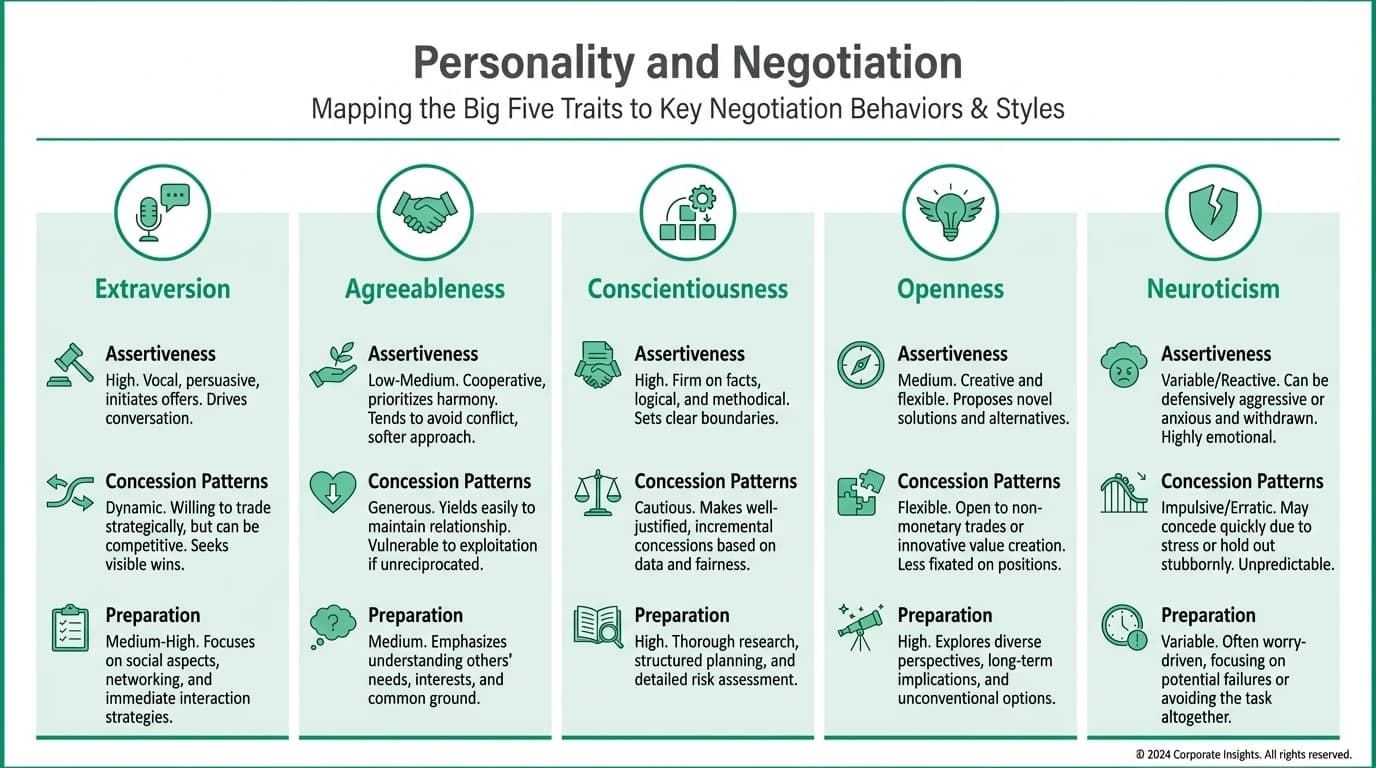
Big Five traits predict negotiation style: Extraversion drives assertiveness, Agreeableness affects concession patterns, and Conscientiousness shapes preparation. No single profile 'wins'—context and adaptability matter more.
Source: Journal of Applied Psychology
Executive Summary
Personality shapes how you negotiate. Research links Big Five traits to negotiation behavior: who speaks first, how much people concede, and whether deals hold. The good news: awareness beats default patterns.
The bottom line: Know your tendencies, prepare for the other side's style, and adapt. Traits are tendencies—not destiny.
Important: Personality predicts style, not fixed outcomes. Skilled negotiators override default tendencies when the situation demands it.
How Traits Map to Negotiation Behavior
| Trait | Typical negotiation behavior | Risk |
|---|---|---|
| High Extraversion | Assertive, speaks first, high opening offers | May overlook listening |
| High Agreeableness | Cooperative, quick to concede | May leave value on table |
| High Conscientiousness | Prepared, structured, follows process | May be inflexible |
| High Openness | Creative solutions, explores options | May over-complicate |
| High Neuroticism | Avoids conflict, anxious under pressure | May concede too early |
- Extraversion correlates with higher first offers and more dominant tactics.
- Agreeableness predicts faster concessions and integrative (win-win) orientation.
- Conscientiousness links to preparation quality and follow-through.
Extraversion: Assertiveness vs. Over-Talking
Extraverts tend to dominate the room. They make higher opening offers and speak more. That can work in distributive (zero-sum) deals—but backfires when the goal is joint value creation.
| Extraversion level | Strength | Pitfall |
|---|---|---|
| High | Confidence, initiative | Monopolizes airtime; misses cues |
| Low | Listening, reflection | May be perceived as passive |
Practical takeaway: If you're high in Extraversion, schedule deliberate "listen-only" phases. If you're low, script your opening and key asks in advance.
Agreeableness: The Concession Trap
Agreeable negotiators prioritize harmony. They concede faster and seek integrative outcomes. In collaborative settings, that builds trust. In competitive ones, it leaks value.
| Scenario | High Agreeableness | Low Agreeableness |
|---|---|---|
| Partnership deal | Builds rapport, finds common ground | May seem adversarial |
| Salary negotiation | Risks under-asking | Holds firm; may damage relationship |
| Conflict resolution | De-escalates quickly | May escalate or stonewall |
- Research finding: Agreeableness predicts lower economic outcomes in purely distributive negotiations.
- Mitigation: Prepare a BATNA (Best Alternative) and a walk-away number. Write it down before the meeting.
Conscientiousness: Preparation and Rigidity
Conscientious negotiators prepare well. They bring data, agendas, and follow-up plans. The downside: they can be rigid when the other side deviates from the script.
| Aspect | High Conscientiousness | Watch out for |
|---|---|---|
| Preparation | Strong—research, benchmarks, scenarios | Over-planning; analysis paralysis |
| Process | Structured, on-agenda | Inflexibility when curveballs arise |
| Follow-through | Reliable implementation | May miss improvisational opportunities |
Key takeaway: Use your preparation as a base, not a straitjacket. Leave room for discovery.
Openness: Creativity and Complexity
Open negotiators explore options. They generate novel solutions and consider multiple dimensions. That helps in complex, multi-issue deals. It can slow down simple, single-issue negotiations.
| Deal type | Openness helps | Openness hinders |
|---|---|---|
| Multi-issue | Trade-offs, creative packaging | — |
| Single-issue (price) | — | Over-complicates; loses focus |
| Partnership | Long-term value creation | — |
Neuroticism: Stress and Concession
High Neuroticism correlates with anxiety in conflict. Under pressure, people tend to concede more and earlier. They also avoid negotiation altogether when possible.
| Response to pressure | High Neuroticism | Lower Neuroticism |
|---|---|---|
| Anxiety | Higher | Lower |
| Concession timing | Earlier | Later |
| Avoidance | More likely to defer | More likely to engage |
Mitigation: Rehearse under pressure (role-play, mock negotiations). Use written communication for high-stakes asks when face-to-face stress is overwhelming.
Negotiation Style by Trait Combination
| Profile | Typical style | Best context |
|---|---|---|
| High E + Low A | Competitive, assertive | Distributive deals; one-off transactions |
| High A + High O | Collaborative, creative | Partnerships; multi-issue deals |
| High C + Low N | Prepared, calm | Complex deals; long timelines |
| High N + High A | Accommodating, conflict-averse | Relationship preservation (but watch value) |
Adapting to the Other Side
You can't change your traits mid-negotiation. You can adapt your behavior.
- If they're high Extraversion: Let them talk; capture commitments in writing. Don't compete for airtime.
- If they're high Agreeableness: Propose options; they'll reciprocate. Avoid hardball.
- If they're high Conscientiousness: Send an agenda, data, and structure. Respect process.
- If they're high Neuroticism: Reduce perceived threat. Frame as problem-solving, not conflict.
| Their likely trait | Your adaptation |
|---|---|
| Extraverted | Listen more; summarize and confirm |
| Agreeable | Propose; don't push |
| Conscientious | Prepare; follow process |
| Anxious | Lower stakes framing; written follow-up |
Common Mistakes by Trait
| Trait | Mistake | Fix |
|---|---|---|
| Extraversion | Talking over the other party | Pause; ask "What would you need?" |
| Agreeableness | Conceding before exploring | "What if we…?" before "Yes" |
| Conscientiousness | Ignoring emotional cues | Check: "How does this feel to you?" |
| Openness | Too many options at once | Prioritize: "Top 2 issues first" |
| Neuroticism | Avoiding the conversation | Script; rehearse; use email for opener |
Negotiation preparation by personality
- Know your trait profile—take a Big Five assessment.
- Identify your default concession pattern.
- Prepare a BATNA and walk-away number in advance.
- Anticipate the other side's likely style.
- Plan one deliberate behavior change (e.g., listen more, hold firm longer).
FAQ
Does personality determine negotiation success?
Can I change my negotiation style?
Which trait is best for negotiation?
How do I negotiate with someone more aggressive?
Does Agreeableness always hurt in negotiation?
How can Neuroticism affect negotiation?
Should I reveal my personality type in negotiation?
Primary Sources
| Source | Type | URL |
|---|---|---|
| Barry & Friedman (1998) | Negotiation and personality | APA PsycNet |
| Sharma et al. (2013) | Big Five and negotiation outcomes | ResearchGate |
| APA Dictionary – Negotiation | Definition | dictionary.apa.org |
Conclusion
Personality shapes negotiation—but it doesn't lock you in. Use your Big Five profile to spot your defaults, then adapt. For deeper self-assessment, see our Big Five Personality Test Complete Guide.