personality-tests
Big Five Traits and Job Interview Success
How each Big Five personality trait affects job interview performance, with data-backed preparation strategies tailored to your OCEAN profile for more offers.
Quick answer
How do the Big Five personality traits affect job interview performance?
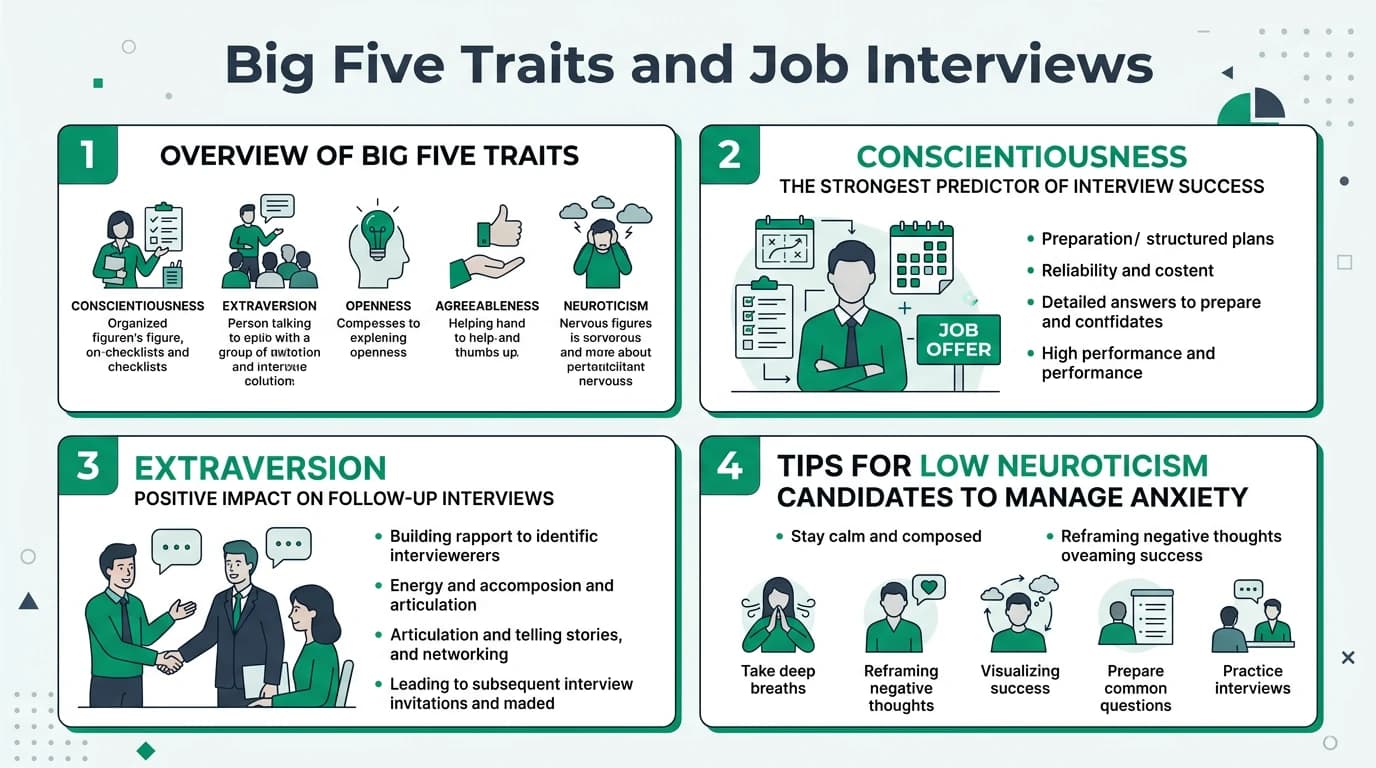
Conscientiousness is the strongest universal predictor of interview success (rho = 0.19 across all job types). Extraversion correlates with more follow-up interviews (r = .27) and job offers (r = .34). Low Neuroticism improves stress management during interviews. However, personality traits explain only about 12 percent of selection variance, so they work best alongside skills assessments and structured preparation.
Key Takeaways
- Conscientiousness is the only Big Five trait that predicts interview success across all job types and levels (rho = 0.19 overall, 0.28 for academic roles)1.
- Extraversion correlates with more follow-up interviews (r = .27) and job offers (r = .34), particularly in interpersonal roles2.
- Low Neuroticism (emotional stability) shows the highest single correlation with selection outcomes in some studies (r = -.21 with offers)3.
- Openness moderately predicts offers (r = .23) and aids performance in creative and professional roles2.
- Agreeableness has the lowest selection correlation but adds value in team-oriented and customer-facing positions4.
- Personality traits explain roughly 12.1 percent of selection variance, making them a supplement to structured interviews rather than a standalone predictor3.
- Pre-interview preparation behaviors, in-room performance, and post-interview follow-up are each influenced by different Big Five traits2.
For a deeper look at how personality informs career direction, see our career choice guide for job seekers.
Disclaimer: This article summarizes organizational psychology research for educational purposes. Interview outcomes depend on many factors beyond personality, including skills, experience, industry norms, and interviewer bias. Use these insights to complement, not replace, thorough professional preparation.
The Big Five Personality Traits: Quick Reference
The Big Five model (also called OCEAN) is the most empirically validated personality framework in organizational psychology. Each trait influences how candidates prepare for, perform in, and follow up after job interviews5.
| Trait | Core Behaviors | High Scorer Example | Low Scorer Example | Interview Relevance |
|---|---|---|---|---|
| Openness | Curiosity, imagination, flexibility | Creative director exploring novel solutions | Accountant preferring established methods | Showcasing innovation vs. reliability |
| Conscientiousness | Organization, goal-orientation, dependability | Project manager with detailed prep notes | Freelancer adapting on the fly | Strongest universal performance predictor |
| Extraversion | Sociability, assertiveness, energy | Sales rep building rapport instantly | Analyst preferring written communication | Drives follow-up and offer likelihood |
| Agreeableness | Cooperation, empathy, trust | Team lead fostering collaboration | Negotiator pushing for best terms | Team-fit interviews and collaborative roles |
| Neuroticism | Emotional reactivity, stress vulnerability | Candidate visibly anxious under pressure | Calm professional in high-stakes settings | Anxiety management during interviews |
- The Big Five is supported by decades of cross-cultural research spanning 50-plus societies5.
- Unlike the MBTI, the Big Five measures traits on continuous spectrums rather than binary categories.
- For an assessment of how personality tests hold up in hiring contexts, see our validity in hiring guide.
Conscientiousness: The Universal Interview Predictor
Conscientiousness is the only Big Five trait that consistently predicts job performance and interview success across all job types, occupational levels, and industries1. This makes it the single most important trait to leverage in interview preparation.
| Performance Metric | Conscientiousness Correlation | Comparison Context | Source |
|---|---|---|---|
| Overall job performance | rho = 0.19 | Across all occupations | Barrick and Mount meta-analysis1 |
| Academic performance | rho = 0.28 | Students and academic roles | Journal of Personality1 |
| Professional roles (accountants, engineers) | Strongest single predictor | Only significant trait for professionals | Scontrino-Powell4 |
| Skilled and semi-skilled labor | Significant predictor | Secondary to emotional stability | Meta-analytic data1 |
- Conscientious candidates prepare detailed answers, research company backgrounds, and arrive with structured talking points.
- They follow through on post-interview thank-you notes and timely responses.
- The trade-off: highly conscientious candidates may prioritize performance over creative risk-taking, which can be a disadvantage in innovation-focused roles5.
Preparation Strategies for Conscientiousness
| Your Level | Strategy | Specific Action | Expected Impact |
|---|---|---|---|
| High | Leverage your planning instinct | Create a detailed prep binder with company research, STAR stories, and questions | Builds confidence through thorough preparation |
| High | Avoid over-preparation rigidity | Practice pivoting when questions go off-script | Prevents appearing rehearsed or inflexible |
| Low | Build external structure | Use checklists and calendar reminders for prep milestones | Compensates for lower natural organization |
| Low | Partner with an accountability buddy | Schedule mock interview sessions with deadlines | Creates the structure your trait profile lacks |
Extraversion and Job Offer Likelihood
Extraversion positively influences both follow-up interview invitations and final job offers. A study by Caldwell and Burger at Santa Clara University quantified these relationships directly2.
| Interview Outcome | Extraversion Correlation (r) | Neuroticism Correlation (r) | Openness Correlation (r) | Statistical Significance |
|---|---|---|---|---|
| Follow-up interviews received | .27 | Not significant | Not significant | p less than .012 |
| Job offers received | .34 | -.21 | .23 | p less than .012 |
| Assertiveness in job hunting | Positive | Negative | Positive | Significant2 |
| Pre-interview preparation | Not significant | Not significant | Not significant | Conscientiousness drives this2 |
- Extraverts naturally build rapport during interviews, making interviewers feel engaged and positive.
- They tend to pursue more follow-up actions (calling back, networking with interviewers) which increases offer probability.
- Extraversion is particularly predictive in sales, managerial, and client-facing roles (rho = 0.14 for job performance in interpersonal jobs)4.
Strategies for Extraverts vs. Introverts
| Profile | Strength to Leverage | Risk to Manage | Specific Tactic |
|---|---|---|---|
| High Extraversion | Natural rapport building | Talking too much or dominating | Practice concise STAR responses under two minutes |
| High Extraversion | Energetic follow-up | Coming across as pushy | Space follow-ups strategically (24-48 hours) |
| Low Extraversion | Thoughtful, prepared responses | Appearing disengaged or low-energy | Practice warm greetings and maintain eye contact |
| Low Extraversion | Deep listening skills | Missing chances to self-promote | Prepare three key achievements to volunteer proactively |
For more on how introverts and extraverts differ in workplace communication, see our communication styles guide.
Neuroticism: Managing Interview Anxiety
Low Neuroticism (high emotional stability) shows a significant negative correlation with job offers (r = -.21), meaning emotionally stable candidates receive more offers2. In some selection models, Neuroticism carries the highest individual correlation with overall interview behavior (r = .461)3.
- Candidates high in Neuroticism experience more pre-interview anxiety, which can impair working memory and verbal fluency.
- The correlation between Neuroticism and actual job performance is weaker (rho = -0.12 to -0.15), suggesting interviews may penalize anxiety more than the job itself does1.
- Emotional stability is a secondary predictor for skilled and semi-skilled labor, reinforcing its value beyond executive roles4.
| Anxiety Management Technique | How It Helps | When to Use | Evidence Base |
|---|---|---|---|
| Cognitive reappraisal | Reframes anxiety as excitement | Before entering the interview room | Neuroscience of stress response5 |
| Mock interviews with recording | Builds familiarity with interview format | Two to four weeks before the interview | Reduces novelty-based anxiety2 |
| Box breathing (4-4-4-4) | Activates parasympathetic nervous system | During waiting period | Physiological stress reduction |
| Power posing | Increases testosterone, decreases cortisol | Two minutes before the interview | Debated but widely practiced |
| Preparation depth | Reduces uncertainty-driven anxiety | Throughout preparation period | Conscientiousness pathway1 |
When Neuroticism Becomes an Advantage
- High Neuroticism can drive thorough preparation through worry-motivated planning.
- In roles requiring risk awareness (compliance, quality assurance, safety), moderate anxiety keeps candidates vigilant.
- The key is channeling emotional reactivity into productive preparation rather than performance-impairing rumination.
Openness to Experience in Creative and Professional Roles
Openness correlates moderately with job performance (rho = 0.13) and with receiving job offers (r = .23)12. It is particularly valuable in roles requiring innovation, complex problem-solving, and adaptability.
- High Openness candidates excel at behavioral questions requiring creative thinking and novel approaches.
- They can struggle with highly structured, process-driven interview formats that reward predictability over imagination.
- Openness aids leadership effectiveness through innovation and complex thinking1.
| Role Type | Openness Value | Interview Strategy | Risk |
|---|---|---|---|
| Creative (design, marketing, R&D) | High | Showcase curiosity and portfolio innovation | Avoid overly abstract or tangential answers |
| Professional (engineering, accounting) | Moderate | Balance reliability with adaptability examples | Do not overshadow conscientiousness signals |
| Sales and customer service | Low to moderate | Focus on relationship building over novelty | High openness may signal instability to conservative interviewers |
| Leadership and management | High | Demonstrate strategic vision and flexibility | Ground ideas in practical, measurable outcomes |
For guidance on aligning personality with negotiation approach in interviews, see our negotiation style guide.
Agreeableness in Team-Oriented Interviews
Agreeableness has the lowest direct selection correlation among the Big Five traits, but it becomes relevant in collaborative roles and team-based interview formats4.
| Dimension | High Agreeableness | Low Agreeableness | Mitigation Strategy |
|---|---|---|---|
| Team fit signal | Strong positive impression in group exercises | May appear competitive or abrasive | Low A: Prepare cooperative language and team examples |
| Assertiveness | May defer too much, appearing passive | Natural confidence in negotiations | High A: Practice stating accomplishments directly |
| Customer-facing roles | Empathy builds client trust | Efficiency may override warmth | Low A: Practice active listening demonstrations |
| Conflict scenarios | Finds collaborative solutions | Pushes for individual wins | Balance both with structured conflict-resolution examples |
- In behavioral interviews with "tell me about a team conflict" questions, agreeableness directly shapes response quality.
- Customer service and healthcare roles weight agreeableness more heavily in their evaluation criteria.
- For competitive roles (trading, litigation, entrepreneurship), moderate to low agreeableness can be advantageous.
Personality-Job Fit by Occupation
Different occupations weight Big Five traits differently. Matching your personality profile to role-specific expectations improves both interview performance and long-term job satisfaction4.
| Job Category | Primary Trait | Secondary Traits | Predictive Strength | Example Roles | Interview Focus |
|---|---|---|---|---|---|
| Sales | Extraversion | Agreeableness, Conscientiousness | Moderate-High | Account executive, retail manager | Rapport, energy, customer stories |
| Professional | Conscientiousness | Openness | High | Accountant, engineer, analyst | Precision, reliability, technical depth |
| Skilled labor | Conscientiousness | Emotional stability | High | Electrician, machinist, technician | Safety awareness, consistency |
| Creative | Openness | Conscientiousness | Moderate | Designer, writer, marketing strategist | Portfolio innovation, creative process |
| Management | Conscientiousness | Extraversion, Openness | High | Operations director, team lead | Strategic vision, team leadership |
| Customer service | Agreeableness | Extraversion, Emotional stability | Moderate | Support specialist, nurse, counselor | Empathy, patience, conflict resolution |
- Universal advice: emphasize conscientiousness regardless of role.
- Role-specific advice: identify and demonstrate the secondary traits your target role values.
- For a comprehensive guide on personality and leadership, see our leadership personality guide.
Interview Behavior Across All Phases
Personality traits influence every phase of the interview process, not just the in-room conversation. Research shows distinct trait-to-phase pathways2.
| Interview Phase | Primary Trait Influence | Behavioral Indicator | Improvement Strategy |
|---|---|---|---|
| Research and preparation | Conscientiousness | Company research depth, STAR story preparation | Use structured checklists and timelines |
| Application and outreach | Extraversion | Number of applications, networking contacts | Introverts: set daily application targets |
| First impression | Extraversion, low Neuroticism | Warm greeting, confident body language | Practice opening statements and handshakes |
| Behavioral questions | Varies by question type | STAR story quality and relevance | Map traits to likely question categories |
| Technical assessment | Conscientiousness, Openness | Accuracy plus creative problem-solving | Practice under timed conditions |
| Follow-up actions | Extraversion | Thank-you notes, follow-up calls, networking | Schedule follow-ups immediately post-interview |
| Salary negotiation | Low Agreeableness, Extraversion | Assertive counter-offers | High A: practice negotiation scripts in advance |
Predictive Validity and Limitations
Understanding what personality traits can and cannot predict is essential for realistic expectations3.
| Predictor | Correlation (r) | Variance Explained | Comparison | Practical Implication |
|---|---|---|---|---|
| Big Five traits (combined) | .121 | 12.1 percent | Moderate predictor | Supplement with skills assessments |
| Education level | .245 | 24.5 percent | Stronger than personality | Credentials still matter significantly |
| Structured interviews | .51 | 26 percent | Much stronger than personality alone | The gold standard for selection |
| Work sample tests | .54 | 29 percent | Strongest single predictor | Direct skill demonstration |
| Interview behavior (composite) | .461 | 21.3 percent | Stronger than Big Five alone | Includes non-personality factors |
- Personality traits provide incremental validity beyond cognitive ability and experience.
- They are most predictive in unstructured environments where candidates have freedom to express individual differences3.
- Over-reliance on personality in hiring decisions risks bias and reduced diversity.
Interview preparation action checklist by trait profile
- Take a validated Big Five assessment to identify your dominant and secondary traits.
- Map your trait profile to the target role using the personality-job fit table above.
- Build a preparation timeline leveraging conscientiousness strategies (checklists, deadlines, mock interviews).
- If high in Neuroticism, begin anxiety management techniques at least two weeks before the interview.
- If low in Extraversion, prepare three self-promotion statements and practice delivering them naturally.
- If high in Agreeableness, rehearse salary negotiation scripts to avoid underselling yourself.
- Prepare at least five STAR stories covering teamwork, leadership, problem-solving, failure recovery, and innovation.
- Schedule post-interview follow-up actions before the interview to ensure timely execution.
FAQ
Which Big Five trait is the strongest predictor of job interview success?
Conscientiousness is the strongest universal predictor, with a meta-analytic correlation of rho = 0.19 across all job types. It is the only Big Five trait that significantly predicts performance for professionals, managers, skilled workers, and semi-skilled workers alike. For academic roles specifically, the correlation rises to rho = 0.281.
How does Extraversion affect job offers?
Extraversion correlates with job offers at r = .34 (p less than .01) and follow-up interviews at r = .27 (p less than .01). Extraverted candidates pursue more assertive job-hunting behaviors including networking, follow-up calls, and rapport-building during interviews. The effect is strongest in roles requiring interpersonal interaction such as sales and management2.
Can introverts succeed in job interviews?
Yes. While Extraversion correlates with more offers, introverts bring strengths including thoughtful responses, deep preparation, and strong listening skills. Introverts should prepare self-promotion statements in advance, practice warm openings, and leverage their conscientiousness to outprepare extraverted competitors. Many technical and analytical roles actively prefer introverted communication styles24.
How much do personality traits actually predict in hiring?
Big Five traits combined explain approximately 12.1 percent of selection variance. By comparison, education explains 24.5 percent and structured interviews explain about 26 percent. Personality provides incremental validity beyond other predictors but works best as a supplementary assessment tool rather than a primary selection criterion3.
Should I take a personality test before job interviews?
Taking a validated Big Five assessment before interview preparation helps you identify strengths to leverage and weaknesses to manage. For example, knowing you are high in Neuroticism allows you to implement anxiety management techniques proactively. Free validated assessments are available through platforms like Simply Psychology and IPIP-based tools5.
Does Neuroticism disqualify you from getting hired?
No. While low Neuroticism (emotional stability) correlates with receiving more offers (r = -.21), the correlation with actual job performance is weaker (rho = -0.12 to -0.15). Interviews may penalize visible anxiety more than the job itself does. Managing interview anxiety through preparation, cognitive reappraisal, and breathing techniques can substantially reduce this disadvantage12.
How do I prepare for team-based or group interviews?
Team-based interviews weight Agreeableness and Extraversion more heavily. Prepare examples demonstrating collaboration, conflict resolution, and supporting others' ideas. If you score low in Agreeableness, practice cooperative language such as "building on that idea" and "I agree, and I would add." If low in Extraversion, volunteer to speak early before anxiety builds4.
Are personality traits the same across different cultures?
The Big Five structure is universal across 50-plus societies, but trait expression varies by culture. Extraversion is valued more in Anglo-American interview contexts, while Conscientiousness is weighted heavily across cultures. When interviewing internationally, research local cultural norms for professional communication. See our cross-cultural communication guide for details5.
Notes
Primary Sources
| Source | Type | Key Contribution | URL |
|---|---|---|---|
| Journal of Personality (Wiley) | Peer-reviewed meta-analysis | Big Five correlations with job performance across occupations | Link |
| Santa Clara University Psychology | Peer-reviewed study | Extraversion and Neuroticism correlations with offers and follow-ups | Link |
| Marshall University Leadership Center | Academic resource | Selection variance explained by personality vs. other predictors | Link |
| Scontrino-Powell | Professional resource | Trait-to-occupation fit and predictive strength by job category | Link |
| Simply Psychology | Educational resource | Big Five definitions, assessment tools, and cross-cultural validity | Link |
Conclusion
Your Big Five personality profile shapes how you prepare for interviews, perform during them, and follow up afterward. Conscientiousness drives preparation depth and universal performance. Extraversion increases offer likelihood through rapport and assertive follow-up. Emotional stability reduces the anxiety penalty that interviews impose.
The practical application is straightforward. Assess your traits, identify which phases of the interview process your profile naturally strengthens, and build deliberate strategies for the phases where your profile creates vulnerability. A high-Neuroticism introvert who builds structured preparation routines and practices self-promotion statements can outperform a naturally extraverted candidate who wings it.
Personality is not destiny in hiring. It is one input in a complex process. Use it wisely.
Footnotes
-
Barrick, M. R. & Mount, M. K. (1991). The Big Five personality dimensions and job performance: A meta-analysis. Personnel Psychology, 44(1), 1-26. Replicated in: Wiley Online Library. "Big Five Personality Traits and Job Performance." Available at: https://onlinelibrary.wiley.com/doi/10.1111/jopy.12683 ↩ ↩2 ↩3 ↩4 ↩5 ↩6 ↩7 ↩8 ↩9 ↩10 ↩11 ↩12
-
Caldwell, D. F. & Burger, J. M. (1998). Personality characteristics of job applicants and success in screening interviews. Personnel Psychology, 51(1), 119-136. Available at: https://www.scu.edu/media/college-of-arts-and-sciences/psychology/documents/Caldwell-&-Burger-1998-PP.pdf ↩ ↩2 ↩3 ↩4 ↩5 ↩6 ↩7 ↩8 ↩9 ↩10 ↩11 ↩12 ↩13 ↩14 ↩15
-
Marshall University Leadership Center. "Personality and Employee Selection." Available at: https://www.marshall.edu/leadershipcenter/files/2018/04/22-Personality.pdf ↩ ↩2 ↩3 ↩4 ↩5 ↩6 ↩7
-
Scontrino-Powell. "Personality and Job Performance." Available at: https://scontrino-powell.com/blog/personality-and-job-performance ↩ ↩2 ↩3 ↩4 ↩5 ↩6 ↩7 ↩8
-
Simply Psychology. "Big Five Personality Traits: The OCEAN Model Explained." Available at: https://www.simplypsychology.org/big-five-personality.html ↩ ↩2 ↩3 ↩4 ↩5 ↩6