personality-tests
Personality Test Validity for Hiring: What Employers Need to Know
Learn what employers need to know about personality test validity in hiring: predictive power, observer vs self-report validity, reliability criteria, and ethical safeguards.
Quick answer
Are personality tests valid for hiring?
Personality tests have moderate predictive validity for hiring, especially when using observer ratings and measuring stable traits.
Source: University of Iowa
Executive Summary
Personality tests have become a staple in the hiring process, with approximately 40% of employers utilizing them to predict job performance. These assessments are particularly valuable when they focus on stable traits and are complemented by observer ratings. However, challenges such as applicant faking and differences between incumbents and applicants can affect their validity.
Key takeaway: Employers should use personality tests as part of a broader assessment strategy, ensuring they are reliable, valid, and ethically applied.
Understanding Predictive Validity
Predictive validity refers to how well a test forecasts future job performance. Personality tests, especially those based on the Five-Factor Model, have shown moderate predictive validity in various settings. For instance, traits like conscientiousness and emotional stability are often linked to better job performance.
| Trait | Predictive Power | Example |
|---|---|---|
| Conscientiousness | High | Employees with high conscientiousness often meet deadlines effectively. |
| Emotional Stability | Moderate | Those with high emotional stability handle workplace stress better. |
Observer Ratings vs. Self-Reports
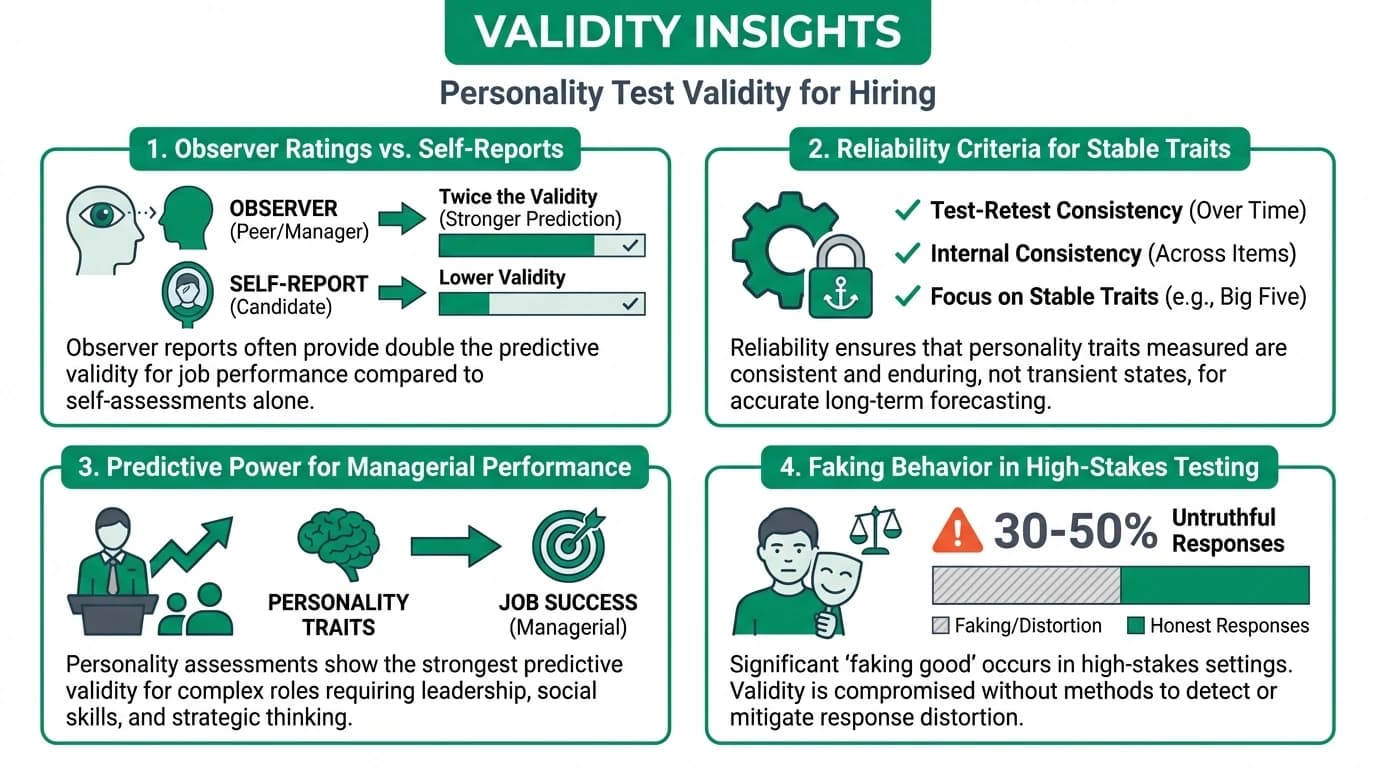
Research indicates that observer ratings are twice as valid as self-reports for predicting job performance. This is because observers can provide a more objective assessment of an individual's traits, reducing the impact of bias and faking.
Consider a scenario where a manager provides ratings for team members. These ratings can offer a more accurate prediction of future performance than self-reported assessments. For more on test quality, see our personality test reliability checklist.
Reliability and Stable Trait Measurement
For personality tests to be effective, they must reliably measure stable traits over time. Reliability ensures that the test results are consistent and accurate, providing a dependable basis for hiring decisions.
| Reliability Criteria | Importance | Example |
|---|---|---|
| Consistency | High | A test consistently measuring the same trait across different contexts. |
| Stability | Essential | Traits like openness should remain stable over time for valid results. |
Criterion and Incremental Validity
Criterion validity measures how well one variable predicts an outcome based on another variable. Incremental validity assesses the added predictive power of a test beyond existing methods like interviews.
For example, a personality test might predict team communication effectiveness more accurately when combined with cognitive ability tests. Compare cognitive ability vs personality tests in hiring to understand when each adds value.
Addressing Faking in High-Stakes Testing
Applicant faking is a significant concern, with 30-50% of candidates potentially providing untruthful responses. Employers can mitigate this by incorporating validity scales and using tests alongside other assessment methods.
Consider using structured interviews to verify personality test results, ensuring a more comprehensive evaluation. Our bias-resistant scorecard helps structure fair, defensible hiring decisions.
Legal and Ethical Considerations
When using personality tests in hiring, employers must adhere to legal guidelines and ethical standards. This includes ensuring tests are non-discriminatory and relevant to job performance.
Important: Personality tests should support hiring decisions, not replace interviews, work samples, or professional judgment. Always validate instruments for your specific context.
| Consideration | Requirement | Example |
|---|---|---|
| Non-discrimination | Legal | Tests must not favor any demographic group. |
| Job Relevance | Ethical | Tests should assess traits directly related to job duties. |
Action checklist
- Ensure personality tests measure stable traits with high reliability.
- Use observer ratings to enhance predictive validity.
- Combine personality tests with other assessment methods for comprehensive evaluation.
- Address potential faking by incorporating validity scales.
- Adhere to legal and ethical guidelines in test application.
FAQ
What is the predictive validity of personality tests?
Why are observer ratings preferred over self-reports?
How can employers address faking in personality tests?
What are the legal considerations for using personality tests?
How do personality tests compare to cognitive ability tests?
Primary Sources
| Source | Type | URL |
|---|---|---|
| University of Iowa | Research Article | now.uiowa.edu |
| Sigma Assessment Systems | White Paper | sigmaassessmentsystems.com |