personality-tests
Big Five Traits Across Cultures
How Big Five personality traits vary across cultures, with Hofstede dimension correlations, regional profiles, gender patterns, and strategies for effective cross-cultural work.
Quick answer
How do Big Five personality traits vary across cultures?
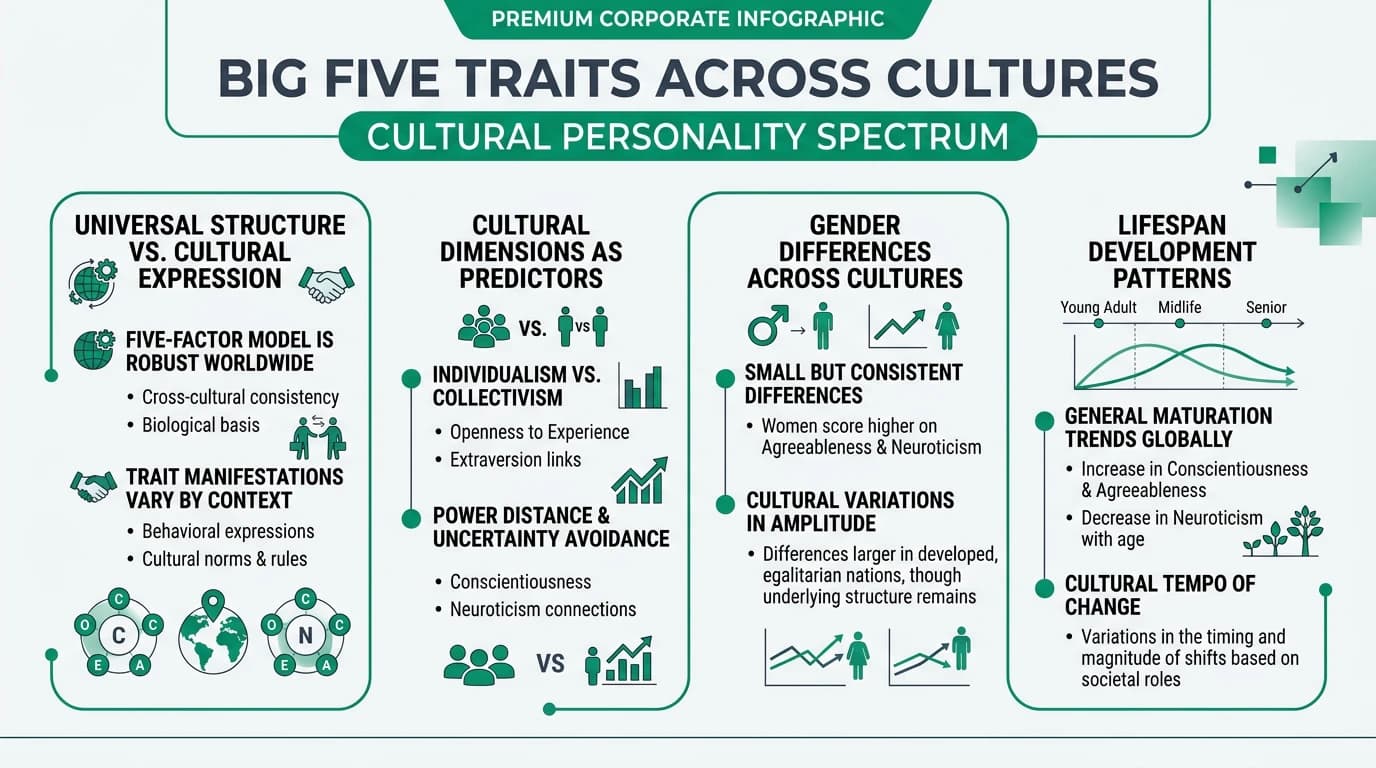
The Big Five trait structure is universal, validated across 50-plus societies on six continents. However, mean trait levels vary significantly by culture. Hofstede's cultural dimensions (Individualism, Power Distance, Masculinity, Uncertainty Avoidance) predict these variations. Anglo-American cultures score higher in Extraversion, while East Asian cultures show higher Conscientiousness. Gender differences in Neuroticism and Agreeableness are larger in developed nations. These patterns have direct implications for international communication and collaboration.
Source: SAGE Journals
Key Takeaways
- The Big Five structure is universal: factor analyses replicate across 50-plus societies spanning six continents and multiple language families1.
- Mean trait levels are culturally variable: the same trait exists everywhere, but how strongly it is expressed depends on cultural context2.
- Hofstede's cultural dimensions predict personality: Individualism, Power Distance, Masculinity, and Uncertainty Avoidance significantly correlate with Big Five trait levels. Long-Term Orientation and Indulgence do not3.
- Gender differences vary by development level: women consistently score higher on Neuroticism and Agreeableness, but these differences are larger in developed societies like France and the United States than in developing nations2.
- Age-related personality changes are universal: increases in Conscientiousness and Agreeableness from adolescence to adulthood appear across all studied cultures2.
- Within-culture variation often exceeds between-culture variation: treating any culture as monolithic ignores substantial individual differences2.
- Indigenous personality dimensions exist: some cultures (Philippines, China, Denmark) identify personality dimensions not fully captured by the Western-origin Big Five model4.
For a comprehensive overview of the Big Five framework itself, see our complete Big Five guide.
Disclaimer: This article summarizes cross-cultural personality psychology research for educational purposes. Cultural generalizations reflect statistical tendencies, not universal truths about individuals within any culture. Avoid stereotyping individuals based on cultural personality profiles. Cross-cultural communication should be informed by research but adapted to individual interaction.
Universal Structure vs. Cultural Expression
The Big Five framework originated in English-language research but has been validated across languages from entirely different language families. Factor analyses of personality inventories in Chinese, Dutch, Italian, Hungarian, German, Australian, South African, Canadian, Finnish, Polish, Portuguese, Israeli, Korean, Japanese, and Filipino samples consistently load on the same five factors2.
| Dimension | Core Definition | Universal Element | Culturally Variable Element |
|---|---|---|---|
| Openness | Curiosity, fantasy, appreciation of art, social attitudes | Trait structure exists globally | Valued highly in individualistic cultures; constrained in traditional societies |
| Conscientiousness | Methodical planning, impulse control, respect for norms | Universal performance predictor | What constitutes "conventional norms" varies by culture |
| Extraversion | Sociability, social ascendancy, excitement-seeking | Recognized in all cultures | Mean levels significantly higher in Anglo-American regions |
| Agreeableness | Compliance, empathy, collaboration, altruism | Gender pattern consistent globally | Expression varies by individualism and collectivism |
| Neuroticism | Emotional stability vs. negative emotionality, anxiety | Correlates with mental health universally | Women score higher; magnitude varies by national development |
- The key distinction is between trait existence (universal) and trait levels (culturally variable).
- A culture with lower mean Extraversion scores does not have less effective communicators. The trait manifests differently in context-appropriate ways2.
- Large amounts of Big Five trait variation exist within particular cultures, often exceeding between-culture differences. Avoid treating cultural means as individual predictions.
Cultural Dimensions as Personality Predictors
Hofstede's six cultural dimensions provide a framework for understanding why personality traits vary across nations. Research using regression and cluster analyses shows that countries grouped by similar cultural dimensions exhibit similar personality profiles3.
| Hofstede Cultural Dimension | Predicts Big Five Traits? | Associated Traits | Example Countries | Practical Implication |
|---|---|---|---|---|
| Individualism | Yes | Higher Extraversion, higher Openness | United States, Canada, Australia | Expect more assertive, self-expressive communication |
| Power Distance | Yes | Higher Agreeableness, higher Conscientiousness | South Korea, Malaysia, India | Expect deference to hierarchy, formal communication |
| Masculinity | Yes | Higher Extraversion, lower Agreeableness | Japan, Germany, United States | Expect competitive, achievement-oriented interaction |
| Uncertainty Avoidance | Yes | Higher Conscientiousness, higher Neuroticism | Greece, Portugal, Japan | Expect preference for rules, structured processes |
| Long-Term Orientation | No | No significant correlation | Not predictive | Not useful for personality prediction |
| Indulgence | No | No significant correlation | Not predictive | Not useful for personality prediction |
- Four of six Hofstede dimensions significantly predict personality trait levels. This means cultural values shape personality expression in measurable, systematic ways3.
- The absence of Long-Term Orientation and Indulgence correlations suggests personality is shaped more by social structure (power, individualism, gender roles, uncertainty tolerance) than by temporal orientation or hedonism.
- For effective cross-cultural communication, identify the cultural dimensions of your counterpart's culture and anticipate the personality expression patterns they predict.
Gender Differences Across Cultures
Gender patterns in personality are consistent in direction across cultures but vary in magnitude based on national development level25.
| Trait | Gender Pattern | Consistency | Developed Nations (US, France) | Developing Nations (Zimbabwe, Malaysia) |
|---|---|---|---|---|
| Neuroticism | Women score higher | Consistent across multiple cultures | Larger gender difference | Smaller gender difference |
| Agreeableness | Women score higher | Consistent across multiple cultures | Larger gender difference | Smaller gender difference |
| Conscientiousness | Mixed or minimal | Varies by culture | Women slightly higher in some samples | Variable |
| Extraversion | Men slightly higher | Not universal | Larger in developed societies | Minimal |
| Openness | Women higher on Aesthetics; Men higher on Ideas | Varies by facet | Larger differences in developed societies | Minimal |
- The "gender equality paradox" in personality: gender differences in personality are larger, not smaller, in more gender-egalitarian societies2.
- Possible explanations include attribution styles (developed-nation women attribute feelings more to internal states) and self-presentation norms (less cultural pressure to minimize emotional expression).
- Norwegian women score higher than American women in Extraversion and Openness but slightly lower in Agreeableness, demonstrating that cultural context modifies even consistent gender patterns5.
Implications for Cross-Cultural Communication
- Do not assume personality gender patterns from your own culture apply elsewhere.
- In high-Masculinity cultures, gender differences in workplace personality expression may be more pronounced in public settings.
- Assessment tools validated in one gender-cultural context may not interpret scores correctly in another.
Regional Personality Profiles
Countries and regions exhibit distinct mean personality profiles, though within-country variation is always substantial25.
| Region or Country | Extraversion | Conscientiousness | Neuroticism | Notable Pattern | Communication Implication |
|---|---|---|---|---|---|
| US, Canada, New Zealand | Higher | Moderate | Moderate | High sociability, moderate emotional reactivity | Expect direct, enthusiastic communication style |
| Germany, Switzerland | Moderate | Higher | Moderate | Similar profiles to each other; structured | Expect organized, rule-following interaction |
| Taiwan, South Korea | Lower | Higher | Moderate | Similar profiles to each other; reserved professionalism | Expect formal, structured, relationship-building before directness |
| Norway (women specifically) | Higher than US women | Moderate | Moderate | More extraverted and open than American counterparts | Gender assumptions from US context do not apply |
| Philippines | Variable | Variable | Variable | Unique indigenous dimensions beyond Big Five | Standard Big Five may miss culturally important traits |
| Southern Europe (Portugal, Croatia) | Moderate | Increasing with age | Higher | Age-related development matches universal pattern | Account for generational personality shifts |
- Regional profiles reflect statistical tendencies, not individual predictions. A South Korean individual may score higher on Extraversion than the average American.
- Cultural stereotypes about personality often do not match measured personality data. Research-based profiles are more reliable than intuition5.
- For strategies on conflict resolution across personality types, see our conflict resolution guide.
Lifespan Personality Development Across Cultures
Personality changes from adolescence to adulthood follow remarkably similar patterns across cultures, suggesting universal developmental processes rather than purely cultural influences24.
| Life Stage | Conscientiousness | Agreeableness | Neuroticism | Openness | Extraversion | Cultures Confirming Pattern |
|---|---|---|---|---|---|---|
| Adolescence (12-18) | Increasing | Increasing | Decreasing | Stable to decreasing | Stable to decreasing | US, Flanders, multiple European and Asian |
| Young adulthood (18-30) | Increasing | Increasing | Decreasing | Stable to decreasing | Stable to decreasing | US, Germany, Italy, Portugal, Croatia, South Korea |
| Middle adulthood (30-50) | Stable at higher level | Stable at higher level | Stable at lower level | Gradual decrease | Gradual decrease | Cross-cultural meta-analyses |
- The "maturity principle" describes consistent increases in Conscientiousness and Agreeableness with age across cultures. People become more reliable and cooperative as they age, regardless of cultural background.
- This universal pattern suggests biological or developmental mechanisms underlying personality change, beyond cultural socialization alone.
- Age must be controlled in cross-cultural personality comparisons. A sample of American college students compared to Japanese middle-aged professionals conflates cultural and developmental differences.
Practical Implication
When working across cultures with age-diverse teams, remember that younger colleagues from any culture will likely show lower Conscientiousness and Agreeableness scores than older colleagues, independent of cultural differences. This is development, not cultural deficiency.
Personality and Mental Health Outcomes Across Cultures
The relationship between personality traits and mental health appears consistent across cultural contexts, providing a universal framework for understanding psychological risk1.
| Personality Profile | Associated Outcomes | Cross-Cultural Consistency | Clinical Relevance |
|---|---|---|---|
| Low Emotional Stability (high Neuroticism) | Internalizing symptoms, rumination, low happiness | Consistent across all studied countries | Universal risk factor for depression and anxiety |
| Low Agreeableness plus low Conscientiousness | Externalizing symptoms, antisocial behavior, substance problems | Consistent across all studied countries | Universal risk factor for behavioral problems |
| High Conscientiousness plus high Agreeableness | Better adjustment, more altruistic behavior | Consistent across all studied countries | Universal protective factors |
| High Neuroticism in acculturation context | May reflect cultural stress, not trait instability | Context-dependent interpretation needed | Requires culturally informed clinical assessment |
- Clinicians working with immigrant or multicultural clients should recognize that high Neuroticism scores may reflect acculturation stress rather than inherent emotional instability1.
- The universality of personality-mental health links provides a shared framework for international mental health collaboration.
- Cultural context modifies the expression of mental health problems, even when personality risk factors are consistent.
Measurement Invariance and Cross-Cultural Assessment
Ensuring personality assessments measure the same constructs across cultures is a fundamental methodological challenge. Without measurement invariance, cross-cultural comparisons are invalid1.
| Assessment Tool | Countries Validated | Invariance Supported | Reliability | Recommended Use |
|---|---|---|---|---|
| BFPTSQ (50-item Short Questionnaire) | US, Argentina, Spain | Yes (Multigroup ESEM, ESEM-within-CFA) | RMSEA 90 percent CI: lower bound below .05, upper bound below .08 | Cross-cultural research, university populations |
| Revised NEO Personality Inventory | 50-plus societies, multiple language families | Yes (consistent five-factor structure) | Factor analyses consistent across languages | Comprehensive cross-cultural assessment |
| Indigenous personality scales | Philippines, China, Denmark, Bolivia | Partial (overlap with Big Five plus unique dimensions) | Captures culturally specific traits | Culture-specific assessment needs |
| HEXACO Model | English and Asian-based adjective studies | Yes (adds Honesty-Humility dimension) | Particularly strong for agreeableness and emotion traits | Research emphasizing honesty and humility |
Common Validity Threats in Cross-Cultural Assessment
| Potential Confound | Impact on Findings | Mitigation Strategy |
|---|---|---|
| Translation errors | Artificially inflate or deflate trait scores | Use validated translations with back-translation protocols |
| Self-presentation biases | Individuals in some cultures over- or under-report traits | Compare self-reports with observer ratings |
| Attribution patterns | Traditional vs. modern cultures attribute traits differently | Account for cultural attribution styles in interpretation |
| Response scale interpretation | Different cultures interpret Likert scales differently | Test measurement invariance before comparing scores |
| Genetic vs. cultural confounds | Unclear whether differences reflect culture or genetics | Examine immigrant populations for disentangling |
- The HEXACO model adds Honesty-Humility as a sixth dimension, which is particularly relevant in Asian and cross-cultural research contexts where this dimension captures meaningful personality variance missed by the standard Big Five4.
- For insights into the reliability of personality assessments in general, see our personality test reliability guide.
Practical Strategies for Cross-Cultural Communication
Understanding personality variation across cultures translates into concrete communication strategies for international work environments.
| Situation | Cultural Personality Pattern | Communication Strategy | Mistake to Avoid |
|---|---|---|---|
| Meeting with high-Individualism culture (US, Canada) | Higher Extraversion and Openness | Be direct, share ideas openly, embrace debate | Interpreting directness as rudeness |
| Meeting with high-Power Distance culture (South Korea, India) | Higher Agreeableness, respect for hierarchy | Address senior members first, use formal titles | Bypassing hierarchy or forcing informality |
| Negotiating with high-Uncertainty Avoidance culture (Japan, Greece) | Higher Conscientiousness, preference for rules | Provide detailed documentation and structured proposals | Expecting flexibility with ambiguous terms |
| Leading age-diverse international team | Universal maturity principle applies | Expect developmental differences layered on cultural ones | Conflating age effects with cultural personality differences |
| Assessing candidates from different cultures | Response biases vary by culture | Use measurement-invariant tools with local norms | Applying home-country score interpretations globally |
| Managing multicultural conflict | Agreeableness and Extraversion norms differ | Establish shared communication protocols | Expecting one cultural conflict style from everyone |
- The most effective cross-cultural communicators adapt their style to the personality norms of their counterpart's culture while remaining authentic.
- Organizations operating internationally should provide cross-cultural personality training as part of expatriate preparation.
- For insights on personality-based communication in workplace settings, see our workplace communication guide.
- For how personality influences leadership across cultures, see our leadership personality guide.
Cross-cultural personality communication checklist
- Research the cultural dimensions (Individualism, Power Distance, Masculinity, Uncertainty Avoidance) of your counterpart's culture before important interactions.
- Anticipate personality expression differences based on cultural dimension predictions, but treat them as hypotheses, not certainties.
- Use measurement-invariant personality assessment tools with local norms when evaluating international candidates or team members.
- Control for age when comparing personality across cultural groups (maturity principle applies universally).
- Avoid applying gender-personality assumptions from your own culture to colleagues from different cultural contexts.
- Establish shared team communication protocols that accommodate different cultural personality norms.
- Recognize that within-culture variation often exceeds between-culture variation: never reduce an individual to their cultural mean.
- Consider indigenous personality dimensions beyond the Big Five when working with cultures where unique traits have been documented.
FAQ
Are the Big Five personality traits universal across cultures?
Yes, the five-factor structure has been validated across 50-plus societies spanning six continents. Factor analyses of personality inventories in Chinese, Dutch, Italian, Korean, Japanese, Filipino, and many other languages consistently produce the same five factors. However, the mean levels of these traits vary significantly across cultures2.
How do cultural dimensions predict personality traits?
Four of Hofstede's six cultural dimensions significantly predict Big Five trait levels. Individualism predicts higher Extraversion and Openness. Power Distance predicts higher Agreeableness and Conscientiousness. Masculinity predicts higher Extraversion and lower Agreeableness. Uncertainty Avoidance predicts higher Conscientiousness and Neuroticism. Long-Term Orientation and Indulgence show no significant personality correlations3.
Why are personality gender differences larger in more developed nations?
This "gender equality paradox" likely reflects differences in self-presentation norms and attribution styles. In more gender-egalitarian societies, women may feel freer to report emotional experiences without social penalty. Different cultures also attribute feelings differently (internal states vs. external circumstances), affecting how personality traits are self-reported25.
What is measurement invariance and why does it matter?
Measurement invariance means a personality assessment measures the same constructs across different cultural groups. Without it, apparent cross-cultural differences might reflect how questions are interpreted rather than actual personality differences. Tools like the BFPTSQ and NEO-PI-R have demonstrated measurement invariance across multiple countries, making cross-cultural comparisons valid1.
Do personality traits change with age the same way across cultures?
Yes. The "maturity principle" describes consistent increases in Conscientiousness and Agreeableness and decreases in Neuroticism from adolescence to adulthood across US, German, Italian, Portuguese, Croatian, and South Korean samples. This universality suggests biological or developmental mechanisms rather than purely cultural influences24.
What is the HEXACO model and how does it differ from the Big Five?
HEXACO adds Honesty-Humility as a sixth personality dimension alongside the standard five. This dimension captures traits related to sincerity, fairness, and modesty that are particularly relevant in Asian cultural contexts and cross-cultural research. The HEXACO model provides better coverage of personality variation in cultures where the Big Five alone may miss important dimensions4.
Can cultural personality differences cause workplace miscommunication?
Yes. Misinterpreting cultural personality expression is a common source of cross-cultural workplace conflict. Lower Extraversion in East Asian colleagues does not indicate disengagement. Higher Agreeableness in high-Power Distance cultures does not mean colleagues lack opinions. Understanding the cultural context behind personality expression prevents misattribution and improves collaboration23.
Should organizations use the same personality assessments globally?
Organizations should use assessment tools with demonstrated measurement invariance across the specific cultures being assessed. The NEO-PI-R and BFPTSQ have strong cross-cultural validation. For cultures with documented indigenous personality dimensions (Philippines, China), supplementary culture-specific tools may be necessary. Always use local norms for score interpretation rather than applying home-country benchmarks14.
Notes
Primary Sources
| Source | Type | Key Contribution | URL |
|---|---|---|---|
| National Center for Biotechnology Information (PMC) | Peer-reviewed research | BFPTSQ cross-cultural validation; measurement invariance; mental health outcomes | Link |
| SAGE Journals | Peer-reviewed research | Hofstede cultural dimensions and Big Five trait correlations; regression analyses | Link |
| Grand Valley State University | Peer-reviewed research | Cross-cultural FFM research; gender differences; regional personality profiles | Link |
| Maricopa Community Colleges (OER) | Educational resource | Big Five universality; indigenous dimensions; HEXACO model | Link |
| Chapman University Digital Commons | Peer-reviewed research | FFM universality across 50-plus societies; observer rating validation | Link |
Conclusion
The Big Five personality framework provides a universal language for understanding human personality across cultures. Its structure replicates reliably across languages and societies, confirming that the same fundamental personality dimensions exist everywhere. The variation lies in how strongly each trait is expressed and how cultural context shapes its behavioral manifestation.
For cross-cultural communication, this means two things. First, you can use the Big Five as a shared framework with colleagues from any cultural background. Second, you must interpret trait scores through the cultural context of the person being assessed. A lower Extraversion score in an East Asian colleague reflects cultural norms, not disengagement. Higher Agreeableness in a high-Power Distance culture reflects social structure, not personal weakness.
The most effective cross-cultural communicators combine Big Five literacy with cultural dimension awareness and individual observation. Research provides the map. Individual interaction fills in the details.
Footnotes
-
National Center for Biotechnology Information (PMC). "Cross-Cultural Validation of the Big Five Personality Trait Short Questionnaire (BFPTSQ)." Available at: https://pmc.ncbi.nlm.nih.gov/articles/PMC6917272/ ↩ ↩2 ↩3 ↩4 ↩5 ↩6
-
Schmitt, D. P., Allik, J., McCrae, R. R., & Benet-Martinez, V. (2007). "The Geographic Distribution of Big Five Personality Traits." Cross-cultural FFM research reviewed in: Grand Valley State University Institutional Repository. Available at: https://scholarworks.gvsu.edu/cgi/viewcontent.cgi?article=1038&context=orpc ↩ ↩2 ↩3 ↩4 ↩5 ↩6 ↩7 ↩8 ↩9 ↩10 ↩11 ↩12 ↩13 ↩14 ↩15
-
SAGE Journals. "Cultural Dimensions and Big Five Personality Trait Correlations." Available at: https://journals.sagepub.com/doi/10.1177/10693971241264363 ↩ ↩2 ↩3 ↩4 ↩5
-
Maricopa Community Colleges Open Educational Resources. "Big Five as Universals." Culture and Psychology. Available at: https://open.maricopa.edu/culturepsychology/chapter/big-five-as-universals/ ↩ ↩2 ↩3 ↩4 ↩5 ↩6
-
McCrae, R. R. et al. (2005). "Universal Features of Personality Traits from the Observer's Perspective." Chapman University Digital Commons. Available at: https://digitalcommons.chapman.edu/cgi/viewcontent.cgi?article=1216&context=esi_pubs ↩ ↩2 ↩3 ↩4 ↩5 ↩6