relationships
Personality and Couples Therapy Outcomes: Big Five Traits, Alliance with Therapists, Conflict Patterns, and Evidence-Based Approaches Research
Explore how personality traits influence couples therapy outcomes, focusing on the Big Five traits, therapeutic alliance, conflict patterns, and evidence-based approaches.
Quick answer
How do Big Five traits affect therapy outcomes?
Higher extraversion, agreeableness, conscientiousness, and openness predict favorable outcomes like improved alliance and abstinence; lower neuroticism links to better results across domains.
Source: Purdue Psych
Executive Summary
Curious about how your personality might affect couples therapy? The Big Five personality traits—neuroticism, extraversion, agreeableness, conscientiousness, and openness—play a crucial role in therapy outcomes. Research shows that lower neuroticism and higher scores in the other traits often lead to better results, such as improved relationship satisfaction and conflict resolution.
The bottom line: Understanding these traits can guide you in choosing the right therapy approach.
Critical Warning: Always consult a professional for personalized advice, as personality assessments are just one piece of the puzzle.
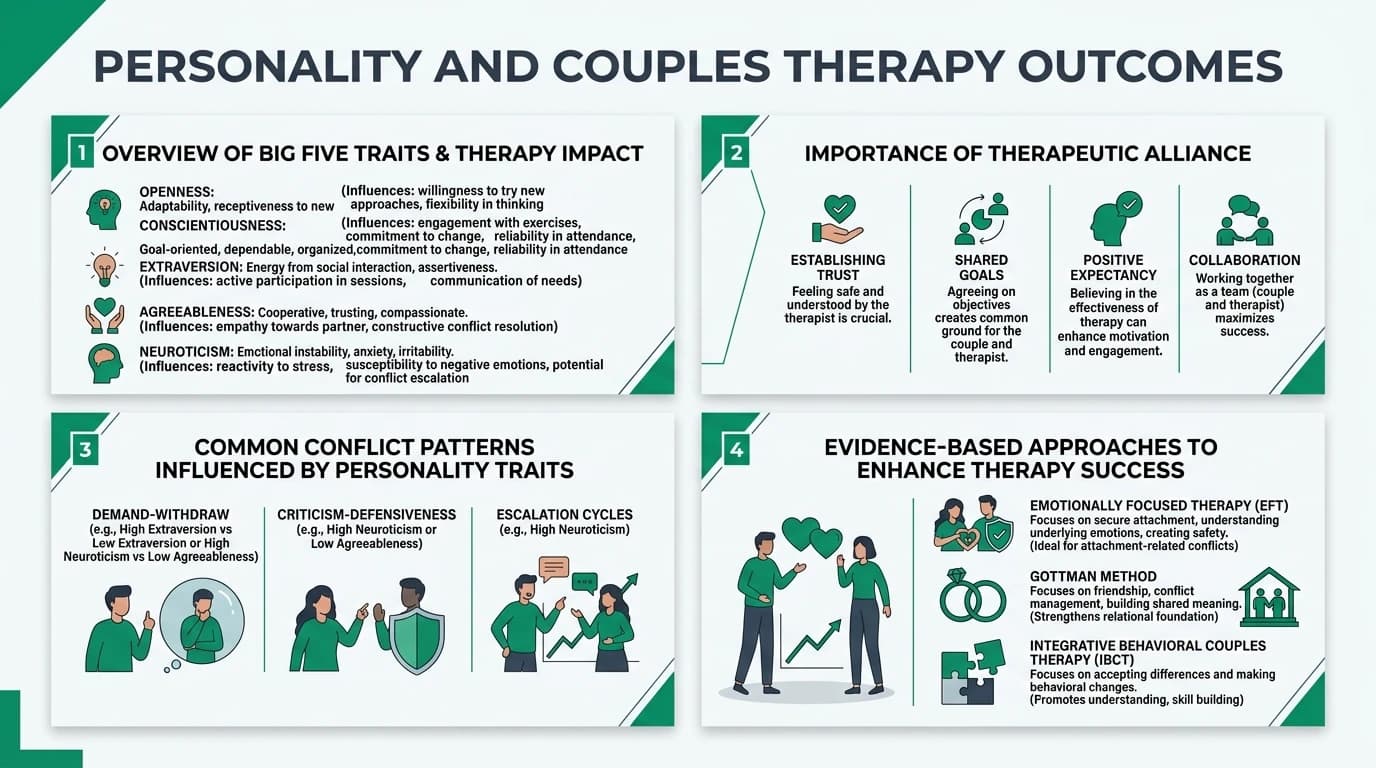
What are the Big Five Traits?
The Big Five personality traits are a popular framework in psychology. They include:
- Neuroticism: Tendency to experience negative emotions.
- Extraversion: Sociability and enthusiasm.
- Agreeableness: Compassion and cooperation.
- Conscientiousness: Organization and dependability.
- Openness: Creativity and open-mindedness.
| Trait | Positive Impact on Therapy Outcomes |
|---|---|
| Neuroticism | Lower levels improve outcomes |
| Extraversion | Enhances communication |
| Agreeableness | Builds a strong therapeutic alliance |
| Conscientiousness | Aids in achieving goals |
| Openness | Facilitates adaptability |
How Do These Traits Affect Therapy?
Influence on Relationship Satisfaction
- Higher Extraversion: Leads to better communication.
- Lower Neuroticism: Reduces conflict and stress.
- Higher Agreeableness: Fosters empathy and understanding.
Key Takeaways:
- Extraversion: Boosts engagement in therapy.
- Neuroticism: Needs management for better outcomes.
- Agreeableness: Essential for building trust.
Why is the Therapeutic Alliance Important?
A strong alliance with your therapist can make or break therapy success. Here's why:
- Trust: Builds a safe space for open communication.
- Collaboration: Encourages joint problem-solving.
- Commitment: Increases motivation to work through issues.
| Factor | Impact on Therapy |
|---|---|
| Trust | Enhances openness |
| Collaboration | Boosts engagement |
| Commitment | Sustains progress |
What Conflict Patterns Affect Outcomes?
Certain conflict patterns, influenced by personality, can hinder therapy:
- High Neuroticism: Leads to frequent arguments.
- Low Agreeableness: Causes stubbornness and resistance.
- High Openness: Can either help or hurt, depending on flexibility.
Important: Recognizing these patterns can help tailor therapy strategies.
Evidence-Based Approaches in Couples Therapy
Popular Methods
- Emotionally Focused Therapy (EFT): Focuses on emotional bonds.
- Cognitive Behavioral Therapy (CBT): Addresses thought patterns.
- Integrative Behavioral Couple Therapy (IBCT): Combines strategies for flexibility and acceptance.
| Approach | Focus Area | Success Rate |
|---|---|---|
| EFT | Emotional connection | High |
| CBT | Thought patterns | Moderate |
| IBCT | Flexibility/Acceptance | High |
How Do Personality Assessments Help?
Personality assessments can guide therapy by:
- Identifying Strengths: Leverage positive traits.
- Highlighting Challenges: Address areas needing improvement.
- Customizing Strategies: Tailor approaches to individual needs.
Pros and Cons:
- Pro: Provides a clear starting point.
- Con: May oversimplify complex personalities.
Real-World vs. Efficacy Trial Outcomes
Real-world therapy often shows different results compared to controlled trials:
- Real-World: Up to 50% of couples see no improvement.
- Trials: Show larger effects on satisfaction.
| Setting | Improvement Rate |
|---|---|
| Real-World | 50% non-improvement |
| Trials | Larger effects |
Checklist for Successful Therapy
Action checklist
- Understand your personality traits.
- Build a strong alliance with your therapist.
- Recognize and address conflict patterns.
- Choose evidence-based therapy approaches.
FAQ
How do Big Five personality traits influence couples therapy success?
Does neuroticism predict poor outcomes in marital therapy?
What role does therapeutic alliance play in personality-driven therapy results?
Are similar personalities in couples better for therapy outcomes?
How does extraversion affect communication in couples counseling?
What conflict patterns worsen couples therapy results?
Can personality assessment improve couples therapy predictions?
Notes
Primary Sources
| Source | Type | URL |
|---|---|---|
| PubMed (Can J Psychiatry) | Peer-reviewed | https://pubmed.ncbi.nlm.nih.gov/7104940/ |
| PubMed (J Marital Fam Ther) | Peer-reviewed meta-analysis | https://pubmed.ncbi.nlm.nih.gov/32551734/ |
| SAGE Journals | Peer-reviewed | https://journals.sagepub.com/doi/10.1177/10664807261415866 |
| Purdue Psych (PDF) | Peer-reviewed meta-analysis | http://samppl.psych.purdue.edu/~dbsamuel/Bucher,%20Suzuki,%20&%20Samuel%20(2019)%20Personality%20and%20Treatment%20Outcomes%20Meta-analysis.pdf |
| PMC/NIH | Peer-reviewed | https://pmc.ncbi.nlm.nih.gov/articles/PMC7756696/ |
| Fam Process (Wiley) | Peer-reviewed | https://onlinelibrary.wiley.com/doi/abs/10.1111/famp.12443 |
Conclusion
Personality traits significantly impact couples therapy outcomes. By understanding the Big Five traits, building a strong therapeutic alliance, and recognizing conflict patterns, couples can enhance their therapy experience.