personality-tests
Personality and Attachment Styles: Big Five Guide
Discover how Big Five personality traits shape your attachment style in romantic relationships, with research-backed strategies for building secure bonds.
Quick answer
How do Big Five traits shape attachment styles?
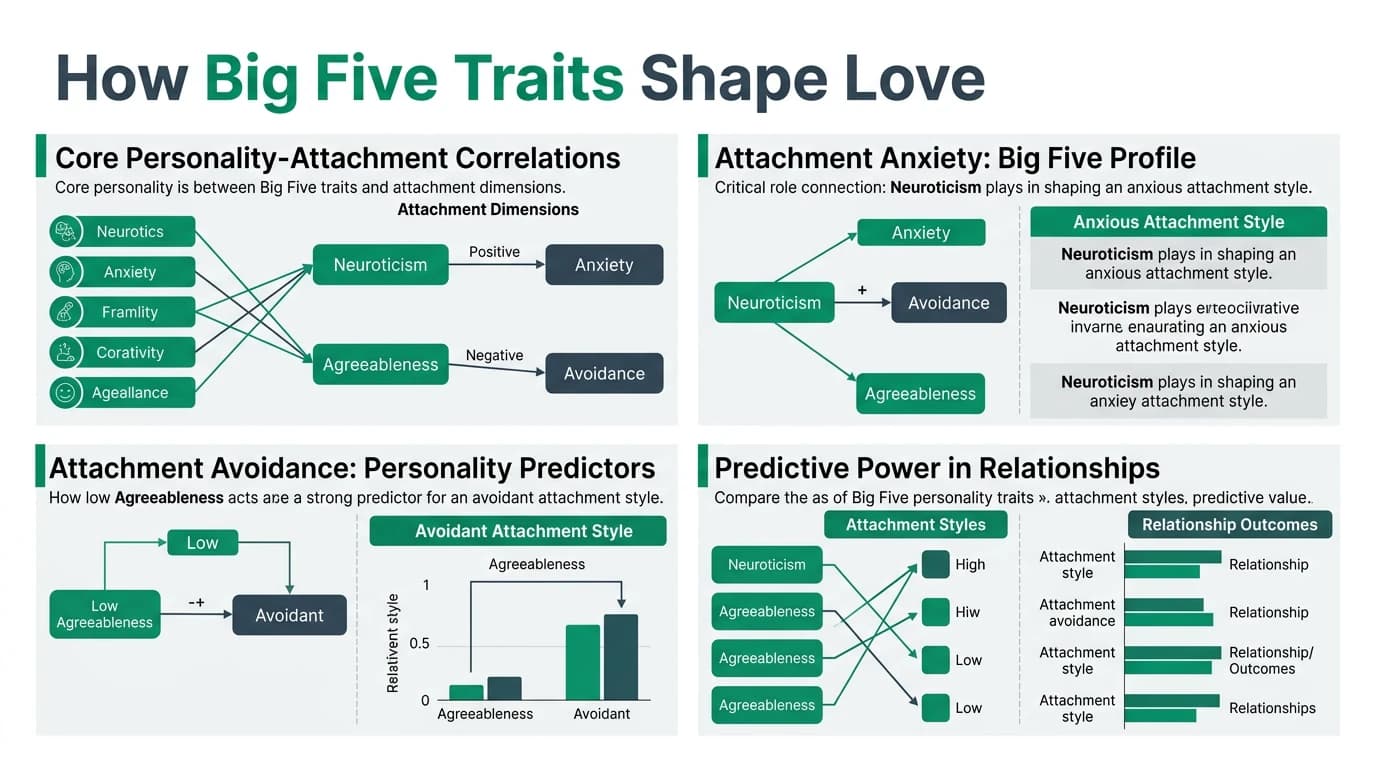
Neuroticism is the strongest predictor of anxious attachment (beta = 0.40), while low agreeableness predicts avoidant attachment. Secure attachment aligns with the Big Five stability meta-trait — low neuroticism combined with high agreeableness and conscientiousness. These correlations have been replicated across cultures and age groups.
Source: Noftle & Shaver, 2006 — Journal of Research in Personality
Key Takeaways
- Neuroticism is the single strongest personality predictor of attachment anxiety across all major studies.
- Agreeableness is inversely related to attachment avoidance — the less agreeable you are, the more avoidant your attachment style.
- Secure attachment aligns with the Big Five stability meta-trait: low neuroticism, high agreeableness, and high conscientiousness.
- Attachment styles often outperform Big Five traits in predicting relationship satisfaction, but both contribute independently.
- Personality and attachment interact bidirectionally — early attachment experiences shape trait development, and traits reinforce attachment patterns.
- Understanding both systems together provides the most complete picture of relationship behavior.
The bottom line: Your Big Five personality profile and your attachment style are overlapping but distinct lenses on how you love. Using both gives you a more actionable roadmap for relationship growth than either framework alone.
Disclaimer: This guide summarizes peer-reviewed research on personality and attachment for educational purposes. For relationship distress or attachment difficulties, consult a licensed therapist specializing in attachment-based interventions.
How Attachment Theory Works
Attachment theory, developed by John Bowlby and later expanded by Mary Ainsworth, describes how early caregiving experiences create internal working models of relationships1.
- These models organize around two dimensions: attachment anxiety (fear of abandonment) and attachment avoidance (discomfort with closeness).
- Adults typically fall into one of three primary styles, though a fourth — fearful-avoidant — combines high anxiety and high avoidance.
| Attachment Style | Anxiety Level | Avoidance Level | Core Belief | Estimated Prevalence |
|---|---|---|---|---|
| Secure | Low | Low | "I am worthy of love and others are trustworthy" | 55–65 percent of adults |
| Anxious-preoccupied | High | Low | "I need constant reassurance that I am loved" | 15–20 percent |
| Dismissive-avoidant | Low | High | "I do not need close relationships" | 20–25 percent |
| Fearful-avoidant | High | High | "I want closeness but expect rejection" | 5–10 percent |
For a broader look at how personality influences romantic compatibility, see our dating compatibility guide.
The Big Five and Attachment: Overview of Correlations
Noftle and Shaver (2006) conducted the landmark study linking Big Five traits to attachment dimensions using multiple personality measures across large samples1. Their findings have been replicated across cultures23.
| Big Five Trait | Attachment Anxiety (beta) | Attachment Avoidance (beta) | Interpretation |
|---|---|---|---|
| Neuroticism | +0.40 | +0.12 | Strongest anxiety predictor by a wide margin |
| Agreeableness | -0.08 | -0.18 | Primary avoidance predictor (inverse) |
| Conscientiousness | -0.12 | -0.10 | Buffers both anxiety and avoidance |
| Extraversion | -0.09 | -0.14 | Reduces avoidance, slight anxiety buffer |
| Openness | -0.03 | -0.05 | Weakest overall correlations |
The pattern is clear: neuroticism drives attachment anxiety, agreeableness (inversely) drives avoidance, and conscientiousness provides a modest protective effect on both dimensions.
Neuroticism: The Primary Bridge to Anxious Attachment
Neuroticism consistently emerges as the strongest Big Five predictor of attachment anxiety, with effect sizes (beta = 0.40) that dwarf other trait–attachment links14.
- Emotional reactivity: Neurotic individuals experience stronger negative emotions in response to perceived relationship threats.
- Hypervigilance: They scan for signs of rejection, interpreting neutral behavior as evidence of partner disinterest.
- Protest behavior: Anxiety triggers reassurance-seeking, clinginess, and escalating conflict — behaviors that can paradoxically push partners away.
| Neuroticism Facet | Attachment Mechanism | Relationship Consequence |
|---|---|---|
| Anxiety | Amplifies fear of abandonment | Excessive reassurance-seeking |
| Depression | Lowers perceived lovability | Withdrawal after conflict |
| Self-consciousness | Doubts partner attraction | Jealousy and monitoring behavior |
| Vulnerability | Overreacts to minor threats | Escalation of small disagreements |
| Angry hostility | Expresses frustration destructively | Conflict cycles |
Shaver and Brennan (1992) found that neuroticism alone accounted for more variance in attachment anxiety than all other Big Five traits combined4.
Practical strategies for high neuroticism:
- Practice labeling emotions before acting on them in relationships.
- Develop a personal "pause protocol" — when you feel an anxious urge, wait 20 minutes before texting or calling.
- Work with a therapist on cognitive reappraisal of perceived threats.
- Explore our neuroticism guide for broader trait management strategies.
Agreeableness: The Avoidance Buffer
Low agreeableness is the strongest personality predictor of attachment avoidance12. This link operates through several behavioral pathways.
- Trust deficits: Low-agreeableness individuals are more skeptical of partner motives and less willing to be vulnerable.
- Independence preference: They prioritize autonomy over interdependence, which manifests as emotional distancing.
- Conflict approach: Rather than seeking resolution through compromise, low-agreeableness individuals may stonewall or withdraw.
| Agreeableness Level | Attachment Tendency | Relationship Behavior | Long-Term Outcome |
|---|---|---|---|
| Very high | Secure or anxious | Accommodating, harmony-seeking | Strong bonds but risk of self-sacrifice |
| Moderately high | Mostly secure | Balanced give-and-take | Healthy interdependence |
| Average | Variable | Context-dependent | Depends on other traits |
| Low | Avoidant | Emotionally distant, self-reliant | Difficulty maintaining intimacy |
| Very low | Strongly avoidant | Dismissive of partner needs | High relationship turnover |
Practical strategies for low agreeableness:
- Practice small acts of vulnerability — share one personal feeling per day with your partner.
- Reframe interdependence as strategic (partners who cooperate achieve more) rather than weakness.
- Use structured communication exercises like "speaker-listener" technique during disagreements.
- Read our agreeableness guide for deeper exploration of this trait.
Secure Attachment and the Stability Meta-Trait
Researchers have identified two higher-order meta-traits within the Big Five: stability (low neuroticism, high agreeableness, high conscientiousness) and plasticity (extraversion, openness)15.
- Secure attachment maps almost directly onto the stability meta-trait.
- This makes intuitive sense: emotional calm, cooperativeness, and reliability are the building blocks of trust in relationships.
| Meta-Trait | Components | Attachment Style Correlation | Relationship Quality Impact |
|---|---|---|---|
| Stability | Low neuroticism + high agreeableness + high conscientiousness | Strong positive with secure attachment | High satisfaction, low conflict |
| Plasticity | High extraversion + high openness | Weak positive with secure attachment | Enhances novelty and communication |
DeYoung et al. (2002) demonstrated that the stability meta-trait predicted relationship functioning more accurately than any single Big Five trait, suggesting that secure attachment reflects a personality pattern rather than a single trait5.
Key implication: If you want to build secure attachment, working on the full stability package — managing emotions, increasing cooperativeness, and developing reliability — is more effective than targeting any one trait.
Extraversion, Openness, and Relationship Dynamics
Extraversion and openness play subtler but meaningful roles in attachment-related behaviors13.
- Extraversion reduces avoidance: Extraverts are comfortable with social closeness and seek connection, making avoidant patterns less likely.
- Openness to vulnerability: Open individuals are more willing to explore emotional depth in relationships, though the effect size is small.
- High-conflict contexts: Openness predicts better adaptation to relationship challenges because open individuals embrace change and process novel emotional experiences more readily3.
| Trait | Low-Conflict Benefit | High-Conflict Benefit | Attachment Link |
|---|---|---|---|
| Extraversion | Enjoys shared activities and socializing | Initiates repair conversations | Reduces avoidance |
| Openness | Explores emotional intimacy | Adapts to partner changes | Weak buffer against anxiety |
Practical strategies:
- Introverted partners can build connection through shared quiet activities (reading together, cooking, nature walks).
- Low-openness partners can practice emotional exploration by asking their partner one "deeper" question each week.
Attachment Predicts Relationships Better Than Personality Alone
A critical finding across multiple studies is that attachment dimensions often outperform Big Five traits in predicting specific relationship outcomes24.
- Shaver and Brennan (1992) found that a single-item attachment measure predicted relationship satisfaction at levels comparable to multi-scale Big Five assessments4.
- This does not mean personality is irrelevant — rather, attachment mediates the effect of personality on relationship quality.
| Predictor | Relationship Satisfaction (R-squared) | Relationship Stability | Conflict Frequency |
|---|---|---|---|
| Big Five traits alone | 0.15–0.20 | Moderate predictor | Moderate predictor |
| Attachment dimensions alone | 0.25–0.35 | Strong predictor | Strong predictor |
| Big Five plus attachment | 0.30–0.40 | Strongest predictor | Strongest predictor |
The practical takeaway: assessing both your Big Five profile and your attachment style gives you the most complete picture. Personality tells you about general behavioral tendencies; attachment tells you specifically how those tendencies play out in intimate relationships.
Self-Esteem as a Mediating Factor
Self-esteem sits at the intersection of personality and attachment, functioning as a key mediator6.
- Neuroticism lowers self-esteem, which increases attachment anxiety.
- Attachment anxiety further erodes self-esteem, creating a reinforcing cycle.
- Secure attachment and high agreeableness protect self-esteem by providing a stable sense of being valued.
| Factor | Effect on Self-Esteem | Downstream Attachment Impact |
|---|---|---|
| High neuroticism | Strongly negative | Increases anxiety |
| Low agreeableness | Moderately negative | Increases avoidance |
| Secure attachment | Strongly positive | Maintains emotional balance |
| Anxious attachment | Moderately negative | Creates reassurance-seeking loops |
Breaking this cycle requires intervention at multiple points — reducing neuroticism through therapy, building secure attachment through consistent relationship behaviors, and directly strengthening self-esteem through competence and social support.
Age, Relationship Status, and Cultural Context
The personality–attachment link is moderated by several demographic factors13.
- Age: Older adults tend to score lower on neuroticism and attachment anxiety. The neuroticism–anxiety correlation weakens with age, suggesting that life experience provides some buffering.
- Relationship length: Longer relationships are associated with lower avoidance, regardless of initial personality profile.
- Cultural context: Collectivist cultures show stronger agreeableness–security links, while individualist cultures amplify the neuroticism–anxiety association.
| Moderator | Effect on Anxiety Link | Effect on Avoidance Link | Practical Implication |
|---|---|---|---|
| Older age | Weakens neuroticism–anxiety | Modest reduction in avoidance | Attachment becomes more secure over time |
| Longer relationship | Slight anxiety reduction | Strong avoidance reduction | Commitment itself is therapeutic |
| Collectivist culture | Weakened | Strengthened agreeableness buffer | Cultural norms reinforce cooperation |
| Individualist culture | Strengthened | Weakened | Greater emphasis on personal emotional regulation |
For more on how personality influences broader social relationships, see our friendship and social relationships guide.
Conclusion
Big Five personality traits and attachment styles are overlapping but distinct systems that jointly predict how you experience love and intimacy. Neuroticism is the dominant bridge to attachment anxiety, agreeableness buffers against avoidance, and the stability meta-trait aligns with secure attachment. Using both frameworks together gives you the most actionable picture of your relationship patterns and the clearest path to growth.
Attachment-personality action checklist
- Complete a validated Big Five personality assessment.
- Take a reliable attachment style questionnaire (ECR-R is the gold standard).
- Identify your dominant attachment dimension — anxiety, avoidance, or security.
- Map your Big Five traits to attachment predictions using the correlation table above.
- If high neuroticism drives anxiety, develop a "pause protocol" for relationship triggers.
- If low agreeableness drives avoidance, practice one vulnerability exercise per week.
- Discuss your attachment and personality profiles with your partner for mutual understanding.
- Seek couples therapy if insecure attachment patterns are causing persistent relationship distress.
FAQ
Which Big Five trait most strongly predicts attachment anxiety?
Can attachment styles change in adulthood?
Does attachment predict relationship quality better than personality?
How does agreeableness relate to avoidant attachment?
What is the stability meta-trait and how does it relate to attachment?
Does culture influence the personality-attachment link?
How does neuroticism affect self-esteem in relationships?
Can therapy change the relationship between personality and attachment?
Notes
Primary Sources
| Source | Type | URL |
|---|---|---|
| Noftle & Shaver (2006) — Journal of Research in Personality | Landmark empirical study (N = 8,318) | UC Davis |
| Shaver & Brennan (1992) — PSPB | Foundational attachment-personality study | Sage Journals |
| Atari & Chegeni (2020) — Frontiers in Psychology | Cross-cultural validation | PMC |
| Lyons et al. (2020) — Personality and Individual Differences | Conflict and attachment study | PubMed |
| Humboldt State University thesis | Thesis on self-esteem and attachment | Digital Commons |
Footnotes
-
Noftle, E. E., & Shaver, P. R. (2006). Attachment dimensions and the Big Five personality traits: Associations and comparative ability to predict relationship quality. Journal of Research in Personality, 40(2), 179–208. ↩ ↩2 ↩3 ↩4 ↩5 ↩6 ↩7
-
Atari, M., & Chegeni, R. (2020). Assessment of Big Five personality traits across cultures: A systematic review. Frontiers in Psychology, 11, 553703. ↩ ↩2 ↩3
-
Lyons, M., Aksayli, N. D., & Brewer, G. (2020). Mental toughness and attachment: Big Five personality and conflict. Personality and Individual Differences, 167, 110214. ↩ ↩2 ↩3 ↩4
-
Shaver, P. R., & Brennan, K. A. (1992). Attachment styles and the "Big Five" personality traits: Their connections with each other and with romantic relationship outcomes. Personality and Social Psychology Bulletin, 18(5), 536–545. ↩ ↩2 ↩3 ↩4
-
DeYoung, C. G., Peterson, J. B., & Higgins, D. M. (2002). Higher-order factors of the Big Five predict conformity: Are there neuroses of health? Personality and Individual Differences, 33(4), 533–552. ↩ ↩2
-
Humboldt State University thesis on self-esteem, attachment, and personality. Humboldt Digital Commons. ↩