personality-tests
Agreeableness: Big Five Cooperation Guide
Master agreeableness in the Big Five personality model with its six facets, relationship impacts, workplace dynamics, and evidence-based strategies.
Quick answer
What is agreeableness in the Big Five?
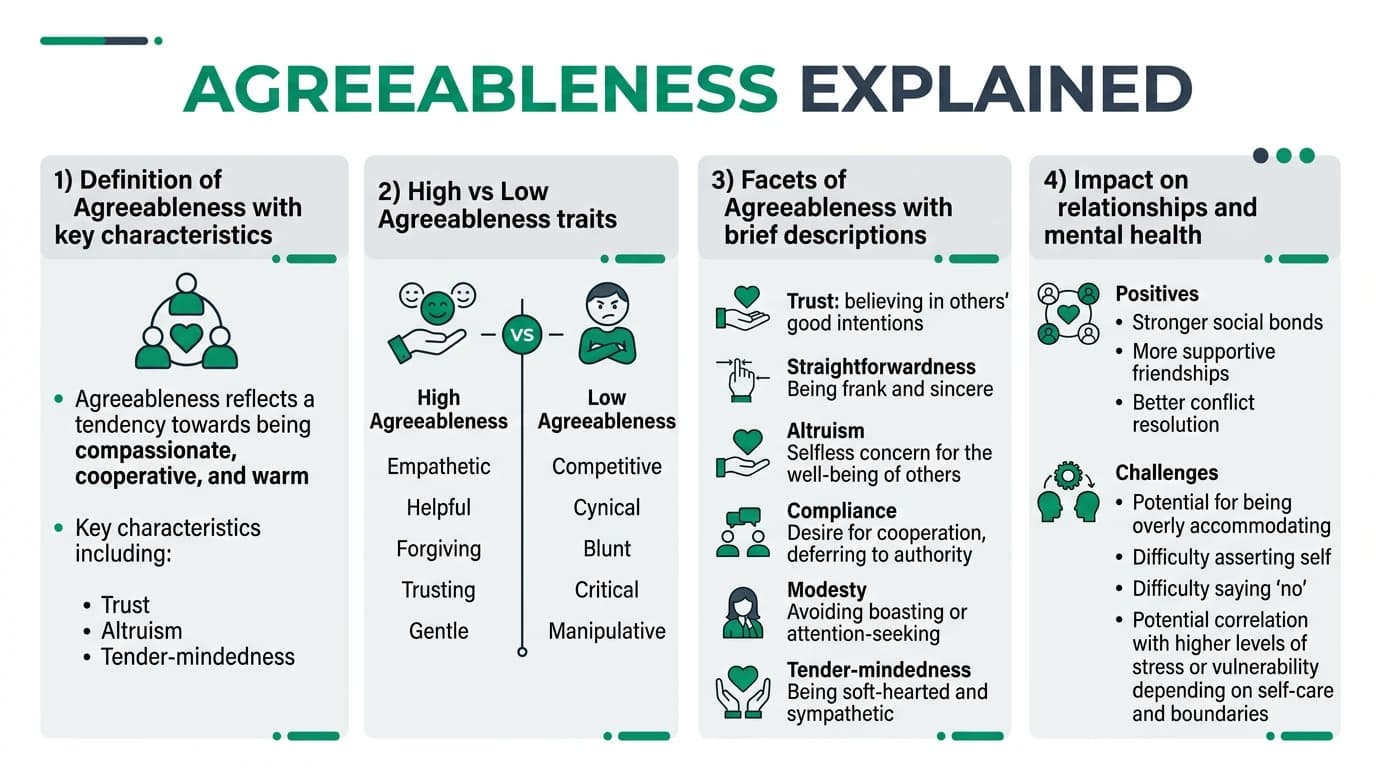
Agreeableness is a personality trait measuring cooperation, empathy, trust, and prosocial behavior. It predicts relationship quality, conflict resolution style, and team effectiveness. High agreeableness supports social harmony but can lead to self-sacrifice, while low agreeableness enables assertiveness but risks interpersonal friction.
Source: Costa, P. T. & McCrae, R. R. (1992). NEO-PI-R Professional Manual
Key Takeaways
- Agreeableness measures cooperation, empathy, trust, and prosocial tendencies within the Big Five (OCEAN) framework.
- The trait comprises six distinct facets: trust, straightforwardness, altruism, compliance, modesty, and tender-mindedness, each shaping behavior differently.
- High scorers excel in collaborative environments and build strong relationships, but risk people-pleasing, burnout, and neglecting personal needs.
- Low scorers bring assertiveness and competitive edge, but face challenges in teamwork, empathy, and social perception.
- Agreeableness increases in stability across the lifespan: rank-order correlation rises from .31 in early childhood to .74 in later life1.
- The trait is consistently valued across cultures, appearing as a core parental descriptor in seven different cultural studies1.
- High agreeableness correlates with lower depression and anxiety risk through stronger social support networks and reduced interpersonal conflict2.
For the full framework of all five personality traits, see our complete Big Five personality test guide.
Disclaimer: This article summarizes personality psychology research for educational purposes. Personality assessments should complement, not replace, professional psychological evaluation when clinical decisions are involved.
What Is Agreeableness?
Agreeableness is one of the five broad personality dimensions in the Big Five (OCEAN) model. It captures individual differences in the tendency to be cooperative, trusting, empathic, and motivated by social harmony rather than self-interest.
The trait was formalized by Costa and McCrae in their NEO Personality Inventory (1985, revised 1992) and further characterized by John and Srivastava (1999) as the dimension most directly tied to interpersonal behavior23.
Unlike extraversion, which measures social energy, agreeableness measures interpersonal orientation: how a person relates to others in terms of warmth, trust, and willingness to prioritize group needs.
| Core Component | Definition | Behavioral Indicator |
|---|---|---|
| Cooperation | Willingness to work with others toward shared goals | Compromises readily, values group outcomes |
| Empathy | Ability to understand and share others' emotional states | Responds to distress, offers support unprompted |
| Trust | Tendency to assume good intentions in others | Gives people the benefit of the doubt |
| Altruism | Motivation to help others without expectation of return | Volunteers, mentors, assists strangers |
| Compliance | Preference for harmony over confrontation | Avoids arguments, defers to group consensus |
| Modesty | Reluctance to claim superiority or draw attention | Deflects praise, shares credit |
- High agreeableness correlates with lower interpersonal conflict and reduced risk of depression and anxiety through stable social support networks (Ozer and Benet-Martinez, 2006; Kotov et al., 2010)2.
- Agreeableness is consistently identified across cultures as a core trait in parental descriptions of children (Kohnstamm et al., 1998)1.
High vs. Low Agreeableness
Neither extreme of the agreeableness spectrum is universally advantageous. Each profile carries distinct strengths and vulnerabilities depending on the context.
High Agreeableness Profile
- Strengths: Empathic, cooperative, trusted by peers, effective mediator, builds lasting relationships.
- Career fit: Thrives in collaborative roles (counseling, teaching, nursing, HR, customer service, social work).
- Risk factors: People-pleasing, difficulty saying no, suppressing personal needs, vulnerability to exploitation.
Low Agreeableness Profile
- Strengths: Assertive, independent, competitive, honest even when uncomfortable, resilient under pressure.
- Career fit: Excels in roles requiring tough decisions (negotiation, litigation, executive leadership, sales, surgery).
- Risk factors: Perceived as cold or confrontational, difficulty building trust, team friction.
| Dimension | High Agreeableness | Low Agreeableness |
|---|---|---|
| Conflict style | Avoids, accommodates | Confronts, competes |
| Trust default | Assumes good intentions | Skeptical until proven |
| Feedback delivery | Softened, diplomatic | Direct, blunt |
| Decision under pressure | Considers group impact first | Prioritizes outcome |
| Social perception | Warm, likable | Tough, abrasive |
| Stress pattern | From suppressed needs | From social friction |
| Leadership style | Servant leadership | Directive leadership |
| Context | Advantage Goes To | Why |
|---|---|---|
| Team conflict mediation | High A | Empathy and desire for harmony |
| Salary negotiation | Low A | Assertiveness without guilt |
| Customer support | High A | Patience and genuine concern |
| Fraud investigation | Low A | Skepticism and tough questioning |
| Mentoring junior staff | High A | Nurturing and trust-building |
| Organizational restructuring | Low A | Willingness to make unpopular decisions |
The Six Facets of Agreeableness
Agreeableness is a composite of six distinct facets identified by Costa and McCrae in the NEO-PI-R framework (Costa et al., 1991)3. Facet-level assessment reveals important behavioral nuances that the aggregate score misses.
| Facet | High Scorer | Low Scorer | Outcome Prediction |
|---|---|---|---|
| Trust | Believes in others' good intentions, gives benefit of the doubt | Skeptical of motives, guards against deception | Relationship quality, team cohesion |
| Straightforwardness | Honest, sincere, transparent in communication | Manipulative, strategic, willing to deceive | Perceived integrity, negotiation style |
| Altruism | Finds fulfillment in helping others | Self-focused, prioritizes personal gain | Prosocial behavior, volunteering |
| Compliance | Cooperative, avoids confrontation, defers to group | Confrontational, challenges authority, combative | Conflict frequency, team dynamics |
| Modesty | Humble, self-effacing, shares credit | Arrogant, self-promoting, claims superiority | Social likability, leadership perception |
| Tender-mindedness | Compassionate, moved by others' suffering | Tough-minded, emotionally detached from others' pain | Empathy, caregiving roles |
Facet Interactions and Profiles
- Compassion vs. politeness represent two higher-order clusters within agreeableness. Compassion (trust, altruism, tender-mindedness) drives emotional connection. Politeness (straightforwardness, compliance, modesty) drives social smoothness3.
- A person can score high on compassion but low on compliance, creating a profile of caring but assertive behavior.
- Low straightforwardness combined with high compliance can indicate surface-level agreeableness that masks manipulation.
| Profile Type | High Facets | Low Facets | Behavioral Pattern |
|---|---|---|---|
| Authentic helper | All six | None | Classic high-agreeableness personality |
| Caring challenger | Trust, altruism, tender-mindedness | Compliance, modesty | Empathic but willing to confront |
| Strategic diplomat | Compliance, straightforwardness, modesty | Trust, tender-mindedness | Socially smooth but emotionally distant |
| Selective helper | Altruism, tender-mindedness | Trust, straightforwardness | Helps those they choose but guards against deception |
| Competitive individualist | None high | All low | Classic low-agreeableness profile |
Measurement and Assessment
Several validated instruments measure agreeableness, from comprehensive clinical tools to brief screening assessments.
| Assessment Tool | Items | Facet Detail | Reliability | Cost | Best For |
|---|---|---|---|---|---|
| NEO-PI-R | 240 (48 for A) | All 6 facets | Very high (alpha 0.86-0.92) | Licensed | Clinical and research use |
| NEO-FFI | 60 (12 for A) | Domain-level only | High (alpha 0.78-0.86) | Licensed | Quick professional screening |
| BFI-2 | 60 (12 for A) | 3 facets | High | Free for research | Academic studies |
| IPIP-NEO | 120 or 300 | Full facet coverage | High | Free | Self-assessment, open access |
| Big Five Inventory | 44 (9 for A) | Domain-level only | Good | Free | Brief screening |
- The NEO-PI-R is the gold standard, but the IPIP-NEO offers comparable facet-level detail at no cost3.
- Agreeableness scores can be influenced by social desirability bias more than other traits, so informant reports are particularly valuable.
Reflective Self-Assessment Questions
- Do you consistently prioritize group harmony over personal preferences?
- Do others describe you as trusting, sometimes to a fault?
- Can you say no without guilt when someone asks for help?
- How do you react when someone challenges your ideas aggressively?
- Do you suppress disagreement to avoid conflict?
Agreeableness in Relationships
Agreeableness is the Big Five trait most directly tied to relationship quality. It shapes how people handle conflict, show empathy, and maintain social bonds.
| Relationship Domain | High A Effect | Low A Effect | Research Evidence |
|---|---|---|---|
| Romantic satisfaction | Higher through warmth and trust | Lower through friction and criticism | Ozer and Benet-Martinez (2006)2 |
| Conflict frequency | Reduced through accommodation | Elevated through confrontation | Kotov et al. (2010) |
| Social network size | Larger, more stable | Smaller, more selective | Simply Psychology review2 |
| Parenting style | Warm, responsive, patient | Authoritarian, demanding | Kohnstamm et al. (1998)1 |
| Friendship quality | Deep, trusted confidant | Respected but emotionally distant | Multiple longitudinal studies |
| Divorce risk | Lower | Higher, especially with high neuroticism | Roberts et al. (2007) |
- High agreeableness in both partners creates warm, stable relationships but may avoid necessary conflicts, allowing problems to fester.
- Mismatched agreeableness often produces the classic dynamic of one partner who accommodates and another who dominates.
- Low agreeableness paired with high neuroticism is the most challenging combination for relationship stability4.
For practical conflict resolution strategies based on personality, see our guide on personality and conflict resolution.
Workplace and Career Implications
Agreeableness shapes team dynamics, leadership effectiveness, and career trajectory in distinct ways depending on role demands.
| Role Category | Ideal A Level | Why It Fits | Performance Prediction |
|---|---|---|---|
| Counseling and therapy | High | Empathy, trust-building, emotional attunement | Strong positive |
| Human resources | High | Conflict mediation, employee advocacy | Strong positive |
| Nursing and healthcare | High | Patient care, compassion, team cooperation | Strong positive |
| Sales negotiation | Low to moderate | Assertiveness, competitive drive | Moderate positive for low A |
| Executive leadership | Moderate | Balance of decisiveness and team sensitivity | Optimal at moderate levels |
| Litigation and law | Low to moderate | Adversarial skill, skepticism | Positive for low A |
| Entrepreneurship | Moderate | Needs both collaboration and tough decisions | Variable |
| Workplace Behavior | High A Pattern | Low A Pattern | Impact |
|---|---|---|---|
| Team meetings | Seeks consensus, listens actively | Debates forcefully, challenges ideas | Meeting dynamics |
| Receiving criticism | Accepts gracefully, may internalize | Pushes back, evaluates objectively | Personal development |
| Delegation | Hesitant, worries about burdening others | Delegates freely, expects results | Management efficiency |
| Negotiation | Concedes too early for harmony | Drives hard bargain | Deal outcomes |
| Mentoring | Nurturing, patient, encouraging | Demanding, direct, challenging | Mentee development style |
- Agreeable employees are rated higher on organizational citizenship behavior (helping colleagues, volunteering for extra tasks) but may receive lower ratings on leadership potential in competitive industries5.
- The ideal agreeableness level for leadership is moderate: enough to build trust and inspire loyalty, but not so high that it prevents difficult decisions.
For insights on negotiation styles shaped by personality, see our personality and negotiation guide.
Health and Psychological Outcomes
Agreeableness contributes to mental health primarily through its effect on interpersonal relationships and social support quality.
| Health Outcome | High A Effect | Mechanism | Evidence |
|---|---|---|---|
| Depression risk | Lower | Stronger social support buffers stress | Kotov et al. (2010)2 |
| Anxiety risk | Lower | Reduced interpersonal conflict | Ozer and Benet-Martinez (2006) |
| Therapeutic alliance | Stronger | Trust and openness with therapist | Costa et al. (1991)3 |
| Cardiovascular health | Potentially better | Lower hostility, reduced chronic stress | Smith and MacKenzie (2006) |
| Longevity | Modestly positive | Social connectedness and support | Roberts et al. (2007) |
| Risk Factor | High A Risk | Low A Risk |
|---|---|---|
| People-pleasing burnout | Elevated | Low |
| Suppressed anger | Elevated (resentment builds) | Low (expressed directly) |
| Exploitation by others | Elevated (too trusting) | Low (naturally skeptical) |
| Social isolation | Low | Elevated |
| Hostility-related health issues | Low | Elevated |
- The people-pleasing trap is a significant risk for very high agreeableness: chronic suppression of personal needs creates resentment, passive aggression, and eventual burnout4.
- Low agreeableness is linked to hostility, which independently predicts cardiovascular disease risk through chronic stress activation.
Development and Stability Over Time
Agreeableness is not fixed. It follows predictable developmental patterns, generally increasing in stability with age.
| Life Stage | Rank-Order Correlation | Behavioral Expression | Driving Factor |
|---|---|---|---|
| Early childhood | .31 | Emerging sharing, turn-taking | Socialization begins |
| Late childhood | .45 | Developing empathy, fairness concepts | Peer interaction |
| Adolescence | .50 | Testing boundaries, identity exploration | Identity formation |
| Young adulthood | .55 | Relationship building, career cooperation | Social role demands |
| Mid-adulthood | .64 | Stable cooperative style, mentoring | Established social role |
| Later life | .74 | Highly consistent interpersonal pattern | Crystallized personality |
- The maturity principle applies to agreeableness: people generally become more cooperative, trusting, and altruistic as they age, driven by increasing social responsibility1.
- Cross-cultural studies confirm that agreeableness is universally recognized, appearing as a core trait in parental descriptions across seven distinct cultures (Kohnstamm et al., 1998)1.
Agreeableness vs. Other Big Five Traits
Agreeableness interacts with other Big Five dimensions in ways that create distinctive behavioral profiles.
| Trait Combination | Behavioral Profile | Workplace Impact | Relationship Impact |
|---|---|---|---|
| High A + High E | Warm, socially energetic, popular | Excellent team builder | Outgoing, supportive partner |
| High A + High N | Caring but emotionally volatile | Compassionate but stressed | Nurturing but anxious |
| High A + High C | Reliable, helpful, organized helper | Ideal team member | Dependable partner |
| Low A + High E | Assertive, dominant, charismatic | Natural leader in competitive settings | Exciting but controlling |
| Low A + High N | Hostile, distrustful, anxious | Difficult colleague | Challenging partner |
| Low A + Low C | Unreliable, confrontational | High conflict risk | Unstable relationship pattern |
- The interaction between agreeableness and neuroticism is particularly important for mental health: low agreeableness combined with high neuroticism creates the highest interpersonal vulnerability2.
- Agreeableness and conscientiousness together predict the best team performance outcomes, as they combine cooperation with reliability.
Strategies for Adapting Agreeableness
For High Scorers: Building Assertiveness
- Practice saying no without excessive explanation or guilt.
- Set boundaries before others make requests, not after.
- Monitor resentment as a signal that your needs are being suppressed.
- Distinguish kindness from compliance: genuine helpfulness does not require self-sacrifice.
For Low Scorers: Building Cooperation
- Practice active listening without formulating a rebuttal while others speak.
- Acknowledge others' perspectives before presenting your own view.
- Invest in trust-building through small consistent acts of reliability.
- Monitor social feedback for signs of perceived coldness or arrogance.
| Strategy | Target Audience | Goal | Expected Timeline |
|---|---|---|---|
| Boundary-setting practice | High A | Protect personal needs | 2-4 weeks for initial habit |
| Active listening exercises | Low A | Improve empathy signals | 1-2 weeks for awareness |
| Assertiveness training | High A | Express disagreement constructively | 4-8 weeks with practice |
| Perspective-taking exercises | Low A | Build genuine cooperation | 2-4 weeks for initial shift |
| Conflict role-playing | Both | Develop flexible conflict styles | Ongoing practice |
For insights on how agreeableness shapes parenting approaches, see our personality and parenting styles guide.
Agreeableness action checklist
- Take a validated Big Five assessment (IPIP-NEO is free) to determine your agreeableness level and facet profile.
- Identify whether your profile leans toward compassion (trust, altruism, tender-mindedness) or politeness (compliance, straightforwardness, modesty).
- If high in agreeableness, monitor for people-pleasing patterns and practice boundary-setting.
- If low in agreeableness, invest in active listening and perspective-taking exercises.
- Match your career path to your agreeableness profile using the workplace tables above.
- Review relationship patterns for agreeableness-driven dynamics (accommodation vs. confrontation).
- Build one specific interpersonal skill per month aligned with your development direction.
- Reassess strategies every six months as life demands and relationships evolve.
FAQ
How is agreeableness measured accurately?
The gold standard is the NEO-PI-R, which measures all six facets (trust, straightforwardness, altruism, compliance, modesty, tender-mindedness) across 48 items. The free IPIP-NEO provides comparable facet-level detail. Because agreeableness is especially susceptible to social desirability bias, supplementing self-report with informant ratings from colleagues, partners, or close friends improves accuracy (Costa et al., 1991)3.
Can agreeableness change over time?
Yes. Agreeableness increases in stability with age, with rank-order correlations rising from .31 in early childhood to .74 in later life (Roberts and DelVecchio, 2000). People generally become more cooperative and trusting through adulthood as social roles demand greater interpersonal investment. However, significant life events like betrayal or trauma can shift agreeableness levels1.
What are the main risks of very high agreeableness?
Primary risks include people-pleasing that leads to burnout, suppression of personal needs that builds resentment, vulnerability to exploitation by less scrupulous individuals, difficulty making tough decisions that affect others negatively, and avoidance of necessary conflicts that allows problems to escalate. These risks are strongest when high agreeableness combines with low assertiveness4.
Is low agreeableness always bad for teams?
No. Low-agreeableness team members bring critical thinking, willingness to challenge groupthink, competitive drive, and honest feedback that high-agreeableness teams may lack. Research shows the most effective teams contain a mix of agreeableness levels, with high-A members building cohesion and low-A members ensuring intellectual rigor (Thomas International research)5.
How does agreeableness affect mental health?
High agreeableness correlates with lower depression and anxiety risk, primarily through stronger social support networks and reduced interpersonal conflict (Kotov et al., 2010; Ozer and Benet-Martinez, 2006). However, the self-sacrificing patterns of very high agreeableness can create a different mental health risk: burnout, resentment, and passive-aggressive behavior2.
What careers suit low agreeableness individuals?
Roles requiring tough decisions, competitive drive, or adversarial skill suit low agreeableness: litigation, executive leadership, sales negotiation, surgery, military leadership, fraud investigation, and debt collection. These roles reward skepticism, assertiveness, and emotional detachment that high-agreeableness individuals struggle to provide5.
How does culture influence agreeableness?
Agreeableness appears consistently across cultures as a fundamental personality dimension, identified in parental descriptions across seven distinct cultural groups (Kohnstamm et al., 1998). However, the behavioral expression varies: collectivist cultures may emphasize compliance and modesty, while individualist cultures may emphasize straightforwardness and assertive trust-building1.
What is the difference between agreeableness and extraversion?
Extraversion measures social energy, assertiveness, and stimulation-seeking from external interactions. Agreeableness measures interpersonal orientation: warmth, trust, cooperation, and willingness to prioritize others. An introverted person can be highly agreeable (quiet but deeply caring), and an extraverted person can be low in agreeableness (socially active but competitive and self-focused). The two traits are moderately correlated but conceptually distinct23.
Notes
Primary Sources
| Source | Type | Key Contribution | URL |
|---|---|---|---|
| Simply Psychology | Educational reference | Big Five model overview, agreeableness trait description, key meta-analyses | Link |
| PMC / NIH | Research database | Rank-order stability data, cross-cultural consistency findings | Link |
| Psychiatry and Psychotherapy Podcast | Research discussion | Agreeableness facets, Costa et al. framework, clinical applications | Link |
| Cleveland Clinic | Medical reference | Health implications and balanced trait interpretation | Link |
| Thomas International | HR research | Workplace applications and team dynamics research | Link |
| Psychology Today | Psychology reference | General agreeableness overview and behavioral examples | Link |
Conclusion
Agreeableness is the Big Five trait most directly connected to the quality of human relationships. It shapes how people handle conflict, extend trust, offer help, and maintain social bonds across every domain of life.
The practical implication is not that more agreeableness is always better. It is that understanding your agreeableness profile, at the facet level, enables you to leverage your interpersonal strengths while managing the specific vulnerabilities your profile creates.
High-agreeableness individuals should guard against self-sacrifice and develop assertiveness. Low-agreeableness individuals should invest in active listening and trust-building. Both profiles contribute essential value when matched to the right context.
Footnotes
-
Roberts, B. W. & DelVecchio, W. F. (2000). The rank-order consistency of personality traits from childhood to old age: A quantitative review of longitudinal studies. Psychological Bulletin, 126(1), 3-25. Referenced in: https://pmc.ncbi.nlm.nih.gov/articles/PMC2730208/ ↩ ↩2 ↩3 ↩4 ↩5 ↩6 ↩7 ↩8
-
John, O. P. & Srivastava, S. (1999). The Big Five trait taxonomy: History, measurement, and theoretical perspectives. Ozer, D. J. & Benet-Martinez, V. (2006). Personality and the prediction of consequential outcomes. Kotov, R. et al. (2010). Linking personality traits to anxiety and depressive disorders. Summary: https://www.simplypsychology.org/big-five-personality.html ↩ ↩2 ↩3 ↩4 ↩5 ↩6 ↩7 ↩8 ↩9
-
Costa, P. T. & McCrae, R. R. (1992). NEO-PI-R Professional Manual. Psychological Assessment Resources. Referenced in: https://www.psychiatrypodcast.com/psychiatry-psychotherapy-podcast/agreeableness-part-1 ↩ ↩2 ↩3 ↩4 ↩5 ↩6 ↩7 ↩8
-
Cleveland Clinic. Big Five personality traits. Available at: https://health.clevelandclinic.org/big-five-personality-traits ↩ ↩2 ↩3
-
Thomas International. What are the Big 5 personality traits? Available at: https://www.thomas.co/resources/type/hr-guides/what-are-big-5-personality-traits ↩ ↩2 ↩3