personality-tests
Big Five Personality and Parenting Styles
How the Big Five personality traits shape parenting styles and child development outcomes including academic performance, mental health, and emotional stability.
Quick answer
How do the Big Five personality traits affect parenting styles?
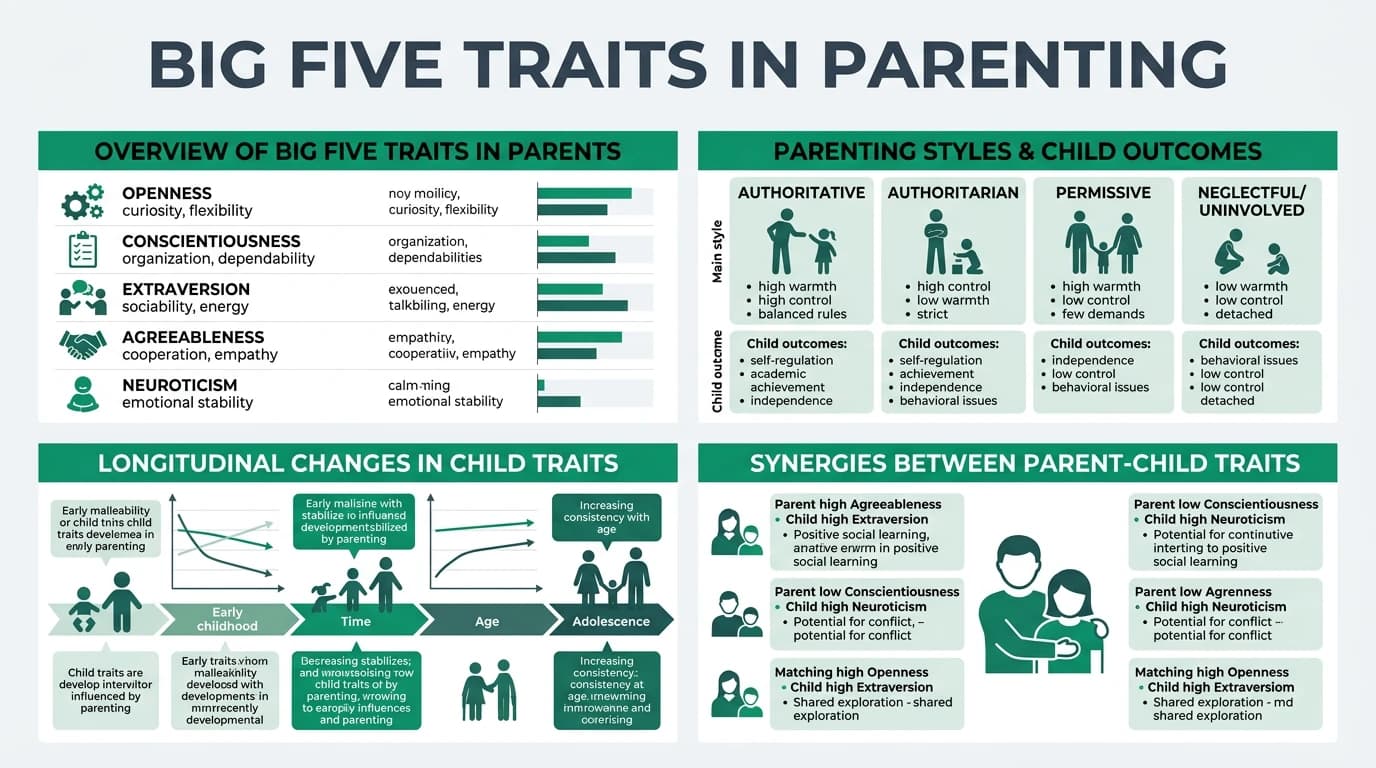
Parental conscientiousness and openness predict authoritative parenting, the style linked to the best child outcomes. Parental neuroticism predicts authoritarian parenting, which correlates with lower child extraversion and agreeableness. Parent-child trait matches (especially agreeableness) dramatically reduce family conflict, while trait mismatches increase behavioral and health risks.
Key Takeaways
- Parental conscientiousness is a significant positive predictor of authoritative parenting style (the style with the best child outcomes).
- Parental neuroticism predicts authoritarian parenting, which is associated with lower child extraversion, agreeableness, and conscientiousness.
- Parental openness inversely predicts authoritarianism, meaning open parents are less likely to adopt rigid, control-based approaches.
- The relationship is bidirectional: parents shape child traits, and child traits influence parenting behavior over time.
- Parent-child personality matches matter enormously. Dual high-agreeableness pairs dramatically reduce family conflict, while dual high-neuroticism pairs produce the worst child health outcomes.
- Warmth-based styles (authoritative and indulgent) consistently produce better child Big Five scores than control-based styles (authoritarian, neglectful).
- Parenting inconsistencies between mothers and fathers are mediated by child agreeableness and openness, affecting mental health outcomes.
For insight into how personality changes across the lifespan (including the child-to-adult transition), see our personality changes guide.
Disclaimer: This article summarizes developmental psychology research for educational purposes. Parenting involves individual, cultural, and situational factors beyond personality traits. Consult a family psychologist for personalized parenting guidance.
Parental Big Five Traits and Parenting Style Prediction
Each parental Big Five trait predicts specific parenting tendencies. An Iranian study of couples with children aged 6-12 quantified these relationships using regression analysis, providing some of the clearest data on trait-to-style pathways1.
| Parental Trait | Predicted Style | Direction | Key Statistic | Mechanism |
|---|---|---|---|---|
| Conscientiousness | Authoritative | Positive | Beta = 0.133, p = 0.003 | Discipline through structure and planning |
| Openness | Anti-authoritarian | Inverse | Beta = -0.212, p less than 0.001 | Flexibility and acceptance of child autonomy |
| Neuroticism | Authoritarian | Positive | Significant negative predictor of warmth | Emotional reactivity drives control-based approach |
| Emotional stability | Authoritative | Positive | Beta = -0.212 for authoritarianism | Calm demeanor supports consistent warmth |
| Agreeableness | Warmth-based | Positive | Mediates parent-child conflict | Empathy and cooperation reduce harshness |
| Extraversion | Involved | Positive | Correlates with warmth and stimulation | Social energy fuels engagement with children |
- Mothers and fathers show similar trait-to-style patterns, but fathers with low emotional stability show particularly strong authoritarian tendencies1.
- The strongest protective factor against authoritarian parenting is the combination of high openness and high emotional stability.
- For understanding how emotional intelligence connects to these dynamics, see our emotional intelligence guide.
The Four Parenting Styles
| Style | Warmth Level | Control Level | Parent Trait Profile | Child Outcome Tendency |
|---|---|---|---|---|
| Authoritative | High | High (democratic) | High C, high O, high E-stability | Best across all metrics |
| Authoritarian | Low | High (rigid) | High N, low O, low A | Lowest child E and A scores |
| Indulgent | High | Low | High A, moderate O | Better than authoritarian for traits |
| Neglectful | Low | Low | Low across multiple traits | Poor emotional stability, mental health |
How Parenting Styles Shape Child Personality
Parenting styles do not simply correlate with child outcomes. Longitudinal data from the TRAIN study shows that changes in parenting behavior predict parallel changes in child personality traits over time2.
Longitudinal Evidence: The TRAIN Study
- Increases in parental warmth predict positive changes in child extraversion, agreeableness, conscientiousness, and openness.
- Increases in overreactivity predict decreases in child agreeableness and conscientiousness.
- Academic involvement and structure from parents positively link to child extraversion and openness growth.
- Cultural stimulation (exposing children to diverse experiences) links to openness development.
| Parenting Dimension Change | Child Trait Affected | Direction | Study |
|---|---|---|---|
| Warmth increase | Extraversion | Positive | TRAIN (2021)2 |
| Warmth increase | Agreeableness | Positive | TRAIN (2021)2 |
| Warmth increase | Conscientiousness | Positive | TRAIN (2021)2 |
| Warmth increase | Openness | Positive | TRAIN (2021)2 |
| Overreactivity increase | Agreeableness | Negative | TRAIN (2021)2 |
| Overreactivity increase | Conscientiousness | Negative | TRAIN (2021)2 |
| Structure increase | Extraversion | Positive | TRAIN (2021)2 |
| Academic involvement | Openness | Positive | TRAIN (2021)2 |
- The relationship is bidirectional. Children with difficult temperaments can also elicit more controlling or reactive parenting, creating feedback loops.
- This means parenting interventions that increase warmth and reduce overreactivity may shift child personality trajectories.
Authoritative Parenting and Child Big Five Outcomes
Authoritative parenting, characterized by high warmth combined with democratic control, consistently produces the most favorable child personality profiles across cultures.
Child Outcomes Under Authoritative Parenting
- Highest mean scores in extraversion, agreeableness, conscientiousness, and openness compared to all other parenting styles3.
- Higher self-esteem and life satisfaction in longitudinal tracking.
- Better academic performance through the conscientiousness and self-regulation pathways.
| Child Trait | Mean Score (Authoritative) | Comparison to Authoritarian | Statistical Significance |
|---|---|---|---|
| Extraversion | Highest across styles | Significantly higher | F(3,358) reported3 |
| Agreeableness | Highest across styles | Significantly higher | p less than 0.053 |
| Conscientiousness | Highest across styles | Significantly higher | F(3,358) = 3.483 |
| Openness | Highest across styles | Higher | p less than 0.053 |
| Emotional stability | Higher | Moderately higher | Variable by sample |
What Makes Authoritative Parenting Effective
- Responsive communication teaches children emotional vocabulary and regulation.
- Consistent boundaries develop conscientiousness through predictable expectations.
- Autonomy support fosters openness and intrinsic motivation.
- Warmth as foundation builds secure attachment, enabling exploration and social confidence.
| Authoritative Component | Psychological Mechanism | Child Trait Developed | Long-term Outcome |
|---|---|---|---|
| Responsive listening | Emotional validation | Agreeableness, E-stability | Relationship quality |
| Clear expectations | Behavioral structure | Conscientiousness | Academic and career success |
| Autonomy encouragement | Self-determination | Openness, extraversion | Creativity, social confidence |
| Warm discipline | Secure attachment | All traits (foundation) | Mental health resilience |
Authoritarian Parenting and Personality Deficits
Authoritarian parenting, defined by high control with low warmth, produces the most consistently negative child personality profiles.
Child Outcomes Under Authoritarian Parenting
- Lowest scores in extraversion, agreeableness, and conscientiousness across studies3.
- Higher anxiety and lower self-esteem through the fear-based compliance mechanism.
- Behavioral compliance without internalized values, leading to rebellion risk in adolescence.
| Risk Area | Mechanism | Child Trait Impact | Long-term Consequence |
|---|---|---|---|
| Social withdrawal | Fear of punishment suppresses initiative | Low extraversion | Social skills deficits |
| Compliance without understanding | Rules enforced without explanation | Low conscientiousness (internalized) | Dependence on external authority |
| Emotional suppression | Feelings dismissed or punished | Low agreeableness | Relationship difficulties |
| Rigidity transfer | Modeling inflexible behavior | Low openness | Reduced creativity, adaptability |
- Parental neuroticism is the primary trait predictor of authoritarian style adoption. Emotionally unstable parents rely on control when they lack the self-regulation for warm, responsive parenting1.
- Parental low openness compounds this pattern. Parents who are closed to new experiences are less willing to adapt their parenting approach as children develop.
Indulgent vs. Neglectful Parenting Compared
The remaining two parenting styles, indulgent (high warmth, low control) and neglectful (low warmth, low control), produce markedly different outcomes despite both involving low behavioral control.
| Dimension | Indulgent Parenting | Neglectful Parenting |
|---|---|---|
| Warmth level | High | Low |
| Control level | Low | Low |
| Child extraversion | Higher than authoritarian | Lower than authoritative |
| Child agreeableness | Higher than authoritarian | Lower across most comparisons |
| Child conscientiousness | Moderate | Low |
| Child emotional stability | Moderate | Poor |
| Mental health mediation | Positive (via agreeableness) | Negative (via low agreeableness)4 |
| Cultural variation | Outperforms authoritative in some Spanish data3 | Consistently worst or near-worst |
- Indulgent parenting produces better child Big Five scores than authoritarian in studies of Spanish adolescents, challenging the assumption that authoritative is always superior across cultures3.
- Neglectful parenting is consistently linked to the poorest emotional stability and mental health outcomes, mediated by low child agreeableness4.
- The critical differentiator is warmth, not control. Both warmth-based styles (authoritative and indulgent) produce better outcomes than both low-warmth styles.
Parent-Child Personality Matches and Mismatches
Beyond parenting style, the specific personality match between parent and child creates powerful synergies or conflicts. A Washington University study identified dramatic effects of parent-child trait combinations5.
Beneficial Matches
- Dual high agreeableness dramatically reduces family arguments and increases household harmony.
- Non-neurotic parent with non-neurotic child produces the highest grades and lowest behavioral problems.
- Matched openness levels reduce friction over lifestyle choices, academic interests, and social activities.
Problematic Matches
- Neurotic parent paired with neurotic child produces the highest child BMI and worst health outcomes.
- Low-agreeableness parent with high-agreeableness child creates frustration from unmet empathy expectations.
- High-conscientiousness parent with low-conscientiousness child generates chronic conflict over organization, timeliness, and effort.
| Parent-Child Match | Outcome | Evidence | Severity |
|---|---|---|---|
| Both high agreeableness | Dramatically fewer arguments | WashU study5 | Strong positive |
| Both low neuroticism | Highest academic grades | WashU study5 | Strong positive |
| Both high neuroticism | Highest child BMI | WashU study5 | Strong negative |
| High C parent, low C child | Chronic organizational conflict | Clinical observation | Moderate negative |
| High O parent, low O child | Cultural interest mismatch | Developmental research | Mild negative |
Managing Personality Mismatches
- Recognize the mismatch as a personality difference, not a character flaw.
- Adapt expectations to the child's actual trait profile rather than projecting your own.
- Build bridges through activities that span both preference sets.
- Seek professional guidance when trait mismatches create persistent family conflict.
For insight into how personality compatibility works in romantic relationships, see our dating compatibility guide.
Parenting Inconsistencies Between Partners
When mothers and fathers adopt different parenting styles, the inconsistency itself becomes a risk factor for child mental health. Research with 2,583 medical students found that Big Five traits mediate this effect4.
How Inconsistency Affects Children
- Parenting difference (the gap between mother's and father's styles) predicts child mental health problems measured by the Kessler-10 scale.
- Agreeableness mediates the relationship: children with higher agreeableness are more resilient to parenting inconsistency.
- Openness also mediates: open children can cognitively process and adapt to different parental expectations.
| Mediation Factor | Effect on Child Mental Health | Sample Size | Mechanism |
|---|---|---|---|
| Child agreeableness | Positive buffering | 2,5834 | Empathy helps process mixed messages |
| Child openness | Positive buffering | 2,5834 | Cognitive flexibility adapts to different rules |
| Low child agreeableness | Vulnerability factor | 2,5834 | Rigidity amplifies parental inconsistency stress |
| Low child openness | Vulnerability factor | 2,5834 | Cannot reconcile differing expectations |
Strategies for Reducing Parenting Inconsistency
- Align on core values before discussing specific rules.
- Discuss parenting differences privately, not in front of children.
- Create a unified front on key behavioral expectations (bedtime, screen time, academic standards).
- Accept style differences in non-critical areas. Some variation is natural and can teach children flexibility.
- For managing stress that contributes to parenting inconsistency, see our stress management guide.
Cultural and Demographic Variations
Parenting style effectiveness is not culturally universal. Research across Spanish, Pakistani, and Iranian populations reveals important variations.
| Cultural Context | Key Finding | Style Hierarchy | Source |
|---|---|---|---|
| Spanish adolescents | Indulgent parenting outperforms authoritative for some traits | Indulgent is greater than Authoritative is greater than Neglectful is greater than Authoritarian | Garcia and Gracia (2009)3 |
| Pakistani youth | Positive correlations across all styles, authoritative highest | Authoritative is greatest, all positive | Hussain and Munaf (2018)6 |
| Iranian couples | Trait predictions consistent across genders | Conscientiousness predicts authoritative equally for both | Mohammadi et al.1 |
| Western meta-analyses | Authoritative consistently best across North American and European samples | Authoritative is greatest across metrics | Multiple reviews |
- The Spanish finding that indulgent parenting can match or exceed authoritative outcomes challenges the universal superiority of authoritative style.
- Cultural values around family hierarchy, collectivism vs. individualism, and emotional expression modify how parenting styles translate to child outcomes.
- Researchers should avoid assuming Western-derived style hierarchies apply globally.
| Demographic Factor | Impact on Parenting-Trait Link | Research Gap |
|---|---|---|
| Socioeconomic status | May moderate style adoption and effectiveness | Under-studied interaction |
| Single-parent households | Different trait-style dynamics | Limited longitudinal data |
| Family size | Resource dilution affects warmth consistency | Mostly cross-sectional evidence |
| Parental age | Maturity principle affects conscientiousness | Few studies control for parent age |
| Child birth order | First-borns may receive more structured parenting | Inconsistent findings |
Impact on Child Outcomes Beyond Personality
Parental personality traits and parenting styles influence child outcomes that extend well beyond the Big Five profile itself.
| Child Outcome | Parenting Factor | Trait Pathway | Evidence |
|---|---|---|---|
| Academic performance | Structure and academic involvement | Parental C boosts child C | TRAIN study2 |
| Body mass index (BMI) | Parent-child trait match | Dual neuroticism raises BMI | WashU study5 |
| Mental health (Kessler-10) | Parenting inconsistency | Mediated by child A and O | Medical student sample4 |
| Self-esteem | Warmth-based styles | Authoritative and indulgent | Cross-cultural studies3 |
| Social competence | Extraversion modeling | Parental E, cultural stimulation | TRAIN study2 |
| Behavioral problems | Overreactivity | Parental N via controlling style | Longitudinal data2 |
- The strongest evidence links parental conscientiousness to child academic success through two pathways: direct modeling and creation of structured home environments.
- Mental health mediation through personality traits means that building child agreeableness and openness can buffer against parenting-related stressors.
- For guidance on personality assessment for teenagers, see our teen personality testing guide.
Personality-informed parenting action checklist
- Take a validated Big Five assessment to understand your own personality profile as a parent.
- Identify which parenting style your traits naturally predict (use the trait-to-style table above).
- Assess whether your default style aligns with authoritative practices (high warmth plus democratic control).
- If high in neuroticism, develop emotional regulation strategies before responding to child behavior.
- Evaluate the personality match between you and your child using the match-mismatch table.
- Discuss parenting style alignment with your partner to identify and reduce inconsistencies.
- Increase warmth behaviors (responsive listening, verbal affection, autonomy support) regardless of your trait profile.
- Reassess your parenting approach annually as your child develops and personality traits evolve.
FAQ
Which Big Five trait most strongly predicts parenting style?
Conscientiousness is the strongest positive predictor of authoritative parenting (Beta = 0.133, p = 0.003), while neuroticism is the strongest predictor of authoritarian parenting. Openness inversely predicts authoritarianism (Beta = -0.212), meaning open parents are significantly less likely to adopt rigid, control-based approaches1.
Can parenting styles actually change child personality traits?
Yes. Longitudinal data from the TRAIN study shows that increases in parental warmth predict positive changes in child extraversion, agreeableness, conscientiousness, and openness over time. Increases in overreactivity predict decreases in child agreeableness and conscientiousness. The relationship is bidirectional but parenting changes do shift child trait trajectories2.
What happens when parents have different parenting styles?
Parenting inconsistency between mothers and fathers predicts child mental health problems (measured by Kessler-10 scores). This effect is mediated by child personality traits, particularly agreeableness and openness, which buffer against the negative impact. Low agreeableness in children makes them more vulnerable to the stress of inconsistent parenting4.
Is authoritative parenting always the best approach?
In most Western research, authoritative parenting (high warmth, democratic control) produces the best child outcomes. However, Spanish studies found that indulgent parenting matched or exceeded authoritative outcomes for some traits. Cultural context matters, and the universal superiority of authoritative style should not be assumed across all populations3.
How does neuroticism affect parenting quality?
Parental neuroticism predicts authoritarian parenting through emotional reactivity. Neurotic parents are more likely to use control-based approaches because they lack the self-regulation required for warm, responsive parenting. This effect is particularly strong in fathers. The good news is that emotional regulation training can help neurotic parents shift toward more effective styles1.
What are the effects of parent-child personality matches?
Personality matches between parents and children create powerful dynamics. Dual high-agreeableness pairs dramatically reduce family arguments. Non-neurotic pairs produce the highest child grades. Conversely, neurotic parent-child pairs yield the highest child BMI and worst health outcomes. Recognizing mismatches as personality differences rather than character flaws is the first step toward management5.
Does parental openness affect child development?
Parental openness inversely predicts authoritarianism, meaning open parents provide more flexible, autonomy-supportive environments. The TRAIN study found that cultural stimulation from parents links to child openness growth. Open parents expose children to diverse experiences, fostering creativity, cognitive flexibility, and adaptive personality development21.
How do personality traits mediate the effect of parenting on mental health?
Child agreeableness and openness mediate the pathway from parenting inconsistency to mental health outcomes. In a study of 2,583 medical students, children with higher agreeableness and openness were more resilient to the negative effects of mother-father parenting style differences, while children low in these traits showed more mental health vulnerability4.
Notes
Primary Sources
| Source | Type | Key Contribution | URL |
|---|---|---|---|
| Collabra: Psychology (UC Press) | Peer-reviewed journal | Longitudinal parenting-child trait associations (TRAIN study) | Link |
| RAMSS Journal (SPCRD) | Peer-reviewed journal | Parenting styles and adolescent Big Five in Pakistani youth | Link |
| PMC / European Journal of Investigation | Peer-reviewed journal | Parenting style comparison across four styles in Spanish adolescents | Link |
| European Journal of Preventive Health | Peer-reviewed journal | Personality trait prediction of parenting styles in Iranian couples | Link |
| Washington University in St. Louis | University research | Parent-child personality matches and family outcomes | Link |
Conclusion
Your personality traits predict your parenting style, and your parenting style shapes your child's personality development. Conscientiousness and openness push parents toward authoritative approaches, while neuroticism pulls toward authoritarian control. The match between parent and child personalities creates either harmony or friction that compounds over years.
The practical application is clear. Understand your own Big Five profile, recognize which parenting tendencies it creates, and make deliberate adjustments toward warmth-based practices. If you are high in neuroticism, invest in emotional regulation before reacting. If you and your partner differ in styles, align on core values to reduce the inconsistency that harms child mental health.
Parenting is not personality destiny. Awareness of trait-driven tendencies is the first step toward intentional, evidence-based family dynamics.
Footnotes
-
Mohammadi, M. et al. Investigating the predictive role of personality traits on parenting styles in Iranian couples. European Journal of Preventive Health. Available at: https://www.ejeph.com/download/investigating-the-predictive-role-of-personality-traits-on-parenting-styles-in-couples-of-6-12-years-8215.pdf ↩ ↩2 ↩3 ↩4 ↩5 ↩6 ↩7
-
De Haan, A. D., Deković, M. & Prinzie, P. (2021). Longitudinal associations between parenting and child personality: The role of child temperament. Collabra: Psychology, 7(1), 29766. Available at: https://online.ucpress.edu/collabra/article/7/1/29766/118998/Longitudinal-Associations-Between-Parenting-and ↩ ↩2 ↩3 ↩4 ↩5 ↩6 ↩7 ↩8 ↩9 ↩10 ↩11 ↩12 ↩13 ↩14 ↩15
-
Garcia, F. & Gracia, E. (2009, reviewed 2024). Parenting styles and child Big Five personality traits in Spanish adolescents. European Journal of Investigation in Health, Psychology and Education. Available at: https://pmc.ncbi.nlm.nih.gov/articles/PMC11939140/ ↩ ↩2 ↩3 ↩4 ↩5 ↩6 ↩7 ↩8 ↩9 ↩10 ↩11 ↩12
-
Raza, A. et al. (2023). Parenting style differences, Big Five mediation, and mental health in medical students. PubMed Central. Available at: https://pmc.ncbi.nlm.nih.gov/articles/PMC10049690/ ↩ ↩2 ↩3 ↩4 ↩5 ↩6 ↩7 ↩8 ↩9 ↩10
-
Washington University in St. Louis (2023). The parent trap: How parent-child personality matches affect family outcomes. Arts and Sciences, WashU. Available at: https://artsci.washu.edu/ampersand/parent-trap ↩ ↩2 ↩3 ↩4 ↩5 ↩6
-
Hussain, S. & Munaf, S. (2018). Perceived parenting styles and Big Five personality traits of adolescents. RAMSS Journal. Available at: https://www.ramss.spcrd.org/index.php/ramss/article/download/8/8 ↩