personal-development
Personality and Emotional Intelligence: How Big Five Traits Relate to EQ and Evidence-Based Strategies to Develop Emotional Intelligence
Explore the connection between the Big Five personality traits and emotional intelligence, along with strategies to enhance EQ.
Quick answer
How do Big Five personality traits relate to emotional intelligence?
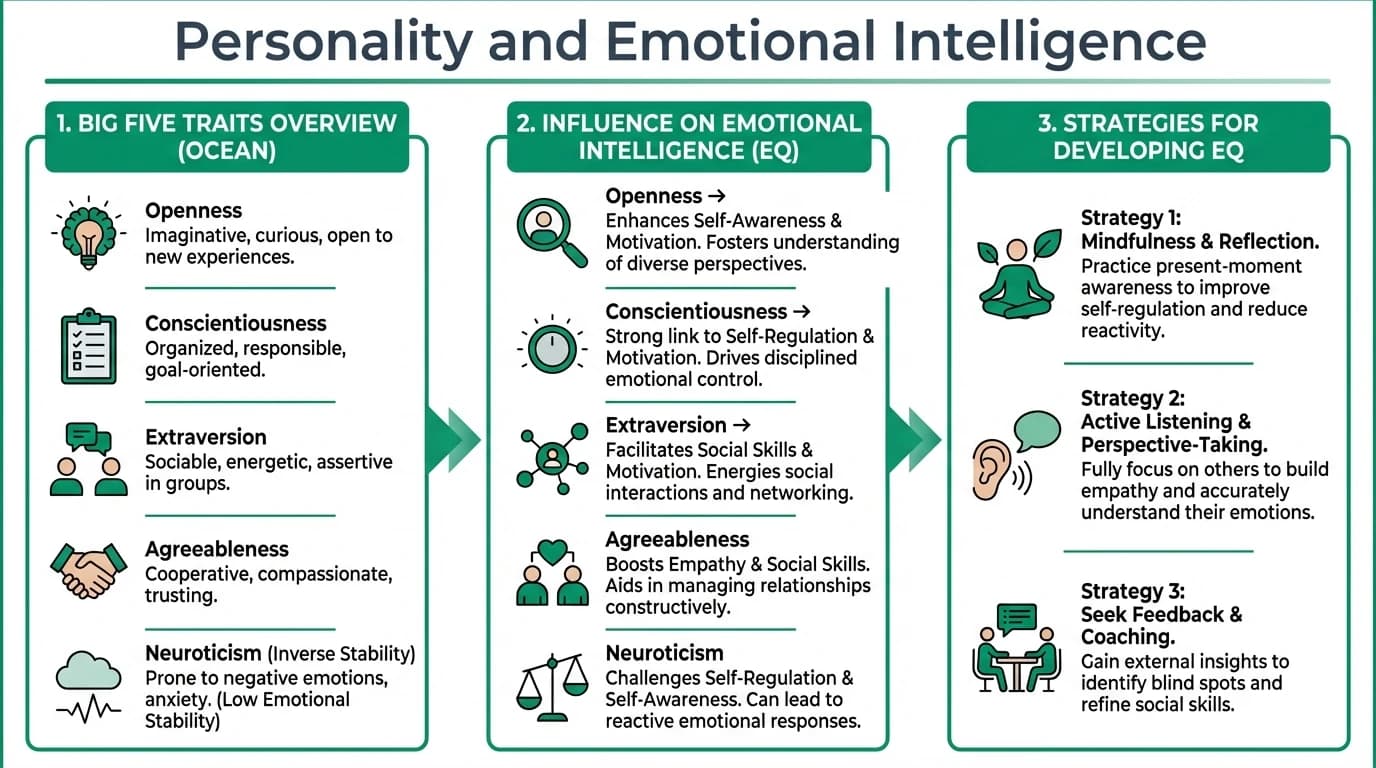
The Big Five personality traits—openness, conscientiousness, extraversion, agreeableness, and neuroticism—are linked to various aspects of emotional intelligence (EQ). For instance, high openness is often associated with better emotional awareness, while high conscientiousness can enhance emotion regulation. Evidence-based strategies to develop EQ include self-reflection, feedback, and cognitive reappraisal.
Source: Psychology Today
Executive Summary
Emotional intelligence (EQ) is a vital skill for personal and professional success, involving the ability to understand and manage emotions. The Big Five personality traits—openness, conscientiousness, extraversion, agreeableness, and neuroticism—offer a framework to explore individual differences in emotional capabilities. While research on the intersection of these traits and EQ is limited, understanding their relationship can provide insights into personal development strategies.
The Big Five traits influence various aspects of EQ. For example, openness might enhance emotional awareness, while conscientiousness aids emotion regulation. Strategies to develop EQ include self-reflection, feedback, and cognitive reappraisal, which can be tailored to one's personality profile.
The bottom line: Understanding the relationship between personality traits and emotional intelligence can guide targeted strategies for EQ development.
Critical Warning: Misunderstanding the role of personality traits in emotional intelligence can lead to ineffective development strategies. Always consider individual differences when applying these concepts.
1) Understanding Emotional Intelligence
What is Emotional Intelligence?
Emotional intelligence (EQ) refers to the ability to recognize, understand, and manage emotions in oneself and others. It encompasses skills like emotional awareness, emotion regulation, and empathy. High EQ is linked to better interpersonal relationships and professional success1.
How Does EQ Work?
EQ operates through a combination of self-awareness, self-regulation, motivation, empathy, and social skills. These components allow individuals to navigate social complexities, manage stress, and make informed decisions.
Key Mechanics
- Self-Awareness: Recognizing one's emotions and their impact.
- Self-Regulation: Managing emotions effectively.
- Motivation: Harnessing emotions to achieve goals.
- Empathy: Understanding others' emotions.
- Social Skills: Building and maintaining relationships.
Key Takeaways
- EQ is multifaceted, involving both personal and social competencies.
- High EQ leads to better relationships and professional outcomes.
2) The Big Five Personality Traits
What Are the Big Five Traits?
The Big Five personality traits include openness, conscientiousness, extraversion, agreeableness, and neuroticism. These traits provide a comprehensive framework to understand individual differences in behavior and emotion2.
How Do They Relate to EQ?
Each trait influences different aspects of emotional intelligence. For example, openness is linked to emotional awareness, while conscientiousness supports emotion regulation.
Key Mechanics
- Openness: Enhances creativity and emotional awareness.
- Conscientiousness: Supports discipline and regulation of emotions.
- Extraversion: Facilitates social interaction and empathy.
- Agreeableness: Promotes cooperation and understanding.
- Neuroticism: May hinder emotion regulation due to sensitivity to stress.
Key Takeaways
- Personality traits impact EQ differently, offering tailored development pathways.
- Understanding your traits can guide effective EQ strategies.
3) Strategies to Develop Emotional Intelligence
Self-Reflection and Feedback
Self-reflection involves analyzing one's emotional responses and behaviors. Feedback from peers and mentors provides external perspectives on emotional competencies3.
Emotion Regulation Techniques
Emotion regulation can be enhanced through cognitive reappraisal and mindfulness practices. These techniques help manage emotional intensity and improve emotional responses4.
Key Mechanics
- Cognitive Reappraisal: Changing perspective to alter emotional impact.
- Mindfulness: Maintaining present-moment awareness to manage emotions.
- Feedback: Incorporating external insights for growth.
Key Takeaways
- Regular self-reflection and feedback are crucial for EQ development.
- Emotion regulation techniques enhance emotional management.
4) The Role of Openness in Emotional Awareness
How Openness Enhances EQ
Openness to experience is linked to creativity and emotional awareness. Individuals high in openness are more likely to explore and understand their emotions5.
Example of Openness in Action
Consider an artist who uses emotional experiences to fuel creativity. Their openness allows them to explore emotions deeply, enhancing emotional awareness.
Key Takeaways
- Openness fosters emotional exploration, leading to greater awareness.
- Creative pursuits can be a pathway to developing EQ.
5) Conscientiousness and Emotion Regulation
How Conscientiousness Supports EQ
Conscientious individuals are disciplined and organized, which aids in regulating emotions. This trait helps maintain emotional stability in stressful situations6.
Example Calculation
A conscientious person might use a structured approach to manage stress, such as scheduling relaxation activities or using a planner to organize tasks.
Key Takeaways
- Conscientiousness enhances emotion regulation, promoting stability.
- Structured approaches can mitigate emotional challenges.
6) Extraversion and Social Skills
How Extraversion Influences EQ
Extraverts are outgoing and sociable, which enhances empathy and social skills. They are often better at reading social cues and building relationships7.
Common Mistakes and Pitfalls to Avoid
- Overreliance on social interactions: Neglecting self-reflection.
- Ignoring introverted tendencies: Failing to balance social and personal time.
Key Takeaways
- Extraversion enhances social competencies, crucial for high EQ.
- Balancing social and personal time is essential for holistic development.
7) Agreeableness and Empathy Development
How Agreeableness Enhances EQ
Agreeable individuals are cooperative and empathetic, which fosters understanding and compassion. This trait supports effective communication and conflict resolution8.
Key Mechanics
- Cooperation: Working well with others.
- Empathy: Understanding and sharing others' feelings.
Key Takeaways
- Agreeableness promotes empathy, enhancing interpersonal relationships.
- Effective communication is a cornerstone of high EQ.
8) Neuroticism and Emotional Challenges
How Neuroticism Affects EQ
High neuroticism can lead to emotional instability and difficulty in emotion regulation. Individuals may experience heightened sensitivity to stress and anxiety9.
Strategies to Mitigate Neuroticism
- Mindfulness practices: Reduce stress and improve emotional stability.
- Cognitive-behavioral techniques: Alter negative thought patterns.
Key Takeaways
- High neuroticism poses challenges to EQ development.
- Mindfulness and CBT can mitigate emotional instability.
9) Integrating Personality and EQ Strategies
Step-by-Step Process
- Identify Your Traits: Use a Big Five assessment to understand your personality profile.
- Tailor Strategies: Align EQ development strategies with your traits.
- Implement Practices: Regularly practice self-reflection, feedback, and emotion regulation.
Key Takeaways
- Personalized strategies enhance EQ, leveraging personality insights.
- Consistent practice is key to sustained improvement.
10) Measuring Emotional Intelligence Progress
Assessment Tools
Tools like the Emotional Intelligence Appraisal provide insights into EQ levels and track progress over time10.
Benchmark Table
| Trait | EQ Component | Assessment Tool |
|---|---|---|
| Openness | Emotional Awareness | SEI Assessment |
| Conscientiousness | Emotion Regulation | EQ Appraisal |
| Extraversion | Social Skills | SEI Assessment |
| Agreeableness | Empathy | EQ Appraisal |
| Neuroticism | Emotional Stability | SEI Assessment |
Key Takeaways
- Assessment tools provide benchmarks for EQ progress.
- Regular evaluation guides ongoing development.
Action checklist
- Identify your Big Five personality traits.
- Align EQ strategies with your personality profile.
- Regularly assess and track EQ progress.
FAQ
What is the relationship between personality traits and emotional intelligence?
Can emotional intelligence be improved?
How does openness affect emotional intelligence?
What role does conscientiousness play in EQ?
How can extraversion enhance social skills?
Are there challenges associated with high neuroticism?
What tools are available to measure EQ progress?
Notes
Primary Sources
| Source | Type | URL |
|---|---|---|
| Six Seconds | EQ Framework & Assessment | https://www.6seconds.org/emotional-intelligence/learn/ |
| Psychology Today | EQ Development Strategies | https://www.psychologytoday.com/us/blog/leading-for-success/202602/10-strategies-to-develop-your-emotional-intelligence |
Conclusion
Understanding the interplay between personality traits and emotional intelligence offers valuable insights for personal development. By aligning EQ strategies with individual traits, one can enhance emotional capabilities and achieve personal and professional growth.