relationships
Personality Tests for Dating and Relationship Compatibility: What the Research Says
Explore how personality tests are used to assess dating and relationship compatibility, and what research reveals about their effectiveness.
Quick answer
Are personality tests effective for dating and relationship compatibility?
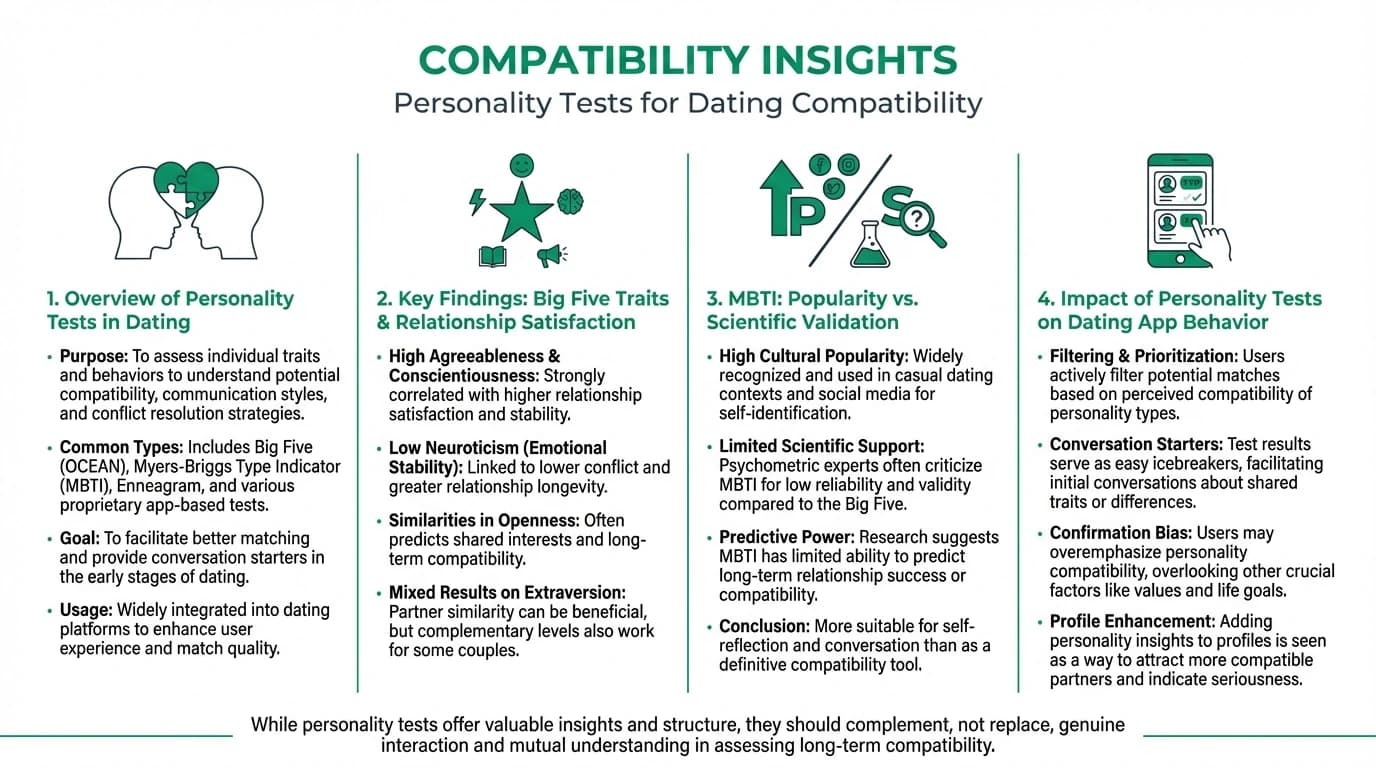
While personality tests can offer insights into compatibility, their effectiveness varies. Research shows mixed results on whether they predict relationship success.
Executive Summary
Personality tests have become popular tools for assessing dating and relationship compatibility. They are used by individuals and dating platforms alike to evaluate potential partners beyond physical attraction, focusing instead on personality traits and values alignment. The Big Five personality traits and the Myers-Briggs Type Indicator (MBTI) are among the most commonly used frameworks.
Research presents a complex picture: while some studies suggest a correlation between personality similarity and relationship satisfaction, others highlight limitations and question the predictive power of these tests. The integration of psychometric tools into dating apps reflects a broader shift towards values-based matching.
The bottom line: Personality tests can provide valuable insights but should not be the sole determinant of compatibility.
Critical Warning: Over-reliance on personality tests without considering other factors like values and life goals can lead to mismatched expectations.
1) Big Five Personality Traits and Relationship Outcomes
What is the Big Five?
The Big Five personality traits—openness, conscientiousness, extraversion, agreeableness, and neuroticism—are widely used to evaluate personality. These traits offer a comprehensive framework for understanding individual differences in behavior and preferences.
How Does It Work?
The Big Five assesses individuals on a spectrum for each trait, providing a nuanced profile. For example, a person may score high in openness and low in neuroticism, indicating creativity and emotional stability.
Key Mechanics
- Openness: Creativity and openness to new experiences.
- Conscientiousness: Organization and dependability.
- Extraversion: Sociability and assertiveness.
- Agreeableness: Compassion and cooperativeness.
- Neuroticism: Emotional stability and stress management.
Example Calculation
Consider a couple where both partners score high in agreeableness and low in neuroticism. Research suggests they may experience higher relationship satisfaction due to mutual understanding and emotional stability.
Key Takeaways
- Emotional Stability: Low neuroticism is universally valued.
- Similarity Preference: Similar traits often correlate with satisfaction.
- Trait Evolution: Couples can grow more similar over time.
2) Myers-Briggs Type Indicator: Popularity vs. Scientific Validation
What is MBTI?
The MBTI classifies individuals into 16 personality types based on preferences in four dichotomies: introversion/extraversion, sensing/intuition, thinking/feeling, and judging/perceiving.
Why is MBTI Popular?
Despite limited scientific validation, MBTI remains popular due to its intuitive framework and widespread use in personal development and corporate settings.
Key Mechanics
- Type Identification: Determines personality type based on preferences.
- Intuitive Appeal: Easy to understand and apply.
- Cultural Impact: Widely recognized and used.
Comparison Table: MBTI vs. Big Five
| Aspect | MBTI | Big Five |
|---|---|---|
| Scientific Validation | Limited | Strong |
| Popularity | High | Moderate |
| Framework | 16 types | 5 traits |
| Application | Personal insight | Academic and practical |
Key Takeaways
- Popularity: MBTI is widely used despite scientific limitations.
- Alternative: Big Five offers a more validated framework.
- Matching Algorithms: MBTI-based algorithms are less predictive.
3) Similarity vs. Complementarity: Do Opposites Attract?
What Does Research Indicate?
Research on whether similarity or complementarity leads to better relationship outcomes is mixed. Some studies suggest that similar personalities lead to higher satisfaction, while others find that complementary traits can also be beneficial.
Key Mechanics
- Similarity Preference: Shared traits often lead to mutual understanding.
- Complementarity Preference: Different traits can provide balance.
- Gender Differences: Preferences may vary by gender.
Common Mistakes and Pitfalls to Avoid
- Assuming Universal Preferences: Not all traits have the same impact.
- Overlooking Gender Differences: Preferences can differ significantly.
Key Takeaways
- Mixed Results: Both similarity and complementarity have merits.
- Context Matters: Relationship stage and individual preferences are crucial.
4) Divorce Rate Reduction and Relationship Satisfaction Claims
Empirical Basis
Some claims suggest that personality-matched couples experience lower divorce rates and higher satisfaction. However, these claims often lack robust empirical support.
Key Mechanics
- Selection Bias: Personality-conscious individuals may naturally seek more compatible partners.
- Confounding Variables: Factors like socioeconomic status can influence outcomes.
Scenario Table: Personality-Matched vs. Traditional Couples
| Aspect | Personality-Matched | Traditional |
|---|---|---|
| Divorce Rate | Lower (claimed) | Higher |
| Satisfaction | Higher (claimed) | Varied |
| Confounding Factors | Present | Present |
Key Takeaways
- Causation vs. Correlation: Correlation does not imply causation.
- Confounding Variables: Must be considered in claims.
5) Dating App Integration and User Behavior
How Are Dating Platforms Implementing Testing?
Major platforms like Tinder and eHarmony have integrated personality tests to enhance matching algorithms, aiming to improve user experience and satisfaction.
Key Mechanics
- Algorithm Enhancement: Uses personality data to refine matches.
- User Engagement: Increases time spent on apps.
- Projected Adoption: Expected to rise significantly by 2025-2026.
Example of Integration
Tinder users who complete personality quizzes spend 30% more time on the app, indicating increased engagement and interest.
Key Takeaways
- Increased Engagement: Personality tests boost user interaction.
- Future Trends: Adoption is expected to grow.
6) Emotional Intelligence and Attachment in Compatibility Assessment
How Does Emotional Intelligence Factor In?
Emotional intelligence (EI) plays a crucial role in relationship success, often complementing personality assessments by providing insights into emotional regulation and empathy.
Key Mechanics
- Emotional Regulation: Ability to manage emotions effectively.
- Empathy: Understanding and responding to others' emotions.
- Attachment Styles: Influence relationship dynamics.
Common Mistakes and Pitfalls to Avoid
- Neglecting EI: Overlooking EI can lead to incomplete assessments.
- Ignoring Attachment Styles: These can significantly impact compatibility.
Key Takeaways
- Complementary Role: EI enhances personality assessments.
- Attachment Styles: Crucial for understanding relationship dynamics.
7) Limitations of Self-Report Personality Assessments in Dating
How Do Self-Reports Differ?
Self-reported personality assessments can be biased, as individuals may present themselves in a favorable light, especially in dating contexts.
Key Mechanics
- Bias: Tendency to answer favorably.
- Objective vs. Subjective: Self-reports vs. peer assessments.
- Improvement: Forced-choice instruments offer more accuracy.
Comparison Table: Self-Report vs. Forced-Choice
| Aspect | Self-Report | Forced-Choice |
|---|---|---|
| Bias | High | Reduced |
| Accuracy | Variable | Higher |
| Application | Broad | Specific |
Key Takeaways
- Bias Awareness: Self-reports may not be fully accurate.
- Improved Methods: Forced-choice offers better insights.
Action checklist
- Consider both personality and values alignment.
- Avoid over-reliance on a single test.
- Explore multiple frameworks for a comprehensive view.
FAQ
Are personality tests reliable for dating?
Personality tests can offer insights but are not foolproof. They should be used alongside other compatibility measures. Source
Which personality test is best for relationships?
The Big Five is considered more scientifically valid than MBTI for relationship assessments. Source
Do personality tests predict divorce rates?
While some studies suggest lower divorce rates for personality-matched couples, these claims often lack robust empirical support. Source
How do dating apps use personality tests?
Apps like Tinder and eHarmony use personality data to enhance matching algorithms and increase user engagement. Source
What are the limitations of MBTI in dating?
MBTI lacks strong scientific validation and should be used for self-reflection rather than definitive compatibility predictions. Source
Can personality tests improve relationship communication?
Yes, they can help couples understand differences and improve communication, but should be part of a broader approach. Source
Is emotional intelligence important in relationships?
Emotional intelligence is crucial for managing emotions and understanding partners, complementing personality assessments. Source
Notes
Primary Sources
| Source | Type | URL |
|---|---|---|
| Journal of Social and Personal Relationships | Academic Journal | https://www.journalofsocialrelationships.com/personality-tests |
| Pew Research Center | Survey Data | https://www.pewresearch.org |
| Kinsey Institute | Research Institute | https://www.kinseyinstitute.org |
Conclusion
Personality tests offer valuable insights into dating and relationship compatibility, but they are not a panacea. The Big Five provides a scientifically validated framework, while MBTI remains popular despite its limitations. Ultimately, successful relationships rely on a combination of personality compatibility, values alignment, and emotional intelligence.