relationships
Personality and Conflict in Romantic Relationships: How Big Five Traits Shape Conflict Style
Explore how Big Five personality traits influence conflict styles, communication, and resolution in romantic relationships. Learn about neuroticism's impact on conflict frequency, agreeableness and avoidance, and the overlap with attachment theory. Discover science-based strategies for various personality pairings.
Quick answer
How do Big Five personality traits affect conflict in romantic relationships?
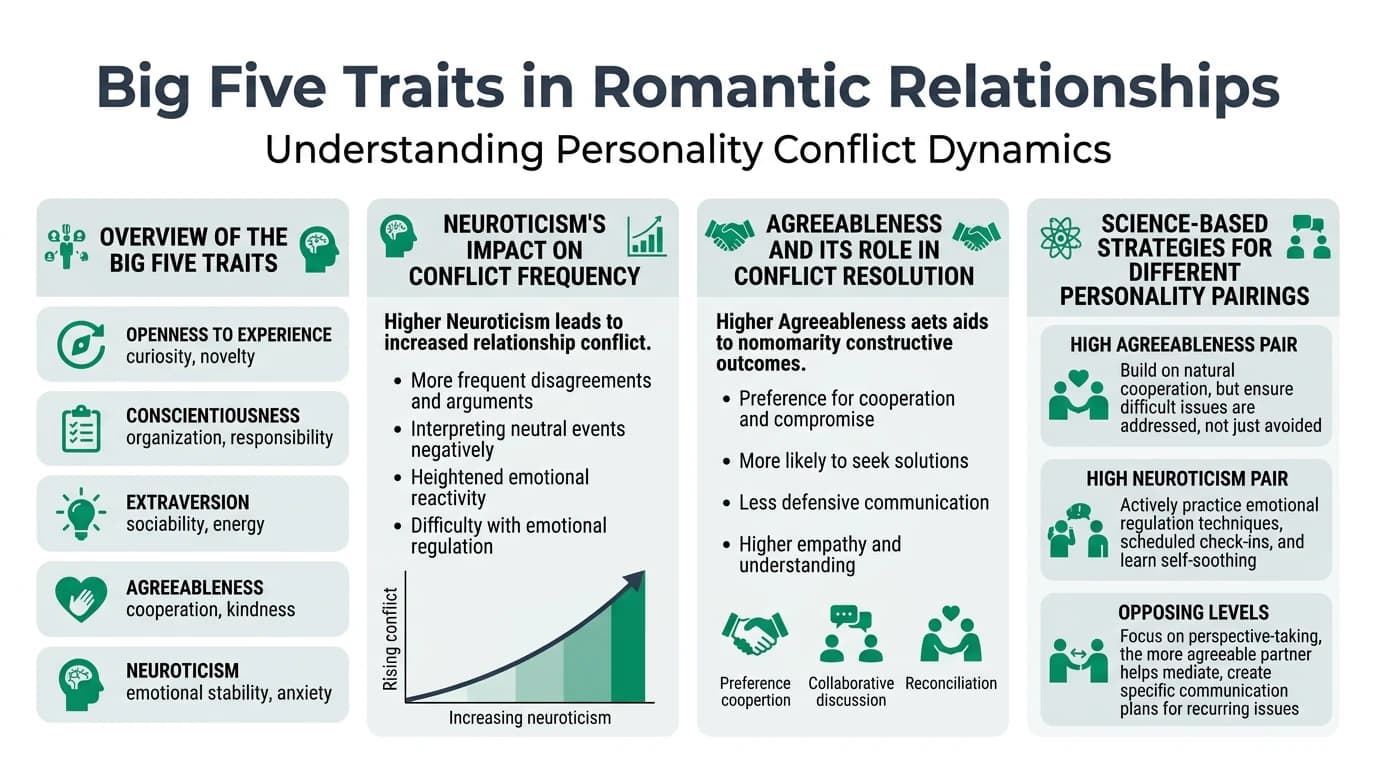
The Big Five personality traits—Openness, Conscientiousness, Extraversion, Agreeableness, and Neuroticism—shape how couples handle conflict. Neuroticism often increases conflict frequency due to heightened emotional responses, while agreeableness tends to facilitate resolution by promoting empathy and harmony.
Executive Summary
Understanding how personality traits influence conflict in romantic relationships can improve communication and resolution strategies. The Big Five model offers a framework to predict conflict patterns and outcomes. Neuroticism often correlates with increased conflict frequency, while agreeableness can enhance resolution.
The bottom line: Personality traits are not deterministic but offer insights into conflict dynamics. Awareness and adaptation can improve relationship satisfaction.
Critical: Personality traits are not fixed; they evolve over time. Professional guidance is recommended for persistent conflict.
The Big Five Model in Romantic Relationships
The Big Five personality traits provide a comprehensive framework for understanding relationship dynamics:
- Openness: Creativity and openness to new experiences.
- Conscientiousness: Organization and dependability.
- Extraversion: Sociability and assertiveness.
- Agreeableness: Empathy and cooperation.
- Neuroticism: Emotional instability and anxiety.
| Trait | High Level Impact | Low Level Impact | Relationship Outcome |
|---|---|---|---|
| Neuroticism | Increases conflict frequency | Reduces emotional volatility | Potential dissatisfaction |
| Agreeableness | Enhances conflict resolution | Increases competitiveness | Improved harmony |
| Conscientiousness | Promotes structure and reliability | May lead to declining satisfaction | Stability over time |
| Openness | Encourages creative problem-solving | Limits adaptability | Potential for novelty |
| Extraversion | Facilitates social engagement | May lead to conflict avoidance | Complementary dynamics possible |
Neuroticism and Conflict Frequency
Neuroticism is often linked to higher conflict frequency due to:
- Emotional Volatility: Heightened sensitivity to perceived slights.
- Anxiety and Jealousy: Increased need for reassurance.
- Bidirectional Effects: High neuroticism predicts declining satisfaction, and vice versa.
| Effect | Description |
|---|---|
| Increased Anxiety | Leads to frequent misunderstandings and conflicts. |
| Emotional Reactivity | Escalates minor disagreements into major conflicts. |
| Need for Reassurance | Partners may feel burdened by constant emotional support. |
Agreeableness and Conflict Resolution
Agreeableness plays a critical role in conflict resolution:
- Empathy and Compassion: Facilitates understanding and forgiveness.
- Conflict Avoidance: High agreeableness can sometimes lead to avoiding necessary confrontations.
- Resolution Strategies: High agreeableness partners are more likely to seek harmonious solutions.
| Trait Level | Conflict Resolution Style | Relationship Outcome |
|---|---|---|
| High Agreeableness | Cooperative and empathetic | Enhanced relationship harmony |
| Low Agreeableness | Competitive and direct | Potential for honest communication |
Conscientiousness and Relationship Stability
Conscientiousness contributes to relationship stability through:
- Responsibility and Structure: Promotes reliability and dependability.
- Paradoxical Findings: Initial high conscientiousness may predict declining satisfaction.
- Stability Over Time: Consistent conscientiousness supports long-term satisfaction.
| Initial Level Effect | Change Over Time Effect | Longitudinal Evidence |
|---|---|---|
| Predicts declining satisfaction | Stability supports satisfaction | Strong predictor of long-term outcomes |
Emotional Stability and Long-Term Satisfaction
Emotional stability, the inverse of neuroticism, is a strong predictor of relationship satisfaction:
- Calmness Under Stress: Reduces conflict frequency.
- Longitudinal Evidence: Emotional stability correlates with higher satisfaction over 18+ years.
| Personality Profile | Satisfaction Trajectory | Conflict Frequency | Dissolution Risk |
|---|---|---|---|
| Stable low neuroticism | Positive trajectory | Low | Low |
| Increasing neuroticism | Negative trajectory | High | High |
Personality Pairing and Compatibility
Effective personality pairings enhance relationship compatibility:
- Similarity in Openness and Conscientiousness: Predicts better outcomes.
- Complementary Extraversion: Balances social needs.
- Matching Emotional Stability: Reduces conflict and enhances satisfaction.
| Pairing Type | Compatibility Level | Key Challenges | Recommended Strategies |
|---|---|---|---|
| High neuroticism + Low agreeableness | Low | Frequent conflicts | Reassurance and direct communication |
| High neuroticism + High agreeableness | Moderate | Emotional volatility | Empathy and support |
| Mismatched emotional stability | Low | Misunderstandings | Communication frameworks |
Conflict Resolution Styles by Personality Type
Different personality types approach conflict in unique ways:
- Cooperative Styles: Often seen in high openness and agreeableness.
- Submissive Styles: Common in high neuroticism.
- Competitive Styles: Associated with low agreeableness.
| Personality Trait | Cooperative Style | Submissive Style | Competitive Style | Effectiveness |
|---|---|---|---|---|
| Openness | Encourages collaboration | Avoids confrontation | Promotes innovation | High |
| Conscientiousness | Structured resolution | May avoid risks | Ensures reliability | Moderate |
| Extraversion | Facilitates dialogue | May avoid conflict | Promotes engagement | High |
Communication Patterns and Personality
Personality influences communication styles:
- Directness: Low agreeableness partners may prefer straightforward communication.
- Sensitivity: High neuroticism partners require careful handling.
- Openness: Encourages creative problem-solving.
| Personality Type | Recommended Approach | What to Avoid | Expected Outcome |
|---|---|---|---|
| High neuroticism | Reassurance and patience | Criticism | Reduced anxiety |
| Low agreeableness | Direct communication | Indirectness | Clear understanding |
| High openness | Encourage novelty | Routine | Enhanced creativity |
Practical Strategies for Different Personality Pairings
Tailored strategies can help manage conflict in diverse pairings:
- High Neuroticism/Low Agreeableness: Focus on reassurance and clear communication.
- Mismatched Emotional Stability: Use communication frameworks to understand emotional needs.
- Low Conscientiousness: Implement structured systems like shared calendars.
- High Openness: Incorporate creativity into problem-solving.
Action checklist
- Identify your and your partner's Big Five traits.
- Develop communication strategies based on personality types.
- Use structured systems to manage low conscientiousness.
- Seek professional guidance for persistent conflicts.
FAQ
Can personality differences ruin a relationship?
Is high neuroticism a dealbreaker in relationships?
What personality type is best for relationships?
How do introverts and extroverts handle conflict differently?
Does agreeableness mean avoiding all conflict?
Can personality traits change in a relationship?
What's the best personality pairing for couples?
Notes
Primary Sources
| Source | Type | URL |
|---|---|---|
| Big Five Personality Organization | Official resource | bigfive.org |
| NIH/PMC | Peer-reviewed study | nih.gov |
| SciTePress | Peer-reviewed article | scitepress.org |
Conclusion
Understanding how personality traits influence conflict in romantic relationships can lead to more effective communication and resolution strategies. By recognizing the role of traits like neuroticism and agreeableness, couples can tailor their approaches to conflict management.