personality-tests
Big Five Personality and Time Management
Research-backed time management and productivity strategies matched to each Big Five personality trait. Align your methods with your natural strengths.
Quick answer
How do the Big Five personality traits affect time management?
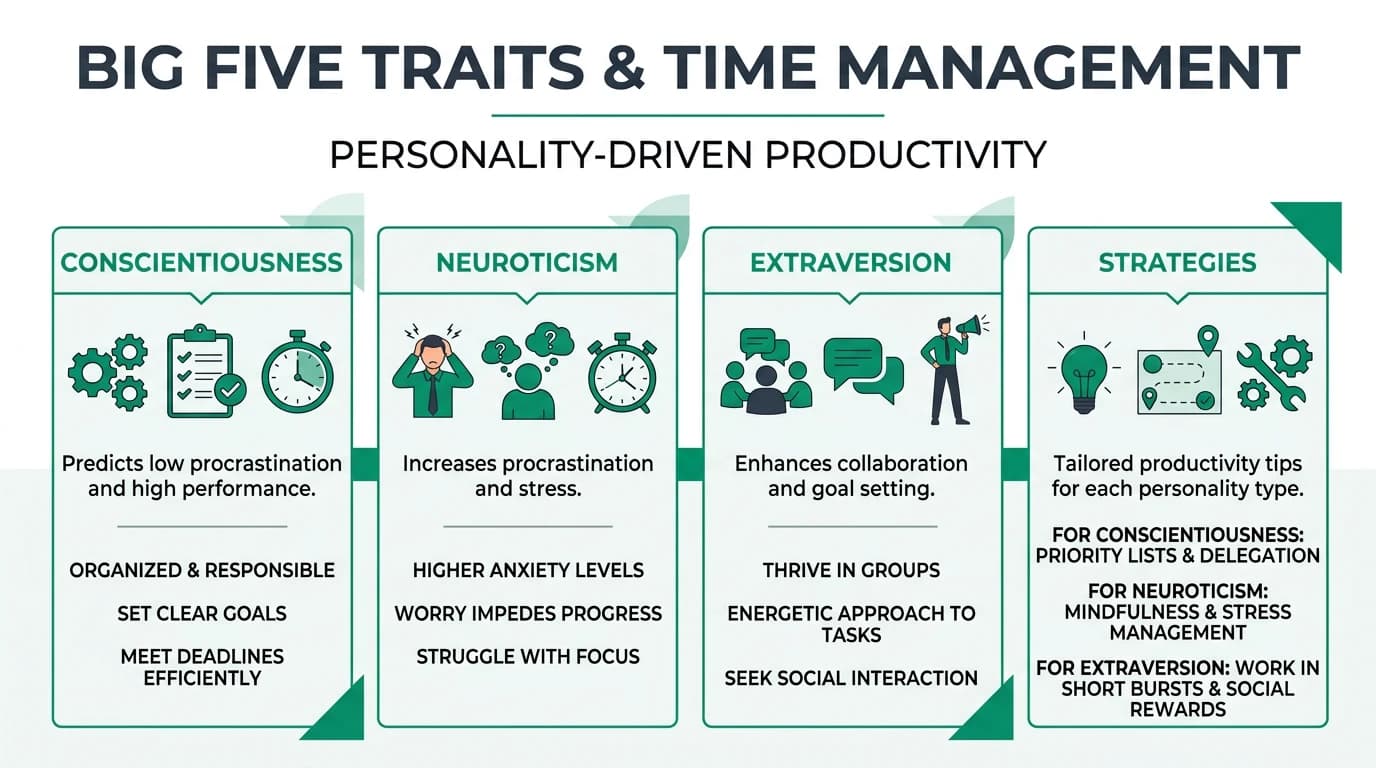
Conscientiousness is the strongest positive predictor of effective time management and low procrastination, while neuroticism is the strongest negative predictor, increasing stress and task avoidance. Extraversion, openness, and agreeableness have moderate or context-dependent effects. Tailoring strategies to your dominant traits can boost productivity by 14 to 17 percent according to regression models.
Source: Frontiers in Psychology (2025)
Key Takeaways
- Conscientiousness is the most powerful personality predictor of effective time management, lower procrastination, and higher academic and job performance across dozens of studies12.
- Neuroticism consistently undermines productivity through emotional instability, decision-making impairment under pressure, and increased procrastination tendencies3.
- Extraversion enhances time management in collaborative settings but may hinder solo deep work without deliberate scheduling adjustments4.
- Openness to experience fuels creative productivity yet can derail routine task completion without structured hybrid approaches2.
- Agreeableness supports team harmony but predicts poor performance under time pressure due to conflict avoidance and indecisiveness3.
- Personality traits explain up to 17 percent of variance in intrinsic motivation and 14 percent of variance in GPA through time management mediation2.
- Generic time management advice fails most people because it ignores personality. Trait-matched strategies produce measurably better outcomes4.
For a deep dive into the trait most tied to productivity, see our conscientiousness complete guide.
Disclaimer: This article summarizes personality psychology research for educational purposes. Personality assessments should complement professional evaluation, not replace it, when clinical or hiring decisions are involved.
Why Personality Shapes Your Productivity
Time management is not a one-size-fits-all skill. Research consistently shows that the Big Five personality traits predict how individuals plan, prioritize, and execute tasks14.
A person high in conscientiousness naturally gravitates toward schedules and checklists. Someone high in openness may thrive with flexible creative blocks but struggle with rigid deadlines. These are not character flaws; they are measurable tendencies rooted in stable personality dimensions.
- The Big Five model (openness, conscientiousness, extraversion, agreeableness, neuroticism) is the most validated framework in personality psychology5.
- Time management mediates the relationship between personality and performance outcomes like GPA and job ratings2.
- Understanding your trait profile allows you to choose tools and strategies that work with your psychology rather than against it.
| Big Five Trait | Productivity Strength | Productivity Risk | Key Strategy |
|---|---|---|---|
| Conscientiousness | Organization, self-discipline, follow-through | Rigidity, burnout from over-planning | Leverage structure; add flexibility breaks |
| Neuroticism | Vigilance, attention to potential problems | Procrastination, stress paralysis | Mindfulness, structured support systems |
| Extraversion | Social accountability, team momentum | Distraction in solo work, over-commitment | Collaborative sprints with solo blocks |
| Openness | Creative problem-solving, adaptability | Poor routine adherence, scattered focus | Hybrid scheduling with creative windows |
| Agreeableness | Team cooperation, low interpersonal friction | Difficulty saying no, deadline slippage | Assertiveness training, firm boundaries |
The sections below unpack each trait with specific data and actionable strategies. For related insights on how personality drives work behavior, explore our workplace motivation guide.
Conscientiousness: The Productivity Powerhouse
Conscientiousness is the single strongest personality predictor of effective time management. High scorers demonstrate superior organization, self-regulation, and task persistence across academic and professional settings12.
In a study of 303 university students, conscientiousness correlated negatively with procrastination (r = −0.45) and positively with GPA (r = +0.50), outperforming all other Big Five traits4. The trait also mediated the relationship between intrinsic motivation and academic achievement, explaining 14 percent of the variance in GPA2.
- Self-regulation is the mechanism: conscientious individuals resist impulses, maintain focus, and follow through on commitments1.
- In unstructured jobs, conscientiousness is the top performance predictor because these individuals impose their own organization5.
- The trait correlates with lower absenteeism, higher task completion rates, and more reliable deadline adherence.
| Conscientiousness Level | Time Management Quality | Procrastination Risk | GPA Correlation | Job Performance |
|---|---|---|---|---|
| High (top quartile) | Excellent: structured routines, proactive planning | Low (r = −0.45) | Strong positive (r = +0.50) | Top performer in unstructured roles |
| Moderate | Good: consistent but less proactive | Moderate | Moderate positive | Reliable in structured environments |
| Low (bottom quartile) | Poor: reactive, inconsistent planning | High (r = +0.40 for linked neuroticism) | Weak or negative | Struggles without external structure |
Strategies for Low-Conscientiousness Individuals
Low scorers are not doomed to poor productivity. External scaffolding can compensate for internal tendencies.
- Externalize planning: use task management apps (Todoist, Notion, Trello) to replace memory-dependent systems.
- Break tasks into micro-goals: 15-minute work blocks with visible progress tracking reduce the activation energy needed to start.
- Accountability partners: weekly check-ins with a colleague or mentor replicate the internal monitoring that high scorers do naturally.
- Gamification: reward systems and streaks leverage the dopamine-driven motivation that low-conscientiousness individuals respond to.
For a comprehensive look at this trait, see our conscientiousness complete guide.
Neuroticism and Time Management Challenges
Neuroticism is the strongest negative predictor of time management effectiveness. High scorers experience more procrastination, greater stress under deadlines, and impaired decision-making when time pressure increases13.
In a dynamic decision-making study, neuroticism predicted poorer performance under pressure with a beta coefficient of −0.31 (p value below .05)3. The emotional instability associated with neuroticism creates a feedback loop: anxiety about deadlines triggers avoidance, which increases time pressure, which amplifies anxiety.
- Procrastination: high-neuroticism individuals delay tasks not from laziness but from fear of failure and perfectionist paralysis1.
- Choking under pressure: in timed tasks, neurotic individuals show the highest performance decrement compared to baseline3.
- Burnout vulnerability: the combination of high neuroticism and demanding deadlines is a well-documented burnout pathway5.
| Neuroticism Metric | Finding | Source |
|---|---|---|
| Decision performance under pressure | β = −0.31 (negative predictor) | Byrne et al., 20153 |
| Procrastination correlation | r = +0.40 (positive, strong) | Al-Mahadin & Abu-Alhija, 20154 |
| Burnout risk in fast-paced roles | Elevated compared to emotionally stable peers | Florida Institute of Technology5 |
| GPA impact | Negative (r = −0.30) | Sorić et al., 20252 |
Coping Strategies for High-Neuroticism Individuals
- Structured mindfulness routines: 10 minutes of daily mindfulness meditation reduces anticipatory anxiety before tasks1.
- Self-esteem building: cross-cultural research shows that positive self-regard buffers the procrastination-neuroticism link1.
- Predictable environments: minimize unexpected demands; high-neuroticism workers perform best with clear expectations and stable routines5.
- Progressive exposure: gradually increasing time pressure in low-stakes settings builds tolerance and reduces choking.
- Support networks: seeking emotional support from colleagues is not weakness; it is a valid coping strategy supported by research.
To learn more about preventing burnout based on your trait profile, read our burnout prevention guide.
Extraversion and Collaborative Productivity
Extraversion positively correlates with time management effectiveness, particularly in group settings where social facilitation drives momentum42.
Extraverts draw energy from interaction, making collaborative planning sessions, team sprints, and accountability groups natural productivity boosters. However, they may struggle with solo deep-work blocks that require sustained internal focus.
- Extraversion correlates positively with goal expectancy and time management quality in student samples4.
- In group tasks, extraverts set the pace and maintain engagement for the entire team5.
- The challenge arises in solo contexts: extraverts may seek social stimulation at the expense of focused output.
| Work Context | Extravert Advantage | Introvert Advantage | Recommended Strategy |
|---|---|---|---|
| Team sprint / brainstorm | High: social energy drives output | Lower: may feel drained | Extraverts lead; introverts contribute async |
| Solo deep work | Lower: craves interaction | High: thrives in solitude | Extraverts schedule 90-min focus blocks with social breaks |
| Deadline crunch | Moderate: motivates others | Moderate: steady under pressure | Mix both for balanced pace |
| Client-facing projects | High: builds rapport quickly | Lower: prefers written communication | Extraverts handle live calls; introverts draft documents |
Strategies for Extraverts
- Body-doubling: work alongside others (in person or virtually) to maintain focus without conversation.
- Social accountability: share daily goals with a colleague each morning and report back at end of day.
- Collaborative planning blocks: schedule weekly team planning sessions to satisfy social needs while driving task alignment.
- Controlled social breaks: replace random socializing with scheduled 10-minute breaks to prevent focus erosion.
For introverts navigating workplace productivity, our introversion workplace guide offers complementary strategies.
Openness to Experience: Creativity Versus Structure
Openness has a complex relationship with productivity. High scorers excel at creative problem-solving and adaptive scheduling but often struggle with repetitive, routine tasks2.
Research shows that openness combined with conscientiousness explains 17 percent of the variance in intrinsic motivation2. When high-openness individuals find their work meaningful, they are exceptionally productive. When tasks feel monotonous, procrastination spikes.
- Creative roles: high openness predicts superior performance in innovation-driven positions5.
- Routine tasks: the same trait predicts lower engagement and higher avoidance in repetitive work2.
- Adaptability: open individuals adjust well to changing priorities, making them valuable in dynamic environments.
| Openness Level | Creative Task Performance | Routine Task Performance | Motivation Variance Explained |
|---|---|---|---|
| High | Excellent: innovative, adaptive | Poor: restless, avoidant | 17% (with conscientiousness)2 |
| Moderate | Good: balanced approach | Adequate: manageable | Moderate |
| Low | Limited: prefers established methods | Strong: consistent, reliable | Lower creative drive |
Strategies for High-Openness Individuals
- Hybrid scheduling: alternate creative blocks (morning brainstorm, design thinking) with structured admin blocks (afternoon emails, reporting).
- Novelty injection: redesign routine tasks periodically (new tools, different sequence, varied environment) to maintain engagement.
- Time-boxing creative exploration: set a hard stop for research and ideation to prevent rabbit-hole procrastination.
- Pair with conscientious partners: delegate tracking and follow-up to detail-oriented colleagues when possible.
Agreeableness and Interpersonal Time Dynamics
Agreeableness supports smooth team interactions but can undermine individual productivity when deadlines demand tough decisions and assertive boundary-setting3.
In decision-making experiments under time pressure, agreeableness predicted performance decline with a beta coefficient of −0.36 (p value below .01), making it the strongest negative predictor in the pressure model3. Agreeable individuals hesitate to push back on unreasonable requests, leading to overcommitment and deadline slippage.
- Conflict avoidance: agreeable people delay difficult conversations (renegotiating deadlines, declining requests), which compounds scheduling problems.
- Over-accommodation: saying yes to every request fragments focus and derails planned priorities.
- Team benefit vs. personal cost: agreeableness predicts higher team satisfaction but lower individual output under time constraints34.
| Agreeableness Level | Team Cooperation | Decision Speed Under Pressure | Personal Productivity Risk |
|---|---|---|---|
| High | Excellent: harmonious, supportive | Slow (β = −0.36) | High: over-commitment, blurred boundaries |
| Moderate | Good: collaborative but can push back | Balanced | Low: healthy assertiveness |
| Low | Challenging: friction-prone | Fast: decisive, direct | Moderate: may alienate teammates |
Strategies for Highly Agreeable Individuals
- Pre-committed boundaries: establish non-negotiable focus blocks in your calendar before requests arrive.
- Assertiveness training: practice scripted refusals ("I can help with that after Thursday's deadline") to build the habit.
- Decision deadlines: set a personal timer for decisions; if undecided after five minutes, default to the higher-priority task.
- Priority frameworks: use Eisenhower matrices to separate genuine urgency from social pressure.
For more on how personality shapes workplace decisions, see our decision-making styles guide.
Procrastination by Personality Profile
Procrastination is not a single behavior but a trait-dependent pattern with different causes and solutions for each Big Five dimension1.
Cross-cultural research across Honduran and Spanish student samples confirms that conscientiousness is the dominant negative predictor of procrastination, while neuroticism is the dominant positive predictor1. The interaction between these two traits is particularly powerful: low conscientiousness combined with high neuroticism creates the highest procrastination risk.
- Conscientiousness: the strongest buffer against procrastination, driven by self-control and organization1.
- Neuroticism: amplifies procrastination through anxiety, avoidance, and impulsivity1.
- Extraversion: weakly protective; social commitments create external deadlines4.
- Openness: negligible direct effect; impacts procrastination only on routine tasks2.
- Agreeableness: indirect effect; may delay personal tasks while prioritizing others' needs3.
| Big Five Trait | Correlation with Procrastination (r) | Correlation with GPA | Primary Mechanism |
|---|---|---|---|
| Conscientiousness | −0.45 (strong negative) | +0.50 (strong positive) | Self-regulation, task persistence |
| Neuroticism | +0.40 (strong positive) | −0.30 (moderate negative) | Anxiety-driven avoidance |
| Extraversion | −0.15 (weak negative) | +0.10 (weak positive) | Social accountability |
| Openness | −0.05 (negligible) | +0.12 (weak positive) | Context-dependent: creative vs. routine |
| Agreeableness | +0.08 (negligible) | +0.05 (negligible) | Indirect via over-accommodation |
Intervention Approach by Risk Profile
- High neuroticism + low conscientiousness (highest risk): combine external structure with emotional regulation. Use apps for planning and mindfulness for anxiety.
- Low conscientiousness + moderate neuroticism: focus primarily on building habits with implementation intentions ("When X happens, I will do Y").
- High neuroticism + high conscientiousness: reduce perfectionism. The planning is there, but anxiety causes paralysis before execution.
- Low across all traits: gamification and social accountability provide the broadest benefit.
Performing Under Time Pressure
Different personality traits produce starkly different outcomes when the clock is ticking. Understanding these patterns helps individuals and managers allocate high-pressure tasks to the right people3.
A regression model incorporating all Big Five traits explained 19 percent of the variance in performance under combined social and time pressure3. Neuroticism and agreeableness emerged as the strongest negative predictors, while conscientiousness provided a moderate protective effect.
| Trait | Effect Under Time Pressure | Beta Coefficient | Practical Implication |
|---|---|---|---|
| Neuroticism | Performance drops sharply (choking) | β = −0.31 | Avoid assigning crisis tasks to high-neuroticism staff |
| Agreeableness | Decision-making slows significantly | β = −0.36 | Pair with decisive partners for urgent decisions |
| Conscientiousness | Performance remains stable or improves | Positive (moderate) | Assign deadline-critical deliverables |
| Extraversion | Thrives under social pressure, mixed under solo pressure | Variable | Best in client-facing crises |
| Openness | Adapts creatively to unexpected constraints | Weak positive | Useful for novel problem-solving under urgency |
Applying This at Work
- Managers: map team members' trait profiles to task types. Assign time-critical deliverables to conscientious, emotionally stable team members.
- Individuals: recognize your pressure response. If you tend to choke, build buffer time into estimates and practice with low-stakes deadlines.
- Teams: implement stress management protocols (breathing exercises, brief stand-ups) before high-pressure sprints.
- Training: role-specific pressure training can reduce choking effects by up to 20 percent in repeated exposure studies.
Workplace Productivity Strategies by Trait
Personality-informed productivity strategies outperform generic advice because they target the specific mechanisms driving each individual's behavior5.
The table below synthesizes research-backed strategies for each trait profile in professional settings. These recommendations draw from both academic studies and applied organizational psychology52.
| Trait Profile | Optimal Work Environment | Key Productivity Strategy | Risk to Monitor |
|---|---|---|---|
| High conscientiousness | Structured roles with clear milestones | Leverage natural planning; add flexibility breaks | Burnout from over-planning and perfectionism |
| Low conscientiousness | Roles with external accountability | External scaffolding: apps, partners, micro-goals | Missed deadlines without support systems |
| High neuroticism | Predictable, supportive settings | Mindfulness routines, stress buffering | Anxiety spirals and avoidance patterns |
| High extraversion | Collaborative, social workplaces | Team sprints, social accountability | Distraction and over-commitment |
| High openness | Innovation-driven, flexible roles | Hybrid scheduling, novelty rotation | Routine task neglect |
| High agreeableness | Cooperative team environments | Boundary-setting protocols, assertiveness | Overcommitment and scope creep |
Organizational Recommendations
- Trait screening in onboarding: use validated Big Five assessments (not for gatekeeping, but for tailored support plans).
- Flexible work design: offer multiple productivity frameworks rather than mandating one system for all employees.
- Early intervention: identify high-neuroticism or low-conscientiousness employees early and provide coaching before performance issues escalate1.
- Manager training: equip leaders to recognize trait-driven behaviors and adjust expectations accordingly.
Self-Assessment Tools
Measuring your Big Five profile is the first step toward personality-informed time management. Several validated instruments are available42.
| Tool | What It Measures | Items | Time to Complete | Best For |
|---|---|---|---|---|
| BFI-44 | Full Big Five profile | 44 items | 10–15 minutes | Comprehensive personal insight |
| BFI-10 | Quick Big Five snapshot | 10 items | 2–3 minutes | Rapid screening, team workshops |
| NEO-PI-R | Big Five with 30 facets | 240 items | 40–60 minutes | Clinical and research use |
| TMQ-25 | Time management quality | 25 items | 5–8 minutes | Pairing with personality data |
| IPIP-50 | Open-source Big Five | 50 items | 12–15 minutes | Free, research-grade assessment |
- Combine a Big Five instrument (BFI-44 or BFI-10) with a time management questionnaire (TMQ-25) for the most actionable results4.
- Online free versions of the BFI and IPIP are available through the International Personality Item Pool.
- Interpret results as tendencies, not fixed labels. Personality shifts gradually over the lifespan, particularly conscientiousness, which increases with age5.
Personality-based productivity action plan
- Complete a Big Five assessment (BFI-44 or BFI-10) to identify your dominant traits.
- Take the TMQ-25 to benchmark your current time management quality.
- Match your trait profile to the strategy tables above and select two to three techniques to implement.
- Set up external scaffolding (apps, accountability partners) if you score low in conscientiousness.
- Practice mindfulness or stress-reduction routines if you score high in neuroticism.
- Schedule a 30-day review to assess which strategies improved your productivity and adjust.
- Share your findings with your manager or team to enable personality-informed task allocation.
FAQ
How does conscientiousness predict time management success?
Conscientiousness enhances time management through self-regulation, organization, and task persistence. It correlates negatively with procrastination (r = −0.45) and positively with GPA (r = +0.50) across multiple studies. Frontiers in Psychology, 2025
What time management strategies work best for people high in neuroticism?
High-neuroticism individuals benefit most from structured mindfulness routines, self-esteem building exercises, predictable work environments, and gradual exposure to time pressure in low-stakes settings. Cross-cultural research validates these approaches across Honduran and Spanish student populations. PubMed Central
Can extraverts be productive when working alone?
Yes, but they need deliberate strategies. Body-doubling (working alongside others silently), scheduled social breaks, and social accountability (sharing daily goals with a partner) help extraverts maintain focus during solo work. Without these, their productivity drops compared to collaborative settings. Richtmann Publishing / JESR
How does openness to experience influence productivity and scheduling?
High openness drives creative productivity and adaptive scheduling but undermines performance on routine tasks. Combined with conscientiousness, openness explains 17 percent of the variance in intrinsic motivation. Hybrid scheduling that alternates creative and structured blocks works best. Frontiers in Psychology, 2025
Why does agreeableness hurt performance under time pressure?
Agreeableness predicts slower decision-making under pressure (β = −0.36) because agreeable individuals avoid conflict and hesitate to make tough calls quickly. This trait also leads to over-accommodation of others' requests, fragmenting personal focus during deadline crunches. Byrne et al., 2015 / PMC
What is the strongest personality predictor of academic success?
Conscientiousness is the strongest Big Five predictor of academic achievement. It outperforms intelligence in some regression models for GPA prediction and mediates the link between motivation and academic outcomes, explaining 14 percent of GPA variance in multi-trait models. Frontiers in Psychology, 2025
How can I assess my personality for better time management?
Use the BFI-44 or BFI-10 for a Big Five profile and the TMQ-25 for time management quality. Combine both results to identify which strategies match your trait profile. Free validated instruments are available through the International Personality Item Pool (IPIP). Richtmann Publishing / JESR
Does personality change over time, and how does that affect time management?
Yes. Conscientiousness increases naturally with age (the maturity principle), meaning time management tends to improve across the lifespan. However, deliberate strategies can accelerate this growth at any age through habit-building and environmental design. Florida Institute of Technology
Primary Sources
| Source | Type | URL |
|---|---|---|
| PubMed Central (PMC) | Peer-reviewed article on procrastination and Big Five | PMC11381604 |
| PubMed Central (PMC) | Peer-reviewed study on personality under pressure | PMC5376094 |
| Florida Institute of Technology | Applied research summary on Big Five and work | FIT Online |
| Richtmann Publishing (JESR) | Peer-reviewed study on time management and personality | JESR Article |
| Frontiers in Psychology | Peer-reviewed study on personality and academic performance | Frontiers 2025 |
Conclusion
Your personality is not a barrier to productivity; it is a blueprint for it. By understanding which Big Five traits drive your time management habits, you can select strategies that leverage your strengths and compensate for your vulnerabilities.
Start with a quick self-assessment using the BFI-10, then match your results to the trait-specific strategies in this guide. The evidence is clear: personality-informed approaches outperform generic productivity advice.
Footnotes
-
Garzón-Umerenkova, A., de la Fuente, J., Amate, J., Paoloni, P. V., Fadda, S., & Pérez, J. F. (2024). Procrastination and the Big Five personality traits: Self-regulation as a mediator in a cross-cultural study. PLoS ONE. https://pmc.ncbi.nlm.nih.gov/articles/PMC11381604/ ↩ ↩2 ↩3 ↩4 ↩5 ↩6 ↩7 ↩8 ↩9 ↩10 ↩11 ↩12 ↩13
-
Sorić, I., Penezić, Z., & Burić, I. (2025). Personality traits and academic performance: The role of time management and intrinsic motivation. Frontiers in Psychology, 16, 1490427. https://www.frontiersin.org/journals/psychology/articles/10.3389/fpsyg.2025.1490427/full ↩ ↩2 ↩3 ↩4 ↩5 ↩6 ↩7 ↩8 ↩9 ↩10 ↩11 ↩12 ↩13 ↩14 ↩15
-
Byrne, K. A., Silasi-Mansat, C. D., & Worthy, D. A. (2015). Who chokes under pressure? The Big Five personality traits and decision-making under pressure. Personality and Individual Differences, 74, 22–28. https://pmc.ncbi.nlm.nih.gov/articles/PMC5376094/ ↩ ↩2 ↩3 ↩4 ↩5 ↩6 ↩7 ↩8 ↩9 ↩10 ↩11 ↩12
-
Al-Mahadin, A. & Abu-Alhija, F. (2015). Time management and personality traits among university students. Journal of Educational and Social Research, 5(3). https://www.richtmann.org/journal/index.php/jesr/article/download/14583/14172/48939 ↩ ↩2 ↩3 ↩4 ↩5 ↩6 ↩7 ↩8 ↩9 ↩10 ↩11
-
Florida Institute of Technology. (2024). How the Big Five personality traits influence work behavior. FIT Online. https://online.fit.edu/degrees/graduate/master-organizational-leadership/how-the-big-five-personality-traits-influence-work-behavior/ ↩ ↩2 ↩3 ↩4 ↩5 ↩6 ↩7 ↩8 ↩9 ↩10