personality-tests
Personality and Burnout Prevention: How Big Five Traits Predict Workplace Exhaustion and Resilience
Explore how the Big Five personality traits can predict burnout and resilience in the workplace, offering insights into prevention strategies.
Quick answer
How do personality traits predict burnout?
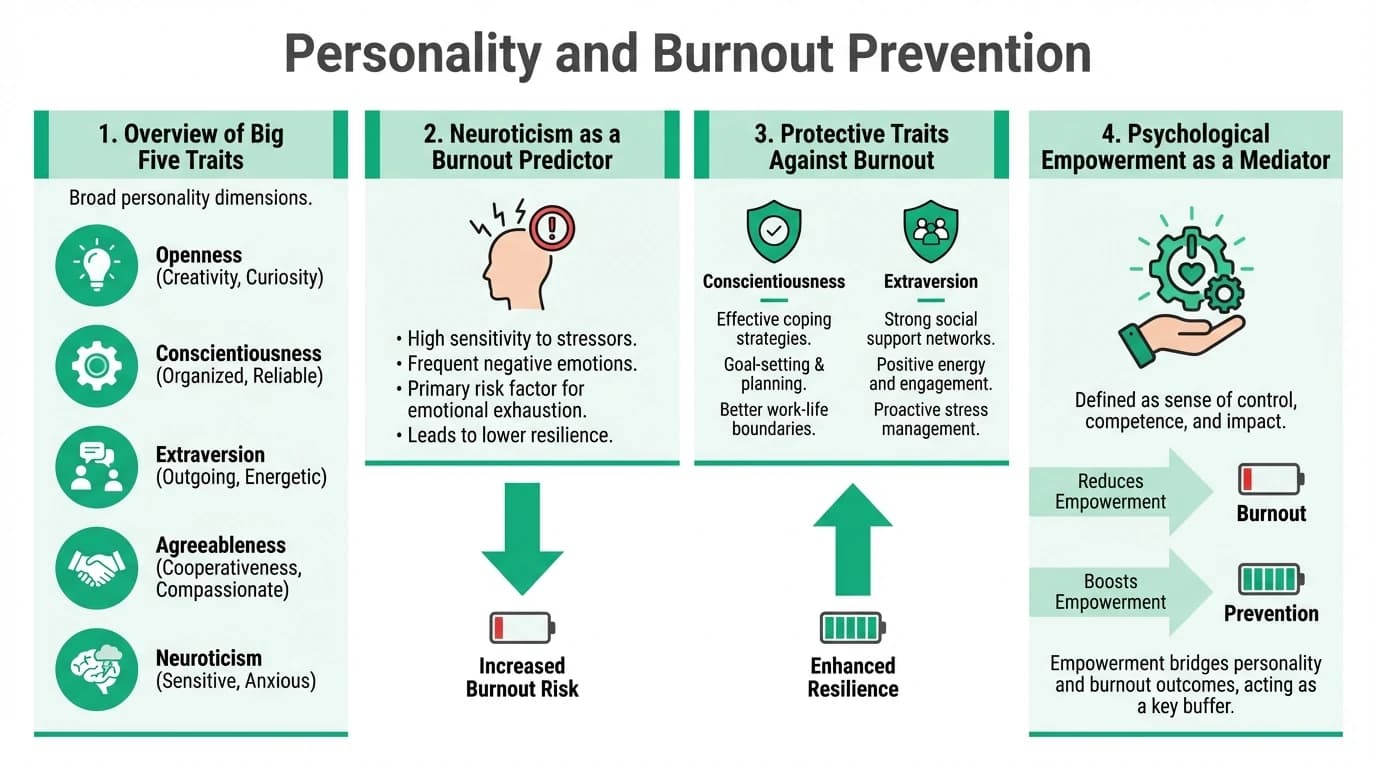
The Big Five traits, especially neuroticism, predict burnout risk, while traits like conscientiousness and extraversion enhance resilience.
Source: Research Synergy Foundation
Executive Summary
The Big Five personality traits are crucial in predicting workplace burnout and resilience. Neuroticism is a strong predictor of burnout, while conscientiousness, extraversion, agreeableness, and openness offer protective benefits.
The bottom line: Understanding these traits can inform strategies to prevent burnout and enhance workplace resilience.
Critical Warning: High neuroticism significantly increases the risk of burnout, necessitating targeted interventions.
What is Burnout?
Burnout is a state of emotional, physical, and mental exhaustion caused by prolonged stress. It often includes:
- Emotional exhaustion: Feeling drained and fatigued.
- Depersonalization: Developing a detached attitude towards work.
- Reduced accomplishment: Feeling ineffective and unproductive.
| Burnout Component | Description |
|---|---|
| Emotional Exhaustion | Chronic fatigue and energy loss |
| Depersonalization | Cynicism and detachment |
| Reduced Accomplishment | Ineffectiveness and low productivity |
The Big Five Personality Traits
The Big Five traits—neuroticism, extraversion, agreeableness, conscientiousness, and openness—are key in understanding burnout.
- Neuroticism: Linked to anxiety and emotional instability.
- Extraversion: Associated with sociability and assertiveness.
- Agreeableness: Involves cooperation and trust.
- Conscientiousness: Relates to organization and dependability.
- Openness: Reflects creativity and open-mindedness.
| Trait | Description |
|---|---|
| Neuroticism | Emotional instability |
| Extraversion | Sociability and assertiveness |
| Agreeableness | Cooperation and trust |
| Conscientiousness | Organization and dependability |
| Openness | Creativity and open-mindedness |
Neuroticism and Burnout Risk
Neuroticism is the strongest predictor of burnout, particularly emotional exhaustion and depersonalization.
- Correlation: Positive with all burnout components.
- Mechanism: Anxiety and insecurity elevate stress.
- Risk: High neuroticism increases vulnerability.
| Trait Level | Pros (Resilience) | Cons (Burnout Risks) | Mitigation Strategies |
|---|---|---|---|
| High Neuroticism | Heightened awareness | Increased stress and anxiety | Stress management and therapy |
| Low Neuroticism | Emotional stability | Complacency risk | Regular self-assessment |
Conscientiousness and Burnout Resistance
Conscientiousness negatively correlates with burnout, offering resilience through disciplined coping.
- Effect: Reduces emotional exhaustion.
- Process: Enhances psychological empowerment.
- Caveat: Gender differences noted in studies.
| Gender | Conscientiousness Effect | Implications |
|---|---|---|
| Male | Moderate resistance | Focus on empowerment |
| Female | Strong resistance | Leverage organizational skills |
Extraversion's Protective Effects
Extraversion is linked to lower burnout through enhanced social support and self-efficacy.
- Effect: Reduces anxiety-related burnout.
- Process: Promotes positive interactions.
- Caveat: Insignificant in some models.
| Trait Level | Burnout Correlation | Self-Efficacy Impact |
|---|---|---|
| High Extraversion | Negative | Positive |
| Low Extraversion | Positive | Neutral |
Agreeableness and Interpersonal Resilience
Agreeableness fosters resilience by enhancing cooperation and reducing depersonalization.
- Effect: Lowers burnout risk.
- Process: Encourages teamwork and trust.
- Caveat: Gender-specific associations.
| Demographic | Trait Mean/Assoc. | Burnout Correlation | Implications |
|---|---|---|---|
| Male | Moderate | Moderate negative | Enhance cooperation |
| Female | High | Strong negative | Leverage empathy |
Openness to Experience and Adaptive Coping
Openness is protective against burnout by promoting creativity and flexibility.
- Effect: Reduces emotional exhaustion.
- Process: Encourages adaptive coping strategies.
- Caveat: Context-dependent effectiveness.
| Trait Level | Burnout Correlation | Adaptive Strategies |
|---|---|---|
| High Openness | Negative | Creative problem-solving |
| Low Openness | Positive | Routine-based coping |
Psychological Empowerment as a Mediator
Psychological empowerment mediates the relationship between personality traits and burnout.
- Mediator: Reduces depersonalization and exhaustion.
- Traits Mediated: Conscientiousness, openness.
- Significance: Proven effectiveness in various models.
| Mediator | Traits Mediated | Effect Significance | Source |
|---|---|---|---|
| Psychological Empowerment | Conscientiousness, Openness | High | RSF Conference Series |
Self-Efficacy Chains in Burnout Prevention
Self-efficacy plays a crucial role in mitigating burnout through confidence-building and empowerment.
- Effect: Lowers burnout risk.
- Process: Boosts resilience and coping.
- Application: Workplace training programs.
| Predictor (Trait/Demo) | Beta Coefficient Range | Significance | N/Sample |
|---|---|---|---|
| Neuroticism | High | Significant | 169 |
| Years Employed | Moderate | Insignificant | 500 |
Measurement Tools for Assessment
Accurate assessment tools are essential for evaluating personality traits and burnout.
- Big Five Inventory: Measures personality traits.
- Burnout Assessment Scale (BAT): Assesses burnout levels.
- Psychological Empowerment Scale: Evaluates empowerment.
| Tool | Purpose | Source |
|---|---|---|
| Big Five Inventory | Personality assessment | NIH |
| Burnout Assessment Scale | Burnout measurement | PLOS ONE |
Action checklist
- Identify high-risk employees using personality assessments.
- Implement targeted interventions for high neuroticism.
- Foster psychological empowerment and self-efficacy.
FAQ
How does neuroticism affect burnout risk?
Can conscientiousness prevent burnout?
What role does extraversion play in burnout prevention?
How can openness to experience help with burnout?
What is psychological empowerment?
How do gender differences affect burnout?
What tools are used to measure burnout and personality?
Notes
Primary Sources
| Source | Type | URL |
|---|---|---|
| Research Synergy Foundation | Conference Paper | RSF Conference Series |
| PLOS ONE | Journal Article | PLOS ONE |
| National Institutes of Health | Research Article | NIH |
Conclusion
Understanding the Big Five personality traits is essential for predicting and preventing burnout. By leveraging traits like conscientiousness and extraversion, organizations can enhance resilience and reduce burnout risk.