personality-tests
Big Five Traits and Workplace Motivation
How each Big Five personality trait drives different workplace motivations, with research-backed strategies for leaders to align roles, goals, and job design to each profile.
Quick answer
How do the Big Five personality traits influence workplace motivation?
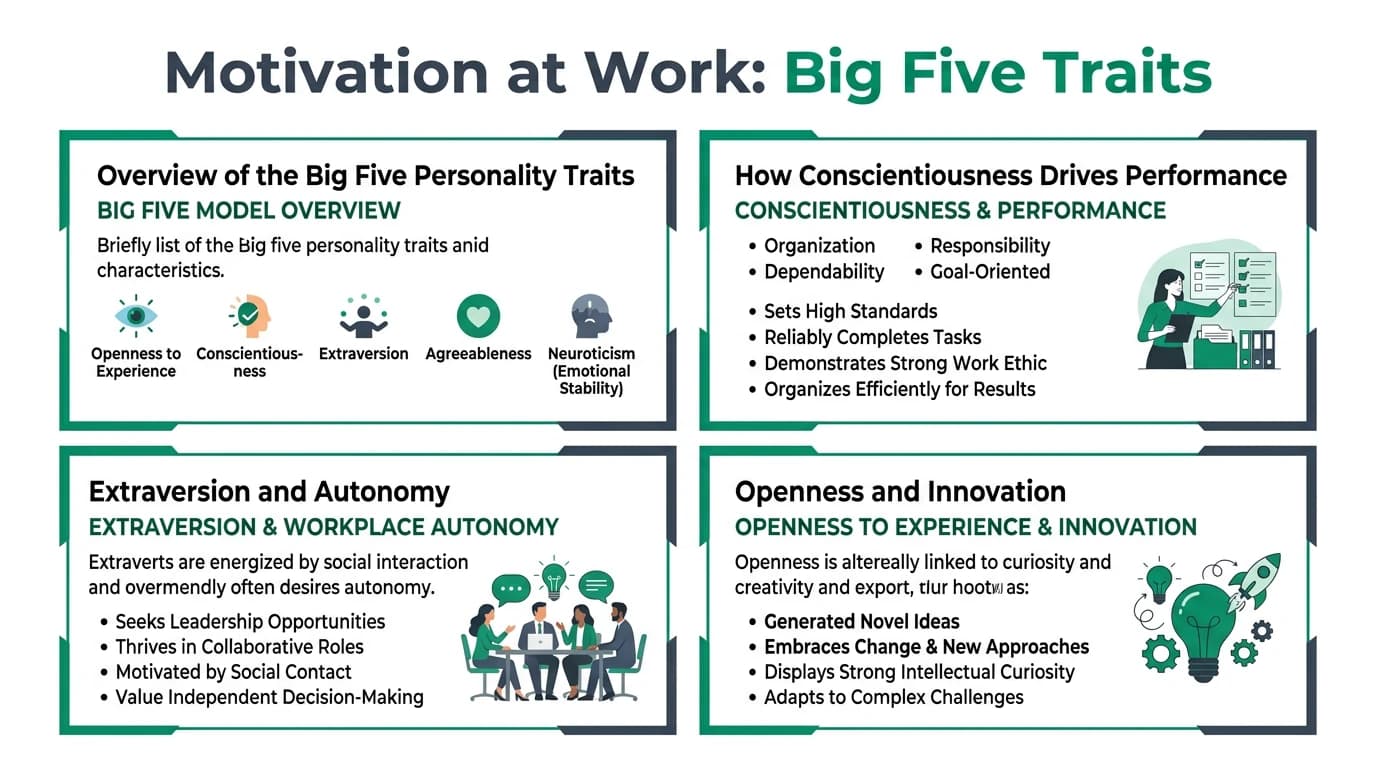
Each Big Five trait activates distinct motivational pathways. Conscientiousness drives achievement and standard-meeting. Extraversion fuels autonomy striving and status seeking. Openness motivates through exploration and complex thinking. Agreeableness drives relationship building and team harmony. Low Neuroticism supports stress resilience and sustained engagement. A 2015 Academy of Management Journal study found all five traits become more predictive of performance in unstructured environments with high job discretion.
Key Takeaways
- Conscientiousness is the only Big Five trait predicting job performance across all job types and levels, making it the universal motivation anchor1.
- Extraversion drives autonomy striving and status motivation; entrepreneurs score significantly higher in extraversion than managers or traditional employees2.
- Openness requires job discretion to activate its motivational potential; rigid processes suppress open individuals' engagement3.
- Agreeableness is identified as the most important Big Five trait for career advancement in relationship-focused research, challenging the assumption that conscientiousness alone drives success4.
- High Neuroticism predicts burnout risk; emotional stability correlates with both job and life satisfaction5.
- High job discretion (not high workload) drives personality development in extraversion, openness, and agreeableness over time3.
- Personality-job mismatches create disengagement; matching trait profiles to job design increases both motivation and retention5.
For strategies on preventing personality-driven burnout, see our burnout prevention guide.
Disclaimer: This article summarizes industrial-organizational psychology research for educational purposes. Workplace motivation involves individual, organizational, cultural, and economic factors beyond personality traits. Consult an organizational psychologist for tailored workplace interventions.
Big Five Traits and Primary Motivational Pathways
Each trait activates a different type of goal striving. Research from the University of Wisconsin-Madison identifies four motivational categories: communion (relationships), status (influence), autonomy (independence), and achievement (standards)3.
| Trait | Primary Motivation | Secondary Motivation | Goal Striving Type | Risk If Unmet |
|---|---|---|---|---|
| Conscientiousness | Meeting standards and targets | Building reputation as dependable | Achievement | Frustration with ambiguous expectations |
| Extraversion | Autonomy and status within the workplace | Social influence and tangible rewards | Status and autonomy | Disengagement in isolated, low-visibility roles |
| Openness | Exploration and complex thinking | Innovation and intellectual freedom | Autonomy | Boredom and disengagement in routine work |
| Agreeableness | Positive relationships and helping others | Team harmony and trust | Communion | Burnout from unreciprocated emotional labor |
| Neuroticism (low stability) | Stress management and predictability | Emotional support and clear processes | Security | Burnout, anxiety, and turnover |
- Motivation is not uniform across personality types. A one-size-fits-all incentive system fails employees whose traits activate different motivational pathways5.
- Understanding these pathways allows leaders to design personalized motivation strategies rather than relying on generic bonuses or recognition programs.
- For how personality shapes decision-making at work, see our decision-making styles guide.
Conscientiousness: The Universal Performance Driver
Conscientiousness is the only Big Five trait with universal predictive power for job performance. A SAGE Encyclopedia of Leadership Studies review confirmed this relationship holds across occupational categories, from entry-level to executive1.
| Performance Context | Conscientiousness Correlation | Comparison | Practical Meaning |
|---|---|---|---|
| All job types and levels | Significant positive predictor | Only trait with universal applicability | Dependable baseline for any role |
| Unstructured environments | Stronger predictor | Becomes more important without rules | Self-direction compensates for lack of structure |
| Complex skill learning | Moderate negative early on | May resist learning new methods initially | Prioritizes proven performance over experimentation |
| Team settings | Positive via reliability | Trust built through consistent delivery | Reduces team coordination costs |
- Conscientious employees are motivated by clear expectations, measurable goals, and recognition for meeting standards.
- They build trust through dependability, which accelerates career advancement in structured organizations.
- The limitation: highly conscientious employees may resist rapid change or complex skill acquisition that temporarily reduces their performance metrics5.
Motivating Conscientious Employees
- Set specific, measurable performance targets with regular progress check-ins.
- Recognize achievement publicly, connecting individual output to team and organizational goals.
- Avoid ambiguous roles with shifting expectations; provide clarity and consistency.
- Gradually introduce change with clear rationale linking new methods to improved outcomes.
Extraversion, Autonomy, and Status Striving
Extraverts are motivated by visibility, social influence, and autonomy in their work. Research shows entrepreneurs score significantly higher in extraversion than managers, supervisors, or traditional employees2.
| Employment Status | Conscientiousness | Openness | Extraversion | Agreeableness | Neuroticism |
|---|---|---|---|---|---|
| Employees | Moderate-High | Moderate | Moderate | Moderate-High | Moderate |
| Supervisors | High | Moderate-High | Moderate | Moderate | Low |
| Managers | High | High | High | Low | Low |
| Entrepreneurs | High | High | High | Moderate | Low |
- Managers show notably low agreeableness combined with high extraversion, reflecting the assertiveness required for directing others2.
- Entrepreneurs combine high extraversion with high openness and low neuroticism, creating a risk-tolerant, socially dominant profile.
- Disengagement in extraverts typically signals insufficient autonomy, visibility, or leadership opportunity rather than dissatisfaction with compensation.
Motivating Extraverted Employees
| Strategy | Implementation | Expected Outcome | Warning Sign If Missing |
|---|---|---|---|
| Leadership opportunities | Cross-team project leads, mentoring roles | Satisfies status striving | Seeks external opportunities |
| Visible impact | Present results to senior leadership | Fulfills social influence need | Disengagement and job searching |
| Collaborative projects | Cross-functional teams, client-facing work | Leverages social energy | Isolation complaints |
| Autonomy in approach | Freedom in how (not what) to accomplish goals | Activates autonomy striving | Micromanagement frustration |
Openness and Innovation-Driven Motivation
Individuals high in openness require job discretion and intellectual challenge to stay engaged. Without autonomy to explore, their intrinsic motivation collapses into disengagement3.
| Job Characteristic | Effect on High Openness | Effect on Low Openness | Job Design Implication |
|---|---|---|---|
| High job discretion | Drives exploration, complex thinking | May feel overwhelmed by ambiguity | Offer structured freedom with clear boundaries |
| Standardized workflows | Suppresses motivation and creativity | Provides comfortable predictability | Avoid forcing rigid processes on open employees |
| Novel challenges | Activates intrinsic motivation | May create anxiety | Match challenge level to openness level |
| Intellectual freedom | Enables innovation and experimentation | Less relevant to motivation | Protect creative time from administrative burden |
- High job discretion drives personality development in openness, meaning the right job design can actually increase creative capacity over time3.
- High workload alone does not produce this development. Autonomy, not intensity, is the mechanism3.
- Open employees are best matched to innovation-focused roles: graphic designers, creative directors, R&D scientists, digital content developers, and strategy consultants5.
Motivating Open Employees
- Provide dedicated time for exploration and creative projects (similar to innovation sprints).
- Shield creative work from interruption-heavy environments.
- Connect creative output to organizational impact to maintain engagement.
- Pair open employees with conscientious partners who can translate ideas into execution.
For how personality drives workplace innovation specifically, see our innovation in the workplace guide.
Agreeableness: The Relationship-Driven Career Accelerator
Research identifies agreeableness as the most important Big Five trait for long-term job success and career advancement, challenging the conventional emphasis on conscientiousness alone4.
| Agreeableness Mechanism | Workplace Outcome | Evidence | Career Implication |
|---|---|---|---|
| Empathy | Productive dialogue without defensiveness | Correlation with emotional intelligence4 | Builds trust with stakeholders |
| Cooperation | Team harmony and reduced conflict | Positive team climate research4 | Accelerates collaborative project success |
| Altruism | Willingness to help beyond role boundaries | Organizational citizenship behavior | Creates reciprocity networks |
| Trust-building | Long-term relationship investment | Career advancement studies4 | Generates sponsorship and mentoring |
- Agreeable employees create harmonious environments that benefit entire teams, not just themselves.
- The risk: high agreeableness can lead to conflict avoidance, boundary erosion, and burnout from excessive emotional labor.
- Leaders should protect agreeable employees from exploitation while leveraging their relationship-building capacity.
Motivating Agreeable Employees
- Assign collaborative projects where their relationship skills create measurable team impact.
- Provide mentoring and coaching roles that satisfy their helping motivation.
- Set clear boundaries around workload to prevent burnout from saying "yes" to everything.
- Recognize relationship contributions, not just task completion metrics.
- For insights on how personality affects feedback reception, see our feedback reception guide.
Neuroticism, Emotional Stability, and Burnout Prevention
High neuroticism is the strongest personality predictor of employee burnout. Emotionally stable employees handle fast-paced change, workplace demands, and interpersonal conflict more effectively5.
| Emotional Stability Level | Job Satisfaction | Life Satisfaction | Stress Management | Burnout Risk |
|---|---|---|---|---|
| High (low neuroticism) | Higher | Higher | Effective | Low |
| Moderate | Average | Average | Adequate with support | Moderate |
| Low (high neuroticism) | Lower | Lower | Difficulty managing emotions | High |
- Neuroticism does not automatically disqualify employees from success. With proper environmental support, neurotic individuals can perform well in roles with clear processes and predictable demands.
- The critical insight: high workload paired with high neuroticism creates the fastest path to burnout5.
- Emotional regulation resources and mentoring reduce the impact of neuroticism on workplace outcomes.
Supporting Emotionally Reactive Employees
| Support Strategy | Mechanism | Implementation | Expected Outcome |
|---|---|---|---|
| Clear processes and expectations | Reduces uncertainty-driven anxiety | Written procedures, regular check-ins | Improved daily functioning |
| Mentoring relationships | Provides emotional support and guidance | Pair with stable, experienced mentor | Reduced isolation and rumination |
| Stress management resources | Builds coping skills | EAP access, mindfulness programs | Lower burnout incidence |
| Predictable scheduling | Removes novelty-based stress | Consistent routines, advance notice of changes | Reduced anxiety spikes |
| Smaller team settings | Limits social overstimulation | Team size under eight, defined roles | More comfortable participation |
Job Discretion as a Personality Development Mechanism
One of the most actionable findings from the MIDUS longitudinal study is that high job discretion drives personality development, while high workload does not3.
| Personality Trait | High Job Discretion Effect | High Workload Effect | Development Implication |
|---|---|---|---|
| Extraversion | Becomes more outgoing and assertive | No similar development | Autonomy drives social confidence growth |
| Openness | Becomes more curious and broadminded | No similar development | Discretion enables intellectual growth |
| Agreeableness | Becomes more helpful and sympathetic | No similar development | Freedom facilitates relationship deepening |
| Conscientiousness | No significant development | No significant development | Relatively stable regardless of job design |
| Neuroticism | No significant development | No significant development | Requires targeted intervention, not job design alone |
- This finding has major implications for talent development. Organizations can grow employees' extraversion, openness, and agreeableness through job design rather than training programs.
- Increasing workload without increasing autonomy produces burnout, not growth.
- Conscientiousness and neuroticism require different interventions: conscientiousness through structured goal-setting and neuroticism through emotional regulation support.
Common Personality-Job Mismatches and Solutions
When personality profiles do not align with job characteristics, predictable problems emerge. Identifying these mismatches early prevents disengagement and turnover5.
| Mismatch Scenario | Personality Profile | Job Characteristic | Problem | Solution |
|---|---|---|---|---|
| Burnout in high-stress role | Low emotional stability | High pressure, fast-paced change | Difficulty managing emotions, higher burnout | Stress resources, mentoring, predictable processes |
| Disengagement in isolated role | High extraversion | Low collaboration, individual contributor | Lacks autonomy, status, social influence | Redesign for cross-team work, visible impact |
| Frustration with rigid processes | High openness | Standardized workflows, low discretion | Cannot explore or think creatively | Increase job discretion, allow process innovation |
| Underperformance in ambiguous role | High conscientiousness | Unclear expectations, no standards | Lacks clarity on performance targets | Provide specific goals, structured feedback |
| Conflict in team settings | Low agreeableness | Highly collaborative, relationship-focused | Difficulty with team harmony | Leverage in assertive roles, pair with agreeable teammates |
Personality-aware motivation action checklist
- Assess team members' Big Five profiles using a validated assessment tool.
- Map each team member's dominant trait to their primary motivational pathway (achievement, status, autonomy, communion, security).
- Audit current job designs for personality-job mismatches using the mismatch table above.
- Increase job discretion for employees high in openness, extraversion, and agreeableness to enable personality development.
- Provide clear, measurable targets for conscientious employees to satisfy achievement motivation.
- Implement burnout prevention resources for employees high in neuroticism, including mentoring and stress management programs.
- Design team activities that accommodate different personality profiles rather than forcing one-size-fits-all engagement.
- Review and adjust motivation strategies quarterly as team compositions and role requirements evolve.
FAQ
Which Big Five trait most strongly predicts job performance?
Conscientiousness is the only Big Five trait that predicts job performance across all job types and levels. A 2015 Academy of Management Journal study found that all Big Five traits become more predictive in unstructured environments, but conscientiousness alone maintains universal predictive power regardless of job context15.
Can personality traits change through job design?
Yes. The MIDUS longitudinal study found that high job discretion drives personality development in extraversion (more outgoing), openness (more curious), and agreeableness (more helpful) over time. High workload alone does not produce these changes. This means organizations can use job design as a personality development tool3.
What personality traits predict entrepreneurial success?
Entrepreneurs score significantly higher than managers or traditional employees in extraversion and achievement motivation. They also show high conscientiousness, high openness, and low neuroticism. This profile reflects a combination of social dominance, risk tolerance, and disciplined execution that differs from the managerial profile (which shows low agreeableness instead)2.
How does neuroticism contribute to workplace burnout?
High neuroticism predicts higher propensity toward employee burnout through difficulty managing emotions, rumination, and vulnerability to stress. Emotionally stable employees (low neuroticism) report higher job and life satisfaction and handle fast-paced change more effectively. Organizations should provide targeted support including stress management resources and predictable scheduling5.
Why does agreeableness predict career advancement?
Agreeableness drives career advancement through empathy, productive dialogue, and relationship investment. Agreeable employees build trust with colleagues and stakeholders, creating reciprocity networks that generate sponsorship and mentoring opportunities. This relationship-driven pathway to advancement operates differently from the achievement-driven pathway associated with conscientiousness4.
How should leaders motivate employees with different personality profiles?
Leaders should match their approach to each employee's dominant trait. High conscientiousness needs clear targets and recognition. High extraversion needs visibility and leadership opportunities. High openness needs intellectual freedom and novel challenges. High agreeableness needs collaborative roles and relationship recognition. Low emotional stability needs structured support and predictable environments5.
Does increasing workload develop employee skills and personality?
No. Research shows that high workload does not produce personality development. Only high job discretion (autonomy in how to accomplish work) drives growth in extraversion, openness, and agreeableness. Increasing workload without autonomy produces burnout rather than development, making job design choices critical3.
What are the best roles for each Big Five trait?
Conscientious employees fit structured, goal-oriented roles across all industries. Extraverts thrive in leadership, sales, and client-facing positions. Open individuals excel in creative, innovation, and strategy roles. Agreeable employees succeed in collaborative, mentoring, and customer-service positions. Emotionally stable individuals handle high-stress, fast-paced environments effectively25.
Notes
Primary Sources
| Source | Type | Key Contribution | URL |
|---|---|---|---|
| University of Wisconsin-Madison (MIDUS) | Peer-reviewed longitudinal study | Job discretion effects on personality development; trait-job characteristic transactions | Link |
| National Institutes of Health (PMC) | Peer-reviewed research | Big Five profiles across employment statuses; entrepreneur vs. manager personality | Link |
| Florida Institute of Technology | Educational resource | Conscientiousness and performance; neuroticism and burnout; unstructured environments | Link |
| Michigan State University Online | Educational resource | Leadership applications of Big Five; team motivation strategies | Link |
| SAGE Encyclopedia of Leadership Studies | Academic reference | Big Five traits and job performance relationships across occupations | Link |
Conclusion
Workplace motivation is not uniform. Each Big Five personality trait activates a distinct motivational pathway, and what energizes one employee may drain another. Conscientiousness drives achievement-oriented motivation universally. Extraversion fuels status and autonomy seeking. Openness demands intellectual challenge. Agreeableness builds careers through relationships. Emotional stability sustains engagement under pressure.
The most actionable insight from this research is the role of job discretion. Increasing autonomy develops employees' personality traits over time, while increasing workload without autonomy accelerates burnout. Leaders who understand this distinction can design jobs that simultaneously improve performance and grow their people.
Match the role to the person. Match the motivation strategy to the trait. Build systems that accommodate personality diversity rather than demanding conformity.
Footnotes
-
SAGE Encyclopedia of Leadership Studies. "Big Five Personality Traits." Available at: https://sk.sagepub.com/ency/edvol/the-sage-encyclopedia-of-leadership-studies/chpt/big-five-personality-traits ↩ ↩2 ↩3
-
National Institutes of Health (PMC). "Big Five Personality Traits Across Employment Statuses." Available at: https://pmc.ncbi.nlm.nih.gov/articles/PMC10089283/ ↩ ↩2 ↩3 ↩4 ↩5
-
University of Wisconsin-Madison. "Transactions Between Big-5 Personality Traits and Job Characteristics Across 20 Years (MIDUS Study)." Available at: https://midus.wisc.edu/findings/pdfs/2277.pdf ↩ ↩2 ↩3 ↩4 ↩5 ↩6 ↩7 ↩8 ↩9 ↩10
-
Michigan State University Online. "Lead Your Team with the Big Five Model." Available at: https://www.michiganstateuniversityonline.com/resources/leadership/lead-your-team-with-big-five-model/ ↩ ↩2 ↩3 ↩4 ↩5 ↩6
-
Florida Institute of Technology. "How the Big Five Personality Traits Influence Work Behavior." Available at: https://online.fit.edu/degrees/graduate/master-organizational-leadership/how-the-big-five-personality-traits-influence-work-behavior/ ↩ ↩2 ↩3 ↩4 ↩5 ↩6 ↩7 ↩8 ↩9 ↩10 ↩11 ↩12 ↩13