personality-tests
Cultural Bias and Fairness in Personality Testing: Global HR and Coaching Best Practices
Explore how cultural bias affects personality testing, including response styles, translation challenges, and norms across countries. Learn best practices for fair global HR and coaching applications.
Quick answer
What is cultural bias in personality testing?
Cultural bias occurs when tests developed on Western values fail to align with other cultures' beliefs, behaviors, and response styles, leading to inaccurate trait measurement; mitigation involves adaptation beyond translation and norm adjustments.
Source: RefHub
Executive Summary
Cultural bias in personality testing often leads to unfair outcomes due to differences in response styles, flawed translations, and non-representative norms. These biases can affect hiring, coaching, and evaluations in global HR settings. Understanding these challenges is crucial for fair and effective personality assessments across different cultures.
The bottom line: Cultural bias in personality tests can lead to discrimination and invalid decisions. It's essential to adapt tests beyond simple translation to ensure fairness.
Critical Warning: Failing to address cultural bias in personality testing can result in legal issues and discrimination claims in diverse workplaces.
What is Cultural Bias in Personality Testing?
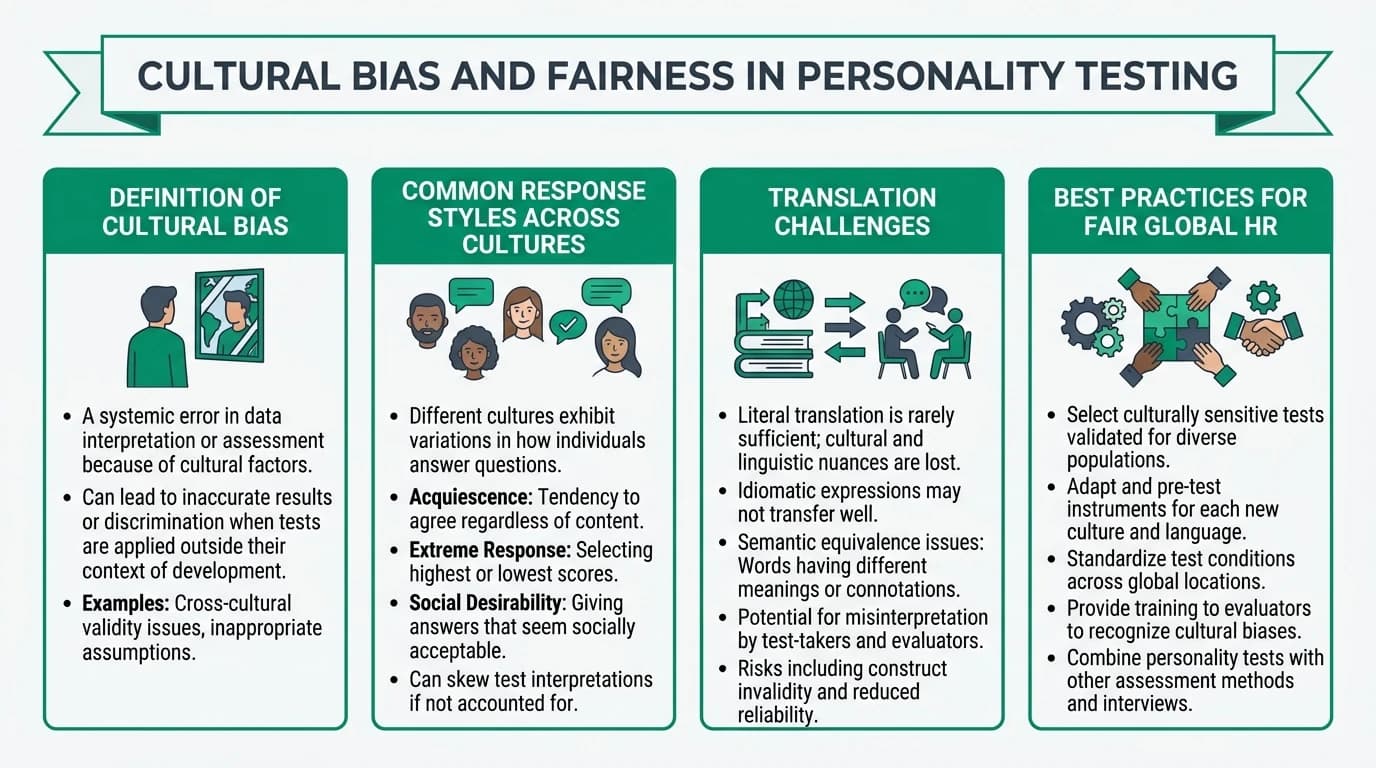
Cultural bias happens when personality tests developed in one cultural context don't translate well to others. This can skew results and lead to unfair assessments.
Key Factors of Cultural Bias
- Western-centric Development: Tests often reflect Western values, which may not align with other cultures.
- Translation Issues: Direct translations can miss cultural nuances, leading to misunderstandings.
- Response Styles: Different cultures may prefer extreme or neutral responses, affecting scores.
| Factor | Description | Impact |
|---|---|---|
| Western-centric | Focus on individualism | Misalignment with collectivist cultures |
| Translation | Misses cultural nuances | Skewed results |
| Response Styles | Varies by culture | Distorted scores |
How Do Response Styles Differ Across Cultures?
Response styles refer to the way people answer test questions, which can vary significantly across cultures.
Common Response Styles
- Extreme Responding: Strong agreement or disagreement.
- Neutral Responses: Preference for middle options.
- Acquiescence: Tendency to agree with statements.
- Halo Bias: Consistently positive ratings.
- Social Desirability: Answering in socially acceptable ways.
| Style | Example Culture | Effect |
|---|---|---|
| Extreme | US | Inflated scores |
| Neutral | Japan | Underestimation of traits |
| Acquiescence | Various | Overestimation of agreeableness |
Why is Translation Not Enough for Global Personality Tests?
Simply translating a test into another language doesn't ensure cultural fairness.
Translation Challenges
- Idiomatic Expressions: Phrases like "feeling blue" don't translate directly.
- Linguistic Equivalence: Ensuring words carry the same meaning across languages.
| Issue | Example | Solution |
|---|---|---|
| Idioms | "Feeling blue" | Use culturally relevant expressions |
| Meaning Shift | "Assertive" | Back-translation to check accuracy |
What are Cross-Country Norms in Personality Testing?
Norms are average scores used as benchmarks. They must reflect the population being tested to ensure fairness.
Importance of Cross-Country Norms
- Avoids Western Bias: Ensures non-Western groups are accurately represented.
- Reflects Real Differences: Distinguishes between actual cultural traits and artifacts.
| Benefit | Description |
|---|---|
| Fair Representation | Avoids misrepresentation of traits |
| Accurate Benchmarks | Reflects true cultural differences |
What is the Reference Group Effect?
The reference group effect occurs when individuals rate themselves based on their cultural norms rather than an absolute scale.
Impact on Testing
- Self-Report Biases: Ratings are influenced by cultural standards.
- Third-Person Modifications: Using third-person questions can reduce bias.
| Effect | Description | Solution |
|---|---|---|
| Self-Report Bias | Cultural influence on ratings | Third-person questions |
| Cultural Standards | Varying norms | Local norming studies |
Are Big Five Traits Universal Across Countries?
The Big Five personality traits are generally considered universal, but cultural differences can affect their expression.
Cross-Cultural Validity
- Convergent Validity: Some traits like extraversion show strong cross-cultural correlations.
- Cultural Adaptations: Adjustments may be needed for traits like openness.
| Trait | Convergent r | Cultures |
|---|---|---|
| Extraversion | 0.4 | Various |
| Openness | -0.27 | Varies |
How to Ensure Fairness in Global HR and Coaching?
Best practices involve adapting tests to account for cultural differences and ensuring fairness.
Best Practices
- Local Norming: Develop norms specific to each culture.
- Validation Testing: Regularly test for cultural fairness.
- Culturally Competent Adaptations: Modify tests to reflect cultural values.
| Practice | HR Application | Evidence Source |
|---|---|---|
| Local Norming | Fair hiring | RefHub |
| Validation Testing | Accurate evaluations | Maricopa Open |
Action Checklist
- Review test translations for cultural relevance.
- Conduct local norming studies for accurate benchmarks.
- Implement validation testing for fairness.
FAQ
What causes cultural bias in personality assessments?
How do response styles differ across cultures in surveys?
Why is translation not enough for global personality tests?
What is the reference group effect in personality ratings?
Are Big Five traits universal across countries?
How to adjust personality test norms for different countries?
What are examples of culturally specific personality tests?
Notes
Primary Sources
| Source | Type | URL |
|---|---|---|
| RefHub | Industry blog | https://www.refhub.com.au/post/understanding-cross-cultural-differences-in-personality-testing |
| Maricopa Open | Academic text | https://open.maricopa.edu/culturepsychology/chapter/five-factor-model-and-cross-cultural-research/ |
| Replication Index | Peer-reviewed analysis | https://replicationindex.com/2020/08/28/cross-cultural-comparisons-of-personality-beware-of-method-factors/ |
Conclusion
Cultural bias in personality testing poses significant challenges for global HR and coaching. By understanding and addressing these biases, organizations can ensure fair and effective assessments. Implementing best practices like local norming and validation testing is crucial for achieving cultural fairness.