personality-tests
Personality and Risk-Taking: How Big Five Traits Shape Decisions Under Uncertainty
Explore how the Big Five personality traits influence risk-taking in finance, career, and everyday life. Discover who takes risks and who avoids them, with clear examples.
Quick answer
Which Big Five traits predict risk-taking?
High extraversion and low conscientiousness strongly predict risk-taking, with openness also playing a role.
Source: LSU Honors Thesis
Executive Summary
- Quick Answer: High extraversion and low conscientiousness are key predictors of risk-taking. Openness also influences decisions under uncertainty.
- Why It Matters: Understanding these traits can guide better financial, career, and everyday decisions.
The bottom line: Personality traits like extraversion and conscientiousness significantly influence risk-taking behaviors.
Critical Warning: Correlations do not imply causation. Individual variations exist, and decisions should consider personal circumstances.
What Are the Big Five Personality Traits?
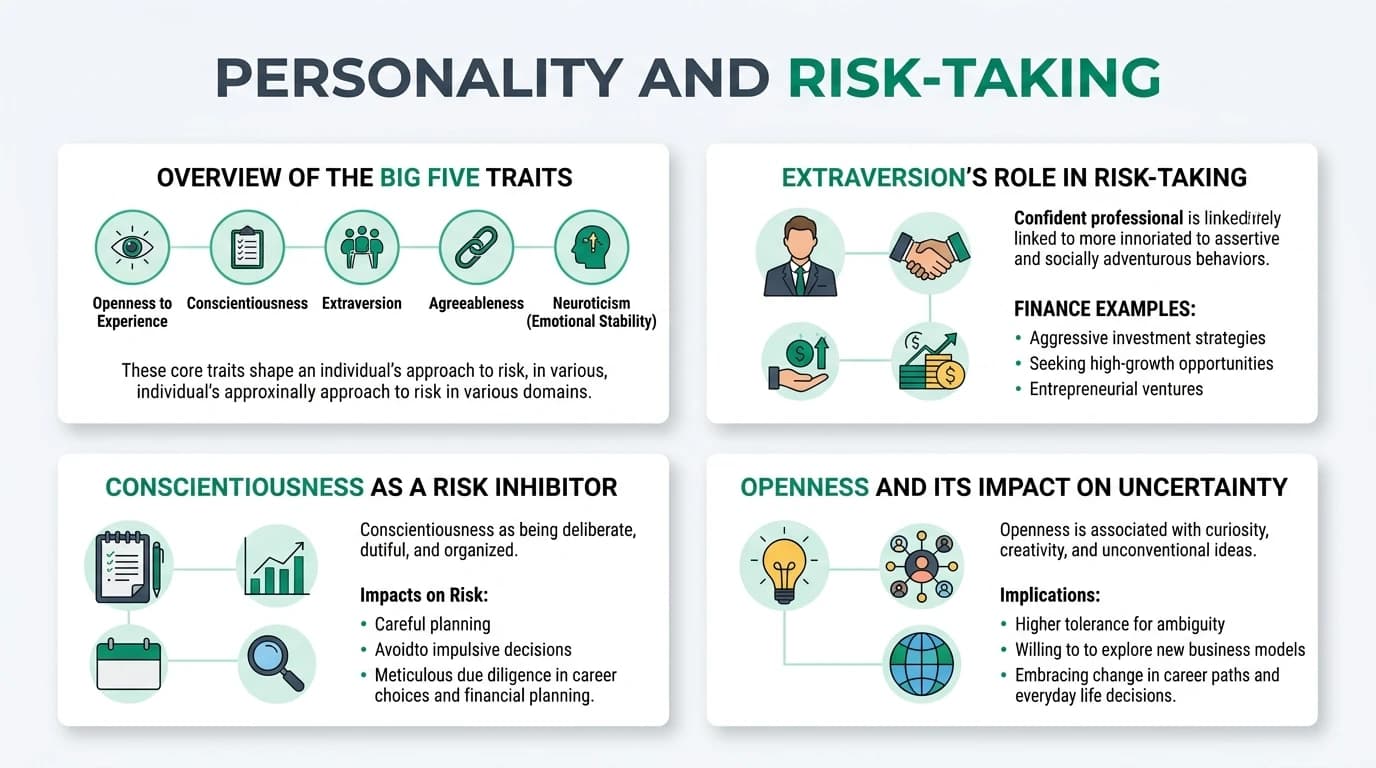
The Big Five personality traits are a widely accepted model in psychology. They include:
- Openness: Creativity and willingness to try new things.
- Conscientiousness: Organization and dependability.
- Extraversion: Sociability and energy.
- Agreeableness: Compassion and cooperation.
- Neuroticism: Emotional instability and moodiness.
These traits influence how we make decisions, especially under uncertainty.
How Does Extraversion Influence Risk-Taking?
Extraversion is strongly linked to risk-taking behaviors. Here's why:
- Sociability: Extraverts thrive in social settings, often seeking excitement.
- Assertiveness: They are more likely to take charge, even in risky situations.
- Energy: This trait drives them toward adventurous activities.
| Trait | Risk Link | Key Facets |
|---|---|---|
| Extraversion | Primary predictor | Sociability, assertiveness, energy |
Example: An extravert might actively trade stocks, enjoying the thrill and social interaction it brings.
Why Is Conscientiousness a Risk Inhibitor?
Conscientiousness often leads to risk aversion. Here's how:
- Responsibility: High conscientiousness means careful planning and risk assessment.
- Dependability: These individuals prefer stable, predictable environments.
| Trait | Risk Link | Key Facets |
|---|---|---|
| Conscientiousness | Risk inhibitor | Responsibility, dependability |
Example: A conscientious person may avoid risky investments, opting for stable financial plans.
Openness to Experience and Uncertainty
Openness to experience is associated with novelty-seeking and risk-taking:
- Creativity: Openness encourages exploring new opportunities.
- Curiosity: A desire to learn can lead to calculated risks.
| Trait | Risk Link | Key Facets |
|---|---|---|
| Openness | Correlates with risk | Creativity, curiosity |
Example: Someone high in openness might pursue a career in a startup, driven by innovation.
Agreeableness and Risk Behavior
Agreeableness shows mixed results in risk-taking:
- Compassion: High agreeableness may avoid risks that affect others negatively.
- Respectfulness: Lower respectfulness can lead to domain-specific risks.
| Trait | Risk Link | Key Facets |
|---|---|---|
| Agreeableness | Mixed | Compassion, respectfulness |
Example: An agreeable person might avoid confrontational business decisions, prioritizing harmony.
Does Neuroticism Affect Risk-Taking?
Neuroticism's link to risk-taking is less direct:
- Emotional Instability: May lead to avoiding risks due to fear of negative outcomes.
- Anxiety: Can result in cautious decision-making.
| Trait | Risk Link | Key Facets |
|---|---|---|
| Neuroticism | Limited link | Emotional instability, anxiety |
Example: A neurotic individual might shy away from extreme sports due to fear of injury.
Real-World Applications: Finance, Career, Everyday Life
Finance
- High Extraversion: Likely to engage in high-risk investments like stocks.
- Low Conscientiousness: May neglect detailed financial planning.
Career
- High Openness: Pursues innovative career paths, like entrepreneurship.
- Low Agreeableness: Willing to take career risks that might affect team dynamics.
Everyday Life
- High Conscientiousness: Prefers routine and safety in daily activities.
- High Extraversion: Enjoys social adventures and new experiences.
| Scenario | High Risk-Taker | Low Risk-Taker |
|---|---|---|
| Finance | Extraverted trader | Conscientious planner |
| Career | Open entrepreneur | Agreeable team player |
| Everyday | Adventurous traveler | Routine follower |
Incremental Validity: Beyond the Big Five
Risk-taking has its distinctiveness:
- Discriminant Validity: Risk-taking behaviors are separate from Big Five facets.
- Predictability: Does not significantly add to predictions beyond Big Five traits.
| Measure | Big Five Link | Incremental Validity |
|---|---|---|
| GRiPS | Strong | Limited |
| DOSPERT | Moderate | Limited |
Key Takeaways
- Extraversion and low conscientiousness are major predictors of risk-taking.
- Openness encourages taking calculated risks.
- Agreeableness and neuroticism show more nuanced effects.
Action checklist
- Identify your dominant Big Five traits.
- Consider how these traits influence your decision-making.
- Apply this understanding to improve financial, career, and everyday choices.
FAQ
Which Big Five trait is most linked to risk-taking?
Do introverts take fewer risks than extraverts?
How does low conscientiousness affect financial decisions?
Is openness to experience tied to career risks?
What personality avoids risks in everyday life?
Can Big Five traits predict investment risk?
Does neuroticism increase or decrease risk-taking?
Notes
Primary Sources
| Source | Type | URL |
|---|---|---|
| LSU Honors Thesis | Peer-reviewed | LSU Thesis PDF |
| European Journal of Psychological Assessment | Peer-reviewed | Hogrefe Journal |
Conclusion
Understanding how the Big Five personality traits influence risk-taking can help you make informed decisions in finance, career, and everyday life. By recognizing your dominant traits, you can navigate uncertainties more effectively.