personality-tests
Big Five Traits & Entrepreneurship Success
Which Big Five personality traits predict startup success? Evidence-based guide covering conscientiousness, extraversion, openness, and context-dependent profiles.
Quick answer
Which Big Five traits predict entrepreneurship success?
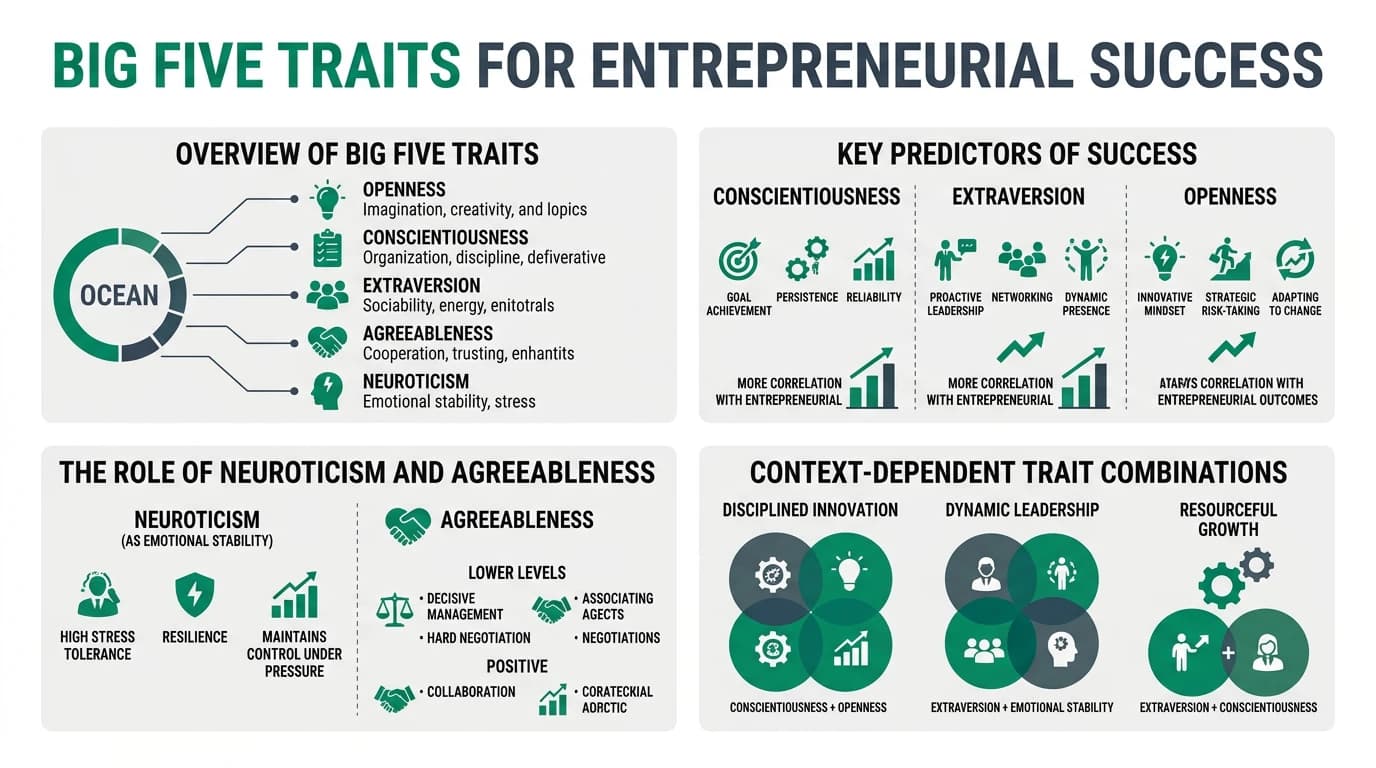
Conscientiousness, extraversion, and openness are the three strongest predictors. A 2023 PNAS study of over 2,000 technology founders found that founders score higher on openness and extraversion — and lower on agreeableness — than matched non-founders. However, the optimal trait profile varies by venture type and growth stage.
Source: PNAS
Executive Summary
Entrepreneurship is not reserved for a single personality type. But decades of research confirm that certain Big Five trait profiles appear more often — and perform better — in founder populations than in the general workforce.
A 2023 PNAS study of technology startup founders found that personality traits explained a significant portion of the variance in venture creation and survival, even after controlling for education, work experience, and industry 1. Conscientiousness, extraversion, and openness consistently emerge as the strongest predictors.
The bottom line: Personality does not guarantee startup success, but it shapes the behaviors — risk tolerance, networking, persistence — that drive it. Knowing your trait profile helps you hire complementary co-founders and build the right support structures.
Critical: Using personality tests as the sole criterion for founder selection or investor screening is both scientifically unsupported and ethically problematic. Traits interact with context, skills, and market conditions.
The Big Five Model in an Entrepreneurial Context
The Big Five — Openness, Conscientiousness, Extraversion, Agreeableness, and Neuroticism — captures personality on five continuous dimensions. Each dimension has distinct implications for the entrepreneurial journey.
| Dimension | Entrepreneurial advantage | Entrepreneurial risk | Effect size 1 |
|---|---|---|---|
| Openness | Innovation, opportunity recognition | Shiny-object syndrome, scattered focus | Medium-large |
| Conscientiousness | Execution, discipline, longevity | Over-planning, slow pivoting | Large |
| Extraversion | Networking, fundraising, sales | Over-commitment, burnout from social demands | Medium |
| Agreeableness | Team cohesion, partnership building | Difficulty with hard decisions (firing, negotiating) | Small-negative |
| Neuroticism | Early risk detection, vigilance | Decision paralysis, founder burnout | Medium-negative |
- Key insight: No single trait predicts success alone. It is the profile — the combination of all five — that matters.
- Common error: Equating "low Agreeableness" with "rude." In research, low Agreeableness reflects assertiveness and comfort with competitive dynamics, not interpersonal hostility.
For a full introduction to the Big Five model, see our Big Five complete guide.
Conscientiousness: The Execution Engine
Conscientiousness is the single most consistent predictor of entrepreneurial performance across meta-analyses 2. High-Conscientiousness founders are more likely to create business plans, hit milestones, and sustain operations over time.
| Facet | Founder behavior | Venture impact |
|---|---|---|
| Achievement striving | Sets aggressive targets and tracks KPIs | Revenue growth |
| Self-discipline | Works through setbacks without external pressure | Survival past year 3 |
| Deliberation | Analyzes decisions before committing resources | Fewer costly pivots |
| Orderliness | Builds systems and documentation early | Scalability |
- The persistence paradox: Very high Conscientiousness can lead founders to persist in failing ventures too long. Research calls this "escalation of commitment" — the tendency to double down on a losing strategy because quitting feels like a personal failure 2.
- Practical mitigation: Set pre-defined "kill criteria" for ventures (e.g., "If we don't reach 100 paying users by month 12, we pivot or shut down"). This externalizes the decision, reducing the emotional cost of quitting.
Important: Conscientiousness predicts venture survival better than venture growth. For hypergrowth, openness and extraversion become more important.
Extraversion: The Growth Catalyst
Extraverted founders excel at the high-interaction demands of entrepreneurship: pitching investors, recruiting talent, building partnerships, and selling to early customers.
| Extraversion facet | Entrepreneurial application | Evidence |
|---|---|---|
| Assertiveness | Pitch competitions, investor negotiations | Positive link to funding success 1 |
| Gregariousness | Community building, networking events | Larger professional networks |
| Positive emotions | Team morale, founder resilience | Lower burnout risk |
| Activity level | High output across multiple domains | More hours worked per week |
- Introvert founders can succeed. Introversion is not a disqualifier. Introverted founders often compensate through conscientiousness, written communication, and strategic networking. Notable examples include Bill Gates and Larry Page.
- The energy trade-off: Extraverted founders risk over-committing to external events at the expense of deep work. Balance synchronous networking with asynchronous execution blocks.
For more on how personality shapes leadership style, see our leadership personality guide.
Openness: The Innovation Driver
Openness to experience predicts opportunity recognition — the ability to spot unmet needs and novel solutions that others miss. High-Openness founders are more likely to enter new markets and create disruptive products 3.
| Openness facet | Startup application | When it becomes a risk |
|---|---|---|
| Imagination | Product vision, creative marketing | Over-engineering, feature creep |
| Intellectual curiosity | Technology exploration, R and D investment | Chasing trends instead of executing |
| Preference for variety | Pivoting, exploring adjacent markets | Lack of focus, diluted resources |
| Aesthetic sensitivity | Brand design, UX quality | Over-investing in polish before product-market fit |
- Best pairing: High Openness combined with high Conscientiousness creates the ideal innovation-plus-execution profile. If one founder has both, great. If not, co-founder complementarity is critical.
- Industry effect: Openness matters more in creative and technology sectors than in franchise or service businesses where proven models dominate.
Agreeableness: The Double-Edged Trait
Research consistently finds that entrepreneurs score lower on Agreeableness than the general population 1. This is not necessarily a character flaw — it reflects comfort with competitive dynamics, willingness to negotiate hard, and ability to make unpopular decisions.
| Scenario | High Agreeableness | Low Agreeableness |
|---|---|---|
| Salary negotiation | Accepts early offers | Pushes for better terms |
| Firing underperformers | Delays, hopes for improvement | Acts decisively |
| Investor terms | Accepts standard deal | Negotiates aggressively |
| Co-founder conflict | Avoids confrontation | Addresses issues directly |
| Customer complaints | Over-accommodates | Sets boundaries |
- Context matters: In social enterprises, B2B partnerships, and collaborative industries, higher Agreeableness can be an advantage. It builds trust and long-term relationships.
- Team balance: If the founding team is entirely low-Agreeableness, internal conflicts escalate. At least one team member should score higher to serve as a relational anchor.
For negotiation strategies by personality type, see our negotiation style guide.
Neuroticism: Managing Emotional Volatility
High Neuroticism is the trait most negatively associated with entrepreneurial outcomes. The uncertainty, financial stress, and rejection inherent in startups amplify anxiety and emotional reactivity 2.
| Neuroticism impact | Mechanism | Mitigation strategy |
|---|---|---|
| Decision paralysis | Overthinking risks | Set decision deadlines and frameworks |
| Founder burnout | Chronic stress without recovery | Structured downtime, coaching |
| Team contagion | Leader anxiety spreads to team | Emotional regulation training |
| Risk aversion | Avoiding necessary bets | Pre-mortem exercises to rationalize risk |
- The vigilance upside: Moderate Neuroticism can help founders detect risks earlier. Completely fearless founders sometimes ignore warning signs. The key is channeling worry into productive risk management rather than paralysis.
- Founder mental health: Studies show that founders experience depression at 2x the rate of the general population. Personality is one factor — but environmental stressors (fundraising, isolation, uncertainty) compound it. Build support systems early.
Context-Dependent Trait Profiles
The "ideal" personality profile shifts depending on venture type, growth stage, and industry. One size does not fit all.
| Venture context | Primary traits | Secondary traits | Key challenge |
|---|---|---|---|
| Tech startup (early stage) | Openness, Extraversion | Conscientiousness | Moving from vision to execution |
| Bootstrapped SaaS | Conscientiousness, low Neuroticism | Openness | Staying disciplined without external pressure |
| Social enterprise | Agreeableness, Openness | Conscientiousness | Balancing mission with financial sustainability |
| Franchise | Conscientiousness, low Openness | Extraversion | Following systems, not reinventing them |
| International expansion | Openness, Extraversion | low Neuroticism | Adapting to cultural differences and uncertainty |
| Turnaround / restructuring | low Agreeableness, low Neuroticism | Conscientiousness | Making hard decisions under pressure |
- Stage transitions: The traits that get a venture started (Openness, Extraversion) are not the same traits that scale it (Conscientiousness, low Neuroticism). This is why many founders struggle at the transition from product-market fit to operational scaling.
- Co-founder complementarity: The most resilient founding teams cover the full Big Five spectrum. If you are high-Openness / low-Conscientiousness, find a co-founder who is the opposite.
For more on how personality drives innovation in the workplace, see our innovation guide.
Beyond the Big Five: Complementary Traits
The Big Five is the most validated framework, but entrepreneurship research also highlights traits that sit outside (or within facets of) the five-factor model.
| Trait | Relationship to Big Five | Entrepreneurial relevance |
|---|---|---|
| Self-efficacy | Facet of Conscientiousness | Confidence to start and persist |
| Internal locus of control | Inversely related to Neuroticism | Belief in ability to shape outcomes |
| Need for achievement | Facet of Conscientiousness | Drive to set and hit ambitious goals |
| Risk propensity | Inversely related to Neuroticism | Comfort with financial uncertainty |
| Proactive personality | Blend of Extraversion and Conscientiousness | Tendency to create change rather than react |
- Practical use: If your Big Five profile does not look "entrepreneurial," these complementary traits may still indicate strong founder potential. Use multiple assessment tools, not just one.
Action checklist
- Take a validated Big Five assessment and review your scores across all five dimensions.
- Map your profile against the venture context table to identify strengths and gaps.
- Identify co-founder or early-hire profiles that complement your weaknesses.
- Set pre-defined kill criteria for your venture to counter escalation-of-commitment bias.
- Build a founder support system (coach, peer group, mental health professional) before you need one.
- Reassess your trait-venture fit annually as your startup evolves through growth stages.
FAQ
Which Big Five trait is most important for entrepreneurs?
Can introverts succeed as entrepreneurs?
Is low Agreeableness necessary for startup success?
How does Neuroticism affect founders?
Should investors use personality tests to screen founders?
Do personality traits change as a startup grows?
What is the best personality profile for a co-founder team?
How reliable are personality assessments for predicting startup outcomes?
Notes
Primary Sources
| Source | Type | URL |
|---|---|---|
| Brattström et al. (2023) — PNAS | Peer-reviewed journal | pnas.org/doi/10.1073/pnas.2215829120 |
| Zhao & Seibert (2006) — Journal of Applied Psychology | Peer-reviewed journal | doi.org/10.1037/0021-9010.91.2.259 |
| Rauch & Frese (2007) — European Journal of Work and Organizational Psychology | Peer-reviewed journal | doi.org/10.1080/13594320701595438 |
| American Psychological Association — Personality | Professional association | apa.org/topics/personality |
Conclusion
The Big Five model offers founders, investors, and coaches a practical lens for understanding entrepreneurial strengths and blind spots. Conscientiousness drives execution, Extraversion fuels growth, and Openness sparks innovation — but the optimal combination depends on your venture context and growth stage.
The most actionable takeaway is not to chase a "perfect founder profile" but to understand your own profile, hire for complementary traits, and build systems that compensate for your gaps. Personality is a lever, not a destiny.
Footnotes
-
Antoncic, B., Kregar, T. B., Singh, G., & DeNoble, A. F. (2015). "The Big Five Personality–Entrepreneurship Relationship." Journal of Small Business Management, 53(3), 819–841. See also: Brattström, A. et al. (2023). "Personality and technology entrepreneurship." PNAS, 120(51). ↩ ↩2 ↩3 ↩4 ↩5 ↩6
-
Zhao, H., & Seibert, S. E. (2006). "The Big Five personality dimensions and entrepreneurial status." Journal of Applied Psychology, 91(2), 259–271. ↩ ↩2 ↩3 ↩4
-
Rauch, A., & Frese, M. (2007). "Let's put the person back into entrepreneurship research." European Journal of Work and Organizational Psychology, 16(4), 353–385. ↩ ↩2