personality-tests
Openness to Experience: Big Five Guide
Understand openness to experience in the Big Five model, including its six facets, links to creativity and intelligence, and practical career implications.
Quick answer
What is openness to experience?
Openness to experience is a Big Five personality trait measuring imagination, intellectual curiosity, aesthetic sensitivity, and receptivity to novel ideas. It is the trait most strongly associated with creativity and shows the highest heritability (57 percent) among all Big Five dimensions.
Source: Costa, P. T. & McCrae, R. R. (1992). NEO-PI-R Professional Manual
Key Takeaways
- Openness to experience measures curiosity, imagination, aesthetic sensitivity, and receptivity to novelty within the Big Five (OCEAN) framework.
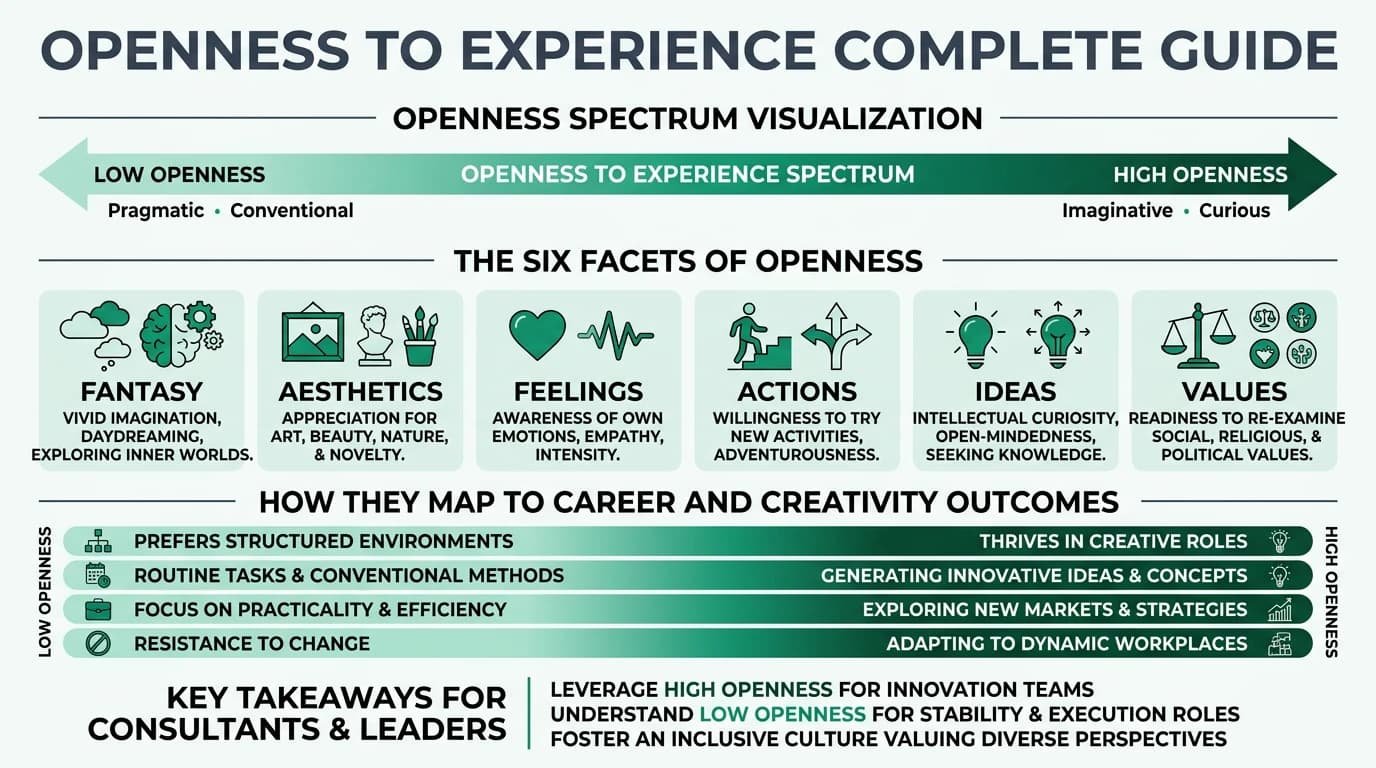
- The trait comprises six distinct facets: fantasy, aesthetics, feelings, actions, ideas, and values, each contributing differently to behavior.
- High scorers thrive in creative, unstructured environments but risk impulsivity and difficulty with routine tasks.
- Low scorers excel in stable, detail-oriented roles but may struggle with innovation and adaptation to change.
- Openness shows the highest heritability among Big Five traits at 57 percent, with biological links to oxytocin receptor gene methylation1.
- The trait correlates significantly with intelligence and creativity, making it a key predictor of artistic achievement and divergent thinking.
- Openness decreases slightly from adolescence to middle adulthood, with facet-specific variation in the rate of change.
For the full framework of all five personality traits, see our complete Big Five personality test guide.
Disclaimer: This article summarizes personality psychology research for educational purposes. Personality assessments should complement, not replace, professional psychological evaluation when clinical decisions are involved.
What Is Openness to Experience?
Openness to experience is one of the five broad personality dimensions in the Big Five (OCEAN) model. It captures individual differences in imagination, intellectual curiosity, aesthetic appreciation, and willingness to engage with novel or unconventional ideas.
The trait was formalized by Costa and McCrae in their NEO Personality Inventory (1985, revised 1992) and refined by John and Srivastava (1999) as a core dimension distinct from extraversion and conscientiousness12.
Unlike extraversion, which measures social energy, openness focuses on inner mental life: the richness of fantasy, depth of emotional experience, and breadth of intellectual engagement.
| Core Component | Definition | Behavioral Indicator |
|---|---|---|
| Imagination | Rich fantasy life and creative visualization | Daydreaming, scenario planning, artistic ideation |
| Intellectual curiosity | Active pursuit of knowledge and ideas | Reads widely, enjoys debate, asks probing questions |
| Aesthetic sensitivity | Deep appreciation for art, beauty, and nature | Moved by music, visual art, or natural landscapes |
| Novelty preference | Attraction to new experiences and change | Seeks travel, experiments with food, tries new hobbies |
| Unconventionality | Willingness to question norms and traditions | Challenges authority, explores alternative viewpoints |
| Emotional breadth | Awareness and valuing of diverse emotional states | Comfortable with ambiguity, reflective about feelings |
- Openness correlates with intelligence at r = 0.30 to 0.45 across meta-analyses, making it the Big Five trait most consistently linked to cognitive ability2.
- The trait shows the highest genetic influence (57 percent heritability) among all five dimensions1.
High vs. Low Openness
Neither end of the openness spectrum is universally superior. Each profile carries distinct strengths and risks depending on the environment.
High Openness Profile
- Strengths: Creative, intellectually curious, adaptable, aesthetically sensitive, comfortable with ambiguity.
- Career fit: Thrives in innovation-driven roles (research, design, writing, entrepreneurship, strategic consulting).
- Risk factors: Impractical idealism, difficulty with routine, risk-taking behavior, scattered focus.
Low Openness Profile
- Strengths: Practical, reliable, detail-oriented, consistent, comfortable with established procedures.
- Career fit: Excels in roles requiring precision, compliance, and consistency (accounting, operations, quality assurance, manufacturing).
- Risk factors: Resistance to change, difficulty innovating, discomfort with ambiguity, cultural rigidity.
| Dimension | High Openness | Low Openness |
|---|---|---|
| Thinking style | Abstract, divergent | Concrete, convergent |
| Response to novelty | Embraces eagerly | Avoids or resists |
| Preferred environment | Unstructured, varied | Structured, predictable |
| Decision-making | Intuitive, exploratory | Practical, data-driven |
| Creative output | Prolific, unconventional | Steady, conventional |
| Social perception | Seen as imaginative or eccentric | Seen as grounded or rigid |
| Stress pattern | From monotony and restriction | From ambiguity and unpredictability |
| Context | Advantage Goes To | Why |
|---|---|---|
| Product innovation | High O | Divergent thinking generates novel solutions |
| Regulatory compliance | Low O | Consistency and attention to established rules |
| Artistic production | High O | Creative freedom and aesthetic sensitivity |
| Manufacturing quality control | Low O | Methodical repetition and reliability |
| Cross-cultural work | High O | Appreciation for diversity and adaptability |
| Financial auditing | Low O | Precision without unnecessary deviation |
The Six Facets of Openness
Openness is not a single trait but a composite of six distinct facets, originally identified by Costa and McCrae in the NEO-PI-R framework1. Facet-level analysis provides far more actionable insight than the aggregate score.
| Facet | High Scorer | Low Scorer | Outcome Prediction |
|---|---|---|---|
| Fantasy | Vivid imagination, rich inner life | Prefers concrete thinking, grounded | Creative ideation, artistic talent |
| Aesthetics | Deeply moved by art and beauty | Indifferent to artistic expression | Artistic achievement, design roles |
| Feelings | Values emotional experience, introspective | Discounts emotions, pragmatic | Emotional intelligence, empathy |
| Actions | Seeks variety, tries new activities | Prefers familiar routines | Adaptability, travel enjoyment |
| Ideas | Intellectually curious, enjoys abstract thought | Focuses on practical knowledge only | Academic achievement, research aptitude |
| Values | Questions traditions, open to new beliefs | Respects authority, conventional morals | Cultural flexibility, tolerance |
Facet Interactions and Profiles
- Intellect vs. openness represent two higher-order clusters. Intellect (ideas, fantasy) predicts academic engagement, while openness proper (aesthetics, feelings, actions) predicts artistic and experiential behavior2.
- A person can score high on ideas but low on actions, creating a profile of intellectual curiosity without behavioral adventurousness.
- Biological research by Haas (2018) found significant correlations between oxytocin receptor DNA methylation and specific facets: actions (r = -0.60), ideas (r = -0.23), and values (r = -0.17)3.
| Profile Type | High Facets | Low Facets | Behavioral Pattern |
|---|---|---|---|
| Creative intellectual | Fantasy, ideas, aesthetics | Actions | Deep thinker, not physically adventurous |
| Adventurous pragmatist | Actions, feelings | Fantasy, ideas | Seeks new experiences, not abstract theory |
| Traditional scholar | Ideas | Values, aesthetics, actions | Intellectually rigorous but culturally conservative |
| Full-spectrum open | All six | None | Classic high-openness personality |
| Selective openness | Aesthetics, feelings | Ideas, fantasy, values | Emotionally rich but not intellectually unconventional |
How Openness Is Measured
Several validated instruments assess openness to experience, from comprehensive clinical tools to brief screening assessments.
| Assessment Tool | Items | Facet Detail | Reliability | Cost | Best For |
|---|---|---|---|---|---|
| NEO-PI-R | 240 (48 for O) | All 6 facets | Very high (alpha 0.86-0.92) | Licensed | Clinical and research use |
| NEO-FFI | 60 (12 for O) | Domain-level only | High (alpha 0.78-0.86) | Licensed | Quick professional screening |
| BFI-2 | 60 (12 for O) | 3 facets | High | Free for research | Academic studies |
| IPIP-NEO | 120 or 300 | Full facet coverage | High | Free | Self-assessment, open access |
| Big Five Inventory | 44 (10 for O) | Domain-level only | Good | Free | Brief screening |
- The NEO-PI-R remains the gold standard, but the IPIP-NEO offers comparable facet-level detail at no cost1.
- Self-report measures can be supplemented with informant reports for greater accuracy in high-stakes contexts.
Reflective Self-Assessment Questions
- Do you actively seek out unfamiliar experiences, cultures, or ideas?
- Are you deeply moved by art, music, or natural beauty?
- Do you enjoy debating abstract concepts even without a practical goal?
- Do you question established traditions and authority?
- Would others describe you as imaginative or unconventional?
For guidance on interpreting Big Five test results, see our personality test complete guide.
Openness, Creativity, and Intelligence
Openness is the Big Five trait most consistently linked to both creativity and intelligence. Understanding this relationship requires distinguishing between the two constructs.
| Cognitive Domain | Correlation with Openness | Mechanism | Key Evidence |
|---|---|---|---|
| Fluid intelligence | r = 0.30 to 0.45 | Intellectual curiosity drives learning | Weisberg, DeYoung, and Hirsh (2011)2 |
| Divergent thinking | r = 0.35 to 0.50 | Fantasy and ideas facets fuel ideation | Multiple creativity meta-analyses |
| Artistic achievement | r = 0.40 to 0.55 | Aesthetics facet drives artistic engagement | Feist (1998) meta-analysis |
| Academic performance | r = 0.10 to 0.20 | Ideas facet supports sustained learning | Poropat (2009) meta-analysis |
| Problem-solving flexibility | r = 0.25 to 0.35 | Willingness to consider alternatives | DeYoung et al. (2012) |
- Openness predicts creativity more strongly than intelligence alone. While intelligence provides raw processing capacity, openness supplies the motivation to explore, experiment, and connect disparate ideas2.
- The ideas facet specifically predicts academic and scientific creativity, while the aesthetics facet predicts artistic and design creativity.
- High openness individuals process complex stimuli differently, showing greater neural activation in regions associated with imagination and abstract reasoning.
For a deeper exploration of the creativity connection, see our guide on personality and creativity in Big Five research.
Openness Across the Lifespan
Openness is not static. It follows predictable developmental patterns influenced by both biology and life experience.
| Age Period | Openness Trend | Facet-Specific Changes | Driving Factors |
|---|---|---|---|
| Childhood (6-12) | Rising | Growing imagination, curiosity | Cognitive development, exploration |
| Adolescence (13-19) | Peak levels | Adventurousness highest | Identity formation, novelty-seeking |
| Young adulthood (20-35) | Gradual decline begins | Actions facet drops first | Career consolidation, responsibility |
| Middle adulthood (36-55) | Steady moderate decline | Values stabilize | Established routines, social roles |
| Late adulthood (56 and older) | Continued decline | Ideas facet most preserved | Cognitive aging, reduced mobility |
- The decline in openness with age is modest compared to changes in other traits like neuroticism or conscientiousness1.
- Facet-specific variation is significant: adventurousness (actions) decreases most, while intellectual curiosity (ideas) remains relatively stable.
- Education and intellectually stimulating environments can buffer age-related openness decline.
For the full picture of how personality changes across the lifespan, see our personality changes guide.
Workplace and Career Implications
Openness shapes career preferences, job satisfaction, and organizational fit. The trait is particularly relevant in roles requiring innovation, cultural sensitivity, and strategic thinking.
| Role Category | Ideal Openness Level | Why It Fits | Performance Prediction |
|---|---|---|---|
| Research and development | High | Curiosity drives discovery | Strong positive |
| Creative arts and design | High | Aesthetic sensitivity and imagination | Strong positive |
| Strategic consulting | High | Comfort with ambiguity and complex problems | Moderate positive |
| Teaching and education | Moderate to high | Intellectual engagement, adapting methods | Moderate positive |
| Software engineering | Moderate | Problem-solving, but process matters | Moderate |
| Accounting and compliance | Low to moderate | Precision and adherence to standards | Positive for low O |
| Manufacturing operations | Low | Consistency and routine adherence | Positive for low O |
| Workplace Behavior | High O Pattern | Low O Pattern | Impact |
|---|---|---|---|
| Idea generation | Prolific, unconventional | Incremental, proven methods | Innovation pipeline |
| Process adherence | Resists rigid procedures | Follows established protocols | Compliance quality |
| Learning new systems | Eager, fast adoption | Cautious, methodical adoption | Training efficiency |
| Team brainstorming | Energized, divergent | Grounding, convergent | Session balance |
| Change management | Champions transformation | Anchors stability | Organizational transitions |
- High-openness individuals are attracted to organizations that value universalism, creativity, and tolerance over hierarchy and tradition4.
- In innovation teams, the ideal mix includes both high-openness idea generators and low-openness implementers who ensure practical execution.
For insights on how personality affects learning preferences, see our personality and learning styles guide.
Health, Biology, and Genetics
Openness has a substantial biological basis, with implications for both physical and psychological well-being.
| Biological Factor | Finding | Effect Size | Key Citation |
|---|---|---|---|
| Heritability | 57 percent genetic influence | Highest among Big Five | Jang et al. (1996)1 |
| OXTR DNA methylation | Reduced methylation linked to higher openness | r = -0.60 for actions facet | Haas (2018)3 |
| Neural activation | Greater prefrontal cortex activity during novel stimuli | Moderate | DeYoung et al. (2005) |
| Dopamine system | Linked to dopaminergic function and reward-seeking | Moderate | DeYoung (2013) |
| Health Outcome | High Openness Effect | Mechanism |
|---|---|---|
| Psychological well-being | Generally positive | Emotional breadth, meaning-seeking |
| Substance experimentation | Elevated risk | Novelty-seeking, reduced inhibition |
| Therapy responsiveness | Higher engagement | Willingness to explore inner states |
| Stress from monotony | Increased | Need for stimulation unmet |
| Cognitive aging | Potential buffer | Intellectual engagement preserves function |
- The 57 percent heritability estimate for openness exceeds that of extraversion (54 percent) and conscientiousness (49 percent), underscoring its strong genetic roots1.
- High openness is associated with greater interest in self-actualization and pursuit of intense, growth-oriented experiences3.
Strengths, Risks, and Real-World Scenarios
Strengths of High Openness
- Innovation: Generates creative solutions to complex problems.
- Adaptability: Adjusts quickly to new environments and cultural contexts.
- Learning agility: Acquires new skills and knowledge rapidly.
- Cultural competence: Navigates diverse perspectives with comfort.
Risks of High Openness
- Impractical idealism: May prioritize novelty over feasibility.
- Risk-taking: Elevated substance experimentation and financial impulsivity.
- Difficulty with routine: Struggles with repetitive or highly structured tasks.
- Overthinking: Can become paralyzed by too many possibilities.
| Scenario | High O Response | Low O Response | Practical Outcome |
|---|---|---|---|
| Career pivot opportunity | Embraces the change enthusiastically | Weighs risks carefully, may decline | Different paths, both valid |
| Team conflict over methodology | Proposes unconventional approach | Defends proven process | Need both perspectives |
| International work assignment | Excited by cultural immersion | Concerned about disruption | H-O adapts faster, L-O maintains consistency |
| New technology adoption | Early adopter, experiments freely | Waits for proven track record | H-O innovates, L-O reduces risk |
| Relationship with mismatched partner | Seeks novelty in shared activities | Prefers predictable date nights | Compromise required |
Openness development action checklist
- Take a validated Big Five assessment (IPIP-NEO is free) to determine your openness level and facet profile.
- Identify whether your profile leans toward intellect (ideas, fantasy) or experiential openness (actions, aesthetics).
- If high in openness, build systems for follow-through on creative ideas to avoid scattered productivity.
- If low in openness, schedule deliberate exposure to new experiences (one new activity per month).
- Match your career path to your openness profile using the workplace tables above.
- Review relationships for openness-driven friction (novelty vs. routine preferences).
- Monitor for risk-taking patterns if you score high on the actions facet.
- Leverage intellectual environments (courses, reading groups, debates) to maintain openness as you age.
FAQ
How is openness to experience measured accurately?
The gold standard is the NEO-PI-R, which measures all six facets (fantasy, aesthetics, feelings, actions, ideas, values) across 48 items. For a free alternative, the IPIP-NEO provides comparable facet-level detail. Brief instruments like the BFI-2 capture domain-level scores but miss important facet distinctions. Self-report can be supplemented with informant ratings from people who know you well1.
Is openness the same as intelligence?
No, but they are correlated. Openness and intelligence share a moderate positive correlation (r = 0.30 to 0.45), primarily through the ideas facet. However, openness also encompasses aesthetic sensitivity, emotional depth, and behavioral adventurousness, which are independent of cognitive ability. A person can be highly intelligent but low in openness, or vice versa2.
Can openness to experience change over time?
Yes. Openness follows a predictable developmental trajectory: it rises through childhood, peaks in adolescence, and declines gradually through adulthood. The decline is modest and facet-specific, with adventurousness decreasing more than intellectual curiosity. Education and stimulating environments can buffer the decline. Deliberate exposure to novel experiences may also increase specific facets15.
What careers are best for highly open individuals?
Research, creative arts, design, strategic consulting, teaching, journalism, and entrepreneurship suit high-openness individuals. These roles reward curiosity, imagination, and comfort with ambiguity. However, the specific facet profile matters: high ideas suits academia, while high aesthetics suits design. Low-openness individuals excel equally in roles requiring precision, compliance, and consistency4.
What are the risks of very high openness?
Risks include elevated substance experimentation due to novelty-seeking, financial impulsivity, difficulty sustaining focus on routine tasks, impractical idealism that ignores feasibility constraints, and scattered productivity from pursuing too many interests simultaneously. These risks are strongest when openness is combined with low conscientiousness13.
How does openness affect relationships?
Partners with mismatched openness levels often face friction: the high-openness partner seeks novel experiences and cultural exploration, while the low-openness partner prefers familiar routines and predictability. Successful relationships navigate this through compromise, with the high-O partner introducing gradual novelty and the low-O partner providing stability. Similar openness levels predict higher relationship satisfaction5.
Is openness genetic or environmental?
Both, but genetics play a dominant role. Twin studies estimate 57 percent heritability for openness, the highest among all Big Five traits. Environmental factors like education, cultural exposure, and intellectually stimulating careers account for the remaining variance. Research by Haas (2018) identified specific epigenetic markers (OXTR DNA methylation) associated with openness facets13.
How does openness differ from extraversion?
Openness measures inner mental engagement: imagination, intellectual curiosity, and aesthetic sensitivity. Extraversion measures social energy: assertiveness, sociability, and stimulation-seeking from external interactions. A person can be introverted (low extraversion) yet highly open, enjoying solitary intellectual pursuits and deep aesthetic experiences. The two traits are only weakly correlated (r = 0.10 to 0.15)2.
Notes
Primary Sources
| Source | Type | Key Contribution | URL |
|---|---|---|---|
| Simply Psychology | Educational reference | Big Five model overview and openness trait description | Link |
| Psychologist World | Research summary | Openness facets, intelligence correlation, and measurement | Link |
| Psychiatry and Psychotherapy Podcast | Research discussion | Biological basis, OXTR methylation, and clinical implications | Link |
| Crystal Knows | Assessment platform | Workplace applications and practical openness assessment | Link |
| Alva Labs | Workplace research | Openness in recruitment and organizational culture fit | Link |
| PMC / NIH | Research database | Openness and daily life experiences, situation construal | Link |
Conclusion
Openness to experience is the Big Five trait that best captures the human drive toward curiosity, creativity, and intellectual engagement. It shapes career choices through innovation preferences, relationships through novelty-seeking, and health through both psychological resilience and risk-taking tendencies.
The practical implication is not that high openness is inherently better. It is that understanding your openness profile, at the facet level, allows you to leverage your strengths and compensate for your limitations in contexts where they matter most.
High-openness individuals should build systems for execution and follow-through. Low-openness individuals should invest in deliberate exposure to new experiences and perspectives. Both profiles contribute essential value when matched to the right environment.
Footnotes
-
Costa, P. T. & McCrae, R. R. (1992). NEO-PI-R Professional Manual. Psychological Assessment Resources. Summary available at: https://www.simplypsychology.org/big-five-personality.html ↩ ↩2 ↩3 ↩4 ↩5 ↩6 ↩7 ↩8 ↩9 ↩10 ↩11 ↩12 ↩13
-
Weisberg, Y. J., DeYoung, C. G., & Hirsh, J. B. (2011). Gender differences in personality across the ten aspects of the Big Five. Frontiers in Psychology, 2, 178. Referenced in: https://www.psychologistworld.com/influence-personality/openness-to-experience-trait ↩ ↩2 ↩3 ↩4 ↩5 ↩6 ↩7
-
Haas, B. W. (2018). Epigenetic modification of OXT and human sociability. Proceedings of the National Academy of Sciences. Referenced in: https://www.psychiatrypodcast.com/psychiatry-psychotherapy-podcast/episode-98-the-big-five-openness ↩ ↩2 ↩3 ↩4 ↩5
-
Crystal Knows. Big Five openness: Workplace applications and trait assessment. Available at: https://www.crystalknows.com/big-five/openness ↩ ↩2
-
John, O. P. & Srivastava, S. (1999). The Big Five trait taxonomy: History, measurement, and theoretical perspectives. In Handbook of personality: Theory and research (2nd ed.). Referenced in: https://www.alvalabs.io/blog/alva-guide-to-the-big-five-openness-explained ↩ ↩2