personality-tests
Personality and Learning Style Preferences: How Big Five Traits Influence Training and Development
Explore how the Big Five personality traits impact learning style preferences and their implications for training and development.
Quick answer
How do Big Five personality traits influence learning style preferences?
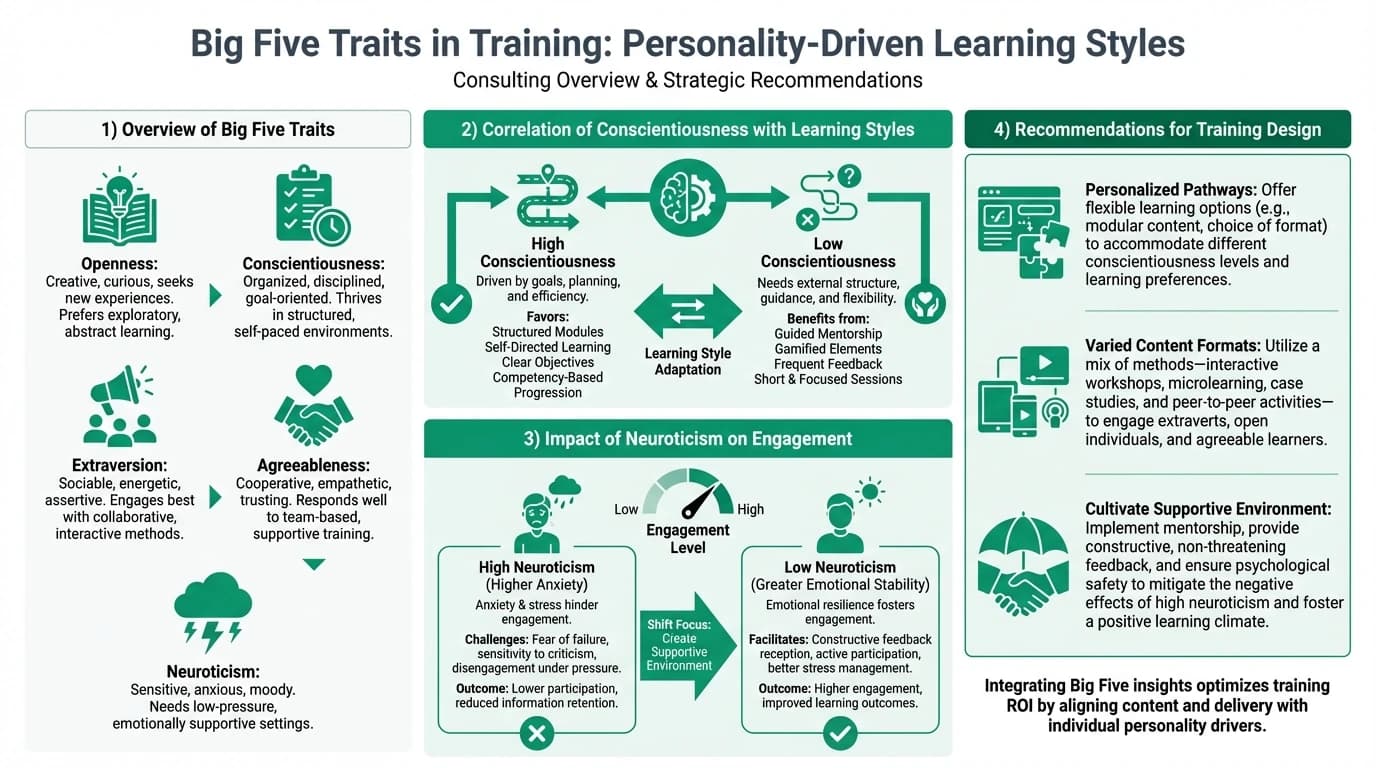
The Big Five personality traits significantly influence learning style preferences, impacting training effectiveness and development outcomes. Conscientiousness, openness, and extraversion show positive correlations with various learning styles, while neuroticism often negatively affects learning engagement.
Executive Summary
Understanding the intersection of personality traits and learning styles is crucial for optimizing training and development. The Big Five traits—conscientiousness, extraversion, openness, agreeableness, and neuroticism—each play a distinct role in shaping learning preferences.
The bottom line: Aligning training methods with personality-informed learning styles can enhance educational outcomes and employee development.
Critical Warning: Ignoring the influence of personality traits on learning preferences may lead to ineffective training programs and missed opportunities for performance improvement.
Understanding the Big Five Personality Traits
The Big Five personality traits provide a framework for understanding individual differences in behavior and learning preferences:
- Conscientiousness: Associated with diligence and organization.
- Extraversion: Linked to sociability and energy.
- Openness: Reflects creativity and curiosity.
- Agreeableness: Indicates cooperation and empathy.
- Neuroticism: Relates to emotional instability and anxiety.
Table 1: Big Five Traits and Learning Style Correlations
| Trait | Synthesis-Analysis | Methodical Study | Fact Retention | Elaborative Processing | GPA Correlation |
|---|---|---|---|---|---|
| Conscientiousness | Positive | Positive | Positive | Positive | Strong Positive |
| Extraversion | Positive | Positive | Positive | Positive | Not specified |
| Openness | Positive | Not specified | Not specified | Positive | Mediated |
| Agreeableness | Positive | Positive | Positive | Positive | Not specified |
| Neuroticism | Negative | Negative | Negative | Negative | Negative |
Source: [1][2]
How Conscientiousness Influences Learning
Conscientious individuals typically excel in structured learning environments due to their diligence and organizational skills. However, excessive focus on elaborative processing can paradoxically suppress performance.
- Effect: High conscientiousness correlates with methodical study.
- Challenge: Over-processing can hinder performance.
- Solution: Emphasize systematic fact retention.
Table 2: Conscientiousness and Learning Outcomes
| Scenario | Conscientiousness | Elaborative Processing | Expected Impact | Actual Finding | Training Implication |
|---|---|---|---|---|---|
| Structured learning | High | Low | Positive | Positive | Encourage systematic approaches |
| Reflective learning | High | High | Positive | Negative | Limit personalization |
Source: [1]
Neuroticism's Impact on Learning Engagement
Neuroticism often negatively affects learning engagement due to anxiety and emotional instability. Creating psychologically safe learning environments can mitigate these effects.
- Effect: Anxiety impairs all learning styles.
- Strategy: Provide reassurance and extended timelines.
- Environment: Design low-pressure learning spaces.
Table 3: Neuroticism and Training Strategies
| Trait | Learning Style Impact | Recommended Strategy |
|---|---|---|
| Neuroticism | Negative | Safe environments, frequent feedback |
Source: [1][2]
Openness and Reflective Learning Styles
Openness is linked to reflective learning styles, such as synthesis-analysis and elaborative processing. These traits foster intellectual curiosity and deep learning engagement.
- Effect: Drives deep learning engagement.
- Approach: Use case studies and problem-solving tasks.
- Benefit: Enhances reflective learning.
Table 4: Openness and Learning Engagement
| Trait | Learning Style Mediator | Training Approach |
|---|---|---|
| Openness | Synthesis-analysis | Case studies, reflective tasks |
Source: [2]
Extraversion and Collaborative Learning
Extraverted individuals thrive in social learning environments. Training programs should incorporate group-based activities to leverage their sociability.
- Effect: Positive correlation with all learning styles.
- Approach: Use interactive and peer-based learning.
- Challenge: Balance group and individual tasks.
Table 5: Extraversion and Training Design
| Trait | Preferred Learning Style | Recommended Format |
|---|---|---|
| Extraversion | All styles | Collaborative, interactive sessions |
Source: [1]
Agreeableness and Team Dynamics
Agreeable individuals excel in collaborative settings. Training programs should focus on team-based learning and conflict resolution.
- Effect: Supports synthesis-analysis and collaboration.
- Approach: Use team projects and peer learning.
- Challenge: Encourage constructive debate.
Table 6: Agreeableness in Team Training
| Trait | Learning Style Impact | Training Focus |
|---|---|---|
| Agreeableness | Positive | Team projects, peer collaboration |
Source: [1][2]
Learning Style Combinations and Performance
Combining multiple learning styles can optimize performance. Trimodal preferences are common among both high and low achievers.
- Effect: Trimodal preference enhances learning.
- Approach: Use blended, multimodal training.
- Insight: Kinesthetic and auditory styles are significant.
Table 7: Learning Style Preferences
| Learning Style | Correlation with Achievement | Prevalence | Recommended Context |
|---|---|---|---|
| Kinesthetic | Significant positive | High | Hands-on, experiential |
| Auditory | Significant positive | Moderate | Lectures, discussions |
| Trimodal | Significant | Predominant | Blended, multimodal |
Source: [3]
Conclusion
Understanding the interplay between personality traits and learning styles is essential for designing effective training programs. By aligning training methods with personality-informed preferences, organizations can enhance educational outcomes and employee development.
FAQ
How do personality traits affect learning styles?
What is the conscientiousness paradox?
How can training programs address neuroticism?
Why is openness important in learning?
What are the benefits of collaborative learning for extraverts?
How do learning styles impact training effectiveness?
What are trimodal learning preferences?
Notes
Primary Sources
| Source | Type | URL |
|---|---|---|
| Journal of Education and Practice | Research Study | https://example.com/journal-education-practice |
| PMC/NCBI | Research Article | https://example.com/pmc-ncbi |