personality-tests
Personality and Professional Networking Success: How Big Five Traits Shape Relationship Building, Follow-Up Habits, and Career Introductions
Explore how the Big Five personality traits impact professional networking success, relationship building, and career advancement.
Quick answer
How do Big Five personality traits affect professional networking?
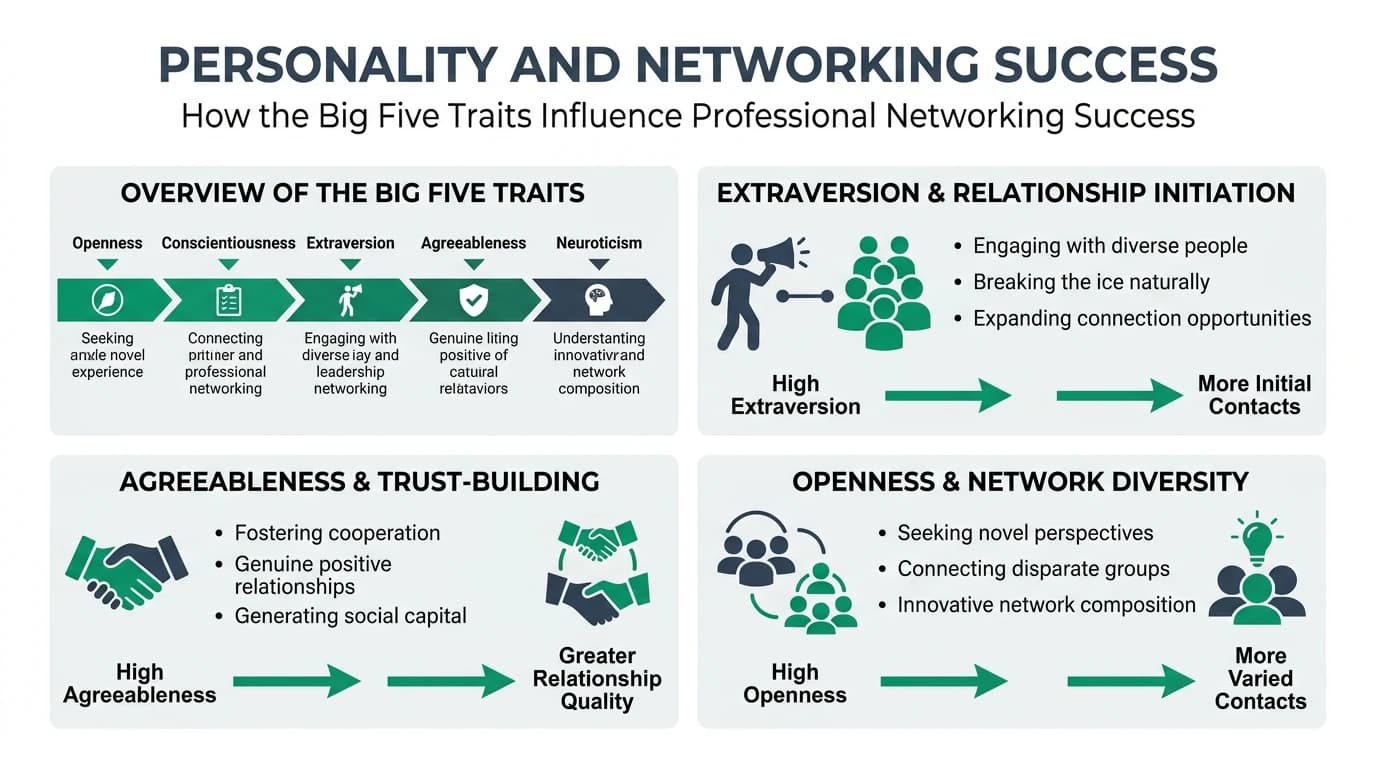
The Big Five personality traits—Openness, Conscientiousness, Extraversion, Agreeableness, and Neuroticism—shape how individuals build relationships, follow up, and make career introductions. Each trait influences networking behavior, which in turn affects career success.
Source: Taylor & Francis Online
Executive Summary
- Big Five Traits: Openness, Conscientiousness, Extraversion, Agreeableness, and Neuroticism.
- Networking Impact: Traits influence how we connect, maintain relationships, and advance careers.
- Success Mechanism: Personality affects networking behavior, which mediates career outcomes.
The bottom line: Understanding your personality can optimize your networking strategy and career success.
Critical: Personality traits are stable but not fixed. Networking success also depends on skill development and context.
What is the Big Five Model?
The Big Five Personality Model, often remembered by the acronym OCEAN, includes:
- Openness to Experience: Creativity and curiosity.
- Conscientiousness: Organization and reliability.
- Extraversion: Sociability and energy.
- Agreeableness: Compassion and cooperation.
- Neuroticism: Emotional stability.
These traits predict workplace behavior and networking capacity12.
| Trait | Description |
|---|---|
| Openness | Creative, curious |
| Conscientiousness | Organized, reliable |
| Extraversion | Sociable, energetic |
| Agreeableness | Compassionate, cooperative |
| Neuroticism | Emotionally stable |
How Does Extraversion Affect Networking?
High Extraversion: Energizes social interaction and facilitates relationship initiation.
- Strength: Initiates connections easily.
- Challenge: May struggle with depth in relationships.
Low Extraversion (Introversion): Prefers solitude and deep connections.
- Strength: Builds meaningful one-on-one relationships.
- Challenge: May find large networking events draining.
| Dimension | Introversion | Extraversion |
|---|---|---|
| Energy Source | Solitude | Social interaction |
| Networking Preference | One-on-one | Group events |
Why is Agreeableness Important in Networking?
Agreeableness enables empathy, cooperation, and trust-building.
- Strength: Builds trust and loyalty.
- Challenge: May avoid difficult conversations.
| High Agreeableness | Low Agreeableness |
|---|---|
| Empathetic, cooperative | Direct, competitive |
| Builds strong relationships | May struggle with empathy |
How Does Openness to Experience Enhance Networking?
Openness encourages diverse connections and idea exchange.
- Strength: Facilitates cross-industry networking.
- Challenge: May lack consistency in follow-up.
| High Openness | Low Openness |
|---|---|
| Diverse connections | Familiar networks |
| Embraces new ideas | Prefers stability |
What Role Does Conscientiousness Play in Follow-Up?
Conscientiousness drives systematic follow-up and relationship maintenance.
- Strength: Ensures consistent outreach.
- Challenge: Can be overly rigid.
| High Conscientiousness | Low Conscientiousness |
|---|---|
| Systematic, reliable | Flexible, spontaneous |
| Consistent follow-up | May miss opportunities |
How Does Neuroticism Affect Professional Relationships?
Low Neuroticism supports consistent follow-up and relationship maintenance.
- Strength: Provides emotional stability.
- Challenge: High Neuroticism may lead to inconsistent outreach.
| Low Neuroticism | High Neuroticism |
|---|---|
| Emotionally stable | Emotionally volatile |
| Consistent engagement | Inconsistent follow-up |
How Do Personality Traits Mediate Networking Success?
Personality influences networking behavior, which then determines career outcomes.
- Extraversion: Initiates relationships.
- Agreeableness: Maintains trust.
- Openness: Expands networks.
| Trait | Effect on Networking | Career Impact |
|---|---|---|
| Extraversion | Initiates connections | Expands opportunities |
| Agreeableness | Builds trust | Deepens relationships |
| Openness | Encourages diversity | Fosters innovation |
Can Personality Traits Be Developed for Better Networking?
While core traits are stable, professionals can develop complementary behaviors.
- Introverts: Practice structured networking.
- High Neuroticism: Build accountability systems.
Actionable Strategies for Each Personality Type
- High Extraversion: Focus on depth in relationships.
- High Agreeableness: Practice assertiveness.
- High Openness: Develop follow-up routines.
- High Conscientiousness: Allow for spontaneity.
- Low Neuroticism: Demonstrate genuine interest.
Action checklist
- Identify your Big Five personality traits.
- Tailor networking strategies to your strengths.
- Develop complementary skills for balanced networking.
FAQ
Does extraversion guarantee networking success?
No; while Extraversion facilitates social engagement, Agreeableness and Openness also predict networking effectiveness1.
Can introverts be successful networkers?
Yes. Introverts can leverage high Agreeableness and Conscientiousness to build deep, meaningful relationships2.
What is the most important Big Five trait for career success?
Conscientiousness has the strongest correlation with job performance, but networking success requires a combination of traits3.
How does neuroticism affect professional relationships?
High Neuroticism can undermine networking through inconsistent follow-up4.
Is agreeableness necessary for networking?
Agreeableness strongly predicts networking behavior, but low-agreeableness individuals can succeed through direct communication5.
How do personality traits influence follow-up habits?
Conscientiousness drives systematic follow-up; Extraversion sustains engagement1.
Can personality traits be developed for better networking?
While core traits are stable, professionals can develop complementary behaviors2.
Notes
Primary Sources
| Source | Type | URL |
|---|---|---|
| Taylor & Francis Online | Peer-reviewed research | tandfonline.com |
| Michigan State University Online | Educational | michiganstateuniversityonline.com |
| Florida Institute of Technology | Educational | online.fit.edu |
Conclusion
Understanding your Big Five personality traits can significantly enhance your networking strategy and career success. By aligning your networking approach with your personality strengths, you can build more effective professional relationships.
Footnotes
-
Taylor & Francis Online, 2024 study on personality-networking-success mediation. ↩ ↩2 ↩3
-
Michigan State University Online, leadership research. ↩ ↩2 ↩3
-
Florida Institute of Technology, organizational behavior curriculum. ↩
-
NIH/PMC, comparative personality research. ↩
-
Arrow Payments, professional application of Big Five model. ↩