personality-tests
Why You Procrastinate: Personality Science of Delay
Discover how Big Five personality traits drive procrastination and learn evidence-based strategies to overcome chronic delay, backed by psychological research.
Quick answer
Why do some people procrastinate more than others?
Low conscientiousness and high neuroticism are the strongest Big Five predictors of chronic procrastination. A landmark meta-analysis of 216 studies found conscientiousness alone accounts for roughly 34 percent of the variance in procrastination behavior, while emotion-regulation difficulties amplify the effect.
Key Takeaways
- Procrastination is not laziness — it is a failure of emotion regulation tied to measurable personality traits.
- Conscientiousness (especially self-discipline) is the single strongest negative predictor of procrastination.
- Neuroticism amplifies avoidance through threat sensitivity and negative affect.
- Impulsivity acts as an independent pathway, distinct from low conscientiousness.
- Targeted interventions — from implementation intentions to self-compassion — work best when matched to your trait profile.
The bottom line: Your personality predicts how and why you procrastinate, which means the most effective fix depends on understanding your own Big Five profile.
Disclaimer: This guide synthesizes peer-reviewed research for educational purposes. It is not a substitute for professional psychological or medical advice.
What Is Procrastination, Really?
Procrastination is the voluntary, irrational delay of an intended action despite expecting to be worse off for the delay1. It differs from strategic postponement because the procrastinator knows the delay is counterproductive.
- Prevalence: Roughly 15–20 percent of adults are chronic procrastinators, and up to 80–95 percent of university students report procrastinating at least occasionally2.
- Cost: Chronic procrastination is associated with lower grades, reduced income, and poorer physical health1.
| Feature | Strategic Delay | Procrastination |
|---|---|---|
| Intent | Deliberate timing choice | Involuntary avoidance |
| Outcome expectation | Positive or neutral | Negative |
| Emotional driver | Calm assessment | Anxiety, dread, boredom |
| Self-regulation | Intact | Impaired |
Understanding the difference matters because strategies that help with scheduling (calendars, reminders) rarely fix the emotional roots of true procrastination. If you struggle with time management more broadly, addressing the personality layer first often produces larger gains.
How the Big Five Map onto Procrastination
Steel's 2007 meta-analysis of 216 studies remains the most comprehensive quantitative review of personality–procrastination links1. The table below summarizes the weighted mean correlations.
| Big Five Trait | Correlation with Procrastination (r) | Direction | Strength |
|---|---|---|---|
| Conscientiousness | −0.62 | Negative | Very strong |
| Neuroticism | +0.24 | Positive | Moderate |
| Extraversion | −0.12 | Negative | Weak |
| Agreeableness | −0.07 | Negative | Negligible |
| Openness | −0.03 | Negative | Negligible |
Key observations:
- Conscientiousness dominates the picture. Its facets of self-discipline (r = −0.58) and dutifulness (r = −0.46) are the strongest individual facet-level predictors1.
- Neuroticism contributes through emotional avoidance rather than lack of organization.
- Extraversion, agreeableness, and openness show minimal direct effects, though they can moderate other pathways.
A later meta-analysis by van Eerde (2003) replicated the pattern with 121 independent samples, confirming conscientiousness as the dominant factor3.
Conscientiousness: The Core Protective Factor
Conscientiousness captures self-discipline, orderliness, achievement striving, and deliberation. Each facet relates to procrastination through a distinct mechanism.
| Conscientiousness Facet | Mechanism | Practical Example |
|---|---|---|
| Self-discipline | Sustains effort on aversive tasks | Finishing a report despite boredom |
| Dutifulness | Obligation-driven follow-through | Meeting a deadline for a colleague |
| Achievement striving | Intrinsic goal pursuit | Working on a passion project daily |
| Deliberation | Planning before acting | Breaking a project into sub-tasks |
| Order | Environmental structure | Maintaining a clean workspace |
| Competence | Confidence in execution | Starting tasks without overthinking |
People low in conscientiousness are not defective — their brains simply assign less automatic reward to task completion. Evidence-based workarounds include:
- Implementation intentions: "When it is 9 a.m. on Monday, I will open the spreadsheet and complete row one." Studies show these if-then plans raise follow-through by 20–30 percent4.
- Temptation bundling: Pair an aversive task with a pleasurable activity (e.g., listen to a favorite podcast only while doing data entry).
- Accountability partners: External structure compensates for low internal dutifulness.
For a deeper dive into this trait, see our complete guide to conscientiousness.
Neuroticism: The Emotional Amplifier
High neuroticism predisposes people to experience tasks as threatening. The resulting anxiety triggers avoidance — not because the person lacks discipline, but because short-term emotional relief outweighs long-term goal pursuit5.
- Threat sensitivity: Neurotic individuals overestimate the difficulty and unpleasantness of upcoming tasks.
- Rumination loop: Worrying about the task replaces working on the task, creating a guilt–anxiety spiral.
- Self-handicapping: Delaying provides an excuse ("I ran out of time") that protects self-esteem.
| Neuroticism Facet | Procrastination Pathway | Intervention Match |
|---|---|---|
| Anxiety | Task-threat overestimation | Cognitive reappraisal |
| Depression | Low motivation, fatigue | Behavioral activation |
| Self-consciousness | Fear of judgment | Self-compassion exercises |
| Vulnerability | Feeling overwhelmed | Task decomposition |
| Impulsiveness (N-facet) | Giving in to distractions | Stimulus control |
| Anger/hostility | Frustration avoidance | Emotion labeling |
Sirois (2014) found that self-compassion partially mediates the neuroticism–procrastination link — treating yourself kindly after a lapse reduces the shame spiral that leads to further delay5. Learn more about managing neuroticism in our neuroticism guide.
Impulsivity: The Hidden Third Pathway
Steel (2007) showed that impulsivity correlates with procrastination at r = +0.41, making it the second-strongest predictor after conscientiousness1. Gustavson et al. (2014) used twin studies to demonstrate that procrastination and impulsivity share a common genetic foundation, largely overlapping with goal-management ability6.
- Lack of perseverance: Difficulty sustaining focus leads to task-switching and incomplete work.
- Urgency: Acting on impulse (checking social media, snacking) displaces planned behavior.
- Sensation seeking: Routine tasks feel intolerable, prompting escape to more stimulating activities.
| Impulsivity Component | Effect on Procrastination | Sample Behavior |
|---|---|---|
| Lack of perseverance | Strong positive | Abandoning long tasks halfway |
| Negative urgency | Moderate positive | Stress-eating instead of studying |
| Positive urgency | Weak positive | Chasing novel ideas mid-project |
| Sensation seeking | Weak positive | Preferring exciting tasks over boring ones |
| Lack of premeditation | Moderate positive | Starting without a plan, then stalling |
Practical countermeasures for impulsive procrastinators differ from those for neurotic procrastinators:
- Environment design: Remove temptations (phone in another room, website blockers).
- Pomodoro technique: Short, timed sprints satisfy the need for novelty.
- Reward schedules: Immediate micro-rewards after each completed block.
Active vs. Passive Procrastination
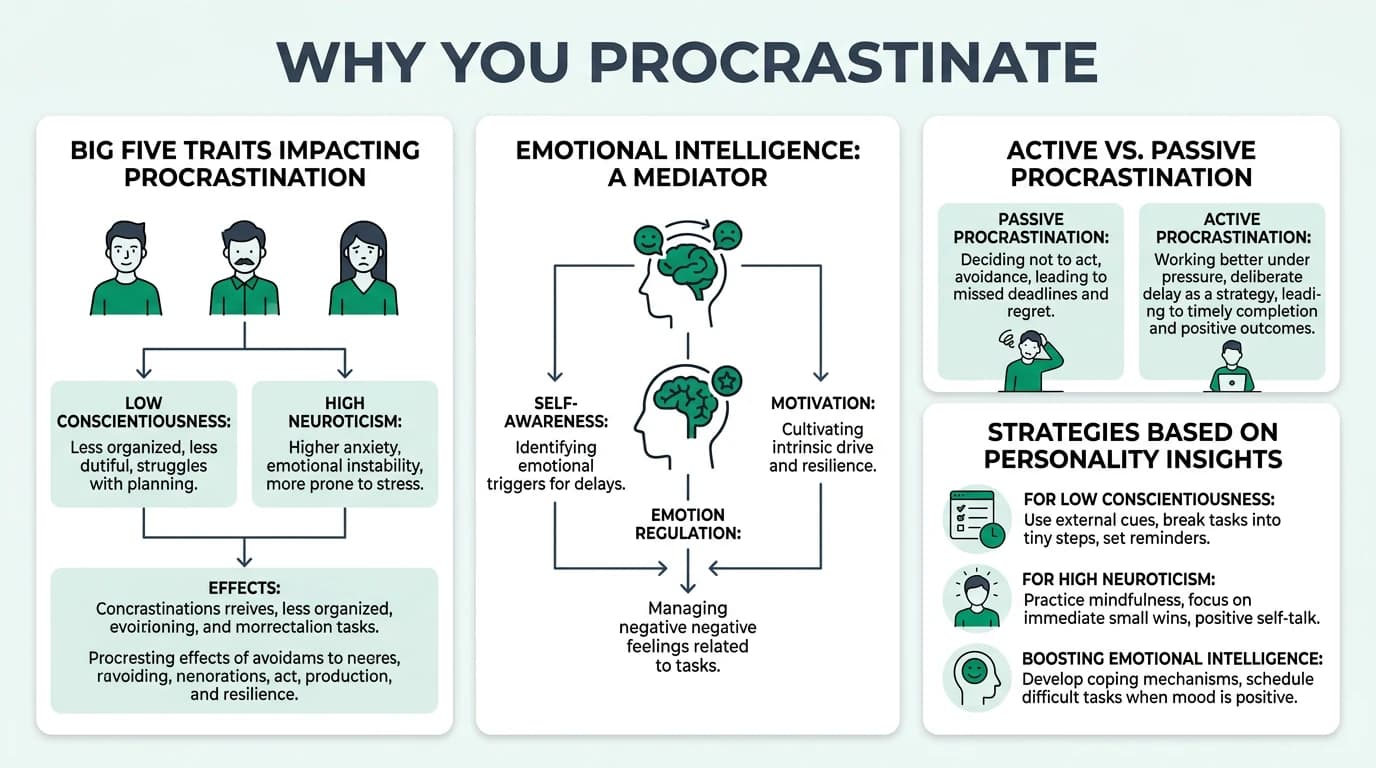
Chu and Choi (2005) introduced the distinction between active and passive procrastination, arguing that some people deliberately delay under pressure and still perform well7.
| Dimension | Active Procrastinator | Passive Procrastinator |
|---|---|---|
| Decision style | Intentional delay | Paralysis by indecision |
| Time pressure | Energizing | Paralyzing |
| Self-efficacy | High | Low |
| Outcome quality | Often good | Often poor |
| Emotional state | Excitement, challenge | Anxiety, guilt |
| Big Five profile | Moderate conscientiousness, high extraversion | Low conscientiousness, high neuroticism |
Active procrastination may not be "true" procrastination at all — it more closely resembles strategic delay with a preference for deadline pressure. Passive procrastinators, by contrast, experience genuine self-regulation failure and suffer the health and performance consequences.
Emotion Regulation: The Unifying Framework
Pychyl and Sirois (2016) proposed that procrastination is fundamentally a failure of emotion regulation rather than time management8. The logic is straightforward:
- A task triggers a negative emotion (boredom, anxiety, frustration, resentment).
- The person avoids the task to repair their mood in the short term.
- The avoidance creates guilt, compounding negative affect.
- The cycle repeats, often worsening over time.
This framework explains why classic time-management advice (buy a planner, set reminders) often fails — it addresses the symptom rather than the cause.
- Cognitive reappraisal: Reinterpreting the task ("This report helps my team") reduces negative emotion before it triggers avoidance.
- Mindfulness: Non-judgmental awareness of the urge to procrastinate weakens automatic avoidance8.
- Self-compassion: Forgiving yourself for past procrastination breaks the guilt–avoidance loop5.
If stress is a major trigger for you, our guide on personality and stress management covers trait-matched coping strategies in depth.
Procrastination in Academic Settings
Academic procrastination is the most studied form. Kim and Seo (2015) conducted a meta-analysis of 33 studies (N = 38,529) and found a significant negative correlation between procrastination and academic performance (r = −0.39 for course grades)9.
| Academic Outcome | Correlation with Procrastination | Practical Impact |
|---|---|---|
| Course grade | r = −0.39 | Half a letter grade lower on average |
| GPA | r = −0.34 | Cumulative decline over semesters |
| Assignment quality | r = −0.28 | Lower depth and originality |
| Exam performance | r = −0.22 | Less preparation time |
| Graduation rate | Negative (varied) | Higher dropout risk |
Risk factors specific to students:
- Low self-efficacy: Believing you lack the ability to succeed makes starting feel pointless.
- Task aversiveness: Boring or unclear assignments are the strongest situational triggers.
- Peer environment: Normalization of procrastination in student culture reduces perceived urgency.
For an in-depth look at how personality shapes academic outcomes, see our guide on personality and academic performance.
Neuroscience and Genetics of Procrastination
Procrastination is not purely psychological — it has measurable biological substrates.
- Prefrontal cortex: Reduced activity in the dorsolateral prefrontal cortex (dlPFC) impairs planning and impulse control in chronic procrastinators.
- Amygdala reactivity: Heightened amygdala response to task-related cues drives avoidance in high-neuroticism individuals.
- Dopamine pathways: Variation in dopamine receptor genes (particularly DRD2) influences reward sensitivity and goal persistence.
Gustavson et al. (2014) used a sample of 347 same-sex twin pairs and found that procrastination is moderately heritable (46 percent of variance) and shares nearly all its genetic variance with impulsivity6.
| Biological Factor | Role in Procrastination | Modifiability |
|---|---|---|
| dlPFC function | Executive control, planning | Trainable via cognitive exercises |
| Amygdala reactivity | Threat detection, avoidance | Reducible via mindfulness practice |
| Dopamine signaling | Reward motivation, persistence | Influenced by sleep, exercise, diet |
| Genetic heritability (46 percent) | Baseline predisposition | Not directly modifiable, but expression is malleable |
The genetic finding does not mean procrastination is fixed. Gene expression is shaped by environment, habits, and deliberate practice — interventions still work, they just may require more sustained effort for some individuals.
Evidence-Based Interventions by Trait Profile
The most effective approach matches the intervention to the underlying personality driver.
| Trait Profile | Root Cause | Best Intervention | Evidence Base |
|---|---|---|---|
| Low conscientiousness | Weak self-regulation | Implementation intentions, habit stacking | Gollwitzer (1999), meta r = 0.65 |
| High neuroticism | Emotional avoidance | Self-compassion, cognitive reappraisal | Sirois (2014), beta = −0.31 |
| High impulsivity | Distraction susceptibility | Environment design, Pomodoro | Steel (2007), r = 0.41 |
| Low self-efficacy | Perceived inability | Mastery experiences, task decomposition | Bandura (1997) |
| Task aversiveness | Boredom or confusion | Temptation bundling, curiosity reframing | Milkman et al. (2014) |
| Mixed profile | Multiple drivers | Combined CBT-based program | Rozental et al. (2015), d = 0.70 |
Rozental and Carlbring (2014) reviewed internet-based CBT interventions for procrastination and found a medium-to-large effect size (Cohen's d = 0.70), with gains maintained at six-month follow-up10.
Age, Development, and Lifespan Trends
Procrastination is not static across the lifespan.
- Peak in late adolescence: Procrastination peaks between ages 18 and 25, coinciding with the period when conscientiousness is still developing1.
- Decline with age: Older adults procrastinate less, partly because conscientiousness increases through middle adulthood.
- Critical window: Early intervention during university years can reshape habits before they calcify.
| Age Group | Procrastination Level | Primary Driver | Intervention Focus |
|---|---|---|---|
| 14–17 | Moderate-high | Developing executive function | Study skills, parental scaffolding |
| 18–25 | Highest | Low conscientiousness, impulsivity | CBT, implementation intentions |
| 26–40 | Moderate | Work stress, neuroticism | Emotion regulation, workplace coaching |
| 41–60 | Low-moderate | Habit momentum | Maintenance, stress management |
| 60 and above | Lowest | Stable conscientiousness | Minimal intervention needed |
Conclusion
Procrastination is a personality-driven emotion-regulation problem, not a character flaw. The strongest research-backed predictors — low conscientiousness, high neuroticism, and high impulsivity — each suggest different intervention strategies. Matching the fix to your specific trait profile is the fastest path to lasting change.
Anti-procrastination action checklist
- Take a Big Five personality assessment to identify your trait profile.
- Determine your primary procrastination pathway (low discipline, emotional avoidance, or impulsivity).
- Choose one evidence-based intervention matched to your pathway.
- Set three implementation intentions for your most-avoided task this week.
- Practice self-compassion after any lapse instead of self-criticism.
- Design your environment to reduce temptation (phone away, website blockers).
- Review progress weekly and adjust your strategy as needed.
FAQ
What personality trait is most linked to procrastination?
Is procrastination genetic?
Does neuroticism cause procrastination?
Can procrastination ever be productive?
How does procrastination affect academic performance?
What is the best treatment for chronic procrastination?
Does procrastination decrease with age?
How does impulsivity differ from low conscientiousness in causing procrastination?
Notes
Primary Sources
| Source | Type | URL |
|---|---|---|
| Steel (2007) — Psychological Bulletin | Meta-analysis (216 studies) | doi.org |
| Gustavson et al. (2014) — Psychological Science | Twin study | doi.org |
| Sirois (2014) — Self and Identity | Empirical study | doi.org |
| Kim & Seo (2015) — Personality and Individual Differences | Meta-analysis (33 studies) | doi.org |
| van Eerde (2003) — Personality and Individual Differences | Meta-analysis (121 samples) | doi.org |
Footnotes
-
Steel, P. (2007). The nature of procrastination: A meta-analytic and theoretical review of quintessential self-regulatory failure. Psychological Bulletin, 133(1), 65–94. ↩ ↩2 ↩3 ↩4 ↩5 ↩6
-
Steel, P. (2007). Reported prevalence estimates in the same meta-analysis, drawing on multiple student and adult samples. ↩
-
van Eerde, W. (2003). A meta-analytically derived nomological network of procrastination. Personality and Individual Differences, 35(6), 1401–1418. ↩
-
Gollwitzer, P. M. (1999). Implementation intentions: Strong effects of simple plans. American Psychologist, 54(7), 493–503. ↩
-
Sirois, F. M. (2014). Procrastination and stress: Exploring the role of self-compassion. Self and Identity, 13(2), 128–145. ↩ ↩2 ↩3
-
Gustavson, D. E., Miyake, A., Hewitt, J. K., & Friedman, N. P. (2014). Genetic relations among procrastination, impulsivity, and goal-management ability. Psychological Science, 25(6), 1178–1188. ↩ ↩2
-
Chu, A. H. C., & Choi, J. N. (2005). Rethinking procrastination: Positive effects of active procrastination behavior on attitudes and performance. Journal of Social Psychology, 145(3), 245–264. ↩
-
Sirois, F. M., & Pychyl, T. A. (2013). Procrastination and the priority of short-term mood regulation: Consequences for future self. Social and Personality Psychology Compass, 7(2), 115–127. ↩ ↩2
-
Kim, K. R., & Seo, E. H. (2015). The relationship between procrastination and academic performance: A meta-analysis. Personality and Individual Differences, 82, 26–33. ↩
-
Rozental, A., & Carlbring, P. (2014). Understanding and treating procrastination: A review of a common self-regulatory failure. Psychology, 5(13), 1488–1502. ↩