personal-development
How Big Five Personality Traits Predict Academic Performance and Student Success
Explore how the Big Five personality traits influence academic performance and student success, with a focus on conscientiousness, openness, and other traits.
Quick answer
How do the Big Five personality traits predict academic performance?
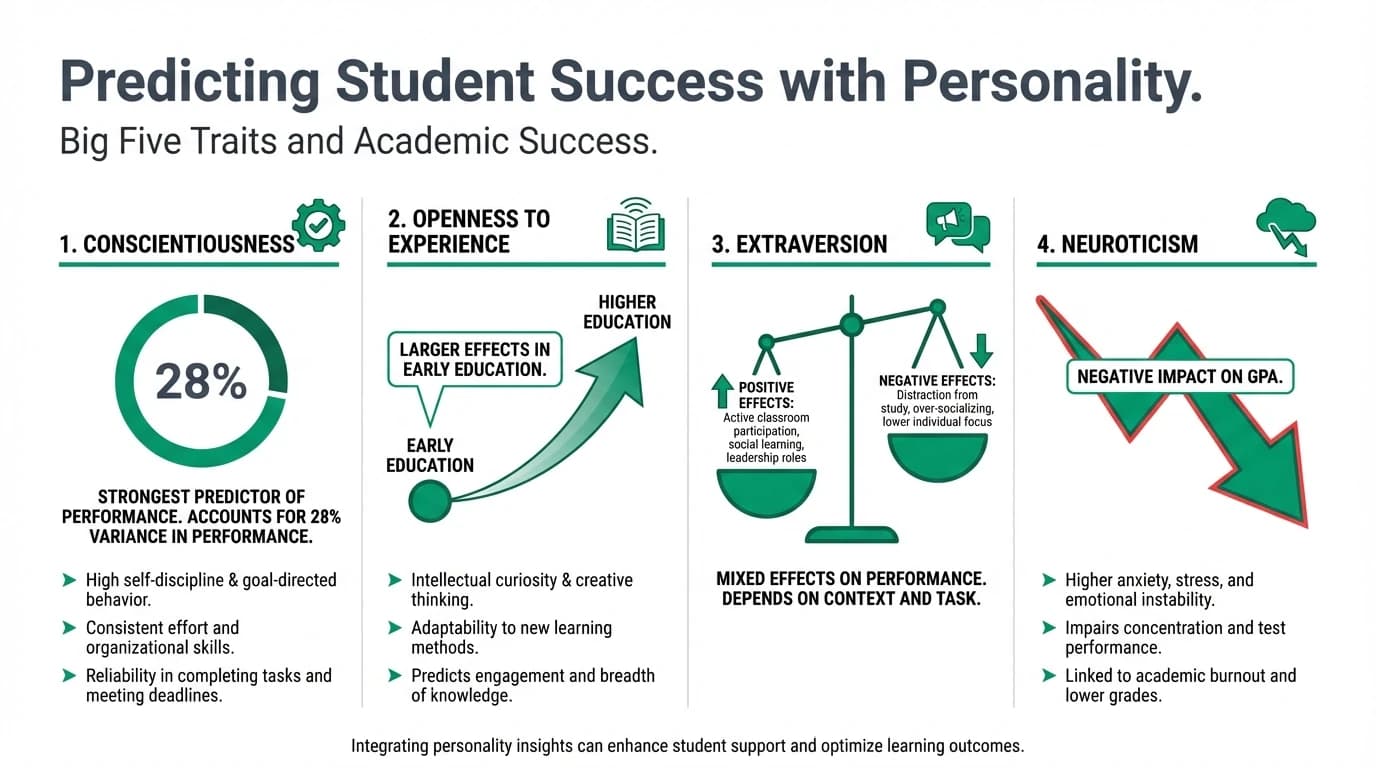
Conscientiousness is the strongest predictor, explaining up to 28% of variance in academic performance, followed by openness, extraversion, agreeableness, and neuroticism.
Source: PubMed Central
Executive Summary
The Big Five personality traits—conscientiousness, openness, extraversion, agreeableness, and neuroticism—play a crucial role in predicting academic performance. Conscientiousness stands out as the primary predictor, significantly influencing GPA and long-term success.
The bottom line: Understanding these traits can help educators tailor strategies to enhance student success.
Critical Warning: Ignoring the role of personality traits may lead to suboptimal educational outcomes.
What is the Big Five Model?
The Big Five model encompasses five key personality traits:
- Conscientiousness: Linked to self-discipline and goal-setting.
- Openness: Associated with creativity and exploratory learning.
- Extraversion: Involves social engagement and assertiveness.
- Agreeableness: Reflects cooperation and empathy.
- Neuroticism: Tied to emotional instability and anxiety.
Understanding these traits helps in predicting academic outcomes.
Conscientiousness as the Primary Predictor
Effect: Conscientiousness explains up to 28% of academic performance variance1.
Process: Enhances self-discipline and goal-setting.
Caveat: Most effective in structured learning environments.
| Study Sample | Conscientiousness Correlation | Openness | Neuroticism | Variance Explained |
|---|---|---|---|---|
| Undergraduate | 0.28 | 0.15 | -0.20 | 28% |
| Medical | 0.30 | 0.12 | -0.18 | 30% |
Role of Openness in Early Education
Openness shows larger effects in elementary and middle school:
- Positive Correlations: Strong with creative learning.
- Interactions: Works well with cognitive ability.
| Education Level | Openness Effect Size |
|---|---|
| Elementary | 0.25 |
| Middle School | 0.20 |
| High School | 0.10 |
Extraversion's Mixed Effects on Performance
Extraversion offers mixed results:
- Positive Effects: Via self-efficacy in group settings.
- Weaker Links: In traditional testing environments.
| Scenario | Total Effect | Direct | Indirect via Self-Efficacy |
|---|---|---|---|
| Business Students | 0.15 | 0.05 | 0.10 |
| Undergraduate | 0.10 | 0.02 | 0.08 |
Agreeableness and Its Context-Specific Benefits
Reliable Predictor: Especially in collaborative environments like PA programs.
Larger Effects: In early schooling; neutral elsewhere.
| Academic Outcome | Agreeableness Correlation | Context |
|---|---|---|
| PA Program | 0.22 | Collaborative |
| Early Schooling | 0.18 | General |
Negative Impacts of Neuroticism
Neuroticism consistently harms academic performance:
- GPA Impact: Negative correlations.
- Indirect Effects: Through reduced self-efficacy.
| Profile | GPA Impact | Self-Efficacy Impact |
|---|---|---|
| High Neuroticism | -0.25 | -0.20 |
| Low Neuroticism | 0.05 | 0.10 |
Incremental Validity Beyond Cognitive Ability
Personality traits add significant predictive power beyond cognitive ability:
- Explained Variance: 27.8% alongside cognitive predictors.
- Regression Analyses: Confirmed in PA admissions.
| Predictor | Relative Importance % | Variance Share |
|---|---|---|
| Cognitive Ability | 64% | 64% |
| Personality Traits | 28% | 27.8% |
Mediating Factors Like Self-Efficacy and Major Identity
Chain Effects: Personality traits influence self-efficacy, impacting achievement.
Tests: Sobel and bootstrap confirm these paths.
| Personality → Mediator → Outcome | Effect Type | Strength |
|---|---|---|
| Extraversion → Self-Efficacy → Achievement | Indirect | Strong |
| Conscientiousness → Major Identity → Success | Indirect | Moderate |
Moderators by Education Level and Field
Stronger Effects: Openness, extraversion, and agreeableness in K-12.
Field-Specific Patterns: Notable in medical and business fields.
| Education Level | Openness | Extraversion | Agreeableness |
|---|---|---|---|
| K-12 | Strong | Moderate | Moderate |
| College | Moderate | Weak | Weak |
Trait Interactions and Combined Effects
Comparisons: High conscientiousness vs. high openness.
Correlations: Positive among conscientiousness, agreeableness, extraversion.
| Trait Combination | Interaction Strength | Outcome |
|---|---|---|
| High Conscientiousness + Openness | Strong | Positive |
| High Agreeableness + Extraversion | Moderate | Neutral |
Applications in Student Counseling and Admissions
Development Programs: Use traits for tailored student support.
Admissions: Combine with GPA for predictive validity.
| Application | Trait Focus | Outcome |
|---|---|---|
| Counseling | Conscientiousness | Improved Discipline |
| Admissions | Agreeableness | Better Success Forecast |
Cultural and Methodological Variations
Global vs. Local: Differences in findings, such as Lahore undergraduates vs. global data.
Measurement Methods: Questionnaire vs. behavioral measures.
| Study Location | Method | Key Finding |
|---|---|---|
| Lahore | Questionnaire | Strong Conscientiousness |
| Global | Meta-Analysis | Consistent Patterns |
Action checklist
- Identify key personality traits in students.
- Develop tailored academic support strategies.
- Integrate personality assessments in admissions.
FAQ
Which personality trait is the strongest predictor of academic success?
How does openness affect academic performance?
Can extraversion improve academic outcomes?
What is the impact of neuroticism on grades?
Do personality traits add value beyond cognitive ability?
How can personality traits be used in admissions?
Are there cultural differences in trait impacts?
Notes
Primary Sources
| Source | Type | URL |
|---|---|---|
| PubMed Central (PMC)/NIH | Article | https://pmc.ncbi.nlm.nih.gov/articles/PMC12240771/ |
| PubMed/Wiley | Article | https://pubmed.ncbi.nlm.nih.gov/34265097/ |
| Frontiers in Psychology | Article | https://www.frontiersin.org/journals/psychology/articles/10.3389/fpsyg.2023.1065554/full |
Conclusion
The Big Five personality traits, particularly conscientiousness, significantly predict academic performance. Understanding these traits can guide educational strategies and improve student success.