personality-tests
Big Five Personality Traits and Success in PhD & Graduate School
Explore how the Big Five personality traits—Conscientiousness, Neuroticism, Openness, Extraversion, and Agreeableness—influence your success in PhD and graduate school, from advisor relationships and persistence to academic writing and impostor syndrome. Learn actionable strategies to thrive.
Quick answer
Which Big Five trait predicts grad school success most?
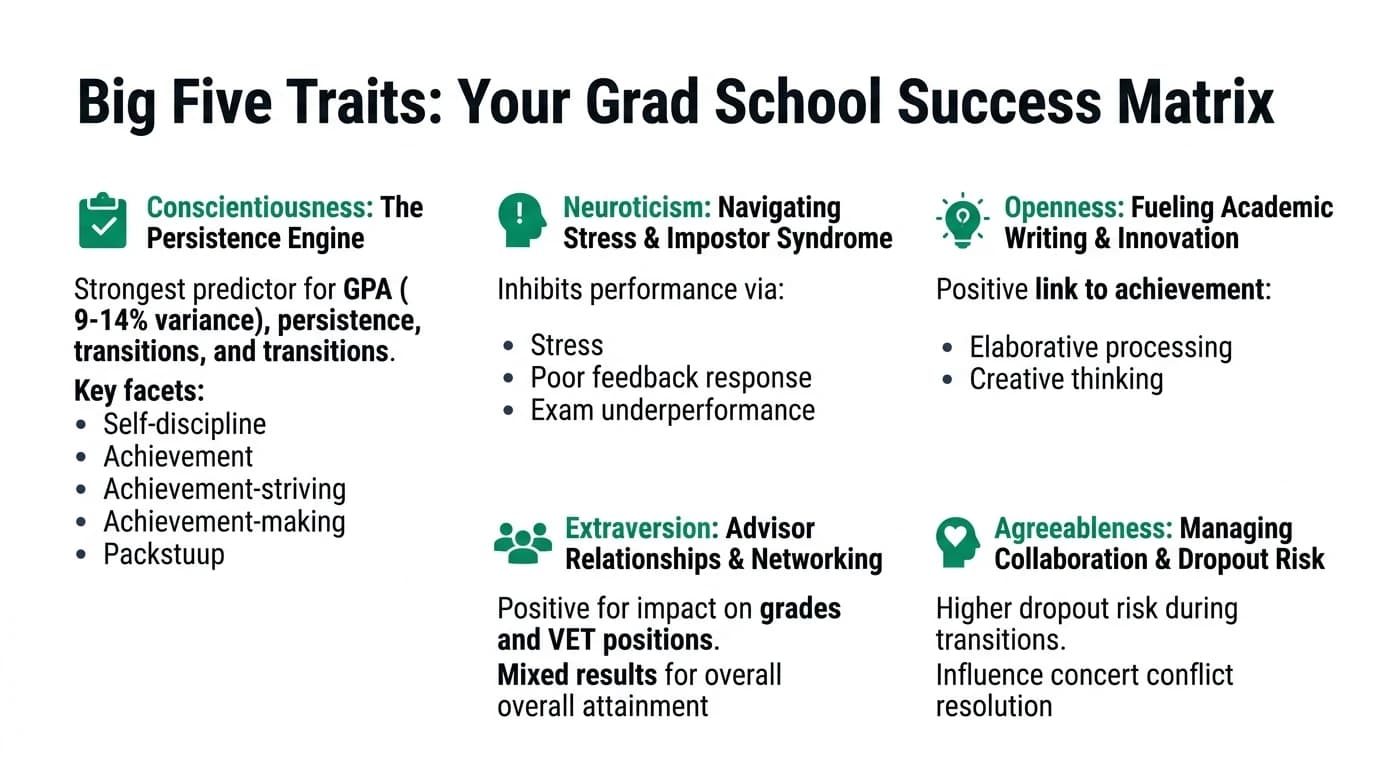
Conscientiousness is consistently the strongest predictor of academic success in graduate school, influencing factors like GPA, persistence, and successful transitions through programs. It's linked to achievement-striving and self-discipline, explaining a significant portion of academic performance variance.
Source: St. John's University Scholar, Frontiers in Psychology
Executive Summary
Embarking on a PhD or graduate program is a challenging journey, and your personality plays a significant role in how you navigate its demands. The Big Five personality traits—Conscientiousness, Neuroticism, Openness to Experience, Extraversion, and Agreeableness—offer a powerful framework for understanding your strengths and potential hurdles in academia. These traits can influence everything from your relationships with advisors to your ability to persist through setbacks and produce high-quality academic writing.
Research consistently highlights Conscientiousness as the most impactful trait for academic achievement, driving persistence and self-discipline. Conversely, Neuroticism can exacerbate stress and impostor syndrome, while Openness fosters creativity and deep learning. Understanding these connections can empower you to leverage your natural tendencies and develop strategies to overcome challenges, ultimately enhancing your graduate school experience and success.
The bottom line: Your personality isn't just a fixed set of characteristics; it's a dynamic blueprint that, when understood, can be strategically managed to optimize your graduate school journey.
Critical Warning: While personality traits predict academic outcomes, they are correlations, not direct causes. Success is multifaceted, influenced by cognitive ability, socioeconomic status, and institutional support. This guide offers insights, not deterministic predictions.
What Are the Big Five Personality Traits?
The Big Five, also known as the Five-Factor Model (FFM), is a widely accepted framework in psychology for describing human personality. It suggests that most individual differences in personality can be grouped into five broad dimensions. These traits are considered relatively stable throughout adulthood and exist on a spectrum, meaning you can be high, low, or somewhere in the middle for each.
Understanding these traits provides a common language for discussing personality and its impact on various life domains, including academic pursuits.
The Big Five at a Glance for Graduate Students
| Trait | Core Characteristic | Impact on Grad School |
|---|---|---|
| Conscientiousness | Organized, disciplined, responsible, goal-oriented | Strongest predictor of GPA, persistence, and timely completion 12 |
| Openness to Experience | Curious, imaginative, intellectual, open to new ideas | Fosters creativity in research, aids academic writing, elaborative processing 1 |
| Extraversion | Outgoing, sociable, energetic, assertive | Helps with networking, advisor relationships, but can sometimes divide focus 32 |
| Agreeableness | Cooperative, empathetic, kind, trusting | Supports collaborative work, but high levels can lead to conflict avoidance 3 |
| Neuroticism | Anxious, moody, emotionally unstable, prone to worry | Linked to stress, impostor syndrome, poor feedback response, exam anxiety 4 |
Conscientiousness: The Driving Force Behind Graduate Success
Conscientiousness stands out as the most consistent and powerful predictor of academic success in graduate school. This trait encompasses qualities like self-discipline, organization, diligence, and a strong drive for achievement. These characteristics are incredibly valuable when facing the rigorous demands of a master's or PhD program.
Students high in Conscientiousness are more likely to set clear goals, manage their time effectively, and persist through difficult tasks, even when motivation wanes.
How Conscientiousness Fuels Academic Achievement
| Aspect of Success | Conscientiousness's Role | Research Finding |
|---|---|---|
| GPA & Grades | Strong work ethic, diligent study habits, attention to detail | Explains 9-14% of GPA variance 12 |
| Persistence | Commitment to goals, resilience in face of setbacks | Predicts all transition success indicators except dropout intentions 3 |
| Self-Discipline | Ability to regulate behavior, focus on long-term objectives | Crucial for managing large projects and deadlines |
| Achievement-Striving | High personal standards, desire to excel | Facet strongly linked to overall academic performance 2 |
| Methodical Study | Structured approach to learning, organized note-taking | Explains 30% variance in methodical study styles 1 |
Important: While Conscientiousness is generally positive, its effects can be nuanced. For example, highly conscientious individuals might sometimes struggle with adapting to unstructured research environments if their learning style is overly rigid, though this is less common 1.
Neuroticism: Navigating Stress, Impostor Syndrome, and Feedback
Neuroticism, sometimes referred to as Emotional Instability, describes a tendency to experience negative emotions like anxiety, worry, and sadness. In the high-pressure environment of graduate school, high Neuroticism can manifest as increased stress, heightened self-doubt, and a greater susceptibility to impostor syndrome.
This trait can make receiving critical feedback particularly challenging, potentially leading to underperformance or withdrawal.
The Double-Edged Sword of Neuroticism in Grad School
| Impact Area | How Neuroticism Manifests | Potential Outcome |
|---|---|---|
| Stress Response | Increased worry, anxiety over deadlines and performance | Higher risk of burnout, mental health challenges 4 |
| Impostor Syndrome | Persistent feelings of inadequacy despite evidence of success | Inhibits confidence, reduces participation, fear of exposure |
| Feedback Processing | Tendency to interpret criticism personally, defensiveness | Hinders learning, strains advisor relationships 4 |
| Exam Performance | High test anxiety, difficulty concentrating under pressure | Linked to worse exam outcomes 4 |
| Motivation (Paradoxical) | Can drive over-preparation and extra effort due to anxiety | High Neuroticism combined with ambition may boost achievement 4 |
Strategies for managing high Neuroticism:
- Mindfulness & Stress Reduction: Practice techniques to manage anxiety.
- Reframing Feedback: View criticism as constructive data, not personal attack.
- Seek Support: Connect with peers, mentors, or university counseling services.
- Focus on Process: Celebrate small wins and progress, not just outcomes.
Openness to Experience: Fueling Creativity and Academic Writing
Openness to Experience reflects a person's intellectual curiosity, imagination, and willingness to embrace new ideas, concepts, and unconventional approaches. For graduate students, especially those in research-intensive fields, high Openness is a significant asset. It fosters creativity in problem-solving, encourages interdisciplinary thinking, and positively influences academic writing productivity.
This trait is strongly linked to "elaborative processing," a deep learning style where individuals connect new information to existing knowledge, leading to richer understanding and more sophisticated written output 1.
Openness and Its Contributions to Academic Writing & Research
| Aspect | Role of Openness | Benefit for Grad Students |
|---|---|---|
| Creative Thinking | Generates novel ideas, explores diverse perspectives | Essential for original research, thesis development |
| Elaborative Processing | Connects new info to existing knowledge, deep understanding | Improves comprehension, leads to more nuanced writing 1 |
| Interdisciplinary Work | Willingness to integrate concepts from different fields | Crucial for innovative research, broadens academic scope |
| Academic Writing Quality | Richer vocabulary, complex sentence structures, conceptual depth | Produces more sophisticated and impactful papers |
| Learning Styles | Explains 43% variance in synthesis-analysis learning style 1 | Adaptability in learning, strong analytical skills |
Key Takeaway: While Openness enhances creativity and writing, it needs the structure provided by Conscientiousness to ensure deadlines are met and projects are completed efficiently. A balance is often ideal for sustained productivity.
Extraversion and Agreeableness: Advisor Relationships and Social Dynamics
The social traits of Extraversion and Agreeableness play a unique role in the graduate school experience, particularly concerning advisor relationships, networking, and collaborative work. While often seen as beneficial, their impact can be nuanced, sometimes presenting both advantages and disadvantages.
Extraversion: Networking and Visibility
| Positive Impact | Negative Impact/Consideration |
|---|---|
| Strong Advisor Bonds | Initiates conversations, builds rapport easily 3 |
| Networking Opportunities | Comfortable attending conferences, meeting new people |
| Class Participation | More likely to speak up, contribute to discussions |
| Mentorship Seeking | Proactively seeks guidance and support from faculty |
Agreeableness: Collaboration and Conflict
| Positive Impact | Negative Impact/Consideration | |---|---|---| | Collaborative Work | Cooperative, empathetic, fosters positive group dynamics | Can lead to conflict avoidance, difficulty saying "no" 3 | | Peer Support | Builds strong relationships with fellow students | Higher dropout risk during program transitions if unable to advocate 3 | | Team Projects | Contributes positively to shared goals, reduces friction | May endure toxic lab environments to maintain harmony | | Advisor Harmony | Generally avoids conflict, seeks consensus | Can struggle to challenge advisor's ideas, even when appropriate |
Critical Insight: While Extraversion can open doors, and Agreeableness can foster collaboration, an overreliance on either can sometimes detract from the solitary, focused work often required in graduate studies. Finding a balance is key.
Beyond Broad Traits: The Power of Personality Facets
While the Big Five traits provide a broad overview, personality psychology research suggests that narrower "facets" (sub-components of each trait) often offer even stronger predictions for specific academic outcomes. For instance, within Conscientiousness, specific facets like "achievement-striving" or "self-discipline" can be more predictive of GPA than Conscientiousness as a whole 2.
Focusing on facets allows for a more granular understanding of how personality influences behavior in academic settings.
Broad Traits vs. Specific Facets: A Closer Look
| Broad Trait | Key Facet | Specific Academic Impact | Research Finding |
|---|---|---|---|
| Conscientiousness | Achievement-Striving | Strong desire to excel, sets high standards | Stronger predictor of GPA than broad Conscientiousness 2 |
| Self-Discipline | Ability to control impulses, persist on tasks | Crucial for meeting deadlines and long-term projects | |
| Dutifulness | Sense of obligation, adherence to rules | Predicts GPA, but can be suppressed by elaborative styles 1 | |
| Extraversion | Exhibition | Desire to be the center of attention, express oneself | Stronger for participation grades than broad Extraversion 2 |
| Openness | Intellect | Active pursuit of intellectual experiences, curiosity | Linked to deep learning and analytical skills |
| Neuroticism | Anxiety | Tendency to experience worry, fear, nervousness | Directly linked to exam stress and underperformance 4 |
Why facets matter:
- Precision: Facets offer a more precise understanding of specific behaviors.
- Targeted Strategies: Knowing which facet is at play allows for more tailored interventions or development plans.
- Nuance: Explains why a "conscientious" person might still struggle with certain tasks (e.g., high dutifulness but low achievement-striving).
Strategies for Leveraging Your Personality in Grad School
Understanding your Big Five profile isn't just for self-awareness; it's a powerful tool for developing targeted strategies to thrive in graduate school. By playing to your strengths and proactively addressing potential challenges, you can optimize your experience.
Trait-Specific Strategies for Success
| Your Trait Profile | Leverage This Strength | Address This Challenge |
|---|---|---|
| High Conscientiousness | Discipline & Organization: Excel at planning, meeting deadlines. | Rigidity: Be open to adapting plans, embracing ambiguity in research. |
| High Openness | Creativity & Curiosity: Pursue novel research questions, interdisciplinary work. | Focus: Structure creative bursts with deadlines; ensure completion. |
| High Extraversion | Networking & Collaboration: Build strong advisor ties, seek mentorship. | Distraction: Balance social engagement with solitary deep work. |
| High Agreeableness | Teamwork & Empathy: Foster positive lab environment, collaborate effectively. | Conflict Avoidance: Practice assertive communication, set boundaries. |
| High Neuroticism | Detail-Oriented (due to worry): Thoroughly check work, anticipate issues. | Stress & Impostor Syndrome: Develop coping mechanisms, seek support, reframe feedback. |
General Tips for All Graduate Students:
- Self-Assessment: Take a reliable Big Five assessment to understand your profile.
- Reflect & Plan: Consider how your traits align with your program's demands.
- Seek Mentorship: Find mentors who can guide you in areas where your traits might pose challenges.
- Develop Coping Skills: Learn stress management, time management, and communication techniques.
- Embrace Growth: Personality traits are relatively stable, but behaviors can be learned and adapted.
The Interplay of Traits: How Combinations Affect Your Journey
Personality traits rarely act in isolation; they often combine in complex ways to influence behavior and outcomes. Understanding these combinations can provide even deeper insights into your graduate school experience. For instance, high Neuroticism combined with high ambition might drive intense effort, while high Openness without sufficient Conscientiousness could lead to many ideas but few completed projects.
These interactions highlight the dynamic nature of personality and its impact on academic life.
Trait Combinations and Their Graduate School Outcomes
| Trait Combination | Potential Outcome in Grad School | Example Scenario |
|---|---|---|
| High Neuroticism + High Ambition | May lead to high achievement through intense effort and over-preparation 4 | An anxious student over-prepares for exams, leading to top grades. |
| High Openness + Low Conscientiousness | Many creative ideas, but difficulty completing projects or meeting deadlines | A brilliant researcher with groundbreaking ideas struggles to publish due to disorganization. |
| High Extraversion + Low Agreeableness | Effective networking, but potential for interpersonal friction or perceived arrogance | A student excels at presenting but struggles with collaborative writing due to assertiveness. |
| High Conscientiousness + High Agreeableness | Excellent collaborator, reliable team member, but may struggle to challenge ideas | A student consistently delivers on group projects but avoids questioning advisor's direction. |
| Low Openness + High Conscientiousness | Methodical and diligent, but may resist novel approaches or interdisciplinary work | A student excels in a traditional field but finds interdisciplinary seminars challenging. |
Important Consideration: While these combinations offer insights, individual experiences vary greatly. Self-awareness and proactive strategy development remain crucial.
Action Checklist for Graduate Students
- Take a reputable Big Five personality test to understand your profile.
- Identify 1-2 key strengths from your traits and brainstorm how to leverage them in your studies.
- Pinpoint 1-2 potential challenges related to your traits (e.g., high Neuroticism, low Conscientiousness).
- Develop specific strategies to mitigate these challenges (e.g., stress management, time blocking).
- Schedule a meeting with your advisor to discuss your working style and expectations.
- Seek out peer support or mentorship to gain diverse perspectives and coping strategies.
- Practice self-compassion and acknowledge that graduate school is a marathon, not a sprint.
FAQ
Does Conscientiousness predict PhD completion rates?
Yes, Conscientiousness is a strong predictor of persistence and successful transitions through academic programs, which indirectly links to higher completion rates. It predicts all transition success indicators except dropout intentions 3.
How does Neuroticism cause impostor syndrome in grad school?
Neuroticism's tendency towards anxiety, self-doubt, and negative emotional responses makes individuals more susceptible to impostor syndrome. They may internalize critical feedback, constantly worry about their competence, and feel like a fraud despite their achievements 4.
Can high Openness improve academic writing productivity?
High Openness to Experience is positively linked to academic writing quality and productivity, primarily through its association with elaborative processing and creative thinking. It helps individuals generate novel ideas and express them with greater conceptual depth 1.
Is Extraversion helpful or harmful for advisor relationships?
Extraversion can be helpful for initiating and maintaining strong advisor relationships through networking and open communication. However, research shows mixed results; while positive for grades and certain professional positions, it can sometimes be negatively associated with overall educational attainment, possibly due to divided focus 32.
Which Big Five trait best predicts persistence in graduate programs?
Conscientiousness is the Big Five trait that best predicts persistence in graduate programs. Its facets like self-discipline and achievement-striving are crucial for navigating long-term academic demands and overcoming setbacks 3.
How do Big Five traits affect GPA beyond cognitive ability?
Does Agreeableness increase dropout risk in PhD programs?
High Agreeableness can be associated with an increased dropout risk during program transitions. This might be due to a tendency to avoid conflict or difficulty asserting personal needs in challenging academic environments 3.
Are personality facets stronger predictors than broad Big Five traits?
Yes, narrow personality facets (e.g., achievement-striving within Conscientiousness) are often stronger and more precise predictors of specific academic outcomes than the broad Big Five traits themselves 2.
Notes
Primary Sources
| Source | Type | URL |
|---|---|---|
| St. John's University Scholar | Peer-reviewed dissertation | scholar.stjohns.edu/cgi/viewcontent.cgi?article=1656&context=theses |
| Frontiers in Psychology | Peer-reviewed journal (2020) | frontiersin.org/journals/psychology/articles/10.3389/fpsyg.2020.01827/full |
| Appalachian State University (via PDF) | Peer-reviewed meta-review (2007) | classdat.appstate.edu/faculty/cochranjj/Big_Five_personality_predictors_of_postsecondary_academic_achievement.pdf |
| APA GradPsych | Official psych association article (2012) | apa.org/gradpsych/2012/09/cover-impedes-success |
Conclusion
Your journey through PhD and graduate school is deeply intertwined with your personality. The Big Five traits offer a robust framework for understanding how you approach challenges, interact with peers and advisors, and ultimately achieve your academic goals. Conscientiousness emerges as a superstar trait, driving persistence and high performance, while Neuroticism presents hurdles like stress and impostor syndrome that require proactive management. Openness fuels creativity and sophisticated academic writing, and the social traits of Extraversion and Agreeableness shape your relationships and collaborative experiences.
By recognizing your unique personality profile, you gain a powerful advantage. This self-awareness allows you to leverage your strengths, develop targeted strategies for areas of growth, and navigate the complex demands of advanced academic study with greater confidence and effectiveness. Your personality isn't just who you are; it's a tool you can use to sculpt your success.
Footnotes
-
St. John's University Scholar. (n.d.). The Big Five Personality Traits and Learning Styles as Predictors of Academic Achievement. Retrieved from scholar.stjohns.edu/cgi/viewcontent.cgi?article=1656&context=theses. This dissertation provides data on Big Five explaining GPA variance and learning style mediation. ↩ ↩2 ↩3 ↩4 ↩5 ↩6 ↩7 ↩8 ↩9 ↩10 ↩11
-
Stricker, L. J., & Rock, D. A. (2007). The Big Five Personality Predictors of Postsecondary Academic Achievement: A Meta-Analytic Review. Appalachian State University. This meta-review emphasizes that facets are stronger predictors than broad traits. (PDF accessed via classdat.appstate.edu/...) ↩ ↩2 ↩3 ↩4 ↩5 ↩6 ↩7 ↩8 ↩9 ↩10
-
Wiese, B. S., & Zacher, H. (2020). Personality and Academic Success in Higher Education: The Role of the Big Five and Vocational Interests. Frontiers in Psychology, 11, 1827. Retrieved from frontiersin.org/journals/psychology/articles/10.3389/fpsyg.2020.01827/full. This study highlights Conscientiousness in predicting transitions and Agreeableness with dropout risk. ↩ ↩2 ↩3 ↩4 ↩5 ↩6 ↩7 ↩8 ↩9 ↩10
-
American Psychological Association. (2012). GradPsych: Does your personality impede success? Retrieved from apa.org/gradpsych/2012/09/cover-impedes-success. This article discusses Neuroticism's role in stress, feedback response, and the ambition interplay. ↩ ↩2 ↩3 ↩4 ↩5 ↩6 ↩7 ↩8