career
Personality and Military Service: Insights from the Big Five
Explore how Big Five personality traits influence military enlistment, leadership, combat stress adaptation, and transition to civilian life.
Quick answer
How do Big Five personality traits impact military service?
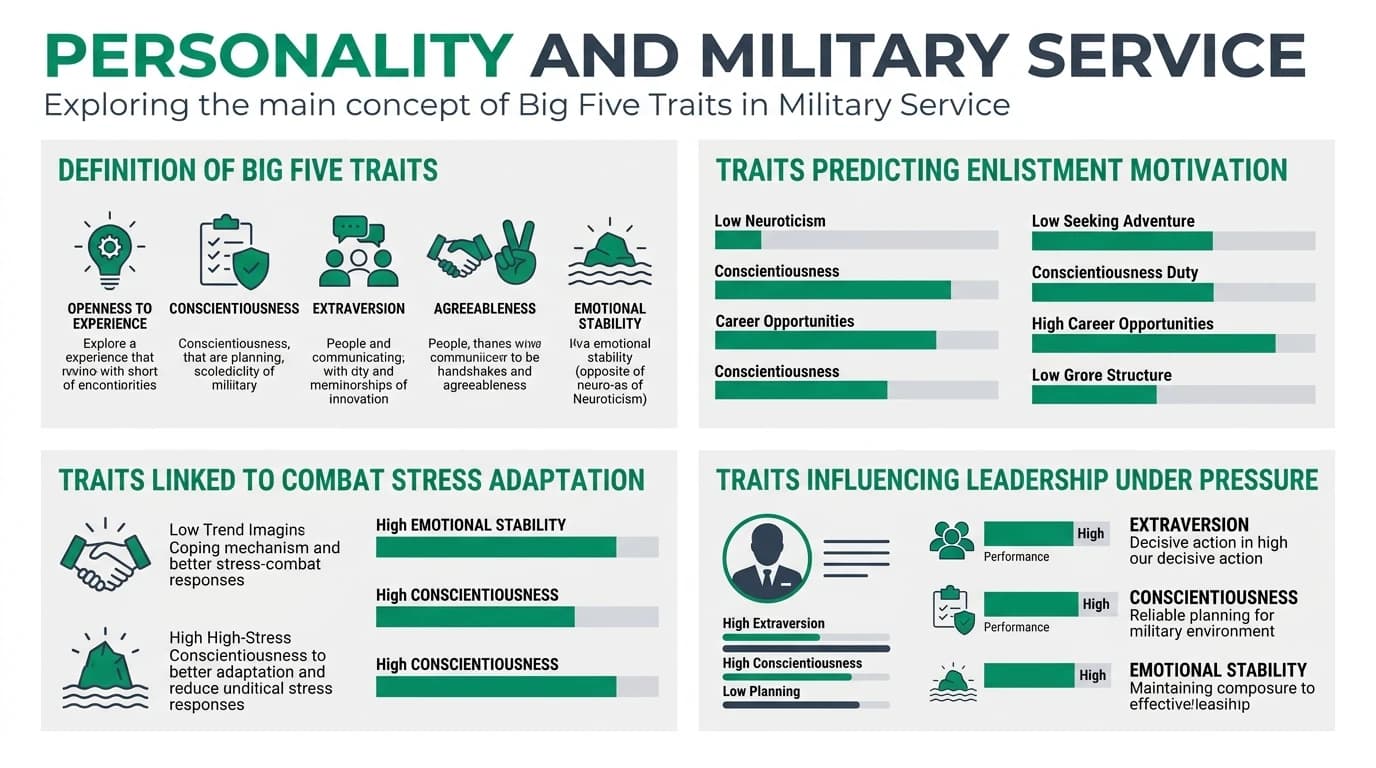
The Big Five traits—neuroticism, extraversion, openness, agreeableness, and conscientiousness—affect enlistment motivation, leadership effectiveness, combat stress adaptation, and transitions to civilian life.
Source: Frontiers in Psychology
Executive Summary
The Big Five personality traits—neuroticism, extraversion, openness, agreeableness, and conscientiousness—play a crucial role in military service. These traits influence everything from enlistment motivation to leadership under pressure and adaptation to combat stress.
The bottom line: Understanding these traits can improve recruitment, training, and support for veterans transitioning to civilian life.
Critical Warning: Findings from specific militaries (US, Norwegian, German) may not generalize; consult professionals for individual assessments.
What Are the Big Five Personality Traits?
The Big Five traits offer a framework for understanding personality:
- Neuroticism: Emotional instability.
- Extraversion: Sociability and assertiveness.
- Openness: Willingness to experience new things.
- Agreeableness: Tendency to be cooperative.
- Conscientiousness: Diligence and organization.
These traits are used to predict military performance and leadership effectiveness.
| Trait | Definition | Military Benefit |
|---|---|---|
| Neuroticism | Emotional instability | Low levels reduce stress |
| Extraversion | Sociability | Enhances leadership |
| Openness | New experiences | Aids adaptability |
| Agreeableness | Cooperation | Influences team dynamics |
| Conscientiousness | Diligence | Improves task performance |
How Do Traits Influence Enlistment Motivation?
Certain traits predict who is more likely to enlist:
- Low Agreeableness: Less concern for social harmony.
- Low Neuroticism: Better stress handling.
- Low Openness: Preference for structured environments.
| Trait | Enlistment Likelihood | Civilian Comparison |
|---|---|---|
| Low Agreeableness | High | Lower in civilians |
| Low Neuroticism | High | Similar to civilians |
| Low Openness | High | Lower in civilians |
Predicting Performance with Personality
Traits like extraversion and conscientiousness correlate with military success:
- Extraversion: Effective in social and active roles.
- Conscientiousness: Excels in structured tasks.
| Trait | Performance Impact | Key Study |
|---|---|---|
| Extraversion | Boosts social leadership | [1] |
| Conscientiousness | Enhances task performance | [1] |
Special Forces and Personality Profiles
Special forces like NORSOF have distinct personality profiles:
- High Extraversion: Essential for dynamic environments.
- Emotional Stability: Critical for high-stress situations.
| Department | Trait Averages | Rank Impact |
|---|---|---|
| NORSOF | High Extraversion | Minimal |
| High Emotional Stability | Minimal |
Combat Stress and Personality Adaptation
Neuroticism is linked to combat stress outcomes:
- High Neuroticism: Increases risk of PTSS and depression.
- Emotional Stability: Improves with age, aiding adaptation.
| Symptom | Linked Trait | Pre-Deployment Role |
|---|---|---|
| PTSS | High Neuroticism | Risk factor |
| Depression | High Neuroticism | Risk factor |
Leadership Under Pressure
Traits determine leadership effectiveness in different environments:
- Low Neuroticism: Reduces stress vulnerability.
- High Extraversion: Benefits social leadership.
- High Conscientiousness: Ideal for structured settings.
| Environment | Best Trait | Performance Impact |
|---|---|---|
| Social | Extraversion | Enhanced leadership |
| Structured | Conscientiousness | Improved outcomes |
Does Military Service Change Personality Traits?
Military service can alter personality traits:
- Agreeableness: Often decreases, impacting post-service life.
- Neuroticism and Openness: Tend to remain stable.
| Time Point | Group | Change Level |
|---|---|---|
| Post-Service | Military | Lower Agreeableness |
| Workforce | Military | Persistent changes |
Transition to Civilian Life
Personality traits affect how veterans adjust to civilian life:
- Low Agreeableness: Challenges in teamwork.
- Conscientiousness: Aids in structured roles.
Important: Veterans may need support to adapt to civilian environments, considering persistent personality changes.
Action checklist
- Understand the Big Five traits and their military implications.
- Consider personality profiles in recruitment and training.
- Support veterans in adapting to civilian life.
FAQ
How do Big Five traits influence military enlistment decisions?
Which personality traits predict success in special forces?
Does low neuroticism help with combat stress?
Can military training change Big Five personality traits?
Why is extraversion key for military leaders under pressure?
How does conscientiousness affect soldier performance?
Do personality traits impact veteran transition to civilian life?
Notes
Primary Sources
| Source | Type | URL |
|---|---|---|
| Cove.army.gov.au (Paul Bartone et al., Emerald Insight) | Peer-reviewed | Link |
| Frontiers in Psychology | Peer-reviewed | Link |
| Army University Press | Official/military | Link |
| IVMF Syracuse University | Peer-reviewed PDF | Link |
| UT Austin Repositories | Academic repository | Link |
Conclusion
Understanding the Big Five personality traits offers valuable insights into military service dynamics. These traits influence everything from enlistment motivation to leadership and stress adaptation, impacting both active duty and veteran life.