personality-tests
Big Five Personality Traits for Life and Wellness Coaching: Client Rapport, Ethics, and Professional Fit
Explore how the Big Five personality traits (Openness, Conscientiousness, Extraversion, Agreeableness, Neuroticism) influence success in life and wellness coaching careers, focusing on client rapport, ethical practice, and finding your professional fit.
Quick answer
What are the Big Five personality traits?
The Big Five personality traits, often remembered by the acronym OCEAN, are Openness to Experience (curiosity and imagination), Conscientiousness (organization and discipline), Extraversion (sociability and assertiveness), Agreeableness (compassion and cooperation), and Neuroticism (emotional stability versus sensitivity). This widely accepted model helps predict behavior and is highly applicable in coaching for developing personalized plans and fostering effective client relationships.
Source: PositivePsychology.com
Executive Summary
Understanding your personality, especially through the lens of the Big Five traits, can be a game-changer if you're looking into a career in life or wellness coaching. These traits—Openness, Conscientiousness, Extraversion, Agreeableness, and Neuroticism—aren't just labels; they're powerful indicators of how you'll connect with clients, uphold ethical standards, and thrive in your professional role. They help shape everything from how you build trust to how you manage stress and adapt to new challenges.
In this guide, we'll explore each Big Five trait and its direct impact on your coaching journey. We'll look at how certain traits can boost your client rapport, ensure you practice ethically, and ultimately help you find a career path that truly fits your unique strengths. Whether you're an aspiring coach or an experienced professional, this insight can help you refine your approach and achieve greater success.
The bottom line: Your personality isn't just a part of who you are; it's a vital tool in your coaching toolkit. Leveraging your Big Five strengths can lead to more impactful client relationships and a fulfilling career.
Critical Warning: While the Big Five traits offer valuable insights, remember that personality is not entirely fixed. Traits can evolve over time, and self-awareness, continuous learning, and professional development are just as crucial as your inherent traits for long-term coaching success. Always consult licensed professionals for formal assessments or clinical guidance.
What Are the Big Five Personality Traits (OCEAN)?
The Big Five personality traits, often called the OCEAN model, represent a widely accepted framework in psychology for understanding human personality. Instead of categorizing people into rigid types, this model describes personality along five broad dimensions, each existing on a spectrum. These traits are considered fundamental because they are consistently found across different cultures and age groups, offering a robust way to describe individual differences 1.
For coaches, understanding the Big Five is like having a map to navigate human behavior. It helps you anticipate how clients might respond, tailor your communication style, and even understand your own strengths and areas for growth as a coach. It's about recognizing patterns to build more effective and empathetic relationships 1.
Here's a quick look at each trait and its general relevance to coaching:
| Trait | Description (High Score) | Coaching Relevance |
|---|---|---|
| Openness to Experience | Imaginative, curious, open to new ideas, artistic, unconventional. | Fosters creative problem-solving, adaptability, and embracing diverse client perspectives. |
| Conscientiousness | Organized, disciplined, responsible, goal-oriented, dependable. | Drives structured coaching, ensures accountability, and promotes client progress and reliability. |
| Extraversion | Outgoing, energetic, assertive, sociable, enjoys social interaction. | Helps in engaging clients, networking, and maintaining dynamic session energy. |
| Agreeableness | Compassionate, cooperative, trusting, empathetic, kind. | Essential for building strong client rapport, fostering trust, and empathetic listening. |
| Neuroticism | Prone to anxiety, moodiness, emotional instability, sensitive to stress. | (Low score is beneficial) Indicates emotional stability, resilience, and calm under pressure, crucial for ethical practice. |
How Do Big Five Traits Predict Coaching Success?
Certain personality traits from the Big Five model consistently appear in profiles of successful coaches. It's not about having a "perfect" score in every area, but rather a beneficial combination that supports the unique demands of coaching. These traits help coaches effectively guide clients, manage challenges, and sustain a thriving practice 2.
Coaching requires a blend of empathy, structure, resilience, and adaptability. When coaches embody these qualities through their personality traits, they're better equipped to create a positive impact. Understanding which traits are most predictive can help aspiring coaches identify their natural strengths and areas for development 2.
Here are the key Big Five traits that often predict success in coaching:
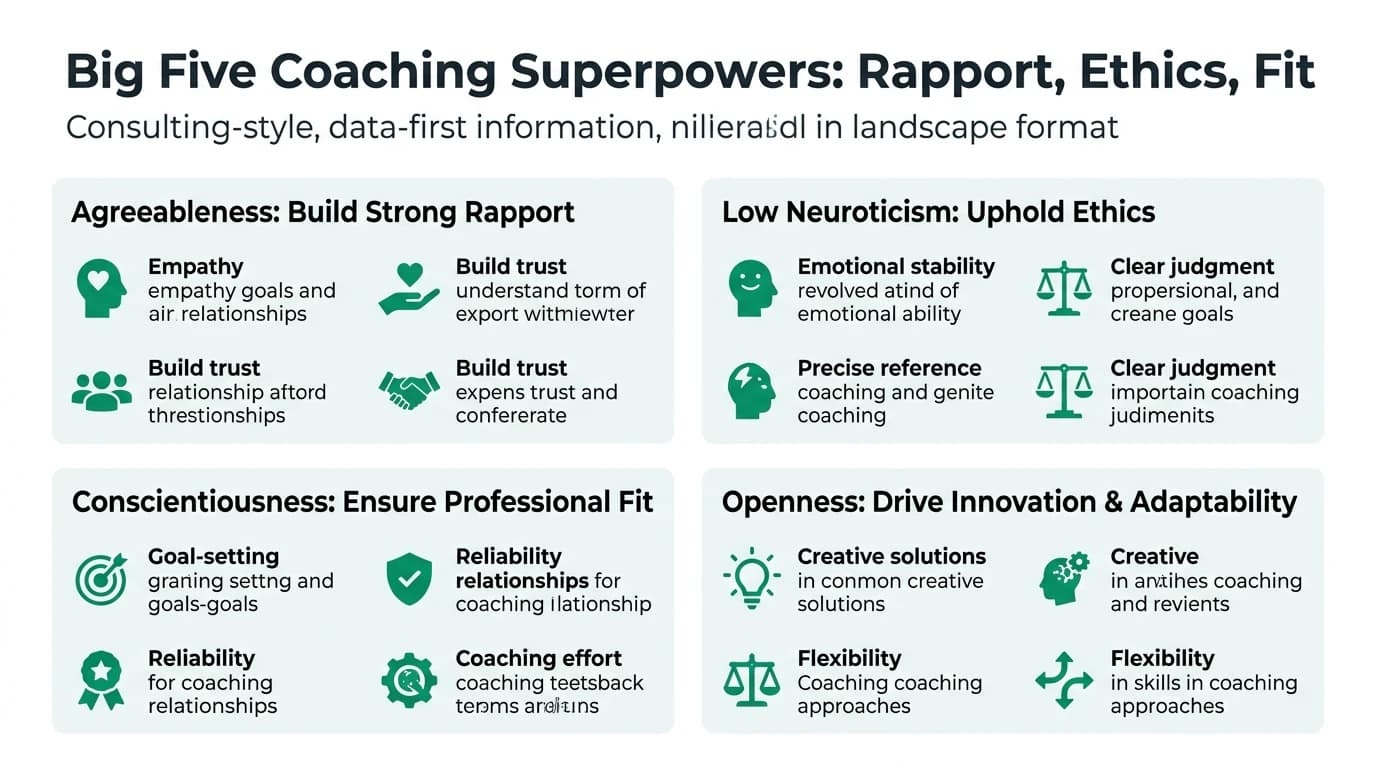
- High Conscientiousness: Coaches with this trait excel at goal-setting, dependability, and ensuring clients follow through on actions. They bring structure and accountability to sessions.
- High Agreeableness: This trait is crucial for empathy, rapport-building, and creating a safe, trusting environment where clients feel understood and supported.
- Moderate Extraversion: While high Extraversion can be engaging, a moderate level allows coaches to be assertive and energetic without dominating the conversation, ensuring active listening.
- Low Neuroticism: Essential for stress management, emotional stability, and maintaining composure, especially when clients are in distress or facing difficult situations.
- High Openness to Experience: This trait fosters adaptability, innovation, and a willingness to explore diverse perspectives and creative solutions with clients [^1, ^6].
To give you a clearer picture, here's how high-performing coaches often compare to leaders in general, highlighting the shared and distinct traits:
| Trait | Ideal for Coaches | Ideal for Leaders | Benefit in Role | Source |
|---|---|---|---|---|
| Conscientiousness | High | High | Discipline, goal achievement, reliability | 2 |
| Agreeableness | High | High | Trust, collaboration, team cohesion | 2 |
| Extraversion | Moderate | Moderate | Engaging communication, balanced influence | 2 |
| Neuroticism | Low | Low | Resilience, calm under pressure, stable decision-making | 2 |
| Openness | High | Varies (often high for innovation) | Creativity, adaptability, embracing new ideas | [^1, ^6] |
Conscientiousness: The Foundation of Professional Reliability
Conscientiousness is a cornerstone trait for any professional role, but it holds particular significance in coaching. Coaches high in Conscientiousness are typically organized, disciplined, and highly dependable. They approach their work with a strong sense of duty and a commitment to excellence, which directly translates into positive client experiences and outcomes 3.
This trait helps coaches structure sessions effectively, set clear goals with clients, and ensure accountability. Clients benefit from a coach who is punctual, prepared, and consistent in their approach, fostering trust and a sense of progress. Without a good degree of conscientiousness, even the most empathetic coach might struggle to deliver consistent results 1.
Here's how Conscientiousness impacts various aspects of coaching:
| Aspect | High Conscientiousness | Low Conscientiousness |
|---|---|---|
| Goal Setting | Excellent at breaking down big goals into actionable steps, tracking progress. | May struggle with structured goal setting, leading to vague objectives. |
| Client Accountability | Consistently follows up, holds clients to commitments, provides clear frameworks. | Inconsistent follow-up, less emphasis on client accountability, leading to missed steps. |
| Session Preparation | Always prepared for sessions, organized notes, relevant resources ready. | May appear disorganized, unprepared, or rush through session planning. |
| Professional Ethics | Adheres strictly to professional standards, timely communication, reliable. | Might occasionally miss deadlines, forget commitments, or appear less reliable. |
| Client Outcomes | Drives consistent progress, helps clients achieve measurable results. | Client progress may be sporadic or less defined due to lack of structure. |
Key Takeaways for Conscientiousness:
- Structure: High Conscientiousness provides the framework for effective coaching, ensuring sessions are productive and goal-oriented.
- Trust: Clients trust coaches who are reliable and consistent, which is a direct outcome of this trait.
- Development: If you're naturally less conscientious, developing organizational habits and time management skills can significantly boost your coaching effectiveness.
Agreeableness: Building Strong Client Rapport and Empathy
Agreeableness is perhaps the most direct link to building strong client rapport in coaching. Coaches high in Agreeableness are typically warm, compassionate, empathetic, and cooperative. They genuinely care about others' well-being and strive to create a harmonious and supportive environment 1. This trait is vital for fostering the trust and psychological safety that clients need to open up and engage deeply in the coaching process.
An agreeable coach listens actively, validates feelings, and responds with understanding rather than judgment. This creates a powerful connection, making clients feel heard, respected, and valued. Without a foundation of Agreeableness, even the most skilled coach might struggle to form the deep, trusting relationships necessary for transformative work 2.
Here's a look at the pros and cons of Agreeableness in the context of client rapport:
| Trait Aspect | Pros in Coaching Rapport | Cons/Risks in Coaching Rapport |
|---|---|---|
| Empathy | Deeply understands client emotions; validates experiences; builds strong emotional connection. | Can lead to over-identification with client problems; difficulty maintaining objectivity. |
| Trust | Fosters immediate trust; clients feel safe to share vulnerabilities; builds loyalty. | May struggle to deliver tough feedback; risk of being perceived as too soft or easily swayed. |
| Cooperation | Encourages collaborative problem-solving; clients feel like a partner in their journey. | Can lead to avoiding necessary confrontation; difficulty setting firm boundaries. |
| Conflict Resolution | Skilled at de-escalating tension; finds common ground; promotes harmony. | Might prioritize harmony over challenging clients when necessary for growth. |
| Client Retention | High rapport leads to stronger client relationships and longer-term engagement. | May struggle to end engagements when appropriate, due to desire to please. |
Key Takeaways for Agreeableness:
- Connection: High Agreeableness is a superpower for forging deep, meaningful connections with clients.
- Balance: While highly beneficial, coaches must balance empathy with the ability to challenge clients constructively and maintain professional boundaries.
- Active Listening: This trait naturally enhances active listening, a core coaching skill.
Extraversion: Balancing Influence and Active Listening
Extraversion in coaching is about finding the right balance. Highly extraverted coaches are often energetic, enthusiastic, and skilled communicators. They can create a dynamic atmosphere, easily engage clients, and are comfortable leading conversations. This can be fantastic for initial consultations, networking, and keeping energy levels high during sessions 4.
However, too much Extraversion can sometimes overshadow the client's voice. Coaching is fundamentally client-centered, requiring deep listening and space for the client to explore their own thoughts. A moderately extraverted coach can leverage their energy and communication skills while still prioritizing active listening and allowing the client to drive the session 2.
Here's how Extraversion plays out in different coaching scenarios:
| Extraversion Level | Coaching Style | Client Interaction | Potential Challenges |
|---|---|---|---|
| High Extraversion | Energetic, assertive, conversational, proactive in guiding discussions. | Clients feel engaged, motivated; good for initial rapport, networking. | May dominate conversations, interrupt, or not allow enough space for client reflection. |
| Moderate Extraversion | Engaging yet balanced, good listener, assertive when needed, comfortable with silence. | Optimal for building rapport, active listening, and guiding without overpowering. | Requires conscious effort to balance natural inclination with client-centered approach. |
| Low Extraversion (Introversion) | Reflective, quiet, excellent listener, thoughtful, may prefer structured dialogue. | Clients feel deeply heard, safe to share; good for introspective work. | May need to consciously project energy, initiate conversation, or appear less dynamic. |
Optimal Balance for Coaches:
- Engage: Use your extraverted tendencies to create a welcoming and stimulating environment.
- Listen: Consciously shift to active listening, asking open-ended questions and allowing silence for client reflection.
- Adapt: Adjust your energy level to match the client's needs and the session's goals.
Neuroticism: Fostering Emotional Stability and Ethical Practice
In the Big Five model, Neuroticism refers to a person's tendency to experience negative emotions like anxiety, worry, and mood swings. For coaches, a low score in Neuroticism (indicating high emotional stability) is highly beneficial. Coaches with low Neuroticism are typically calm, resilient, and able to manage stress effectively, even in challenging situations 2.
This emotional stability is critical for ethical practice. Coaches often deal with sensitive topics and clients in vulnerable states. A coach who remains composed and objective can provide a safe, stable presence, make sound decisions, and maintain professional boundaries. High Neuroticism, conversely, can lead to emotional reactivity, burnout, and potentially compromise the coaching relationship and ethical standards 2.
Here's a quick reference for how Neuroticism impacts coaching ethics and practice:
| Trait Aspect | Ethical Strength (Low Neuroticism) | Risk if Extreme (High Neuroticism) |
|---|---|---|
| Emotional Stability | Maintains composure under pressure; provides a steady, reassuring presence for clients. | Prone to emotional reactivity; may project personal anxieties onto clients; difficulty managing client distress. |
| Decision-Making | Makes rational, objective decisions, even in ambiguous or high-stakes situations. | Impulsive or anxious decision-making; second-guessing; difficulty providing clear guidance. |
| Resilience | Recovers quickly from setbacks; manages stress effectively; avoids burnout. | High risk of burnout; difficulty coping with challenging clients or negative feedback; may withdraw. |
| Professional Boundaries | Clearly defines and maintains boundaries; avoids emotional entanglement with clients. | Blurring of boundaries; over-involvement; difficulty separating personal feelings from professional role. |
| Ethical Conduct | Upholds professional standards consistently; acts with integrity and responsibility. | May struggle with objectivity; potential for ethical lapses under stress; difficulty maintaining confidentiality. |
Important: While low Neuroticism is ideal, it doesn't mean coaches should be emotionless. It means they possess the capacity to regulate their emotions and respond thoughtfully, rather than reactively, ensuring the client's well-being remains paramount.
Openness to Experience: Driving Innovation and Adaptability
Openness to Experience describes a person's intellectual curiosity, imagination, and willingness to try new things. Coaches high in Openness are typically creative, adaptable, and enjoy exploring novel ideas and approaches. This trait is invaluable in coaching because it allows you to think outside the box, tailor unique solutions for diverse clients, and stay current with evolving coaching methodologies 5.
In a field that often requires flexibility and creative problem-solving, an open coach can help clients explore possibilities they hadn't considered. They are less likely to stick to rigid scripts and more likely to adapt their style to the client's unique personality and situation, fostering a dynamic and engaging coaching experience 1.
Here's how Openness can manifest in innovative coaching:
| Aspect of Openness | How it Benefits Coaching | Example in Practice |
|---|---|---|
| Intellectual Curiosity | Drives continuous learning; explores new theories and techniques; asks insightful questions. | A coach researches mindfulness techniques for a client struggling with stress, even if it's outside their usual methods. |
| Imagination & Creativity | Develops unique exercises and metaphors; helps clients visualize new futures; finds unconventional solutions. | A coach uses a storytelling approach to help a client reframe a limiting belief, rather than a standard worksheet. |
| Adaptability | Adjusts coaching style to client's personality and needs; comfortable with ambiguity; embraces change. | A coach pivots from a structured goal-setting session to an exploratory discussion when a client reveals unexpected emotional distress. |
| Broad Interests | Connects diverse fields of knowledge; brings fresh perspectives; understands varied client backgrounds. | A coach draws parallels between a client's passion for gardening and their career growth, using it as a metaphor. |
| Tolerance for Ambiguity | Comfortable with uncertainty; helps clients navigate complex, unclear situations without needing immediate answers. | A coach guides a client through a period of career transition, emphasizing exploration over immediate decision-making. |
Key Takeaways for Openness:
- Innovation: High Openness fuels creativity, allowing coaches to develop personalized and effective strategies.
- Growth: It encourages continuous learning and adaptation, keeping coaches relevant and effective in a changing world.
- Client Engagement: Clients often appreciate a coach who can offer fresh perspectives and isn't afraid to explore new territory.
Assessing Your Big Five Traits for a Coaching Career
Understanding your own Big Five profile is a powerful first step in determining your professional fit for a coaching career. It's not about finding a "perfect" score, but rather gaining self-awareness to leverage your strengths and identify areas where you might need to develop specific skills or strategies. Several tools can help you assess your traits, from informal self-reflection to validated psychometric tests 6.
Self-assessment can provide initial insights, but for a more reliable understanding, professional assessments are recommended. These tests are designed to be objective and provide a comprehensive report of your personality profile, which can then be used for career planning and personal development 7.
Here are the steps to assess your Big Five traits and how to use the results:
- Self-Reflection:
- Journaling: Write about past experiences where you excelled or struggled. Which traits seem to be at play?
- Feedback: Ask trusted friends, colleagues, or mentors for their honest observations on your personality.
- Informal Online Quizzes:
- Quick Insights: Take free, reputable online quizzes (e.g., IPIP-NEO) for a general idea. Remember these are not clinical assessments.
- Initial Data: Use these as a starting point for further exploration.
- Professional Psychometric Assessments:
- Validation: Seek out scientifically validated tests administered by qualified professionals or reputable platforms (e.g., Hogan Assessments).
- In-depth Report: These provide detailed reports and often include interpretations relevant to career development.
- Interpret Results with a Coach/Mentor:
- Context: Discuss your results with an experienced coach or mentor who can help you understand their implications for your career path.
- Action Plan: Develop a plan to leverage your strengths and address any potential challenges identified.
Here's a table outlining different assessment options:
| Assessment Type | Description | Pros | Cons |
|---|---|---|---|
| Self-Reflection | Introspective journaling, asking for informal feedback from others. | Free, accessible, personal insights. | Subjective, prone to bias, lacks scientific validation. |
| Online Quizzes (e.g., IPIP-NEO) | Free, quick tests available online, often based on scientific models. | Easy to access, provides a general overview, good starting point. | Not clinically validated, results can be less precise, no professional interpretation. |
| Professional Psychometric Tests (e.g., Hogan, NEO-PI-R) | Validated tests administered by certified professionals or specialized platforms. | Highly reliable, scientifically validated, in-depth reports, professional interpretation. | Can be costly, requires time commitment, may need a certified interpreter. |
| Coaching Workshops | Programs designed to help coaches understand their own and clients' traits. | Combines assessment with practical application, group learning, peer feedback. | Varies in cost and quality, may not include formal psychometric assessment. |
Tailoring Your Coaching Approach Based on Personality
Once you understand your own Big Five traits, the next level of mastery involves recognizing and adapting to your client's personality. This isn't about diagnosing them, but about observing their tendencies and tailoring your coaching style for maximum impact. Personalizing your approach based on perceived client traits can significantly enhance rapport, communication, and ultimately, client outcomes [^1, ^5].
For example, a highly conscientious client might thrive with structured action plans and clear deadlines, while a highly open client might prefer more exploratory, creative sessions. An agreeable client might need gentle encouragement to challenge themselves, whereas a less agreeable client might respond better to direct, logical arguments. This dynamic adaptation is a hallmark of effective coaching 4.
Here are some scenarios illustrating how to tailor your coach response based on a client's likely Big Five traits:
| Client's Likely Trait | Client Behavior/Need | Coach Response (Tailored Approach) | Expected Outcome |
|---|---|---|---|
| High Conscientiousness | Seeks structure, asks for clear steps, values deadlines. | Provide detailed action plans, use SMART goals, schedule regular check-ins. | Client feels supported, motivated; consistent progress towards goals. |
| High Agreeableness | Avoids conflict, seeks harmony, may struggle to say "no." | Use gentle probing, validate feelings, encourage self-advocacy, create a safe space for difficult conversations. | Client feels understood, empowered to set boundaries; deeper trust. |
| High Extraversion | Enjoys talking, seeks interaction, may get bored with long silences. | Engage in dynamic dialogue, allow brainstorming, incorporate interactive exercises, maintain energetic pace. | Client feels stimulated, engaged; active participation in sessions. |
| High Openness | Expresses curiosity, enjoys abstract ideas, seeks novel solutions. | Encourage exploration of new perspectives, use creative exercises, discuss diverse concepts, embrace ambiguity. | Client feels inspired, intellectually stimulated; innovative solutions emerge. |
| High Neuroticism | Expresses worry, anxiety, self-doubt; may be sensitive to criticism. | Offer reassurance, focus on emotional regulation techniques, provide clear structure, emphasize small wins, be patient. | Client feels safe, supported; develops coping strategies; reduced anxiety over time. |
Key Takeaways for Tailoring:
- Observation: Pay close attention to your client's communication style, preferences, and reactions.
- Flexibility: Be willing to adjust your coaching tools, language, and pace to match their needs.
- Empathy: Always approach tailoring with empathy, recognizing that personality traits are simply different ways of experiencing the world.
Checklist: Enhancing Your Coaching with Big Five Insights
Action Checklist
- Assess Your Own Big Five Profile: Take a validated personality test to understand your natural strengths and potential growth areas as a coach.
- Identify Your Coaching Strengths: Pinpoint which of your Big Five traits naturally support client rapport, ethical practice, and structured coaching.
- Develop Complementary Skills: If you identify a trait that could be a challenge (e.g., low Conscientiousness), actively work on developing skills like organization or time management.
- Practice Trait-Aware Client Observation: During sessions, consciously observe client behaviors that might indicate their Big Five tendencies and adapt your approach accordingly.
- Seek Feedback: Ask clients or mentors for feedback on your coaching style, specifically regarding rapport, clarity, and emotional support.
- Continuous Learning: Stay updated on personality psychology research and coaching methodologies that integrate Big Five insights.
FAQ
What Big Five traits make a good life coach?
Good life coaches often exhibit a combination of high Conscientiousness (for structure and accountability), high Agreeableness (for empathy and rapport), moderate Extraversion (for engaging communication), low Neuroticism (for emotional stability), and high Openness to Experience (for adaptability and creative problem-solving) [^2, ^1].
How does high Agreeableness improve client rapport?
High Agreeableness directly improves client rapport by fostering empathy, trust, and cooperation. Coaches with this trait are perceived as compassionate, understanding, and supportive, making clients feel safe to open up and build a strong, trusting relationship 1.
Is low Neuroticism essential for wellness coaches?
Yes, low Neuroticism (high emotional stability) is highly beneficial for wellness coaches. It enables them to remain calm under pressure, manage client distress effectively, and make objective decisions, which are crucial for maintaining ethical standards and providing a stable presence for clients 2.
Can Openness predict success in coaching careers?
High Openness to Experience is a strong predictor of success, especially in dynamic coaching fields. It correlates with adaptability, creativity, and a willingness to explore innovative solutions, allowing coaches to tailor unique approaches and stay flexible with diverse client needs 5.
How do Big Five traits affect coaching ethics?
Big Five traits significantly impact coaching ethics. Low Neuroticism ensures emotional stability for sound judgment, while high Conscientiousness promotes reliability and adherence to professional standards. High Agreeableness fosters client well-being and respectful boundaries, all contributing to ethical practice 2.
What personality fits wellness coaching best?
A strong fit for wellness coaching typically includes high Conscientiousness (for structured plans), high Agreeableness (for empathetic support), low Neuroticism (for a calm presence), and moderate Extraversion (for engaging communication). High Openness also helps in adapting to various wellness modalities [^1, ^2].
Does Conscientiousness help coaches retain clients?
Yes, high Conscientiousness can significantly help coaches retain clients. A conscientious coach is dependable, organized, and consistent in their approach, which builds client trust and demonstrates a commitment to their progress, leading to higher satisfaction and longer-term engagement 3.
How to assess Big Five for professional fit?
To assess Big Five for professional fit, start with self-reflection and informal online quizzes, then consider taking a professional psychometric assessment (like the NEO-PI-R or Hogan Assessments) for validated results. Discuss these findings with a mentor or career coach to understand their implications for your career path [^4, ^8].
Notes
Primary Sources
| Source | Type | URL |
|---|---|---|
| PositivePsychology.com | Industry/Psychology | https://positivepsychology.com/big-five-personality-theory/ |
| Launch 360 | Industry (2026) | https://launch-360.com/blog/the-big-five-personality-traits-a-complete-guide/ |
| BetterUp | Industry | https://www.betterup.com/blog/big-five-personality-traits |
| Innovation Training | Training/Official | https://www.innovationtraining.org/big-five-personality-workshop-training-programs/ |
| LifeMapHQ | Coaching Guide | https://www.lifemaphq.com/articles/openness-big-five-multidimensional-coaching-guide |
| Crowe Associates | Coaching Tools | https://www.crowe-associates.co.uk/coaching-tools/the-big-5-personality-traits/ |
| Hogan Assessments | Assessment/Psychometric | https://www.hoganassessments.com/blog/big-five-personality-characteristics-behind-hogan-personality-tests/ |
Conclusion
Understanding the Big Five personality traits offers a profound advantage for anyone in or aspiring to a life or wellness coaching career. From building deep client rapport through Agreeableness and managing ethical responsibilities with low Neuroticism, to structuring sessions with Conscientiousness and innovating with Openness, your unique personality profile is a powerful asset. By recognizing your own strengths and learning to adapt to your clients' traits, you can create more effective, empathetic, and impactful coaching experiences.
Embrace your personality as a tool for growth and connection. Continuously assess, reflect, and refine your approach, knowing that self-awareness is the first step toward truly transformative coaching.
Footnotes
-
PositivePsychology.com. (2024). The Big Five Personality Theory: The 5-Factor Model Explained. Retrieved from https://positivepsychology.com/big-five-personality-theory/ ↩ ↩2 ↩3 ↩4 ↩5 ↩6
-
Launch 360. (2026). The Big Five Personality Traits: A Complete Guide. Retrieved from https://launch-360.com/blog/the-big-five-personality-traits-a-complete-guide/ ↩ ↩2 ↩3 ↩4 ↩5 ↩6 ↩7 ↩8 ↩9 ↩10 ↩11 ↩12
-
BetterUp. (n.d.). Big Five personality traits: What they are and why they matter. Retrieved from https://www.betterup.com/blog/big-five-personality-traits ↩ ↩2
-
Innovation Training. (n.d.). Big Five Personality Workshop Training Programs. Retrieved from https://www.innovationtraining.org/big-five-personality-workshop-training-programs/ ↩ ↩2
-
LifeMapHQ. (n.d.). Openness: The Big Five Multidimensional Coaching Guide. Retrieved from https://www.lifemaphq.com/articles/openness-big-five-multidimensional-coaching-guide ↩ ↩2
-
Crowe Associates. (n.d.). The Big 5 Personality Traits. Retrieved from https://www.crowe-associates.co.uk/coaching-tools/the-big-5-personality-traits/ ↩
-
Hogan Assessments. (n.d.). Big Five Personality Characteristics Behind Hogan Personality Tests. Retrieved from https://www.hoganassessments.com/blog/big-five-personality-characteristics-behind-hogan-personality-tests/ ↩