personality-tests
Using Big Five Personality Assessments in Coaching and Mentoring Programs
Explore how Big Five personality assessments can enhance coaching and mentoring programs. Learn about frameworks, session design, and ethical boundaries for effective coaching.
Quick answer
How can Big Five personality assessments be used in coaching programs?
Big Five assessments help personalize coaching by identifying individual traits, enhancing communication, and setting tailored goals.
Source: PositivePsychology.com
Executive Summary
The Big Five personality model, also known as OCEAN, is a powerful tool for enhancing coaching and mentoring programs. It provides insights into individual traits, aiding in personal development and improving team dynamics.
The bottom line: Using Big Five assessments in coaching requires careful session design and ethical considerations to maximize benefits and avoid pitfalls.
Critical Warning: Always use certified facilitators to prevent misinterpretation and ensure ethical use.
What is the Big Five Personality Model?
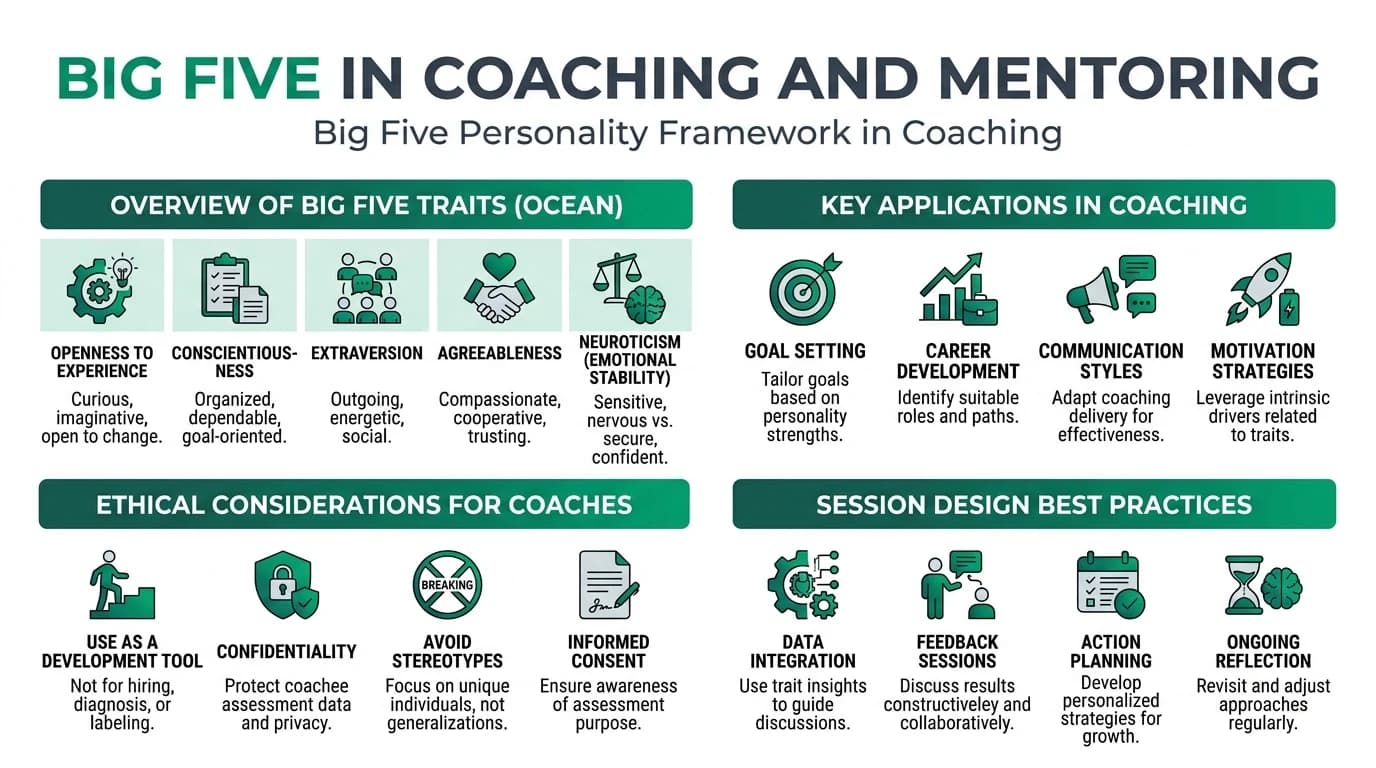
The Big Five model categorizes personality into five traits: Openness, Conscientiousness, Extraversion, Agreeableness, and Neuroticism. Each trait represents a spectrum, providing a nuanced view of personality.
| Trait | Description | Coaching Application |
|---|---|---|
| Openness | Creativity, curiosity | Innovation and adaptability |
| Conscientiousness | Discipline, responsibility | Goal setting and productivity |
| Extraversion | Sociability, energy | Networking and leadership |
| Agreeableness | Cooperation, empathy | Teamwork and conflict resolution |
| Neuroticism | Emotional stability | Stress management and resilience |
Key takeaways:
- Empirical Basis: Derived from factor analysis.
- Continuous Traits: Unlike MBTI's dichotomies, Big Five offers a spectrum.
- Cross-Cultural Validity: Widely applicable across different contexts.
How to Integrate Big Five in Coaching Programs
Integrating the Big Five into coaching programs enhances self-awareness and leadership development. Here's how:
- Pre-Assessment: Conduct assessments to understand personality profiles.
- Debrief Sessions: Discuss results to align coaching goals.
- Trait-Based Plans: Customize development plans based on trait profiles.
| Stage | Activities | Duration Estimate |
|---|---|---|
| Pre-Workshop | Assessment and optional debrief | 1-2 hours |
| Workshop Intro | Introduction to OCEAN traits | 30 minutes |
| Exercises | Teamwork, leadership, conflict resolution | 2-3 hours |
| Action Planning | Set SMART goals | 1 hour |
| Follow-Up | Post-workshop support | Ongoing |
Key takeaways:
- Personalization: Tailor coaching to individual needs.
- Engagement: Use interactive exercises for better retention.
- Support: Provide ongoing support to reinforce learning.
Designing Effective Coaching Sessions
Designing sessions around the Big Five involves structured activities and goal setting.
- Communication Exercises: Tailor exercises to enhance communication based on traits.
- Real-World Scenarios: Use scenarios to practice trait application in real situations.
- Post-Session Support: Offer resources and follow-up sessions for continuous improvement.
| Element | Best Practice | Ethical Check |
|---|---|---|
| Assessment | Use validated tools | Ensure informed consent |
| Debrief | Focus on strengths | Avoid stereotyping |
| Exercises | Interactive and relevant | Respect individual differences |
| Goals | SMART and trait-based | Align with personal values |
Key takeaways:
- Engagement: Keep sessions interactive and relevant.
- Ethical Considerations: Be mindful of participant privacy and consent.
Ethical Boundaries in Using Big Five
Ethical use of the Big Five assessments is crucial in coaching.
- Certification: Ensure facilitators are certified to administer assessments.
- Informed Consent: Obtain consent before conducting assessments.
- Avoid Stereotyping: Use results to guide, not label, individuals.
| Boundary | Guideline | Risk if Ignored |
|---|---|---|
| Certification | Use certified facilitators | Misinterpretation of results |
| Consent | Obtain informed consent | Breach of trust |
| Stereotyping | Focus on development, not labels | Reduced participant engagement |
Key takeaways:
- Professionalism: Maintain high ethical standards.
- Respect: Treat assessments as tools for growth, not judgment.
Predictive Power and Outcomes
The Big Five model is linked to various positive outcomes, making it a valuable tool in coaching.
- Job Performance: Conscientiousness predicts performance.
- Retention: High trait alignment improves retention rates.
- Satisfaction: Personalized coaching enhances satisfaction.
| Trait | Linked Outcomes | Evidence |
|---|---|---|
| Conscientiousness | Job performance | Supported by empirical studies |
| Extraversion | Leadership and networking | Enhances team dynamics |
| Agreeableness | Teamwork and conflict resolution | Improves collaboration |
Key takeaways:
- Evidence-Based: Relies on empirical research for validity.
- Versatile Application: Useful across various professional contexts.
Tools and Assessments for Implementation
Several tools are available to integrate the Big Five into coaching programs.
- Workplace Big Five Profile™: Offers detailed insights for workplace applications.
- Cloverleaf Platform: Integrates assessments with team dynamics.
| Tool | Features | Application |
|---|---|---|
| Workplace Big Five Profile™ | Detailed trait analysis | Recruitment and development |
| Cloverleaf | Team integration | Enhances team collaboration |
Key takeaways:
- Accessibility: Use tools that are easy to integrate.
- Customization: Choose tools that allow for personalized insights.
Personalized Development Strategies
Leverage the Big Five to create tailored development strategies.
- Harness Strengths: Use traits like Conscientiousness for productivity.
- Address Weaknesses: Implement exercises to improve low Agreeableness.
| Strategy | Key Traits | Implementation |
|---|---|---|
| Goal Setting | Conscientiousness | Use SMART goals |
| Conflict Resolution | Agreeableness | Role-playing exercises |
Key takeaways:
- Strength-Based Approach: Focus on enhancing strengths.
- Continuous Improvement: Regularly reassess and adjust plans.
Action checklist
- Conduct Big Five assessments with certified tools.
- Design interactive and personalized coaching sessions.
- Ensure ethical guidelines are followed rigorously.
- Utilize tools like Workplace Big Five Profile™ for insights.
- Regularly evaluate and adjust coaching strategies.
FAQ
What are the five traits in the Big Five model?
How reliable is the Big Five for coaching?
Can Big Five assessments predict job performance?
What are ethical guidelines for using Big Five in mentoring?
How do you design a Big Five coaching session?
Big Five vs. MBTI: Which is better for teams?
How does Conscientiousness affect leadership coaching?
Notes
Primary Sources
| Source | Type | URL |
|---|---|---|
| Innovation Training | Industry Workshop | Innovation Training |
| Paradigm Personality Labs | Industry Tool | Paradigm Personality Labs |
| Assess.com | Assessment Expert | Assess.com |
| PositivePsychology.com | Educational | PositivePsychology.com |
Conclusion
Using the Big Five personality assessments in coaching and mentoring programs offers a structured, evidence-based approach to personal development. By focusing on individual traits, coaches can craft personalized strategies that enhance performance and satisfaction.
Footnotes
-
PositivePsychology.com, "Big Five Personality Theory." ↩
-
Paradigm Personality Labs, "Big Five and MBTI Personality Assessment Tools." ↩
-
Assess.com, "Big Five Personality Traits Assessment." ↩
-
PositivePsychology.com, "Practical Coaching Use." ↩
-
Innovation Training, "Big Five Personality Workshop Training Programs." ↩
-
Paradigm Personality Labs, "Empirical Validity, Coaching Applications." ↩
-
Assess.com, "Traits Breakdown, Outcomes." ↩