personality-tests
How to Integrate DISC and Enneagram for Enhanced Team Coaching
Explore how combining DISC and Enneagram can transform team dynamics by integrating behavioral insights with motivational depth.
Quick answer
How can combining DISC and Enneagram improve team coaching?
By integrating DISC's behavioral insights with Enneagram's motivational depth, teams can enhance communication, resolve conflicts, and boost collaboration.
Source: Team Dynamics
Executive Summary
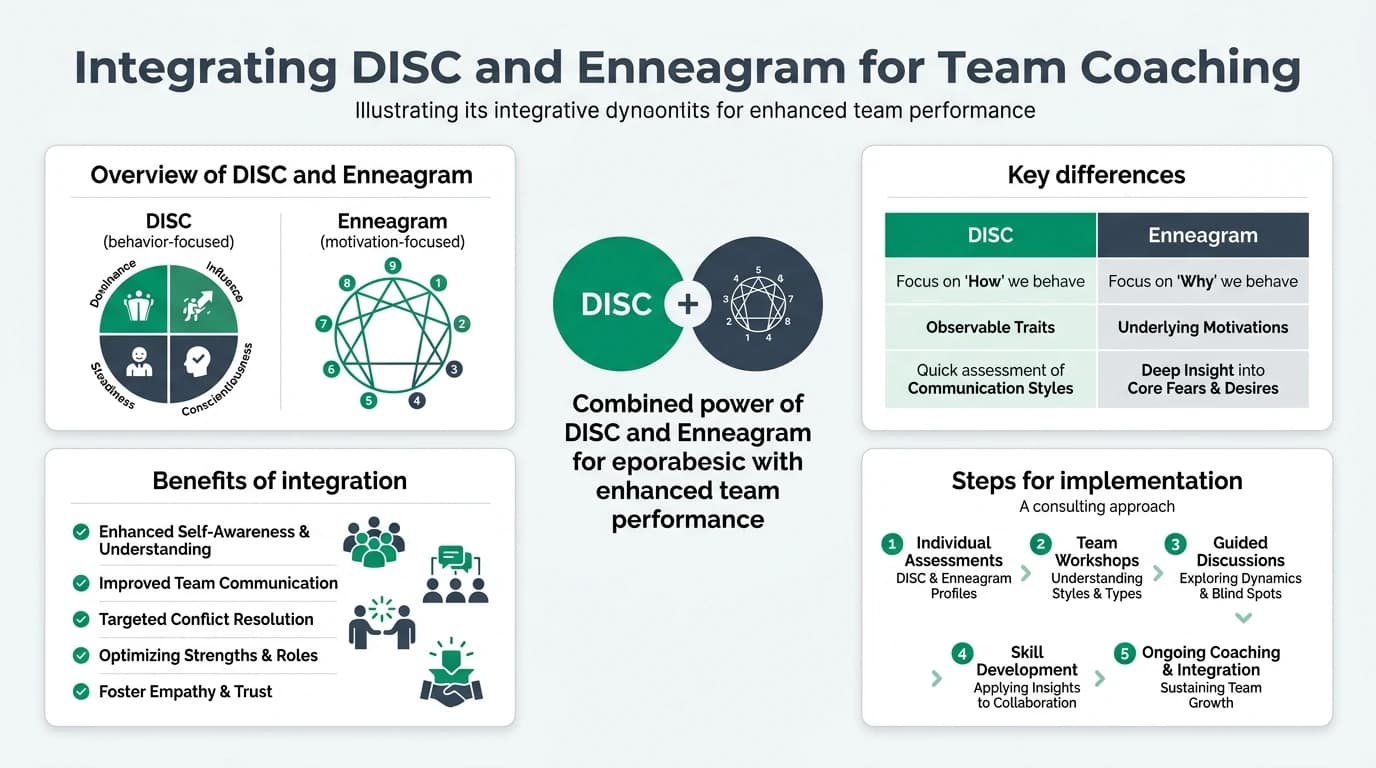
Integrating DISC and Enneagram in team coaching offers a powerful way to understand both behaviors and motivations. DISC provides quick insights into how team members act, while Enneagram delves into why they act that way.
The bottom line: Combining these models enhances communication, conflict resolution, and collaboration in teams.
Critical: While DISC is well-researched for workplace use, Enneagram's scientific backing is limited. Consider this when integrating the tools.
Understanding DISC Basics
What is DISC?
- Definition: A behavioral assessment with four styles: Dominance, Influence, Steadiness, Conscientiousness.
- Purpose: Helps understand observable behaviors in workplace settings.
- Assessment Time: ~10 minutes.
| Dimension | Description |
|---|---|
| Dominance | Results-oriented, confident. |
| Influence | Social, persuasive. |
| Steadiness | Cooperative, patient. |
| Conscientiousness | Analytical, detail-oriented. |
Key Takeaways:
- Quick insights into team behaviors.
- Focus: Observable actions, not motivations.
- Application: Team building, communication enhancement.
Understanding Enneagram Basics
What is Enneagram?
- Definition: A model of nine personality types focused on core motivations and fears.
- Purpose: Explores deeper psychological drivers.
- Assessment Time: 15-30 minutes.
| Type | Core Motivation |
|---|---|
| 1 | Striving for perfection. |
| 2 | Desire to be loved. |
| 3 | Need for success. |
| 4 | Seeking identity. |
| 5 | Pursuit of knowledge. |
| 6 | Desire for security. |
| 7 | Seeking pleasure. |
| 8 | Need for control. |
| 9 | Desire for peace. |
Key Takeaways:
- Deep insights into motivations.
- Focus: Internal drivers, not just behaviors.
- Application: Personal growth, motivation understanding.
Key Differences and Complements
How do DISC and Enneagram differ?
| Aspect | DISC | Enneagram |
|---|---|---|
| Focus | Behavior | Motivation |
| Types | 4 primary | 9 types |
| Complexity | Low | High |
| Best For | Quick team insights | Personal growth |
Complementary Use:
- DISC: Quick behavioral insights.
- Enneagram: Deeper motivational understanding.
- Together: Comprehensive view of team dynamics.
Integration Steps for Teams
How to integrate DISC and Enneagram?
- Take both assessments: Establish a baseline.
- Analyze results: Understand behaviors and motivations.
- Map team types: Enhance communication.
- Practice adaptive styles: Apply insights in meetings.
| Step | Action | Benefit |
|---|---|---|
| 1 | Take assessments | Gain baseline insights. |
| 2 | Analyze results | Understand team dynamics. |
| 3 | Map types | Improve communication. |
| 4 | Practice styles | Enhance collaboration. |
Key Takeaways:
- Structured approach to integration.
- Enhanced team communication and understanding.
Communication Improvements
How can combined insights improve communication?
- Adapting Styles: Use DISC to adjust communication based on Enneagram motivations.
- Scenario Example: A Dominance type (DISC) may need to consider the peace-seeking nature of a Type 9 (Enneagram).
| Receiver Type | Sender Adjustment |
|---|---|
| Dominance | Be direct, but consider motivations. |
| Influence | Engage socially, align with desires. |
| Steadiness | Be patient, understand fears. |
| Conscientiousness | Provide details, respect knowledge. |
Key Takeaways:
- Tailored communication strategies.
- Improved team interactions through understanding.
Conflict Resolution Strategies
How do DISC and Enneagram aid conflict resolution?
- Identify Triggers: Use Enneagram to understand fears.
- Behavioral Adjustments: Apply DISC insights to modify responses.
| Challenge | DISC Insight | Enneagram Insight | Outcome |
|---|---|---|---|
| Team Conflict | Dominance clash | Type 9 fear | Improved feedback loop. |
Key Takeaways:
- Effective conflict resolution through understanding.
- Balanced team dynamics by addressing fears and behaviors.
Team Building Applications
How to use DISC and Enneagram for team building?
- Role Alignment: Match tasks with DISC styles and Enneagram motivations.
- Trust-Building Exercises: Use insights to foster deeper connections.
| DISC Type | Enneagram Pairing | Strengths in Teams |
|---|---|---|
| Dominance | Type 3 | Leadership, drive. |
| Influence | Type 7 | Creativity, enthusiasm. |
| Steadiness | Type 6 | Support, reliability. |
| Conscientiousness | Type 5 | Analysis, precision. |
Key Takeaways:
- Enhanced role alignment and team synergy.
- Stronger team bonds through shared understanding.
Coaching Frameworks
How to structure coaching sessions with both models?
- Individual Sessions: Focus on personal growth using Enneagram.
- Group Workshops: Enhance team dynamics with DISC insights.
| Session Type | Focus | Tool |
|---|---|---|
| Individual | Personal growth | Enneagram |
| Group | Team dynamics | DISC |
Key Takeaways:
- Balanced coaching approach for individuals and teams.
- Improved team performance through structured sessions.
Real-World Case Studies
What are the outcomes of integrating these models?
- Example: A sales team reduced conflicts by understanding DISC behaviors and Enneagram fears.
- Result: Improved communication and collaboration.
Key Takeaways:
- Practical benefits in real-world applications.
- Deeper team connections through combined insights.
Limitations and Alternatives
What are the limitations of each model?
- DISC: Limited to observable behaviors.
- Enneagram: Lacks strong empirical validation.
| Aspect | Pros | Cons |
|---|---|---|
| DISC | Quick insights | Limited depth |
| Enneagram | Motivational depth | Limited science |
Key Takeaways:
- Consider limitations when choosing tools.
- Explore alternatives for comprehensive insights.
Implementation Tips
How to effectively implement these tools?
- Training Needs: Ensure team is trained in both models.
- Tools for Reports: Use software for detailed analysis.
| Goal | Recommended Tool |
|---|---|
| Quick insights | DISC |
| Motivational depth | Enneagram |
| Comprehensive view | Both |
Key Takeaways:
- Successful implementation requires training.
- Effective use of tools for team insights.
Measuring Success
How to measure the success of integration?
- Qualitative Feedback: Gather team feedback on collaboration gains.
- Performance Metrics: Track improvements in team dynamics.
Key Takeaways:
- Feedback-driven improvements in team performance.
- Enhanced collaboration through integrated insights.
Action checklist
- Conduct DISC and Enneagram assessments for the team.
- Analyze and map team profiles for communication improvements.
- Implement adaptive communication strategies based on insights.
FAQ
How can combining DISC and Enneagram improve communication skills?
What are practical steps to use DISC and Enneagram together?
Are DISC and Enneagram suitable for understanding team dynamics?
What does DISC measure compared to Enneagram?
Can you use DISC and Enneagram together for coaching?
Which is better for teams: DISC or Enneagram?
How does Enneagram help team collaboration?
Notes
Primary Sources
| Source | Type | URL |
|---|---|---|
| Crystal Knows | Industry (workplace assessments) | crystalknows.com |
| Team Dynamics | Industry blog | teamdynamics.io |
| InnerWork Coaching | Industry (coaching firm) | innerworkcoaching.org |
Conclusion
Integrating DISC and Enneagram in team coaching provides a holistic approach to understanding both behaviors and motivations. This integration enhances team communication, conflict resolution, and collaboration.