personality-tests
Enneagram Complete Guide Nine Types
Practical guide to understand and apply Enneagram Complete Guide Nine Types.
md
title: "Enneagram Complete Guide: The 9 Types Explained" description: "Explore the Enneagram's nine personality types, their wings, stress and growth arrows, and dynamics. Discover core motivations, workplace strengths, and relationship patterns. Compare Enneagram with the Big Five and learn about coaching and self-discovery applications." slug: "enneagram-complete-guide-nine-types" category: "personality-tests" keywords: ["Enneagram types explained", "What is the Enneagram", "Enneagram wings", "Enneagram stress and growth arrows", "Enneagram vs Big Five"] author: "Editorial Team" datePublished: "2026-03-16" lastUpdated: "2026-03-16" featured: true images:
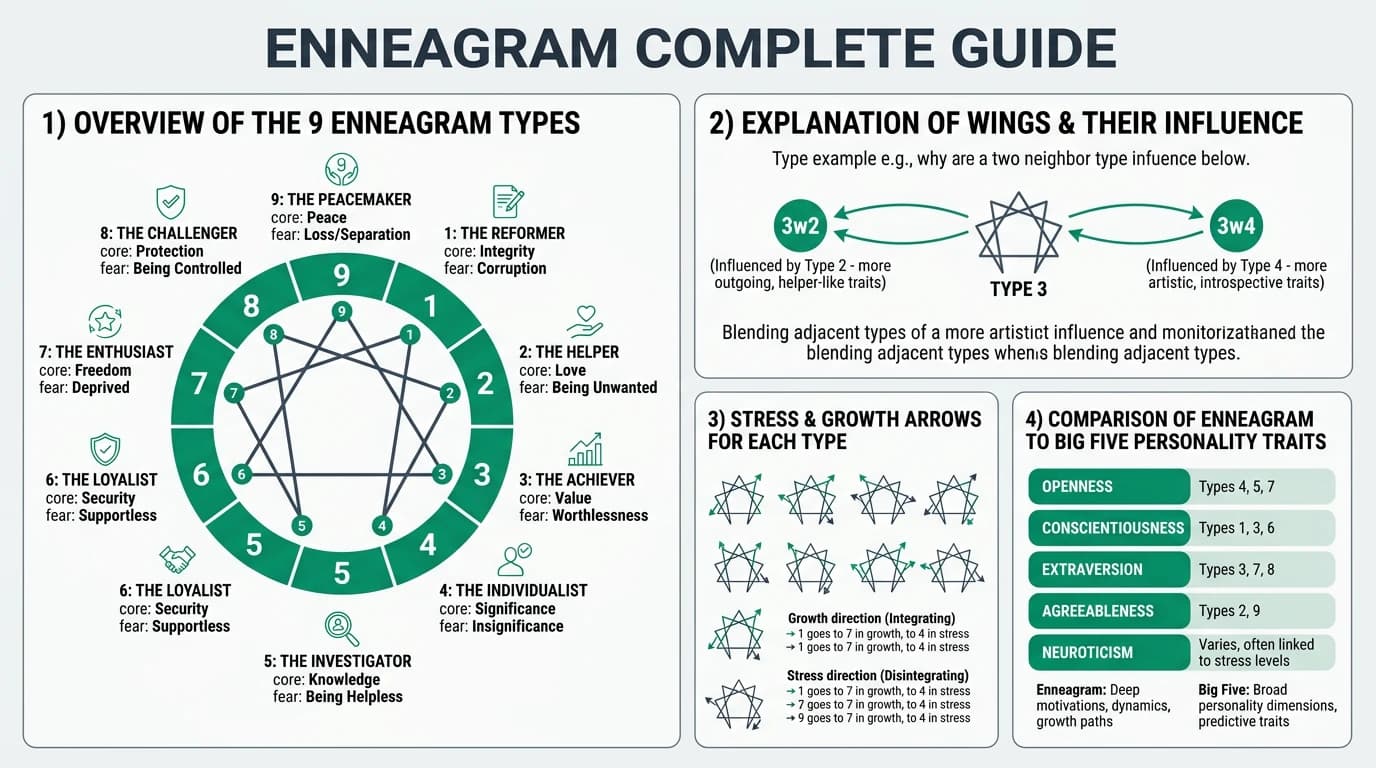
- url: "/images/guides/enneagram-complete-guide-nine-types.webp" alt: "Illustration of the Enneagram symbol with arrows indicating stress and growth paths for each type." caption: "The Enneagram symbol showing the interconnectedness of the nine types through stress and growth paths." relatedGuides:
- "big-five-vs-enneagram-team-coaching"
- "mbti-vs-big-five"
- "big-five-personality-test-complete-guide"
Quick answer
What is the Enneagram?
The Enneagram is a personality classification system that divides individuals into nine distinct types based on core beliefs, motivations, and behavioral patterns.
Source: The Enneagram Institute
Executive Summary
The Enneagram is a powerful tool for understanding personality through nine distinct types, each with unique motivations, fears, and desires. It offers insights into personal growth, relationship dynamics, and career paths.
The bottom line: While the Enneagram provides valuable self-awareness and development insights, it lacks the scientific validation of models like the Big Five.
Critical Warning: The Enneagram should be used for self-reflection and personal growth, not as a diagnostic tool.
What is the Enneagram?
The Enneagram is a personality classification system that categorizes individuals into nine types. Each type is defined by core motivations, fears, and desires, influencing behavior and interpersonal dynamics.
Key Features
- Nine Types: Each represented by a number (1-9).
- Wings: Adjacent types that modify core traits.
- Stress and Growth Arrows: Paths indicating behavioral changes under stress or growth.
The Nine Enneagram Types
| Type | Name | Core Motivation | Basic Fear | Basic Desire |
|---|---|---|---|---|
| 1 | The Reformer | To be right and principled | Being wrong or corrupt | Integrity and improvement |
| 2 | The Helper | To be needed and loved | Being unwanted | Being appreciated |
| 3 | The Achiever | To succeed and excel | Failure and worthlessness | Validation and effectiveness |
| 4 | The Individualist | To be authentic and unique | Being ordinary | Self-understanding |
| 5 | The Investigator | To understand and know | Incompetence | Competence and mastery |
| 6 | The Loyalist | To be secure and supported | Abandonment | Guidance and safety |
| 7 | The Enthusiast | To be happy and stimulated | Being trapped | Contentment |
| 8 | The Challenger | To be strong and in control | Being controlled | Autonomy |
| 9 | The Peacemaker | To be at peace | Conflict | Stability |
Understanding Wings
Enneagram wings are the types adjacent to your core type. They add depth and variation, creating 18 possible combinations.
Example: Type 2
- 2W1: Principled, organized, cause-driven.
- 2W3: Charming, ambitious, image-conscious.
Stress and Growth Arrows
Types move along arrows under stress or growth, adopting traits of other types.
| Type | Stress Arrow | Growth Arrow | Stressed Behavior | Growth Behavior |
|---|---|---|---|---|
| 3 | Moves to 9 | Moves to 6 | Withdrawn, loses direction | Grounded, loyal |
| 6 | Moves to 3 | Moves to 9 | Image-conscious | Trusting, accepting |
Enneagram in the Workplace
Each type brings unique strengths to professional environments.
| Type | Workplace Strength | Recommended Careers |
|---|---|---|
| 1 | Ethics and quality control | Teacher, lawyer |
| 2 | Relationship building | Social worker, nurse |
| 3 | Goal achievement | Marketer, executive |
| 4 | Creativity | Artist, designer |
| 5 | Analysis | Researcher, engineer |
| 6 | Reliability | Project manager |
| 7 | Optimism | Entrepreneur, event planner |
| 8 | Leadership | CEO, military officer |
| 9 | Mediation | Diplomat, librarian |
Relationship Patterns
Understanding Enneagram types can enhance relationship dynamics.
| Type | Love Language | Communication Style | Growth Edge |
|---|---|---|---|
| 1 | Acts of service | Direct, principled | Accepting imperfection |
| 2 | Words of affirmation | Warm, attentive | Healthy independence |
| 3 | Quality time | Efficient, goal-focused | Vulnerability |
| 4 | Quality time | Expressive, deep | Stability |
| 5 | Quality time | Analytical, reserved | Emotional expression |
| 6 | Acts of service | Questioning, loyal | Trust |
| 7 | Quality time | Enthusiastic, scattered | Depth |
| 8 | Physical touch | Direct, commanding | Collaboration |
| 9 | Physical touch | Agreeable, passive | Assertiveness |
Enneagram vs. Big Five
| Dimension | Enneagram | Big Five |
|---|---|---|
| Types | 9 types | 5 dimensions |
| Focus | Motivations | Behavioral traits |
| Structure | Categorical | Dimensional |
| Application | Personal development | Research |
| Validation | Limited | Extensive |
Coaching and Self-Discovery Applications
The Enneagram is widely used in coaching to tailor personal development plans. It helps individuals understand their core motivations and areas for growth.
Key Takeaways
- Self-awareness: Enhances understanding of personal motivations.
- Growth: Guides personal and professional development.
- Relationships: Improves communication and empathy.
Action checklist
- Identify your core Enneagram type.
- Explore your wings and stress/growth paths.
- Apply insights to improve personal and professional relationships.
FAQ
How accurate is the Enneagram?
What is the rarest Enneagram type?
Can your Enneagram type change?
How do Enneagram wings work?
What is the difference between Enneagram and Myers-Briggs?
How can the Enneagram be used in coaching?
What are Enneagram subtypes?
Notes
Primary Sources
| Source | Type | URL |
|---|---|---|
| The Enneagram Institute | Official | Enneagram Institute |
| BetterUp | Industry | BetterUp |
Conclusion
The Enneagram offers a nuanced framework for personal growth and understanding. While it lacks scientific validation, its practical applications in self-awareness and relationship dynamics make it a valuable tool.