personality-tests
DISC Personality Profiles: Strengths, Blind Spots, and Workplace Applications
Explore the DISC personality profiles to understand strengths, blind spots, and how they can be applied in the workplace.
Quick answer
What are the four DISC personality styles?
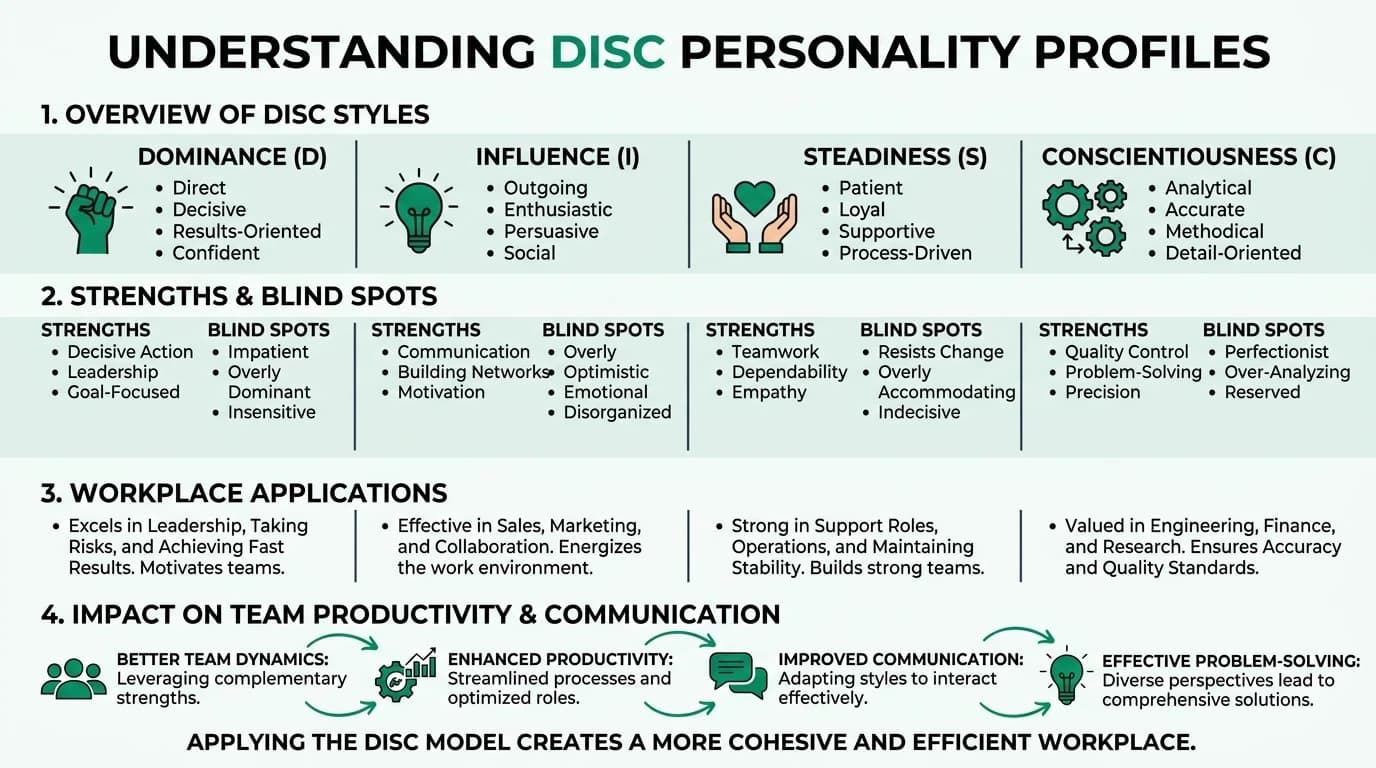
DISC classifies behaviors into Dominance (D: fast-paced, skeptical), Influence (I: fast-paced, people-focused), Steadiness (S: reflective, people-focused), and Conscientiousness (C: reflective, skeptical). These traits predict workplace behavior for better team fit and communication.
Source: Celarity
Executive Summary
The DISC personality model breaks down behaviors into four styles: Dominance, Influence, Steadiness, and Conscientiousness. Each style has unique strengths and potential blind spots that can impact workplace dynamics.
The bottom line: Understanding DISC profiles can significantly enhance team productivity and communication.
Critical Warning: DISC measures behaviors, not innate personality. Results vary by context and are not predictive of job success alone.
What is the DISC Personality Model?
The DISC model categorizes human behavior into four main styles:
- Dominance (D): Fast-paced and skeptical.
- Influence (I): Fast-paced and people-focused.
- Steadiness (S): Reflective and people-focused.
- Conscientiousness (C): Reflective and skeptical.
These styles help predict workplace behavior, improving team fit and communication.
| Style | Pace | Priority | Key Traits |
|---|---|---|---|
| Dominance (D) | Fast | Results | Decisive, Direct |
| Influence (I) | Fast | Relationships | Outgoing, Persuasive |
| Steadiness (S) | Reflective | Support | Reliable, Patient |
| Conscientiousness (C) | Reflective | Accuracy | Analytical, Precise |
Dominance (D) Profile
Strengths:
- Decisive: Quick decision-making.
- Results-driven: Focused on goals.
Blind Spots:
- Impatient: Can overlook details.
- Insensitive: May seem blunt.
Applications:
- Leadership: Effective in fast-paced environments.
- Sales: Thrives in competitive settings.
Influence (I) Profile
Strengths:
- Persuasive: Great at motivating others.
- Enthusiastic: Brings energy to the team.
Blind Spots:
- Disorganized: May struggle with details.
- Overly Optimistic: Can underestimate challenges.
Applications:
- Customer Service: Excellent in roles requiring interaction.
- Marketing: Ideal for creative and dynamic roles.
Steadiness (S) Profile
Strengths:
- Reliable: Consistent and dependable.
- Supportive: Excellent team player.
Blind Spots:
- Resistant to Change: Prefers stability.
- Indecisive: May avoid conflict.
Applications:
- Team Support: Provides stability in teams.
- Human Resources: Effective in nurturing roles.
Conscientiousness (C) Profile
Strengths:
- Analytical: Detail-oriented and precise.
- Thorough: Ensures accuracy.
Blind Spots:
- Overly Critical: Can be perfectionistic.
- Reserved: May struggle with open communication.
Applications:
- Finance: Suitable for roles requiring precision.
- Quality Control: Ensures high standards.
How to Use DISC in the Workplace
- Hiring: Match styles to roles (e.g., D/I for sales, S/I for service).
- Team Building: Pair complementary styles (e.g., I with C).
- Conflict Resolution: Adapt communication to styles.
- Leadership Development: Balance teams for productivity.
| Role | Best Styles | Why |
|---|---|---|
| Sales | D, I | Goal-oriented, persuasive |
| Service | S, I | Supportive, people-focused |
| Management | D, C | Decisive, analytical |
Improving Team Productivity with DISC
Organizations using DISC report:
- 31% higher team productivity
- 50% reduction in employee turnover
- 34% improvement in leadership effectiveness
| Metric | DISC Impact % | Source |
|---|---|---|
| Productivity | 31% | Wiley |
| Turnover | 50% | Wiley |
| Leadership | 34% | Wiley |
Real-Life Case Studies
- Marketing Team Conflict: High-D pushes for fast decisions; high-S prefers stability. DISC training reduced friction.
- Sales Optimization: Pair high-I rapport-builders with high-C detail-handlers for efficiency.
| Scenario | Pre-DISC Issue | Post-Improvement |
|---|---|---|
| Conflict | High-D vs. High-S | Tailored communication training |
| Sales | Disjointed client handling | Efficient client processing |
Implementing DISC in Your Organization
- Assessment: Use DISC assessments to understand team dynamics.
- Feedback Sessions: Discuss results with team members.
- Follow-Up: Implement changes and monitor progress.
Action checklist
- Conduct DISC assessments for all team members.
- Organize feedback sessions to discuss results.
- Implement strategies to leverage strengths and address blind spots.
FAQ
What are the strengths and weaknesses of each DISC style?
How does a high D personality behave at work?
Can DISC profiles improve team productivity?
What DISC style is best for sales roles?
How do you resolve conflicts using DISC?
Is DISC effective for hiring and retention?
What are blind spots for Influence (I) types?
Notes
Primary Sources
| Source | Type | URL |
|---|---|---|
| Ole Miss eGrove | Academic thesis | https://egrove.olemiss.edu/cgi/viewcontent.cgi?article=4067&context=etd |
| Aptahire.ai | Industry research | https://aptahire.ai/disc-personality-tests-workplace-behavior/ |
| TalentEdge Group | Industry case studies | https://www.talentedgegroup.com/blogs-disc-at-work-real-life-insights-and-case-studies/ |
| Celarity | Industry guide | https://www.celarity.com/blog/the-dynamic-uses-of-disc-in-the-workplace/ |
| Everything DiSC | Official research report | https://www.everythingdisc.com/EverythingDiSC/media/SiteFiles/Assets/LeadGenAssets/ed-research-report-090121.pdf |
Conclusion
Understanding DISC personality profiles can transform workplace dynamics by enhancing communication and team productivity. By applying DISC insights, organizations can tailor roles to fit individual strengths and address potential blind spots.