career
Personality and Aviation Pilot Careers: Big Five Traits in Cockpit Crews
Explore how the Big Five personality traits influence aviation pilots, focusing on stress tolerance, situational awareness, rule adherence, and CRM teamwork.
Quick answer
What are the Big Five personality traits of pilots?
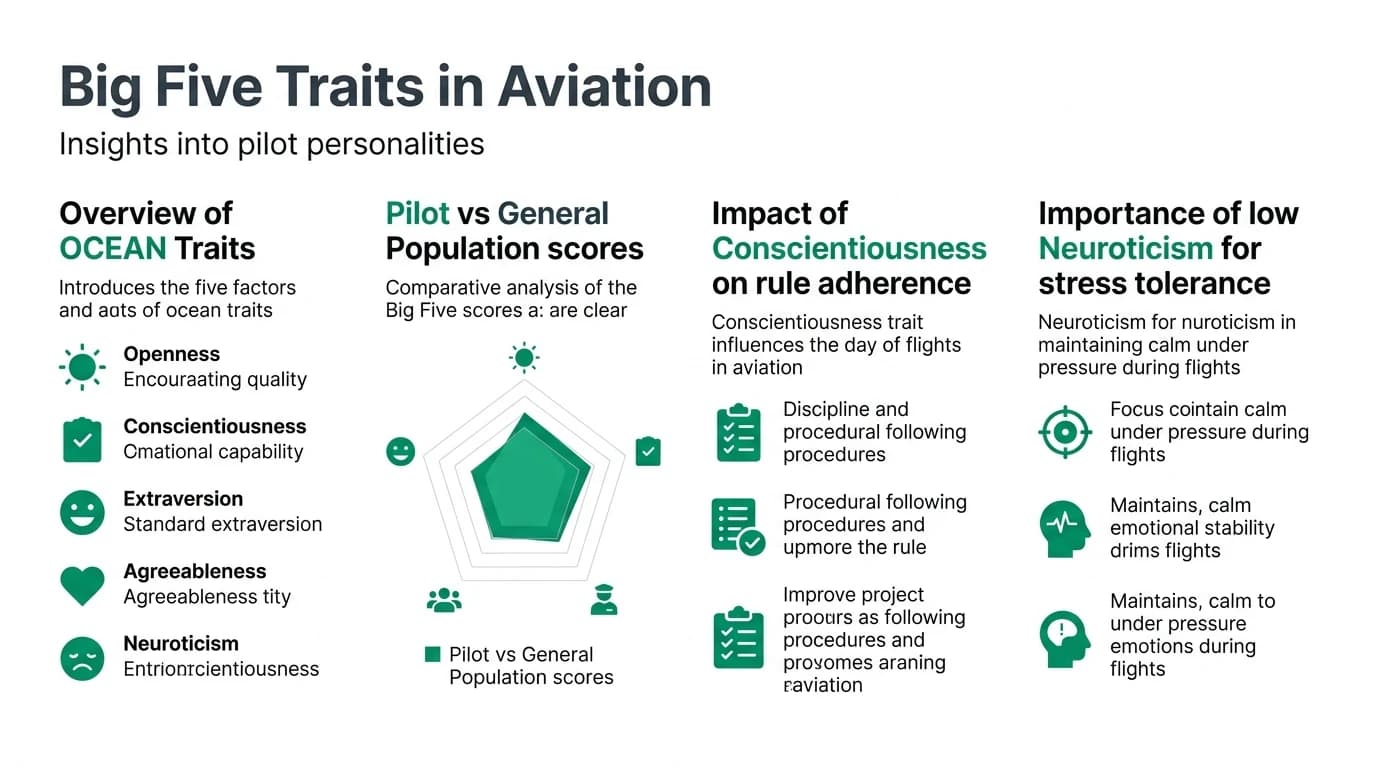
Pilots score high in conscientiousness and extraversion, low in neuroticism and agreeableness, with openness being less significant.
Source: NASA Langley Research Center
Executive Summary
Understanding the personality traits of pilots can enhance safety and performance in aviation. The Big Five traits—Openness, Conscientiousness, Extraversion, Agreeableness, and Neuroticism—play a significant role in how pilots handle stress, follow rules, and work in teams.
The bottom line: Pilots typically show high conscientiousness and extraversion, low neuroticism and agreeableness, which aids in crisis management but can challenge team dynamics without proper Crew Resource Management (CRM) training.
Critical Warning: While personality traits provide insights, individual variations exist. Always consult FAA standards for specific selection criteria.
What Are the Big Five Traits in Pilots?
The Big Five personality traits, often referred to as OCEAN, are crucial in understanding pilot behavior:
- Openness: Creativity and curiosity.
- Conscientiousness: Discipline and organization.
- Extraversion: Sociability and assertiveness.
- Agreeableness: Cooperation and kindness.
- Neuroticism: Emotional stability and stress tolerance.
Pilot vs. General Population
| Trait | Pilot Score | General Population | Impact on Pilots |
|---|---|---|---|
| Conscientiousness | High | Average | Enhances rule adherence |
| Extraversion | High | Average | Improves leadership and teamwork |
| Neuroticism | Low | Average | Increases stress tolerance |
| Agreeableness | Low | Average | Aids in making tough decisions |
| Openness | Average | Average | Less significant in pilot roles |
How Does Conscientiousness Affect Rule Adherence?
Conscientiousness is a key trait for pilots, emphasizing:
- Discipline: Ensures thorough pre-flight checks.
- Organization: Keeps cockpit operations smooth.
- Goal-orientation: Focuses on safety and efficiency.
Pros and Cons of High Conscientiousness
| Pro | Con |
|---|---|
| Enhances safety compliance | May lead to rigidity |
| Improves task management | Can resist flexibility |
Why Is Low Neuroticism Important for Stress Tolerance?
Low neuroticism helps pilots manage stress effectively:
- Calm under pressure: Essential during emergencies.
- Emotional stability: Reduces anxiety and improves decision-making.
Stress Response Scenarios
| Situation | Low Neuroticism Action | High Neuroticism Risk |
|---|---|---|
| Turbulence | Remains calm, reassures crew | Panic, poor communication |
| Engine Issue | Follows procedures methodically | Freezes, delays response |
What Role Does Extraversion Play in Cockpit Dynamics?
Extraversion enhances cockpit dynamics by:
- Leadership: Guides crew confidently.
- Communication: Facilitates clear interactions with ATC and crew.
CRM Challenges by Trait
| Trait | Strength | Weakness | Mitigation |
|---|---|---|---|
| High Extraversion | Strong leadership | Overdominance | CRM training |
| Low Agreeableness | Decisive in crises | Potential team conflict | Team-building exercises |
Why Are Pilots Low in Agreeableness?
Low agreeableness can be beneficial:
- Straightforwardness: Makes tough calls without hesitation.
- Independence: Reduces susceptibility to peer pressure.
CRM Teamwork Challenges
| Trait | Challenge | Solution |
|---|---|---|
| Low Agreeableness | Team conflicts | CRM training for trust |
| High Assertiveness | Overpowering in discussions | Encourage open dialogue |
How Does Openness Relate to Situational Awareness?
Openness, though less significant, supports:
- Adaptability: Helps pilots adjust to new technologies.
- Curiosity: Encourages continuous learning.
Military vs. Commercial Pilot Profiles
Military and commercial pilots share some traits but differ in others:
| Trait | Commercial Pilots | Military Pilots |
|---|---|---|
| Neuroticism | Low | Very Low |
| Agreeableness | Low | Very Low |
| Extraversion | High | Very High |
| Conscientiousness | High | High |
How Is Personality Testing Used in Pilot Selection?
Airlines often use the NEO-PI-R test to evaluate pilot candidates:
- Predicts training success: Identifies stress-tolerant, conscientious profiles.
- Flags high neuroticism: Helps avoid candidates prone to stress.
Key Takeaways
- High conscientiousness aids in rule adherence and safety.
- Low neuroticism enhances stress tolerance and crisis management.
- Extraversion supports leadership and communication.
- Low agreeableness allows decisive action but requires CRM for teamwork.
Action checklist
- Consider personality traits when assessing pilot suitability.
- Incorporate CRM training for balanced teamwork.
- Use personality tests like NEO-PI-R in recruitment.
FAQ
What Big Five traits make a good pilot?
Why do pilots score low on agreeableness?
How does low neuroticism help pilots in stress?
What role does extraversion play in CRM?
Are pilots more conscientious than average?
Does personality affect situational awareness?
How does CRM training address pilot traits?
Notes
Primary Sources
| Source | Type | URL |
|---|---|---|
| NASA Langley Research Center | Peer-reviewed PDF | ntrs.nasa.gov |
| SafePilots.org | Industry PDF | safepilots.org |
Conclusion
Understanding the Big Five personality traits in pilots provides valuable insights into their performance and teamwork capabilities. These traits influence stress management, rule adherence, and CRM effectiveness.