personality-tests
Personality and AI Adoption at Work
Learn which Big Five traits predict AI adoption or resistance at work. Use evidence-based strategies to help every personality type embrace new technology.
Quick answer
Which personality traits predict AI adoption at work?
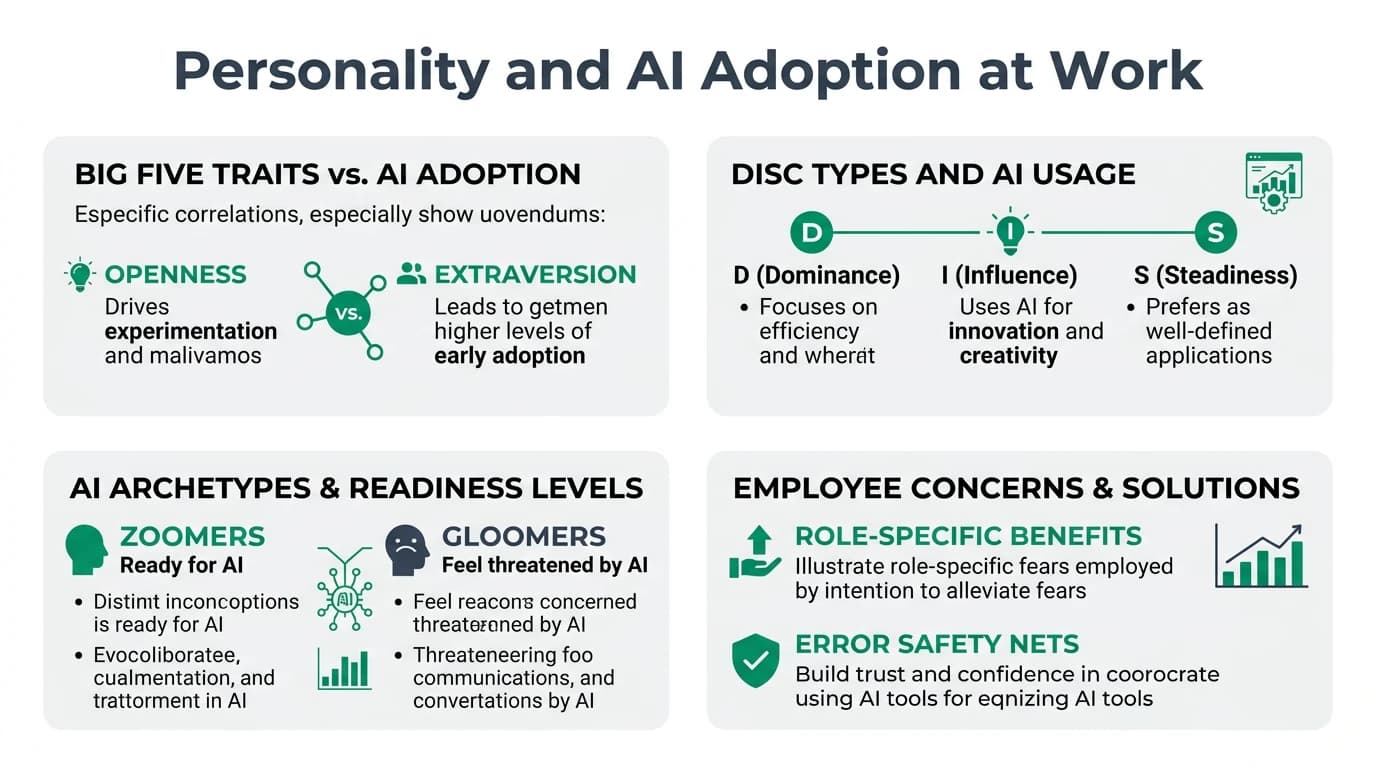
High Openness to Experience is the strongest Big Five predictor of AI adoption willingness. High Conscientiousness predicts structured adoption. Low Neuroticism reduces anxiety-based resistance. Extraversion and Agreeableness play secondary roles depending on social context and role type.
Executive Summary
AI adoption is not purely a technology problem — it is a people problem. Research consistently shows that personality traits predict who embraces, resists, or anxiously avoids AI tools in the workplace 1.
Organizations that treat AI rollout as a one-size-fits-all training program miss the reality that a high-Openness engineer and a high-Neuroticism operations manager will respond to the same tool in fundamentally different ways.
Key takeaway: personality-informed change management doubles as an adoption accelerator. Matching communication strategies, training formats, and support structures to trait profiles reduces resistance and increases productive engagement.
Important: Personality is one factor among many. Role demands, organizational culture, past technology experiences, and leadership behavior all interact with traits to shape adoption outcomes.
Big Five Traits and AI Adoption Patterns
Each Big Five dimension influences a different aspect of the adoption process — from initial openness to sustained use.
| Big Five trait | Adoption influence | High-scorer tendency | Low-scorer tendency |
|---|---|---|---|
| Openness to Experience | Strongest predictor | Eager to experiment, early adopter | Skeptical, prefers proven methods |
| Conscientiousness | Shapes adoption style | Systematic evaluation, follows protocols | Ad-hoc experimentation, inconsistent use |
| Extraversion | Social adoption driver | Adopts when peers do, vocal champion | Quiet adoption, less visible influence |
| Agreeableness | Team harmony concern | Worries about AI mistakes affecting others | Pragmatic, less concerned about group impact |
| Neuroticism | Anxiety-based resistance | Fears errors, job displacement, competence threat | Calm experimentation, lower resistance |
A 2024 SnapLogic study of 4,000 workers found that low-extraversion employees were paradoxically more likely to embrace AI, potentially because they valued the tool's ability to reduce mandatory social interaction 1.
For a deep dive into how Openness shapes workplace behavior, see Openness to Experience Complete Guide.
Adoption Archetypes by Personality Profile
Combining Big Five traits creates distinct adoption profiles. These archetypes help managers target interventions.
| Archetype | Trait profile | Adoption behavior | Primary barrier | Best intervention |
|---|---|---|---|---|
| Enthusiast | High O, low N | Rapid adoption, seeks advanced features | May skip validation steps | Channel enthusiasm into pilot programs |
| Systematic Evaluator | High C, moderate O | Structured testing, data-driven decision | Slow to commit without evidence | Provide case studies and ROI data |
| Social Follower | High E, high A | Adopts when team adopts | Peer pressure both ways | Create visible early-adopter cohorts |
| Anxious Avoider | High N, low O | Delays adoption, fears mistakes | Anxiety about competence and job loss | One-on-one coaching, error safety nets |
| Pragmatic Skeptic | Low O, high C | Adopts only when mandated | Sees no improvement over current methods | Demonstrate tangible time savings |
| Independent Adopter | Low E, high O | Quiet experimentation, self-directed | Dislikes group training formats | Provide self-paced learning resources |
Understanding these profiles allows change managers to design targeted interventions rather than generic training programs.
The Role of Neuroticism in AI Resistance
Neuroticism deserves special attention because it is the primary source of anxiety-based AI resistance — the most emotionally charged barrier to adoption 2.
| Neuroticism-driven concern | Prevalence (survey data) | Underlying fear | Effective response |
|---|---|---|---|
| Job displacement | 38 percent of workers | Existential threat to livelihood | Reframe AI as augmentation, not replacement |
| Competence threat | 29 percent of workers | Fear of appearing incompetent | Normalize learning curves, celebrate small wins |
| Error consequences | 36 percent of workers | Fear of AI-caused mistakes | Implement error safety nets and rollback options |
| Loss of autonomy | 22 percent of workers | AI controlling work processes | Give users control over AI involvement level |
| Privacy concerns | 18 percent of workers | Surveillance via AI monitoring | Transparent data policies, opt-out options |
The Yerkes-Dodson law applies: moderate anxiety can motivate engagement, but high anxiety paralyzes action. Effective interventions lower anxiety to the productive zone without eliminating it entirely.
For strategies on managing anxiety-related workplace challenges, see Neuroticism Complete Guide.
Social Networks and Behavioral Contagion
Adoption is not an individual decision — it spreads through social networks. Research from Irrational Labs found that employees who know at least one active AI user are three times more likely to adopt AI themselves 3.
| Network factor | Impact on adoption | Mechanism | Actionable strategy |
|---|---|---|---|
| Knowing one or more AI users | Three times higher adoption rate | Social proof and practical exposure | Seed AI champions across departments |
| Manager uses AI visibly | 2.5 times higher team adoption | Authority-driven modeling | Train managers as visible first adopters |
| No known AI users in network | Baseline (low) adoption | Isolation from social proof | Connect isolated employees with adopter peers |
| Cross-functional AI community | Sustained long-term adoption | Continuous learning and problem-solving | Create cross-team AI practice groups |
- Extraverts amplify social contagion because they share experiences publicly.
- Introverts benefit from structured peer-matching rather than broadcast adoption campaigns.
- Agreeable employees adopt when the team consensus shifts — making them late followers rather than resisters.
Personality-Tailored Change Management
Generic "AI training day" programs ignore personality diversity. Evidence-based change management maps intervention types to trait profiles.
| Strategy | Target trait profile | Format | Expected outcome |
|---|---|---|---|
| AI sandbox (safe experimentation) | High N, low O | Individual, no-stakes environment | Reduces anxiety, builds competence |
| Peer champion program | High E, high A | Group-based, social proof | Creates visible adoption momentum |
| ROI case studies | High C, moderate O | Data-driven presentations | Satisfies need for evidence before commitment |
| Self-paced tutorials | Low E, high O | Online, asynchronous | Matches independent learning preference |
| Manager-led demonstrations | High A, moderate N | Authority-endorsed, team context | Leverages trust in leadership |
| Gamified challenges | High O, low N | Competitive, reward-based | Channels curiosity into structured engagement |
Emotional Impacts of AI Collaboration
Working alongside AI is not emotionally neutral. Research from Conservation of Resources (COR) theory shows that AI collaboration can both deplete and replenish psychological resources 4.
| Emotional impact | Trigger | Personality moderator | Organizational mitigation |
|---|---|---|---|
| Loneliness | AI replacing human interaction | High Extraversion (needs social contact) | Maintain human collaboration alongside AI |
| Competence threat | AI outperforming the employee | High Neuroticism (threat-sensitive) | Frame AI as a tool, not a competitor |
| Autonomy loss | AI making decisions without input | Low Agreeableness (values independence) | Give employees control over AI involvement |
| Positive mastery | Successfully directing AI | High Openness (enjoys novelty) | Celebrate and share success stories |
| Efficiency satisfaction | AI handling tedious tasks | High Conscientiousness (values productivity) | Redirect freed time to high-value work |
A 2024 study in Frontiers in Psychology found that AI-induced loneliness increased counterproductive work behavior, but this effect was buffered by supportive leadership 4.
Employee Concerns by Personality Type
Understanding what each personality type worries about enables targeted communication.
| Concern category | Percentage reporting | Most affected trait profile | Recommended message framing |
|---|---|---|---|
| Role-specific AI benefits unclear | 42 percent | Low Openness, high Conscientiousness | "Here is exactly how AI saves time in your role" |
| Error safety net needed | 36 percent | High Neuroticism, high Agreeableness | "Mistakes are reversible — here is how" |
| Job security threatened | 38 percent | High Neuroticism | "AI augments your work, it does not replace you" |
| Training and support insufficient | 31 percent | Low Openness | "Step-by-step guidance is available on demand" |
| Privacy and surveillance risk | 18 percent | Low Agreeableness | "Your data is protected — here is our policy" |
| Social dynamics disrupted | 15 percent | High Extraversion | "AI frees time for more meaningful collaboration" |
Data sources: SnapLogic (2024) 1, McKinsey Superagency Report (2025) 5.
Measuring Readiness Across Teams
Before launching AI tools, assess your team's personality-based readiness to calibrate your rollout strategy.
Pre-launch readiness checklist
- Survey team members on Big Five traits (even a brief 20-item instrument helps).
- Map the distribution of Openness and Neuroticism to identify likely champions and resisters.
- Identify social network influencers who can seed adoption.
- Design at least two intervention tracks: one for high-anxiety profiles, one for early adopters.
- Establish error safety nets and rollback procedures before launch.
- Create a feedback loop to monitor emotional impact during the first 90 days.
- Brief leadership on personality-adoption dynamics so they model the desired behavior.
Case Studies: Personality-Driven Rollouts
Real-world examples illustrate how personality-aware strategies improve outcomes.
| Organization type | Key challenge | Personality insight applied | Outcome |
|---|---|---|---|
| Financial services firm | High-N compliance team resisted AI document review | Provided sandbox with no-stakes practice and dedicated error support | Adoption reached 78 percent within 90 days |
| Technology startup | High-O engineers adopted rapidly but skipped governance | Channeled enthusiasm into structured pilot with validation gates | Reduced AI-related errors by 40 percent |
| Healthcare system | Mixed profiles across nursing and administrative staff | Segmented training: self-paced for introverts, group demos for extraverts | Overall adoption 65 percent vs. 35 percent industry average |
| Retail chain | Low-O store managers saw no value in AI scheduling | Demonstrated concrete time savings per shift using their own data | Manager buy-in increased from 20 to 60 percent |
FAQ
Which Big Five trait most strongly predicts AI adoption?
Openness to Experience is the strongest and most consistent predictor. Individuals high in Openness are more curious about new tools, more tolerant of ambiguity, and more willing to experiment with unfamiliar technology 1.
Why do introverts sometimes adopt AI faster than extraverts?
Research suggests introverts value AI's ability to reduce mandatory social interaction — for example, automating tasks that previously required meetings or collaborative work. They also prefer self-directed learning, which AI tools often support 1.
How does anxiety affect AI adoption?
High Neuroticism predicts anxiety-based resistance to AI. Affected employees fear making errors, losing their jobs, or appearing incompetent. Targeted interventions — error safety nets, one-on-one coaching, and gradual exposure — can reduce this barrier 2.
Can personality assessment improve AI change management?
Yes. By mapping team personality profiles before rollout, organizations can segment training, allocate coaching resources, and design communication strategies that address trait-specific concerns rather than using generic messaging 1.
Does AI collaboration increase workplace loneliness?
It can. Research based on Conservation of Resources theory found that AI replacing human interaction depletes social resources, increasing loneliness and counterproductive work behavior — especially for extraverted employees 4.
What role do social networks play in AI adoption?
Social contagion is powerful. Employees who know at least one active AI user are three times more likely to adopt AI themselves. Organizations should seed visible AI champions across departments to accelerate network effects 3.
How should managers model AI adoption?
Managers who visibly use AI tools increase their team's adoption rate by approximately 2.5 times. This works through authority-driven social proof and signals that AI use is valued and safe within the organizational culture 5.
Is personality the only factor in AI adoption?
No. Role demands, organizational culture, leadership behavior, prior technology experience, and the quality of the AI tool itself all interact with personality traits. Personality is one important lens, but not the only one 1.
Notes
Primary Sources
| Source | Type | URL |
|---|---|---|
| SnapLogic (2024) | Industry research on personality and AI adoption | snaplogic.com |
| Svendsen et al. (2013), Behaviour and Information Technology | Peer-reviewed study on personality and technology acceptance | doi.org/10.1080/0144929X.2011.553740 |
| Irrational Labs (2024) | Behavioral science research on AI adoption | irrationallabs.com |
| Li & Huang (2024), Frontiers in Psychology | AI collaboration and employee well-being | doi.org/10.3389/fpsyg.2024.1340232 |
| McKinsey (2025) | AI adoption strategy report | mckinsey.com |
Conclusion
Personality is not destiny, but it is a map. Understanding which traits drive AI enthusiasm, anxiety, and resistance lets organizations design change management programs that work with human psychology instead of against it.
The most successful AI rollouts are not the ones with the best technology — they are the ones that match their adoption strategy to the people who will use it.
Footnotes
-
SnapLogic. (2024). Research reveals personality traits indicate AI acceptance in the workplace. https://www.snaplogic.com/company/newsroom/press-releases/snaplogic-research-reveals-personality-traits-indicate-ai-acceptance-in-the-workplace ↩ ↩2 ↩3 ↩4 ↩5 ↩6 ↩7
-
Svendsen, G. B., Johnsen, J. K., Almas-Sorensen, L., & Vitterso, J. (2013). Personality and technology acceptance: The influence of personality factors on the core constructs of the Technology Acceptance Model. Behaviour and Information Technology, 32(4), 323–334. https://doi.org/10.1080/0144929X.2011.553740 ↩ ↩2
-
Irrational Labs. (2024). AI workplace research: Employee AI adoption. https://irrationallabs.com/blog/ai-workplace-research-employee-ai-adoption/ ↩ ↩2
-
Li, J., & Huang, J. (2024). Artificial intelligence and employee well-being: A Conservation of Resources perspective. Frontiers in Psychology, 15. https://doi.org/10.3389/fpsyg.2024.1340232 ↩ ↩2 ↩3
-
McKinsey & Company. (2025). Superagency in the workplace: Empowering people to unlock AI's full potential at work. https://www.mckinsey.com/capabilities/tech-and-ai/our-insights/superagency-in-the-workplace-empowering-people-to-unlock-ais-full-potential-at-work ↩ ↩2