personality-tests
Honesty-Humility: The 6th Trait Big Five Misses
Discover why Honesty-Humility is the sixth personality trait the Big Five overlooks. Learn its four facets, workplace impact, and Dark Triad connection.
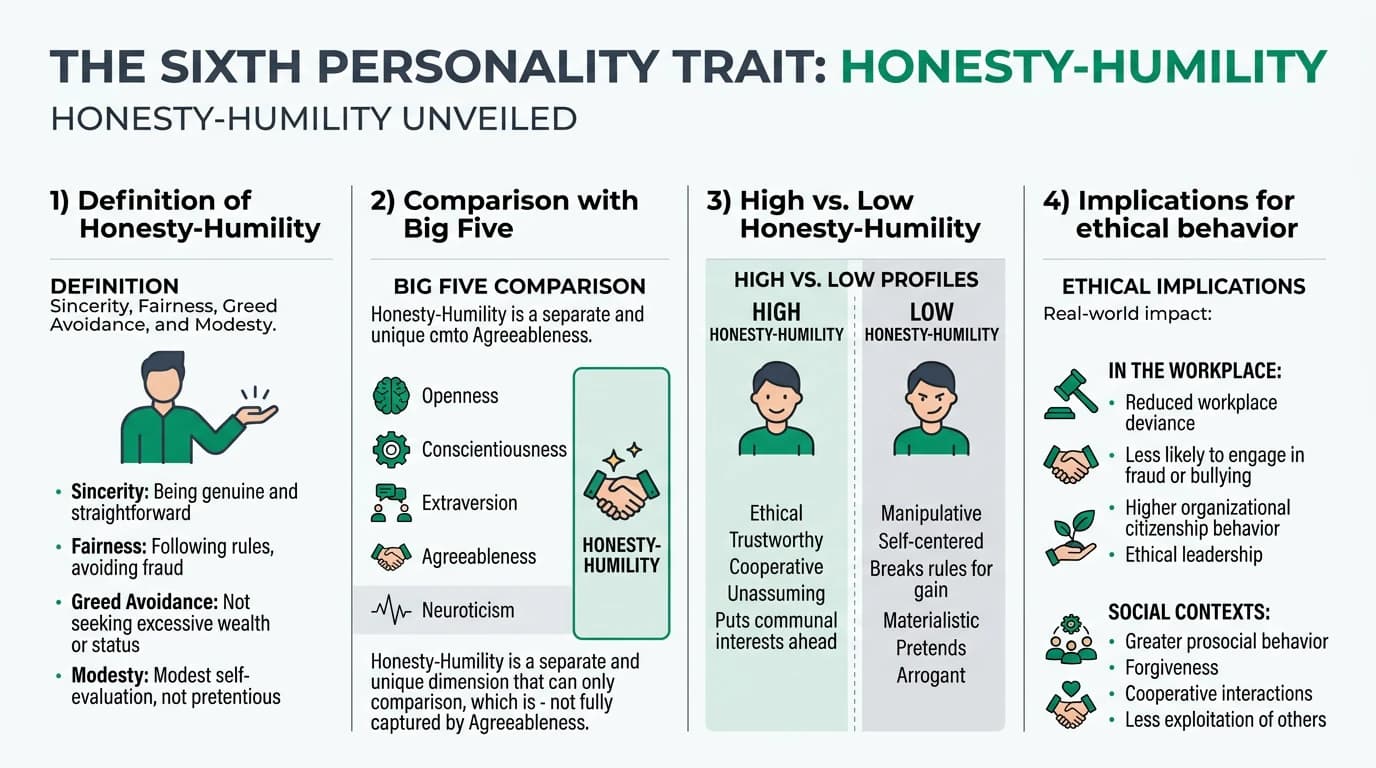
Quick answer
What is Honesty-Humility and why does the Big Five miss it?
Honesty-Humility is the sixth factor in the HEXACO personality model. It measures sincerity, fairness, greed avoidance, and modesty — traits the Big Five partially buries inside Agreeableness or ignores entirely. It is the single best personality predictor of counterproductive work behavior and Dark Triad tendencies.
Source: Ashton & Lee (2007), European Journal of Personality
Executive Summary
The Big Five model has dominated personality science for decades. Yet cross-language lexical research consistently uncovers a sixth factor — Honesty-Humility — that Big Five either misclassifies or underweights 1.
This dimension captures a person's willingness to be fair, genuine, modest, and uninterested in exploiting others. Low scores predict bribery acceptance, workplace fraud, Dark Triad profiles, and counterproductive work behavior more accurately than any single Big Five dimension 2.
Key takeaway: if your assessment goals involve integrity, ethics, or trust-critical roles, Honesty-Humility fills a gap that Big Five cannot cover on its own.
Important: Personality scores are tendencies, not diagnoses. A low Honesty-Humility score flags risk but does not prove misconduct. Always combine trait data with behavioral evidence.
The Four Facets of Honesty-Humility
Honesty-Humility is not a single score — it comprises four distinct facets, each targeting a different aspect of ethical disposition 1.
| Facet | Core definition | High-scorer behavior | Low-scorer behavior |
|---|---|---|---|
| Sincerity | Genuineness in social interactions | Avoids flattery and manipulation | Uses charm strategically to gain favors |
| Fairness | Resistance to fraud and corruption | Declines unfair shortcuts even when undetected | Willing to cheat, bribe, or bend rules for advantage |
| Greed Avoidance | Low motivation for wealth and status | Content with modest possessions | Pursues luxury, power, and material gain aggressively |
| Modesty | Absence of entitlement | Sees self as ordinary; avoids spotlight | Feels deserving of special treatment |
Together, these four facets form a coherent ethical profile that Big Five Agreeableness only partially approximates. The correlation between Honesty-Humility and Big Five Agreeableness is typically 0.30–0.45 — meaningful overlap but roughly 80 percent unique variance 1.
Why the Big Five Missed This Trait
The Big Five was derived primarily from English-language adjective studies in the 1980s. When researchers later analyzed personality adjectives in Korean, French, Italian, Dutch, Hungarian, and other languages, six factors — not five — emerged consistently 3.
- English lexical bias: the original English word pools underrepresented terms for manipulation, greed, and modesty.
- Factor rotation choices: some Honesty-Humility content appeared in early Big Five analyses but was absorbed into Agreeableness or Conscientiousness during factor rotation.
- Cultural framing: languages with richer vocabularies for deception and social hierarchy surfaced the sixth factor more clearly.
| Evidence source | Number of languages | Factors found | Honesty-Humility present? |
|---|---|---|---|
| Goldberg (1990), English only | 1 | 5 | No (content absorbed) |
| Ashton et al. (2004), multi-language | 7 | 6 | Yes, in all seven samples |
| Saucier (2009), expanded lexical | 12 | 6 | Yes, consistently |
| De Raad et al. (2010), European | 6 | 6 | Yes, in most samples |
The empirical pattern is clear: the sixth factor is not an artifact of one dataset. It replicates across cultures and languages 3.
For a full comparison of the two frameworks, see HEXACO vs Big Five Comparison Guide.
Honesty-Humility and the Dark Triad
The strongest practical argument for measuring Honesty-Humility is its relationship with the Dark Triad: narcissism, Machiavellianism, and psychopathy 2.
| Dark Triad trait | Correlation with low H-H | Primary Honesty-Humility facet involved | Big Five equivalent predictor |
|---|---|---|---|
| Narcissism | Strong negative (r approx -0.50) | Modesty, Greed Avoidance | Low Agreeableness (weaker signal) |
| Machiavellianism | Strong negative (r approx -0.55) | Sincerity, Fairness | Low Agreeableness (partial overlap) |
| Psychopathy | Moderate-to-strong negative (r approx -0.45) | Fairness, Sincerity | Low Agreeableness + low Conscientiousness (diffuse signal) |
Big Five Agreeableness captures some Dark Triad variance, but it mixes prosocial warmth with ethical disposition. Honesty-Humility isolates the ethical component, producing a sharper, more actionable signal 2.
For organizational implications, see Dark Triad Personality in Workplace Assessment.
Workplace Applications
Honesty-Humility has direct implications for hiring, team design, leadership selection, and organizational risk management.
Counterproductive Work Behavior (CWB)
Low Honesty-Humility is the strongest personality predictor of CWB — stronger than low Conscientiousness or low Agreeableness in Big Five models 4.
| CWB category | Honesty-Humility prediction strength | Big Five best predictor | Incremental value of H-H |
|---|---|---|---|
| Theft and fraud | Strong | Conscientiousness (moderate) | High — 8–12 percent additional variance |
| Sabotage | Moderate-to-strong | Agreeableness (moderate) | Moderate — 5–8 percent additional variance |
| Withdrawal (absenteeism) | Moderate | Conscientiousness (moderate) | Low — minimal incremental gain |
| Interpersonal aggression | Moderate | Agreeableness (moderate) | Moderate — cleaner signal via Sincerity facet |
Role-Specific Recommendations
- Finance and compliance: screen for Honesty-Humility to reduce fraud risk.
- Law enforcement and security: low H-H signals higher corruption vulnerability.
- Healthcare: high H-H predicts patient-centered care and ethical decision-making.
- Sales: moderate H-H balances persuasiveness with integrity. Very high H-H may reduce assertive selling behavior.
- Leadership: high H-H predicts servant leadership style and follower trust.
For general trait-based hiring strategies, see Agreeableness Complete Guide.
Measuring Honesty-Humility
The standard instrument is the HEXACO-PI-R, available in 60-item and 100-item versions.
| Instrument | Items for H-H | Total items | Time to complete | Cost | Validated languages |
|---|---|---|---|---|---|
| HEXACO-PI-R (100) | 16 | 100 | 15–18 min | Free for research | 20+ |
| HEXACO-PI-R (60) | 10 | 60 | 10–12 min | Free for research | 20+ |
| HEXACO-60 (short form) | 10 | 60 | 10 min | Free for research | 15+ |
| SPI (Situational Judgment) | Varies | Varies | 20–30 min | Commercial | Limited |
The HEXACO-PI-R is freely available at hexaco.org for research and non-commercial use. Internal consistency for the Honesty-Humility scale is typically 0.77–0.85 1.
High vs Low Honesty-Humility: Behavioral Profiles
Understanding the behavioral implications of different score levels helps practitioners interpret results responsibly.
| Behavioral domain | High H-H (75th+ percentile) | Average H-H (25th–75th) | Low H-H (below 25th percentile) |
|---|---|---|---|
| Negotiation style | Transparent, collaborative | Flexible, pragmatic | Strategic, may withhold information |
| Response to authority | Compliant, respectful | Situationally adaptive | May challenge or circumvent rules |
| Financial decisions | Conservative, risk-averse | Balanced | Aggressive, opportunity-seeking |
| Social impression | Modest, unassuming | Appropriately confident | Self-promoting, status-conscious |
| Team contribution | Cooperative, selfless | Balanced contribution | Competitive, self-interested |
| Conflict approach | Avoidant or conciliatory | Problem-solving | Adversarial or manipulative |
- Neither extreme is inherently "good" or "bad." Very high Honesty-Humility can produce passivity and under-assertiveness.
- Context determines whether a given score level is adaptive. A startup founder may benefit from moderate H-H; a compliance officer benefits from high H-H.
Relationship to Other HEXACO Dimensions
Honesty-Humility does not operate in isolation. Its interactions with other HEXACO dimensions create meaningful personality profiles.
- H-H + high Emotionality: cautious, empathetic, risk-averse. Suited for care-giving and counseling roles.
- H-H + high Extraversion: charismatic and sincere. Effective in public-facing leadership.
- H-H + low Agreeableness: honest but blunt. May cause friction in team settings despite good intentions.
- H-H + high Conscientiousness: reliable and principled. Ideal for regulated environments.
- H-H + high Openness: creative and ethical. Effective in roles requiring both innovation and integrity.
For the broader HEXACO framework context, see Big Five Personality Test Complete Guide.
Criticisms and Limitations
No construct is without limitations. Practitioners should be aware of the following.
- Social desirability bias: Honesty-Humility is vulnerable to faking, especially in high-stakes selection contexts. Forced-choice formats reduce but do not eliminate this issue.
- Limited commercial norms: compared to Big Five, fewer large-scale occupational norm groups exist for HEXACO.
- Incremental value debate: some researchers argue the incremental variance explained by H-H over Big Five Agreeableness is modest in certain populations 5.
- Facet-level instability: short-form instruments may not reliably differentiate among the four H-H facets.
Despite these limitations, the weight of evidence supports Honesty-Humility as a meaningful, replicable, and practically useful dimension — particularly when ethical behavior is a criterion of interest 1.
For guidance on evaluating test quality, see Personality Test Reliability.
FAQ
Is Honesty-Humility the same as Big Five Agreeableness?
No. The correlation between Honesty-Humility and Big Five Agreeableness is typically 0.30–0.45. They share some prosocial content, but Honesty-Humility specifically isolates fairness, sincerity, greed avoidance, and modesty — content that Agreeableness blends with warmth and compliance 1.
Can someone fake a high Honesty-Humility score?
Yes, especially in self-report questionnaires. Research shows faking increases in high-stakes settings like job applications. Forced-choice item formats and situational judgment tests reduce — but do not eliminate — faking. Always supplement with behavioral data 5.
Does low Honesty-Humility mean someone is unethical?
Not necessarily. Low scores indicate a tendency toward self-interest, status-seeking, and pragmatic rule-bending. Many people with low H-H operate ethically when situational constraints and accountability structures are strong 2.
How does Honesty-Humility relate to psychopathy?
Low Honesty-Humility correlates moderately to strongly with psychopathic traits (r approximately -0.45). It captures the interpersonal manipulation and lack of empathy components, though clinical psychopathy involves additional features like impulsivity and emotional detachment 2.
Is the HEXACO-PI-R free to use?
Yes, for academic and non-commercial purposes. The instrument is available in over 20 languages at hexaco.org. Commercial use may require licensing depending on jurisdiction and application 1.
Which jobs benefit most from screening for Honesty-Humility?
Roles involving fiduciary responsibility, confidential information, regulatory compliance, law enforcement, healthcare, and financial management benefit most. These roles carry high trust requirements where the incremental validity of H-H over Big Five is greatest 4.
Can Honesty-Humility change over time?
Personality traits are relatively stable in adulthood but not fixed. Research suggests modest increases in Honesty-Humility with age, consistent with broader patterns of personality maturation. Significant shifts may occur following major life events or sustained ethical reflection 3.
How many items measure Honesty-Humility on the HEXACO-PI-R?
The 100-item HEXACO-PI-R includes 16 items for Honesty-Humility (4 per facet). The 60-item short form includes 10 items. Longer forms provide better facet-level differentiation 1.
Notes
Primary Sources
| Source | Type | URL |
|---|---|---|
| Ashton & Lee (2007), European Journal of Personality | Foundational HEXACO paper | doi.org/10.1002/per.611 |
| Lee, Ashton & de Vries (2005), Human Performance | Workplace delinquency prediction | doi.org/10.1207/s15327043hup1802_4 |
| Ashton et al. (2004), JPSP | Cross-language six-factor evidence | doi.org/10.1037/0022-3514.86.2.356 |
| Lee et al. (2008), JOOP | Integrity prediction with HEXACO | doi.org/10.1348/096317907X195175 |
| Official HEXACO-PI-R instrument | Free validated questionnaire | hexaco.org |
Conclusion
Honesty-Humility fills a genuine gap in personality assessment. It isolates ethical tendencies that Big Five Agreeableness conflates with social warmth, and it outperforms any single Big Five dimension in predicting counterproductive work behavior and Dark Triad profiles.
For organizations making trust-critical decisions, measuring this sixth trait is no longer optional — it is an evidence-based upgrade to standard personality assessment practice.
Footnotes
-
Ashton, M. C., & Lee, K. (2007). Empirical, theoretical, and practical advantages of the HEXACO model of personality structure. European Journal of Personality, 21(2), 150–166. https://doi.org/10.1002/per.611 ↩ ↩2 ↩3 ↩4 ↩5 ↩6 ↩7 ↩8
-
Lee, K., Ashton, M. C., & de Vries, R. E. (2005). Predicting workplace delinquency and integrity with the HEXACO and Five-Factor Models. Human Performance, 18(2), 179–197. https://doi.org/10.1207/s15327043hup1802_4 ↩ ↩2 ↩3 ↩4 ↩5
-
Ashton, M. C., Lee, K., Perugini, M., et al. (2004). A six-factor structure of personality-descriptive adjectives: Solutions from psycholexical studies in seven languages. Journal of Personality and Social Psychology, 86(2), 356–366. https://doi.org/10.1037/0022-3514.86.2.356 ↩ ↩2 ↩3
-
Lee, K., Ashton, M. C., Morrison, D. L., Cordery, J., & Dunlop, P. D. (2008). Predicting integrity with the HEXACO personality model: Use of self- and observer reports. Journal of Occupational and Organizational Psychology, 81(1), 147–167. https://doi.org/10.1348/096317907X195175 ↩ ↩2
-
De Vries, R. E., Zettler, I., & Hilbig, B. E. (2014). Rethinking trait conceptions of social desirability scales. Assessment, 21(3), 286–299. https://doi.org/10.1177/1073191113504619 ↩ ↩2