personality-tests
Big Five Personality Tests for Workplace Mental Health Screening and Employee Wellbeing Programs: Evidence, Ethics, and Practical Implementation
Explore the use of Big Five personality tests in workplace mental health screening and employee wellbeing programs. Understand the evidence, ethical considerations, and practical steps for implementation.
Quick answer
How are Big Five personality tests used in workplace mental health screening?
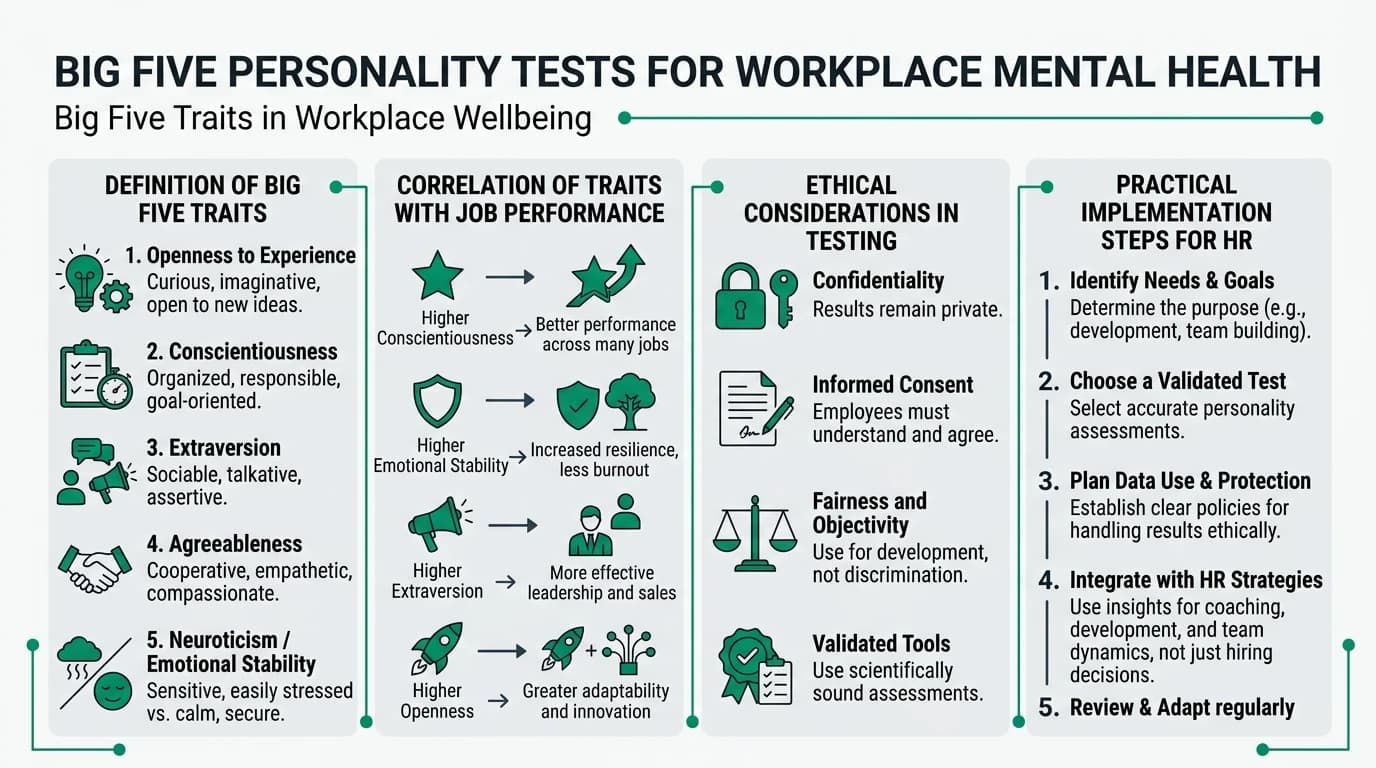
Big Five tests assess traits like Conscientiousness and Neuroticism to predict job performance and manage stress, aiding in mental health screening and employee wellbeing programs.
Source: Paradigm Personality Labs
Executive Summary
The Big Five personality tests are tools used to assess key traits that influence workplace behavior and mental health. They help predict job performance, stress management, and teamwork capabilities.
The bottom line: Big Five tests offer valuable insights but must be used ethically, considering privacy and bias risks.
Critical Warning: These tests are not substitutes for clinical assessments. Always consult with licensed professionals.
What is the Big Five Personality Model?
The Big Five model defines five broad traits:
- Openness: Curiosity, creativity.
- Conscientiousness: Organization, dependability.
- Extraversion: Sociability, energy.
- Agreeableness: Cooperation, empathy.
- Neuroticism: Emotional instability, anxiety.
| Trait | Description |
|---|---|
| Openness | Curiosity and creativity |
| Conscientiousness | Organization and dependability |
| Extraversion | Sociability and energy |
| Agreeableness | Cooperation and empathy |
| Neuroticism | Emotional instability and anxiety |
These traits are validated across cultures and are crucial in predicting workplace behaviors12.
How Do Big Five Traits Predict Job Success?
Certain traits are strong indicators of job success:
- Conscientiousness: Strongest positive correlation across jobs3.
- Extraversion: Important for managerial roles3.
- Emotional Stability: Inverse of Neuroticism, linked to effectiveness3.
- Agreeableness: Supports teamwork and cooperation3.
- Openness: Enhances creativity and problem-solving3.
| Trait | Correlation with Job Success |
|---|---|
| Conscientiousness | Strong positive |
| Extraversion | High for managers |
| Emotional Stability | Positive for effectiveness |
| Agreeableness | Supports teamwork |
| Openness | Enhances creativity |
Why Use Big Five for Mental Health Screening?
Big Five tests help identify traits linked to mental health:
- Low Neuroticism: Correlates with better emotional stability.
- High Conscientiousness: Linked to productivity and lower stress.
These insights are valuable for designing employee wellbeing programs34.
| Trait | Mental Health Impact |
|---|---|
| Neuroticism | Emotional instability, anxiety |
| Conscientiousness | Productivity, lower stress |
Ethical Considerations in Using Big Five Tests
Using these tests requires careful ethical consideration:
- Self-report Bias: Responses may be skewed by personal perceptions.
- Falsification Risks: Candidates might manipulate answers.
- Privacy Concerns: Handling sensitive data responsibly is crucial5.
| Ethical Concern | Mitigation Strategy |
|---|---|
| Self-report Bias | Use alongside other assessments |
| Falsification Risks | Ensure anonymity and honest responses |
| Privacy Concerns | Secure data and obtain consent |
Implementing Big Five Tests in the Workplace
To effectively use Big Five tests:
- Select a Reliable Test: Choose validated tools like the Big Five Inventory.
- Integrate into HR Processes: Use results for hiring, development, and wellbeing programs.
- Analyze and Apply Results: Interpret scores to guide decisions and interventions36.
| Step | Tool/Example | Outcome Metric |
|---|---|---|
| Test Selection | Big Five Inventory | Validity and reliability |
| HR Integration | Workplace Big Five | Enhanced HR processes |
| Analysis | Percentile Scoring | Informed decision-making |
Big Five Traits and Job Roles
Different roles benefit from different traits:
- Entrepreneurs: High Openness, low Neuroticism.
- Managers: High Extraversion, low Neuroticism.
- General Employees: High Conscientiousness7.
| Role | Key Traits |
|---|---|
| Entrepreneurs | High Openness, low Neuroticism |
| Managers | High Extraversion, low Neuroticism |
| General Jobs | High Conscientiousness |
Limitations of Big Five Assessments
While useful, these tests have limitations:
- Predictive Specificity: Traits predict tendencies, not specific outcomes.
- Personality Change: Traits can evolve with experiences and environments45.
Important: Always combine personality tests with other evaluation methods for a comprehensive assessment.
Integration with Wellbeing Programs
Big Five tests can enhance wellbeing programs by:
- Tracking Mental Health: Monitoring traits like Neuroticism over time.
- Guiding Interventions: Tailoring programs to individual needs2.
| Program Aspect | Big Five Application |
|---|---|
| Mental Health Tracking | Monitor Neuroticism changes |
| Intervention Guidance | Tailor to individual traits |
Action checklist
- Choose validated Big Five tests.
- Integrate into HR and wellbeing programs.
- Ensure ethical use and data privacy.
FAQ
What is the Big Five personality model?
How does Conscientiousness affect job performance?
Is Neuroticism linked to workplace stress?
Can Big Five tests predict employee engagement?
What are the limitations of Big Five assessments?
How to use Big Five in hiring ethically?
Big Five vs. MBTI for workplace screening?
Notes
Primary Sources
| Source | Type | URL |
|---|---|---|
| Paradigm Personality Labs | Industry | Link |
| NIH/PMC | Peer-reviewed | Link |
| University of Liverpool | Academic | Link |
Conclusion
The Big Five personality tests are valuable tools for understanding workplace behaviors and enhancing mental health screening. However, ethical use and careful implementation are essential.