lifestyle
Personality and Smartphone Use: Exploring the Big Five Traits
Discover how personality traits influence smartphone use, social media habits, digital wellbeing, and self-regulation.
Quick answer
How do personality traits affect smartphone use?
Personality traits like Neuroticism and Conscientiousness influence smartphone use patterns, impacting digital wellbeing and potentially leading to problematic use.
Source: PMC/NCBI
Executive Summary
Understanding how your personality affects smartphone use can help you manage your digital habits better. The Big Five personality traits—Openness, Conscientiousness, Extraversion, Agreeableness, and Neuroticism—play a significant role in how we interact with our devices.
The bottom line: Personality traits can predict smartphone use patterns, with Neuroticism often linked to problematic use and Conscientiousness associated with better self-regulation.
Critical Warning: If you find your smartphone use impacting your daily life negatively, consider seeking professional advice.
What Are the Big Five Personality Traits?
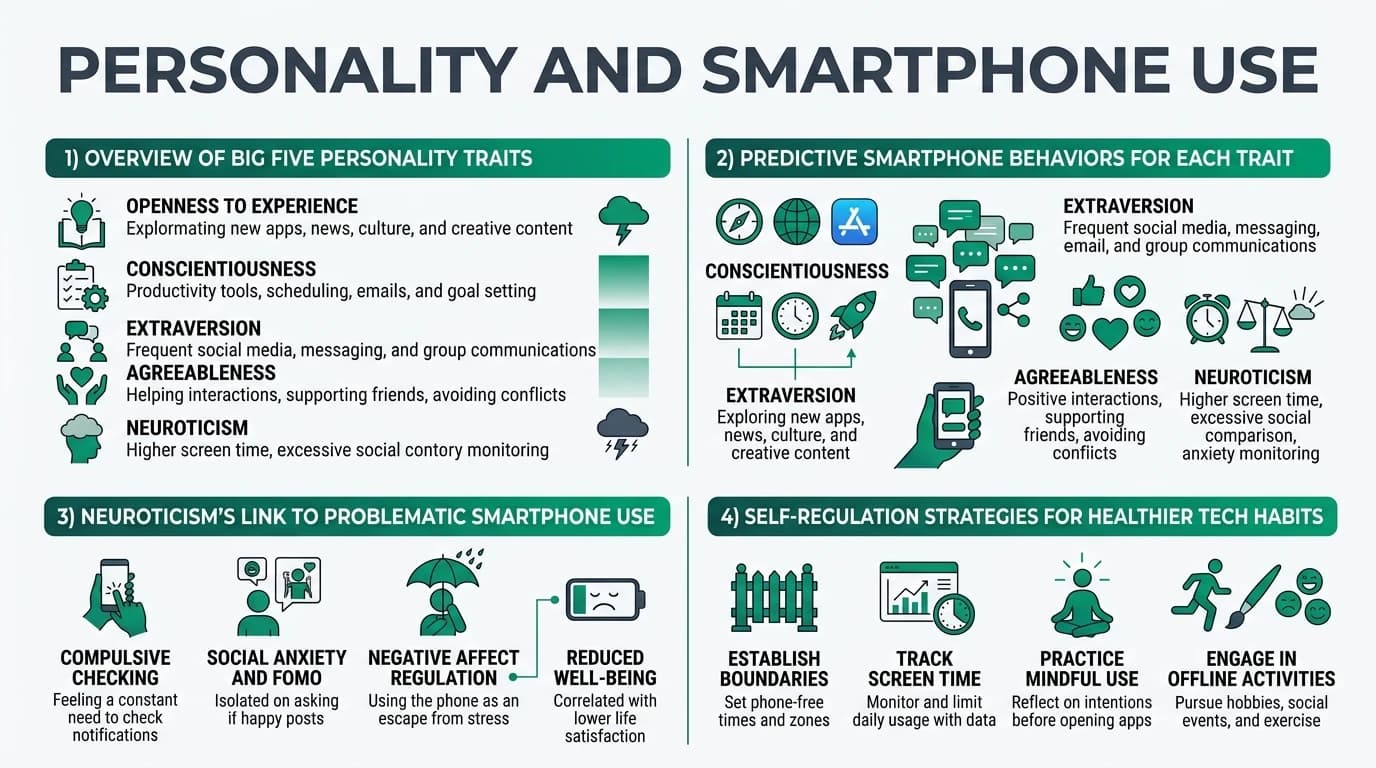
The Big Five personality traits are a widely accepted model for understanding human personality. Here's a quick overview:
- Openness: Creativity and willingness to try new things.
- Conscientiousness: Organization and dependability.
- Extraversion: Sociability and enthusiasm.
- Agreeableness: Compassion and cooperativeness.
- Neuroticism: Tendency towards emotional instability and anxiety.
How Do These Traits Affect Smartphone Use?
Big Five vs. Top Smartphone Predictors
| Trait | Top Predictors | r-value |
|---|---|---|
| Openness | Text length, photo count | 0.37 |
| Conscientiousness | Task management apps, reminders | -0.25 |
| Extraversion | Social media app usage | 0.15 |
| Agreeableness | Communication apps | 0.10 |
| Neuroticism | Notification checks, escapism apps | 0.25 |
Key Takeaways:
- Openness: Linked to creative app use.
- Conscientiousness: Tied to productivity tools.
- Neuroticism: Strongly predicts problematic use.
What Is Problematic Smartphone Use (PSU)?
Problematic Smartphone Use (PSU) refers to excessive phone use that negatively impacts daily life. It often involves:
- Escapism: Using phones to avoid real-life problems.
- Preoccupation: Constantly thinking about phone use.
- Negative Impact: Affecting work, relationships, or health.
Neuroticism Facets and PSU
| Facet | Correlation to PSU | Habitual Use |
|---|---|---|
| Anxiety | Positive | Positive |
| Impulsiveness | Positive | Positive |
Important: High Neuroticism can lead to PSU due to escapism and anxiety relief.
How Does Social Media Overlap with Personality?
Social Media Platforms by Traits
| Platform | Linked Traits | Usage Hypothesis |
|---|---|---|
| Snapchat | Openness, Extraversion | Creative sharing |
| Neuroticism | Validation seeking |
Key Takeaways:
- Extraversion: More social media engagement.
- Neuroticism: Linked to validation-seeking behaviors.
How Can Self-Regulation Improve Digital Wellbeing?
Self-regulation involves controlling impulses and behaviors. For smartphone use, this means:
- Setting Limits: Use app blockers to manage time.
- Mindful Use: Be aware of when and why you use your phone.
- Healthy Habits: Replace phone time with other activities.
Self-Regulation Strategies
| Trait | Strategy | Effect |
|---|---|---|
| Conscientiousness | Task scheduling | Increases productivity |
| Neuroticism | Mindfulness exercises | Reduces anxiety-driven use |
FAQ
How does Neuroticism lead to problematic smartphone use?
Can smartphone data accurately predict Big Five traits?
Which personality traits increase social media time?
Does low Conscientiousness cause phone preoccupation?
How does Extraversion relate to app usage patterns?
What role does Openness play in music app consumption?
Are Big Five traits linked to nighttime phone activity?
Notes
Primary Sources
| Source | Type | URL |
|---|---|---|
| PNAS | Peer-reviewed | PNAS |
| PMC/NCBI | Peer-reviewed | PMC/NCBI |
Conclusion
Understanding the link between personality traits and smartphone use can help you manage your digital habits better. By recognizing your tendencies, you can implement strategies to improve your digital wellbeing.