personality-tests
Big Five Personality Traits and Sleep Quality
Discover how the Big Five personality traits affect sleep quality, insomnia risk, and chronotype preferences, with evidence-based strategies for better rest.
Quick answer
How do personality traits affect sleep quality?
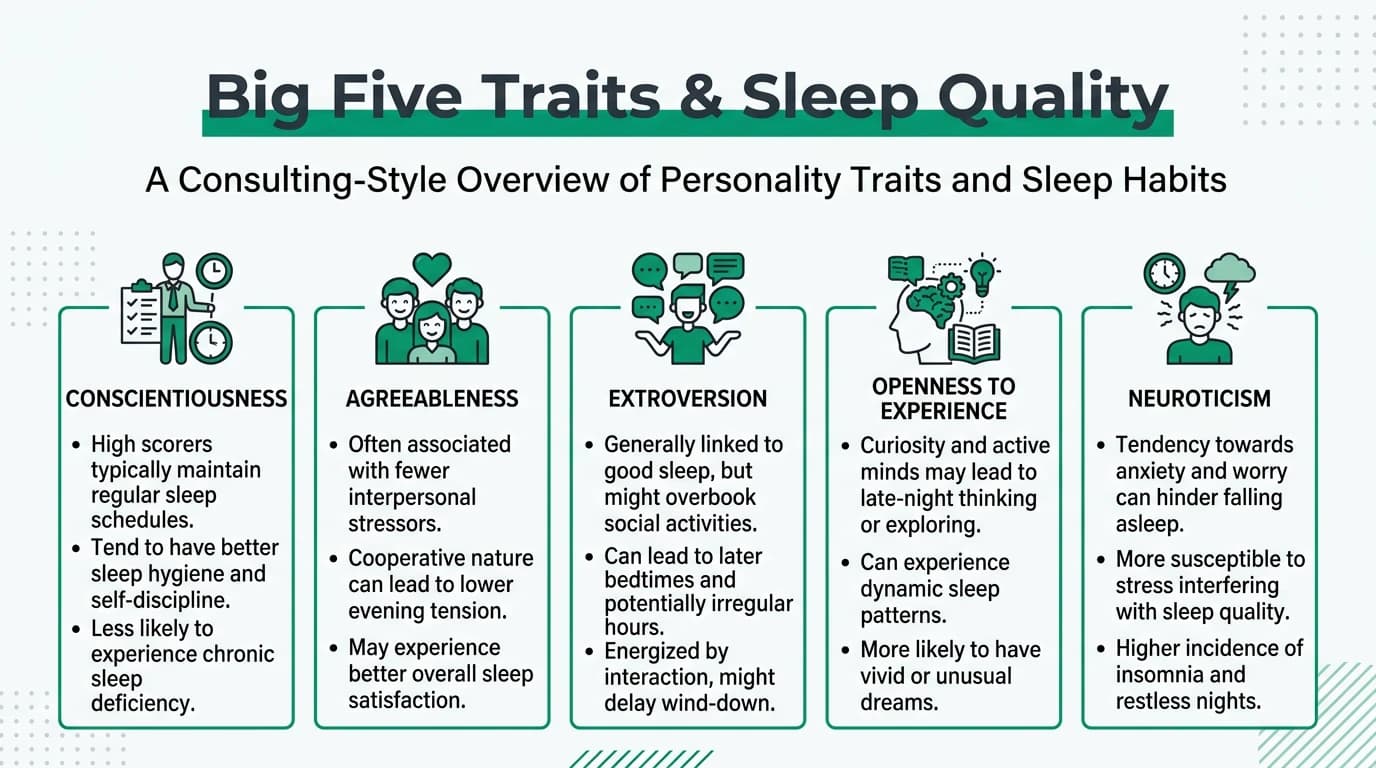
Neuroticism is the strongest predictor of poor sleep, with correlations of r = 0.05 to 0.31 across 51 studies. Conscientiousness protects sleep through better routines, while extraversion links to higher subjective sleep satisfaction.
Source: PubMed Meta-Analysis
Key Takeaways
- Neuroticism is the single strongest personality predictor of insomnia and poor sleep quality across meta-analytic evidence.
- Conscientiousness acts as a protective factor, promoting consistent sleep routines and morningness chronotype.
- Extraversion predicts better subjective sleep but may decline over time if poor sleep persists.
- Openness and agreeableness show weaker or inconsistent associations with sleep outcomes.
- The relationship between personality and sleep is bidirectional: poor sleep can change your personality traits over years.
Understanding your Big Five profile can help you choose sleep strategies that actually work for your temperament. If you are new to the Big Five framework, our complete guide to the Big Five personality test covers each trait in depth.
Disclaimer: This article synthesizes published research for educational purposes. It does not replace professional medical advice. Consult a healthcare provider for persistent sleep issues.
How Each Big Five Trait Relates to Sleep
A meta-analysis of 51 studies covering approximately 31,000 participants across 20 countries found consistent personality-sleep associations1. The table below summarizes the direction and strength of each link.
| Trait | Sleep Quality | Insomnia Risk | Chronotype | Sleep Hygiene | Effect Strength |
|---|---|---|---|---|---|
| Neuroticism | Worse | Higher | Evening | Poor | Strong (r = 0.18–0.31) |
| Conscientiousness | Better | Lower | Morning | Good | Moderate-Strong (r = 0.16–0.35) |
| Extraversion | Better (subjective) | Lower | Evening | Mixed | Moderate (r = 0.05–0.15) |
| Agreeableness | Variable | Lower (some studies) | Neutral | Neutral | Weak-Variable |
| Openness | Neutral | Neutral | Neutral | Neutral | Non-significant |
- Neuroticism and conscientiousness consistently outperform the other three traits as sleep predictors2.
- All traits except openness showed significant associations with insomnia severity1.
- Effect sizes vary by sample type, age, and geography.
Neuroticism: The Strongest Sleep Disruptor
Neuroticism stands out as the most robust predictor of poor sleep outcomes. People high in neuroticism experience more anxiety, rumination, and emotional reactivity, all of which interfere with falling and staying asleep.
Why Neuroticism Hurts Sleep
- Pre-sleep worry activates the hypothalamic-pituitary-adrenal (HPA) axis, increasing cortisol at bedtime.
- Emotional reactivity amplifies the perceived severity of minor nighttime disturbances.
- Rumination cycles delay sleep onset and fragment sleep architecture.
A systematic review found neuroticism-sleep quality effect sizes ranging from 0.183 to 0.40, confirming a moderate-to-strong relationship3.
Neuroticism and Insomnia: The Numbers
| Measure | Finding | Source |
|---|---|---|
| Cross-sectional correlation | r = 0.05 to 0.31 | Meta-analysis of 51 studies1 |
| Longitudinal prediction | Beta = 0.175, p less than 0.001 | Frontiers in Psychology4 |
| Effect size range | 0.183 to 0.40 | Systematic review3 |
| Bidirectional effect | Insomnia also predicts rising neuroticism | MIDUS longitudinal study5 |
- The relationship is bidirectional: baseline neuroticism predicts future insomnia, and insomnia predicts increases in neuroticism over 4 to 10 years45.
- This creates a feedback loop that can escalate without intervention.
For more on how neuroticism manifests at work and in daily life, see our neuroticism interpretation guide.
Strategies for High-Neuroticism Sleepers
- Cognitive Behavioral Therapy for Insomnia (CBT-I) breaks the worry-sleep cycle by restructuring bedtime thoughts.
- Mindfulness-based stress reduction lowers pre-sleep arousal.
- Worry journaling 2 hours before bed externalizes anxious thoughts.
- Stimulus control: reserve the bed exclusively for sleep to weaken the bed-anxiety association.
- Progressive muscle relaxation targets the physical tension that accompanies emotional reactivity.
| Strategy | Target Mechanism | Evidence Level | Time to Benefit |
|---|---|---|---|
| CBT-I | Cognitive restructuring | Strong (meta-analytic) | 4–8 weeks |
| Mindfulness meditation | Pre-sleep arousal | Moderate (RCTs) | 2–4 weeks |
| Worry journaling | Rumination | Moderate | Immediate to 1 week |
| Stimulus control | Conditioned arousal | Strong | 2–6 weeks |
| Progressive muscle relaxation | Physical tension | Moderate | 1–2 weeks |
Conscientiousness: A Natural Sleep Protector
Conscientiousness is associated with better sleep hygiene, morningness chronotype, and lower insomnia severity. Highly conscientious individuals tend to maintain regular sleep-wake schedules, limit caffeine and screen use before bed, and prioritize health behaviors.
How Conscientiousness Supports Sleep
- Routine adherence strengthens circadian rhythm alignment.
- Goal-directed behavior translates into disciplined wind-down rituals.
- Health consciousness reduces stimulant use and late-night eating.
Longitudinal data show that baseline conscientiousness predicts reduced insomnia over time (beta = -0.168, p less than 0.001)4. The protective effect persists across 4 to 10 years of follow-up5.
| Conscientiousness Facet | Sleep Benefit | Mechanism |
|---|---|---|
| Self-discipline | Consistent bedtime | Circadian reinforcement |
| Orderliness | Optimized bedroom environment | Reduced stimulation |
| Dutifulness | Following sleep recommendations | Evidence-based compliance |
| Achievement striving | Tracking sleep goals | Accountability loop |
- People scoring high on conscientiousness are significantly more likely to be morning chronotypes3.
- High conscientiousness buffers against the sleep-disrupting effects of stress, relevant for burnout prevention.
Building Conscientious Sleep Habits (Even If You Score Low)
You do not need to be naturally high in conscientiousness to benefit from structured sleep practices:
- Use a sleep tracker app to create external accountability.
- Set phone alarms for both bedtime and wake time.
- Prepare your sleep environment at the same time each night (dim lights, lower thermostat, remove devices).
- Start with one habit and add others weekly rather than overhauling everything at once.
Extraversion and Subjective Sleep Experiences
Extraversion predicts better self-reported sleep quality, though the mechanisms differ from conscientiousness. Extraverts tend to feel more satisfied with their sleep, partly because social engagement during the day reduces bedtime stress.
Key Findings
- Extraversion correlates negatively with insomnia (beta = -0.146, p less than 0.001)4.
- Extraverts in college samples often prefer evening chronotypes, which can conflict with early class schedules2.
- Longitudinal evidence suggests that poor sleep predicts declining extraversion over time, creating another bidirectional loop5.
| Aspect | Extraverts | Introverts |
|---|---|---|
| Subjective sleep quality | Higher satisfaction | Lower satisfaction |
| Chronotype preference | Often evening | Varies |
| Social regulation of stress | Strong (via social support) | Weaker |
| Impact of persistent poor sleep | Declining extraversion | Stable trait levels |
| Daytime sleepiness risk | Lower | Higher |
- Introverted individuals facing bidirectional insomnia-personality cycles may benefit from therapy targeting both sleep hygiene and social energy5.
- Learn how personality shifts over the lifespan in our personality changes across the lifespan guide.
Openness and Agreeableness: Weaker but Notable Links
Openness to Experience
- Shows limited or non-significant associations with sleep quality and insomnia across most studies14.
- May relate to nightmare frequency and dream vividness, though evidence is sparse6.
- High-openness individuals sometimes show greater chronotype flexibility, adapting more easily to schedule changes.
Agreeableness
- Linked to better sleep quality in some studies but results are inconsistent13.
- Has a one-directional longitudinal tie to insomnia: low agreeableness predicts future sleep problems, but insomnia does not significantly predict changes in agreeableness4.
- Poor baseline sleep quality predicts declines in agreeableness over time5.
| Trait | Association with Sleep Quality | Consistency Across Studies | Longitudinal Direction |
|---|---|---|---|
| Openness | Neutral to non-significant | Low | No significant link |
| Agreeableness | Positive (some studies) | Moderate | Low agreeableness predicts future insomnia |
Chronotype Preferences by Personality Trait
Chronotype, your natural preference for morning or evening activity, is partially predicted by personality. This has practical implications for scheduling, productivity, and sleep health.
| Trait | Preferred Chronotype | Sleep Duration Tendency | Practical Implication |
|---|---|---|---|
| High conscientiousness | Morning ("lark") | Adequate (7–8 hours) | Align work start with natural rhythm |
| High neuroticism | Evening ("owl") | Shorter, fragmented | Avoid early obligations when possible |
| High extraversion | Evening | Variable | Schedule social activities to avoid late-night stimulation |
| High openness | Flexible | Variable | Use flexibility for shift adaptation |
| High agreeableness | No strong preference | Adequate | Focus on consistent schedule |
- Conscientiousness-morningness correlations range from 0.16 to 0.353.
- Neuroticism's association with eveningness compounds its negative sleep effects because evening types often face social jetlag from early work or school schedules.
Longitudinal Evidence: Sleep and Personality Change Over Time
One of the most striking findings in this field is that sleep quality and personality traits influence each other over years. The MIDUS study tracked participants over 4 to 10 years and found significant bidirectional effects5.
| Direction | Trait Affected | Effect | Source |
|---|---|---|---|
| Poor sleep predicts trait decline | Extraversion | Significant decline | MIDUS Study5 |
| Poor sleep predicts trait decline | Agreeableness | Moderate decline | MIDUS Study5 |
| Poor sleep predicts trait decline | Conscientiousness | Moderate decline | MIDUS Study5 |
| Baseline neuroticism predicts | Future insomnia | Beta = 0.175 | Frontiers4 |
| Baseline low conscientiousness predicts | Worsening sleep | Beta = -0.168 | Frontiers4 |
- These findings suggest that investing in sleep is also an investment in personality stability.
- Untreated insomnia may gradually erode the very traits (conscientiousness, extraversion) that could help resolve it.
- Understanding how traits change over time is essential context. Our personality changes across the lifespan guide covers the science of trait development.
Moderators: Why Results Vary Across Populations
Not everyone with high neuroticism sleeps poorly. Several moderators influence how strongly personality predicts sleep outcomes.
| Moderator | Impact on Personality-Sleep Link | Meta-Regression Evidence |
|---|---|---|
| Age | Stronger associations in younger adults | Significant1 |
| Geography | Western samples show larger effects | Significant1 |
| Population type | Clinical samples differ from community | Significant1 |
| Study quality | Higher-quality studies find smaller effects | Significant1 |
| Sample size | Larger samples reduce noise | Moderate1 |
- College student samples, common in personality research, may overrepresent evening chronotypes and irregular sleep schedules2.
- Cultural norms around bedtime routines and social schedules modify the expression of personality-driven sleep behaviors.
- Stress management approaches also interact with personality. See our stress management guide for trait-matched coping strategies.
Big Five Sleep Profile: A Self-Assessment Framework
Use this table to identify which personality-driven sleep challenges may apply to you and which strategies to prioritize.
| Your Profile | Likely Sleep Challenge | Priority Strategy | Expected Timeline |
|---|---|---|---|
| High neuroticism | Pre-sleep anxiety, insomnia | CBT-I, mindfulness | 4–8 weeks |
| Low conscientiousness | Irregular schedule, poor hygiene | Habit tracking, external cues | 2–4 weeks |
| High extraversion, evening type | Social jetlag, late-night stimulation | Earlier wind-down, social scheduling | 2–3 weeks |
| Low extraversion | Bidirectional insomnia-withdrawal cycle | Combined sleep and social therapy | 6–12 weeks |
| High openness | Nightmares, vivid dreams | Dream journaling, relaxation | Variable |
| Low agreeableness | Conflict-driven stress at bedtime | Conflict resolution before evening | Ongoing |
Sleep improvement action checklist
- Identify your dominant Big Five traits using a validated assessment.
- Match your top sleep complaint to the trait-strategy table above.
- Set a consistent bedtime and wake time (even on weekends) for at least 2 weeks.
- If you score high on neuroticism, start a pre-sleep worry journal tonight.
- Eliminate screens from the bedroom or use blue-light filters after 9 PM.
- Track sleep quality daily using a simple 1-to-10 rating for 30 days.
- Review progress at 4 weeks and adjust strategies if needed.
- Consult a sleep specialist if self-help strategies do not improve sleep within 8 weeks.
FAQ
Which Big Five trait has the strongest impact on sleep quality?
Neuroticism is the strongest predictor of poor sleep quality, with meta-analytic correlations ranging from r = 0.05 to 0.31 across 51 studies and approximately 31,000 participants. It predicts both insomnia severity and subjective sleep dissatisfaction more consistently than any other Big Five trait1.
Can improving sleep actually change your personality traits?
Yes. Longitudinal research from the MIDUS study shows that poor sleep quality predicts declines in extraversion, agreeableness, and conscientiousness over 4 to 10 years. Improving sleep may help stabilize or reverse these personality shifts5.
How does conscientiousness protect sleep quality?
Conscientious individuals maintain consistent bedtime routines, limit pre-sleep stimulant use, and adhere to sleep hygiene recommendations. Longitudinally, high conscientiousness predicts reduced insomnia severity (beta = -0.168, p less than 0.001) over multiple years4.
What is the connection between personality and chronotype?
Conscientiousness correlates with morningness (r = 0.16 to 0.35), while neuroticism is associated with eveningness. Extraversion also tilts toward evening preference, particularly in college-age samples. Chronotype mismatches with work schedules can compound personality-driven sleep issues3.
Does extraversion help or hurt sleep?
Are personality-sleep links the same across all age groups?
No. Meta-regression analyses show that age significantly moderates personality-sleep associations, with stronger effects in younger adults. Geography, population type (clinical vs. community), and study quality also influence effect sizes1.
What sleep strategies work best for people high in neuroticism?
How reliable are the studies linking personality to sleep?
The evidence base is substantial. The primary meta-analysis covers 51 studies across 20 countries with approximately 31,000 participants. Longitudinal studies from Frontiers in Psychology and the MIDUS project add causal direction. However, most individual studies rely on self-report measures, and effect sizes are moderate rather than large15.
Notes
Primary Sources
| Source | Type | Key Contribution | URL |
|---|---|---|---|
| PubMed/NCBI | Meta-analysis (51 studies, N = 31,000) | Comprehensive trait-sleep correlations | Link |
| PLOS ONE | Peer-reviewed journal | Conscientiousness and neuroticism as sleep predictors | Link |
| PubMed Central | Systematic review | Effect size ranges across sleep outcomes | Link |
| Frontiers in Psychology | Longitudinal study | Bidirectional personality-insomnia effects | Link |
| MIDUS / University of Wisconsin | Prospective cohort | 4-to-10 year trait-sleep trajectories | Link |
| SAGE Journals | Peer-reviewed journal | Chronotype and personality associations | Link |
Conclusion
Your personality shapes your sleep, and your sleep shapes your personality. Neuroticism drives insomnia risk, conscientiousness builds protective routines, and extraversion supports subjective sleep satisfaction. These are not fixed outcomes. By identifying your trait profile and applying targeted strategies, you can break negative cycles and build better sleep habits.
The bidirectional nature of these relationships means that every night of improved sleep contributes to trait stability and emotional resilience. Start with one targeted change from the checklist above, track your progress, and adjust over time.
Footnotes
-
Mega, T. et al. (2025). Big Five personality traits and sleep quality: A meta-analysis of 51 studies. PubMed/NCBI. Available at: https://pubmed.ncbi.nlm.nih.gov/40593293/ ↩ ↩2 ↩3 ↩4 ↩5 ↩6 ↩7 ↩8 ↩9 ↩10 ↩11 ↩12 ↩13
-
Duggan, K. A. et al. (2014). Personality and healthy sleep: The importance of conscientiousness and neuroticism. PLOS ONE, 9(3), e90628. Available at: https://journals.plos.org/plosone/article?id=10.1371/journal.pone.0090628 ↩ ↩2 ↩3
-
Stephan, Y. et al. (2024). Personality traits and sleep: A systematic review. PubMed Central/NCBI, PMC11380882. Available at: https://pmc.ncbi.nlm.nih.gov/articles/PMC11380882/ ↩ ↩2 ↩3 ↩4 ↩5 ↩6 ↩7
-
Zhang, L. et al. (2025). Bidirectional longitudinal associations between Big Five personality traits and insomnia. Frontiers in Psychology, 16, 1569036. Available at: https://www.frontiersin.org/journals/psychology/articles/10.3389/fpsyg.2025.1569036/full ↩ ↩2 ↩3 ↩4 ↩5 ↩6 ↩7 ↩8 ↩9 ↩10 ↩11
-
Stephan, Y. et al. (2018). Personality and sleep quality: Evidence from four prospective studies. MIDUS (University of Wisconsin). Available at: https://www.midus.wisc.edu/findings/pdfs/1738.pdf ↩ ↩2 ↩3 ↩4 ↩5 ↩6 ↩7 ↩8 ↩9 ↩10 ↩11 ↩12 ↩13
-
Randler, C. (2017). Chronotype, sleep behavior, and Big Five personality factors. SAGE Open, 7(3). Available at: https://journals.sagepub.com/doi/10.1177/2158244017728321 ↩