mental-health
Personality Sensory Processing Sensitivity Hsp Big Five
Practical guide to understand and apply Personality Sensory Processing Sensitivity Hsp Big Five.
md
title: "Sensory Processing Sensitivity and the Big Five: Understanding the HSP Trait" description: "Explore the connection between Sensory Processing Sensitivity (SPS) and the Big Five personality traits, focusing on Neuroticism and Openness, and discover effective coping strategies for Highly Sensitive Persons (HSPs)." slug: "personality-sensory-processing-sensitivity-hsp-big-five" category: "mental-health" keywords: ["Sensory processing sensitivity", "Highly sensitive person", "HSP and Big Five", "SPS Neuroticism overlap", "HSP coping strategies"] author: "Editorial Team" datePublished: "2026-03-23" lastUpdated: "2026-03-23" featured: true images:
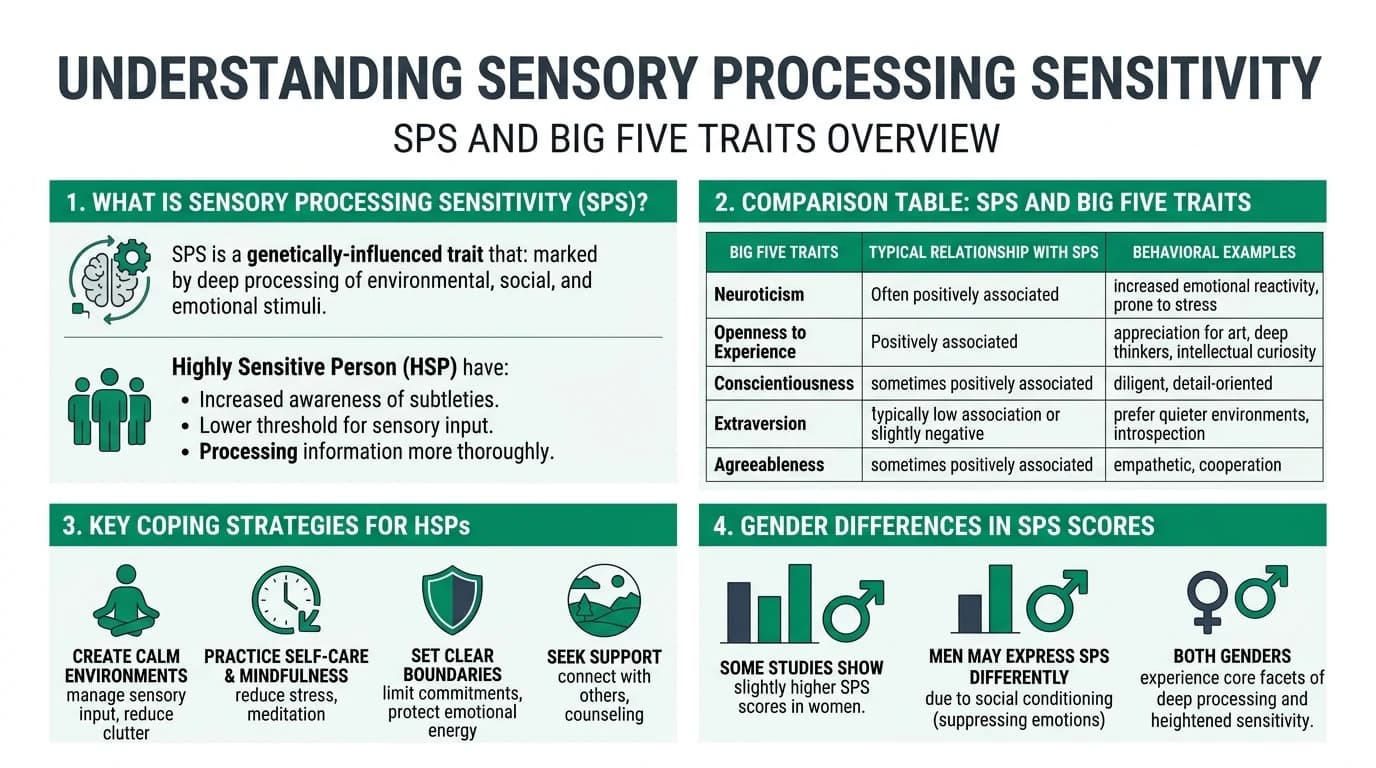
- url: "/images/guides/personality-sensory-processing-sensitivity-hsp-big-five.webp" alt: "An illustration of a person surrounded by various sensory stimuli, representing the concept of sensory processing sensitivity." caption: "Sensory Processing Sensitivity involves heightened responsiveness to environmental stimuli, affecting daily life." relatedGuides:
- "personality-neurodivergence-adhd-autism-big-five"
- "neuroticism-complete-guide-big-five"
- "introversion-workplace-guide-big-five"
Quick answer
What is the relationship between sensory processing sensitivity and Big Five traits?
Sensory Processing Sensitivity (SPS) correlates with lower emotional stability (Neuroticism), higher openness, and sometimes higher agreeableness, but remains a distinct trait reflecting emotional reactivity and environmental sensitivity.
Source: Sensitivity Research
Executive Summary
Sensory Processing Sensitivity (SPS) is a trait linked to heightened responsiveness to stimuli, often seen in Highly Sensitive Persons (HSPs). It overlaps with Big Five traits like Neuroticism and Openness but stands as a unique characteristic.
The bottom line: Understanding SPS helps in recognizing its impact on mental health and relationships, and developing effective coping strategies.
What is Sensory Processing Sensitivity?
Sensory Processing Sensitivity (SPS) is a trait characterized by:
- Deep Processing: Thoughtful reflection on experiences.
- Emotional Reactivity: Strong emotional responses.
- Overstimulation: Easily overwhelmed by sensory input.
SPS vs. Sensory Processing Disorder
| Aspect | SPS | Sensory Processing Disorder |
|---|---|---|
| Nature | Trait | Disorder |
| Impact | Emotional and cognitive | Sensory and motor |
| Management | Coping strategies | Therapy |
Important: SPS is not a disorder. It’s a personality trait that can be managed with the right strategies.
How Does SPS Relate to the Big Five?
SPS has intriguing overlaps with the Big Five personality traits:
- Neuroticism: Higher emotional instability.
- Openness: Greater aesthetic sensitivity.
- Conscientiousness: Mixed results, sometimes higher.
- Extraversion: Generally lower in HSPs.
- Agreeableness: Sometimes higher.
SPS and Big Five Comparison
| Trait | SPS Profile |
|---|---|
| Neuroticism | Higher |
| Openness | Higher |
| Conscientiousness | Higher/mixed |
| Extraversion | Lower |
| Agreeableness | Higher |
Neuroticism and SPS: The Overlap
Effect: Emotional reactivity and stress response.
Process: Neuroticism contributes to heightened emotional responses in HSPs.
Caveat: While SPS correlates with Neuroticism, it's distinct and not just emotional instability.
Openness and SPS: A Deeper Connection
Effect: Appreciation for aesthetics and creativity.
Process: SPS individuals often engage deeply with art and imagination.
Key Takeaways:
- Aesthetic Sensitivity: Enjoyment of beauty and art.
- Imaginative Engagement: Rich inner life.
Coping Strategies for HSPs
Managing SPS involves practical strategies:
- Mindfulness: Helps in reducing overstimulation.
- Journaling: Encourages emotional processing.
- Scheduled Breaks: Prevents overwhelm in busy environments.
Coping Strategies by Trait Overlap
| SPS Aspect | Linked Big Five | Strategy |
|---|---|---|
| Emotional Reactivity | Neuroticism | Mindfulness |
| Depth of Processing | Openness | Journaling |
| Overstimulation | Extraversion | Scheduled Breaks |
Gender Differences in SPS
Research shows gender differences in SPS:
- Women: Higher SPS scores.
- Men: Lower, but significant when controlled for personality traits.
Gender Differences in SPS
| Gender | Mean SPS Score | Big Five Controls |
|---|---|---|
| Women | 115.72 | Higher |
| Men | 100.92 | Lower |
Important: These differences persist even after accounting for Big Five traits.
Measurement Tools for SPS
SPS is often measured using:
- Highly Sensitive Person Scale (HSPS): Assesses sensitivity levels.
- Big Five Inventory (BFI): Evaluates broader personality traits.
Quick Reference: SPS Scores
| Group | Mean Score | Interpretation |
|---|---|---|
| High HSP | Above 115 | Very sensitive |
| Average | 100-115 | Moderately sensitive |
| Low | Below 100 | Less sensitive |
FAQ
What is sensory processing sensitivity?
How does SPS differ from Neuroticism?
Is HSP the same as being an introvert?
What Big Five traits are linked to high sensitivity?
Do highly sensitive people have higher Openness?
Can SPS be measured with Big Five tests?
What coping strategies help HSPs with overstimulation?
Notes
Primary Sources
| Source | Type | URL |
|---|---|---|
| Lithuanian Health Sciences University | Peer-reviewed | https://lsmu.lt/cris/entities/publication/d510ecaa-e274-49f5-996b-6c7cf662f35e |
| PubMed / Journal of Psychology | Peer-reviewed | https://pubmed.ncbi.nlm.nih.gov/30321115/ |
Conclusion
Sensory Processing Sensitivity offers a unique lens through which to view personality, distinct from but related to the Big Five traits. Recognizing and managing this sensitivity can enhance well-being and interpersonal relationships.