personality-tests
ADHD, Autism, and Big Five Personality Traits
Learn how ADHD and autism interact with Big Five personality traits, with research-backed profiles, effect sizes, and practical coping strategies.
Quick answer
How do ADHD and autism interact with Big Five traits?
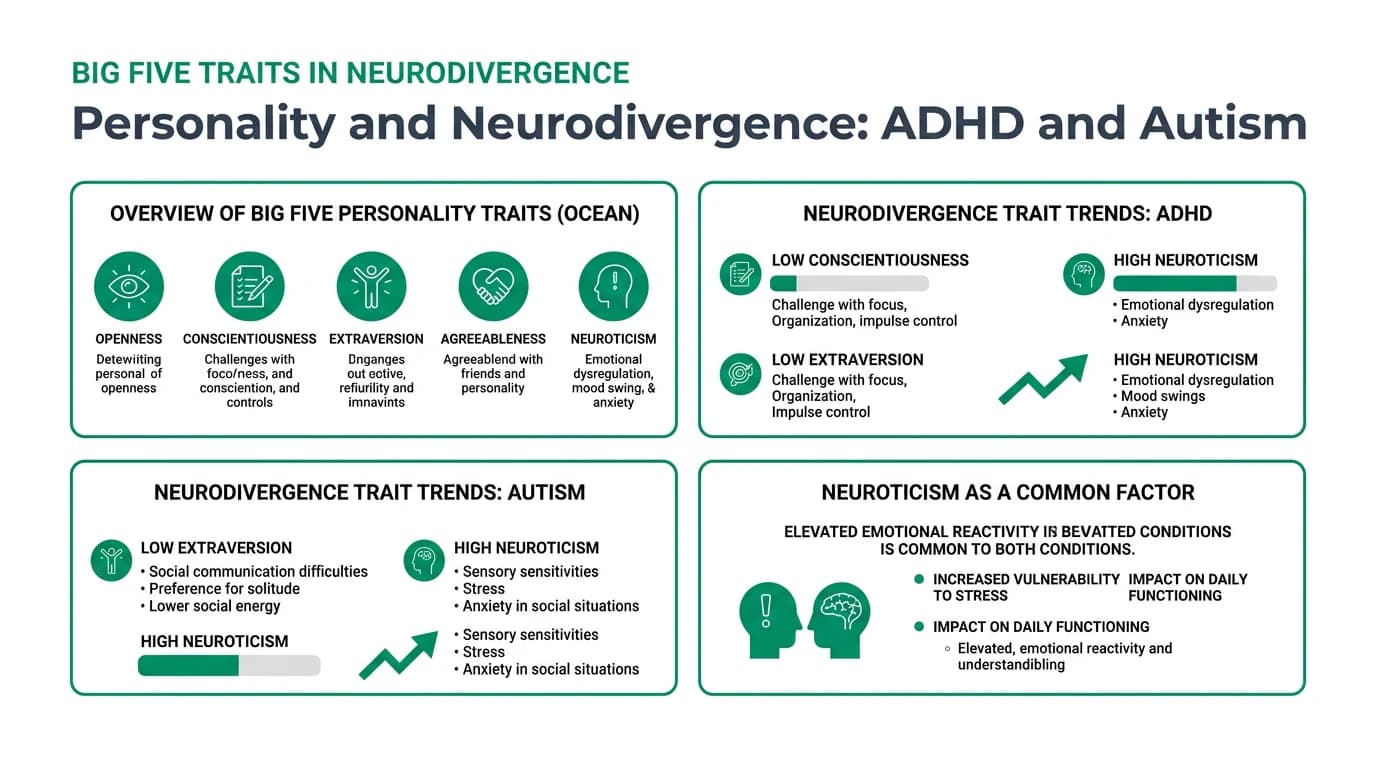
ADHD is most strongly linked to low conscientiousness and high neuroticism. Autism shows marked reductions in extraversion (Hedges g = -1.42) and agreeableness, with elevated neuroticism. Both conditions share a neuroticism overlap, but their profiles diverge on extraversion and openness. These patterns are consistent across meta-analyses covering thousands of participants.
Key Takeaways
- ADHD is most consistently linked to low conscientiousness (the strongest effect) and high neuroticism.
- Autism shows the largest personality deviations on extraversion (strongly reduced) and neuroticism (elevated).
- Neuroticism is the shared overlap between ADHD and autism — both conditions elevate it significantly.
- ADHD subtypes produce different Big Five profiles: inattentive type maps to low conscientiousness, while hyperactive-impulsive type involves low agreeableness.
- Personality trait awareness can guide targeted coping strategies, workplace accommodations, and therapeutic interventions.
- Big Five assessments should not be used to diagnose neurodivergent conditions, but understanding the overlap helps neurodivergent individuals make sense of their personality profiles.
The bottom line: Neurodivergence does not replace personality — it interacts with it. Understanding your Big Five profile alongside your ADHD or autism diagnosis gives you more precise strategies for managing challenges and leveraging strengths.
Disclaimer: This guide summarizes peer-reviewed research for educational purposes. It is not a diagnostic tool. Always consult a qualified healthcare professional for assessment, diagnosis, and treatment of ADHD or autism spectrum conditions.
How the Big Five Framework Applies to Neurodivergence
The Big Five model measures personality across five broad dimensions. When applied to neurodivergent populations, distinctive patterns emerge that differ from neurotypical norms12.
- Meta-analyses consistently find that ADHD and autism produce reliable shifts in multiple Big Five dimensions.
- These shifts represent population-level trends — individual neurodivergent people can score anywhere on each dimension.
- The Big Five captures traits, not symptoms. Trait elevations associated with neurodivergence reflect stable personality patterns, not momentary states.
| Big Five Trait | Description | ADHD Direction | Autism Direction |
|---|---|---|---|
| Openness | Creativity, intellectual curiosity | Slightly reduced | Reduced |
| Conscientiousness | Organization, dependability | Strongly reduced | Moderately reduced |
| Extraversion | Sociability, assertiveness | Variable by subtype | Strongly reduced |
| Agreeableness | Compassion, cooperativeness | Reduced | Reduced |
| Neuroticism | Emotional instability, anxiety | Elevated | Elevated |
For a comprehensive introduction to the Big Five framework, see our complete Big Five guide.
ADHD and Big Five Traits: The Complete Profile
ADHD produces a characteristic Big Five profile that varies by subtype. The inattentive presentation primarily affects conscientiousness, while the hyperactive-impulsive presentation additionally impacts agreeableness and extraversion13.
- Conscientiousness: The defining trait reduction in ADHD. Executive function deficits directly map to low self-discipline, disorganization, and difficulty following through on plans.
- Neuroticism: Elevated across all ADHD subtypes. Emotional dysregulation — a core but historically underrecognized feature of ADHD — drives this elevation.
- Agreeableness: Reduced primarily in the hyperactive-impulsive and combined presentations, linked to oppositional behaviors and interpersonal friction.
| ADHD Subtype | Conscientiousness | Neuroticism | Agreeableness | Extraversion | Openness |
|---|---|---|---|---|---|
| Inattentive | Very low | Elevated | Mildly reduced | Variable | Slightly reduced |
| Hyperactive-impulsive | Low | Elevated | Reduced | Elevated or variable | Variable |
| Combined | Very low | Strongly elevated | Reduced | Variable | Slightly reduced |
Nigg et al. (2002) found that ADHD symptoms in adults correlated most strongly with low conscientiousness (r = -0.40) and high neuroticism (r = +0.35), with smaller effects on agreeableness (r = -0.20)3.
Autism and Big Five Traits: The Complete Profile
Autism spectrum conditions produce the most pronounced Big Five deviations of any neurodevelopmental condition, particularly on extraversion and neuroticism24.
- Extraversion: The largest effect size of any trait–condition pairing. Autistic individuals score dramatically lower on extraversion (Hedges g = -1.42), reflecting reduced social motivation and preference for solitary activities.
- Neuroticism: Significantly elevated, driven by sensory sensitivities, anxiety, and difficulty navigating unpredictable social environments.
- Agreeableness: Reduced, though this may partly reflect measurement artifacts — Big Five scales assess social warmth in neurotypical-normed ways.
| Big Five Trait | Autism Effect (Hedges g) | Interpretation | Key Mechanism |
|---|---|---|---|
| Extraversion | -1.42 | Very large reduction | Low social motivation, sensory avoidance |
| Neuroticism | +0.85 | Large increase | Anxiety, sensory overwhelm, social stress |
| Agreeableness | -0.65 | Moderate reduction | Different social processing, not callousness |
| Conscientiousness | -0.45 | Moderate reduction | Executive function difficulties, rigidity paradox |
| Openness | -0.30 | Small reduction | Preference for routine offsets intellectual curiosity |
Lodi-Smith et al. (2018) conducted a meta-analysis of Big Five traits in autism and confirmed these effect sizes across 23 studies, noting that extraversion showed the largest and most consistent deviation4.
Neuroticism: The Shared Thread
Neuroticism is elevated in both ADHD and autism, making it the primary personality overlap between the two conditions125.
- In ADHD, elevated neuroticism reflects emotional dysregulation — rapid mood shifts, frustration intolerance, and rejection sensitivity.
- In autism, elevated neuroticism reflects anxiety from sensory overload, social confusion, and unpredictability.
- The mechanisms differ, but the personality outcome is similar: both groups experience more frequent and intense negative emotions.
| Source of Neuroticism | ADHD Mechanism | Autism Mechanism | Shared Outcome |
|---|---|---|---|
| Anxiety | Worry about forgetting tasks | Worry about social demands | Chronic stress |
| Emotional reactivity | Rapid mood fluctuation | Sensory overwhelm | Difficulty with emotional regulation |
| Vulnerability | Sensitivity to rejection | Sensitivity to change | Avoidance of challenging situations |
| Self-consciousness | Awareness of social errors | Awareness of being different | Lower self-esteem |
Practical strategies for managing elevated neuroticism:
- Identify your specific neuroticism triggers (social, sensory, task-related) to target interventions accurately.
- Practice grounding techniques (5-4-3-2-1 sensory exercise) during acute emotional spikes.
- Build predictability into daily routines — both ADHD and autism respond well to environmental structure.
- Explore our mental health and personality guide for evidence-based approaches.
Low Conscientiousness: Impact and Strategies
Low conscientiousness is the hallmark personality feature of ADHD and a moderate feature of autism13. It manifests differently in each condition.
- ADHD: Low conscientiousness reflects executive function deficits — poor working memory, difficulty initiating tasks, and trouble maintaining organization.
- Autism: Low conscientiousness scores can be misleading. Many autistic individuals are highly systematic in their areas of interest but score low on conscientiousness scales that measure flexible goal pursuit and social dependability.
| Challenge | ADHD Manifestation | Autism Manifestation | Coping Strategy |
|---|---|---|---|
| Task initiation | Paralysis despite intention | Difficulty switching from preferred activity | Use "body doubling" (working alongside someone) |
| Organization | Cluttered environment, lost items | Rigid systems that break under change | External tools: apps, visual schedules, timers |
| Follow-through | Starts many projects, finishes few | Hyperfocuses on preferred tasks only | Break tasks into 15-minute blocks with visible timers |
| Time awareness | Time blindness | Time rigidity (distress when schedules shift) | Multiple alarm systems, visual countdowns |
Practical strategies:
- Use external scaffolding (alarms, checklists, accountability partners) to substitute for internal conscientiousness.
- Embrace "good enough" standards rather than perfectionism or avoidance.
- Match routines to energy patterns — tackle demanding tasks during peak alertness windows.
- See our conscientiousness guide for trait-building approaches.
Extraversion Differences: ADHD vs. Autism
Extraversion shows the most divergent pattern between ADHD and autism, making it a useful differentiator in personality profiles24.
- ADHD: Extraversion is variable. Some individuals with ADHD (especially the hyperactive-impulsive type) score high on extraversion due to stimulation-seeking and social impulsivity. Others, particularly the inattentive type, score lower.
- Autism: Extraversion is consistently and dramatically reduced. This is the single largest personality effect associated with autism (Hedges g = -1.42).
| Extraversion Dimension | ADHD Pattern | Autism Pattern | Implication |
|---|---|---|---|
| Sociability | Variable — may seek social stimulation | Low — preference for solitude | Social needs differ dramatically |
| Assertiveness | Can be high (impulsivity reads as assertiveness) | Low — difficulty self-advocating | Workplace communication strategies diverge |
| Positive emotions | Fluctuating — highs and lows | Muted outward expression (not necessarily muted experience) | Emotional expression does not equal emotional experience |
| Activity level | High in hyperactive presentation | Variable — may have intense focused activity | Energy management strategies differ |
Practical strategies:
- ADHD (high extraversion): Channel social energy productively — choose roles with built-in collaboration.
- ADHD (low extraversion): Protect alone time to recharge, especially if the inattentive subtype dominates.
- Autism: Design social interactions on your terms — smaller groups, predictable settings, clear agendas.
Agreeableness: Understanding the Reduction
Both ADHD and autism are associated with lower agreeableness scores, but for different reasons14.
- ADHD: Lower agreeableness reflects impulsivity-driven social friction — interrupting, impatience, and unintentional insensitivity.
- Autism: Lower agreeableness reflects different social processing rather than intentional unkindness. Autistic individuals may score low on agreeableness because they communicate directly, struggle with social reciprocity norms, or fail to mask disagreement.
| Agreeableness Facet | ADHD Mechanism | Autism Mechanism | Reframe for Strengths |
|---|---|---|---|
| Trust | Impulsive judgment of others | Difficulty reading intentions | Both benefit from explicit communication |
| Straightforwardness | Blurts opinions without filtering | Values honesty over social smoothing | Directness valued in technical and creative fields |
| Compliance | Resists rules that feel arbitrary | Follows rules rigidly or not at all | Clear, logical rules work for both |
| Modesty | May overestimate abilities impulsively | May understate or struggle to self-promote | Different self-awareness coaching needed |
Practical strategies:
- Reframe directness as an asset in professions that value candor (engineering, science, consulting).
- Practice "social scripts" for common situations where agreeableness norms matter (meetings, feedback sessions).
- Recognize that low agreeableness on a personality scale does not mean low empathy — many neurodivergent individuals experience strong emotional empathy.
Openness to Experience: A Complex Picture
Openness shows small to moderate reductions in both ADHD and autism, but the underlying pattern is nuanced26.
- ADHD: Slight reductions in openness may reflect difficulty sustaining engagement with intellectual pursuits rather than lack of curiosity. Some studies find elevated openness in ADHD, particularly for novelty-seeking aspects.
- Autism: Reduced openness is driven by preference for routine and predictability. However, autistic individuals often show extremely high openness in their specific interest domains — a pattern that standard scales may miss.
| Openness Facet | ADHD Pattern | Autism Pattern | Clinical Relevance |
|---|---|---|---|
| Fantasy and imagination | Variable — can be very high | May be expressed through special interests | Creative therapies can leverage this |
| Aesthetics | Variable | Intense sensory preferences (positive or negative) | Sensory-informed environments help |
| Intellectual curiosity | High but unfocused | Very high in specific domains | Support deep-dive learning |
| Values and ideas | Open to new perspectives | May resist changing core beliefs | Gradual introduction of new concepts works best |
Emotional Regulation as a Mediating Factor
Emotional regulation mediates the relationship between personality traits and neurodivergent symptoms. It explains why two people with similar ADHD severity can present very differently56.
- Poor emotional regulation amplifies the effects of high neuroticism, turning moderate anxiety into crisis-level distress.
- Good emotional regulation buffers against the interpersonal consequences of low agreeableness.
| Regulation Skill | ADHD Benefit | Autism Benefit | Training Method |
|---|---|---|---|
| Emotion labeling | Reduces impulsive reactions | Clarifies internal states (alexithymia) | Mood tracking apps, therapy |
| Cognitive reappraisal | Decreases rejection sensitivity | Reframes social situations | CBT-based interventions |
| Distress tolerance | Prevents task abandonment | Manages sensory overwhelm | DBT skills training |
| Situational selection | Avoids environments that trigger dysregulation | Designs sensory-friendly spaces | Environmental modification |
Practical strategies:
- Emotional regulation skills should be the first intervention target — they amplify the benefit of all other strategies.
- ADHD-specific: Practice the "name it to tame it" technique — labeling emotions reduces their intensity.
- Autism-specific: Use visual emotion scales if verbal labeling is difficult.
- See our guide for teenagers and parents for age-appropriate approaches.
Personality Assessment Considerations for Neurodivergent People
Standard Big Five assessments were developed on predominantly neurotypical samples. Several adjustments improve accuracy for neurodivergent individuals16.
- Response style: Autistic individuals may interpret items more literally, producing different scores than intended.
- State vs. trait: ADHD medication status can shift conscientiousness and neuroticism scores significantly.
- Masking effects: Autistic masking can inflate agreeableness and extraversion scores, hiding the true trait level.
| Assessment Concern | ADHD Impact | Autism Impact | Recommendation |
|---|---|---|---|
| Self-report accuracy | May rate inconsistently due to attention | May interpret items literally | Supplement with informant reports |
| Medication effects | Stimulants increase conscientiousness scores | Anxiolytics reduce neuroticism scores | Note medication status during assessment |
| Social desirability | Moderate effect | May be reduced (less masking on anonymous scales) | Use forced-choice formats when available |
| Contextual variation | Performance varies by environment | Behavior varies by social demand | Assess across multiple contexts |
Conclusion
ADHD and autism produce distinctive but overlapping Big Five personality profiles. ADHD is most characterized by low conscientiousness and high neuroticism, while autism shows its largest effects on reduced extraversion and elevated neuroticism. Understanding these patterns helps neurodivergent individuals and the professionals who support them design more targeted, personality-informed interventions. The Big Five is not a diagnostic tool for neurodivergence, but it is a powerful complement to clinical assessment.
Neurodivergence and personality action checklist
- Complete a Big Five assessment and note where your profile aligns with ADHD or autism patterns.
- Identify your primary trait challenges — low conscientiousness, high neuroticism, or low extraversion.
- Implement one external scaffolding tool (timer, checklist app, visual schedule) this week.
- Practice one emotional regulation technique daily for two weeks.
- Discuss personality-informed accommodations with your therapist or workplace manager.
- If taking medication, note how it shifts your personality profile and discuss with your prescriber.
- Reframe low agreeableness and extraversion as different — not deficient — social styles.
- Revisit your Big Five profile quarterly as you develop new coping strategies.
FAQ
Can Big Five personality tests diagnose ADHD or autism?
Which Big Five trait is most affected by ADHD?
Why is extraversion so low in autism?
Do ADHD medications change personality test results?
Is low agreeableness in autism the same as being unkind?
What strategies help with low conscientiousness in ADHD?
How does neuroticism differ between ADHD and autism?
Can autistic people have high extraversion?
Notes
Primary Sources
| Source | Type | URL |
|---|---|---|
| Kotov et al. (2010) — Psychological Bulletin | Meta-analysis | PubMed |
| Lodi-Smith et al. (2018) — Autism | Meta-analysis (23 studies) | Summary |
| Nigg et al. (2002) — JPSP | Empirical study | SIUC Digital Commons |
| Bunford et al. (2018) — Journal of Attention Disorders | Empirical study | Penn State |
| Schwartzman et al. (2016) — JADD | Empirical study | Washington University |
Footnotes
-
Kotov, R., Gamez, W., Schmidt, F., & Watson, D. (2010). Linking "big" personality traits to anxiety, depressive, and substance use disorders: A meta-analysis. Psychological Bulletin, 136(5), 768–821. ↩ ↩2 ↩3 ↩4 ↩5 ↩6
-
Lodi-Smith, J., Rodgers, J. D., Cunningham, S. A., Lopata, C., & Thomeer, M. L. (2018). Meta-analysis of Big Five personality traits in autism spectrum disorder. Autism, 23(3), 556–567. ↩ ↩2 ↩3 ↩4 ↩5
-
Nigg, J. T., John, O. P., Blaskey, L. G., Huang-Pollock, C. L., Willcutt, E. G., Hinshaw, S. P., & Pennington, B. (2002). Big Five dimensions and ADHD symptoms: Links between personality traits and clinical symptoms. Journal of Personality and Social Psychology, 83(2), 451–469. ↩ ↩2 ↩3
-
Lodi-Smith et al. (2018). Meta-analysis confirmed that extraversion showed the largest and most consistent reduction in autism (Hedges g = -1.42 across 23 studies). ↩ ↩2 ↩3 ↩4
-
Bunford, N., Evans, S. W., & Langberg, J. M. (2018). Emotion dysregulation is associated with social impairment among young adolescents with ADHD. Journal of Attention Disorders, 22(1), 66–82. ↩ ↩2
-
Schwartzman, B. C., Wood, J. J., & Kapp, S. K. (2016). Can the Five Factor Model of personality account for the variability of autism symptom expression? Journal of Autism and Developmental Disorders, 46, 3044–3056. ↩ ↩2 ↩3