career
Personality and Real Estate Careers: Big Five Traits in Agents and Brokers
Explore how the Big Five personality traits influence success in real estate careers, focusing on negotiation, rejection tolerance, commission stress, and client trust.
Quick answer
What personality traits make a good real estate agent?
Traits like persistence, stress tolerance, relationship focus, adaptability, and accountability are key for success in real estate careers.
Source: WizeHire
Executive Summary
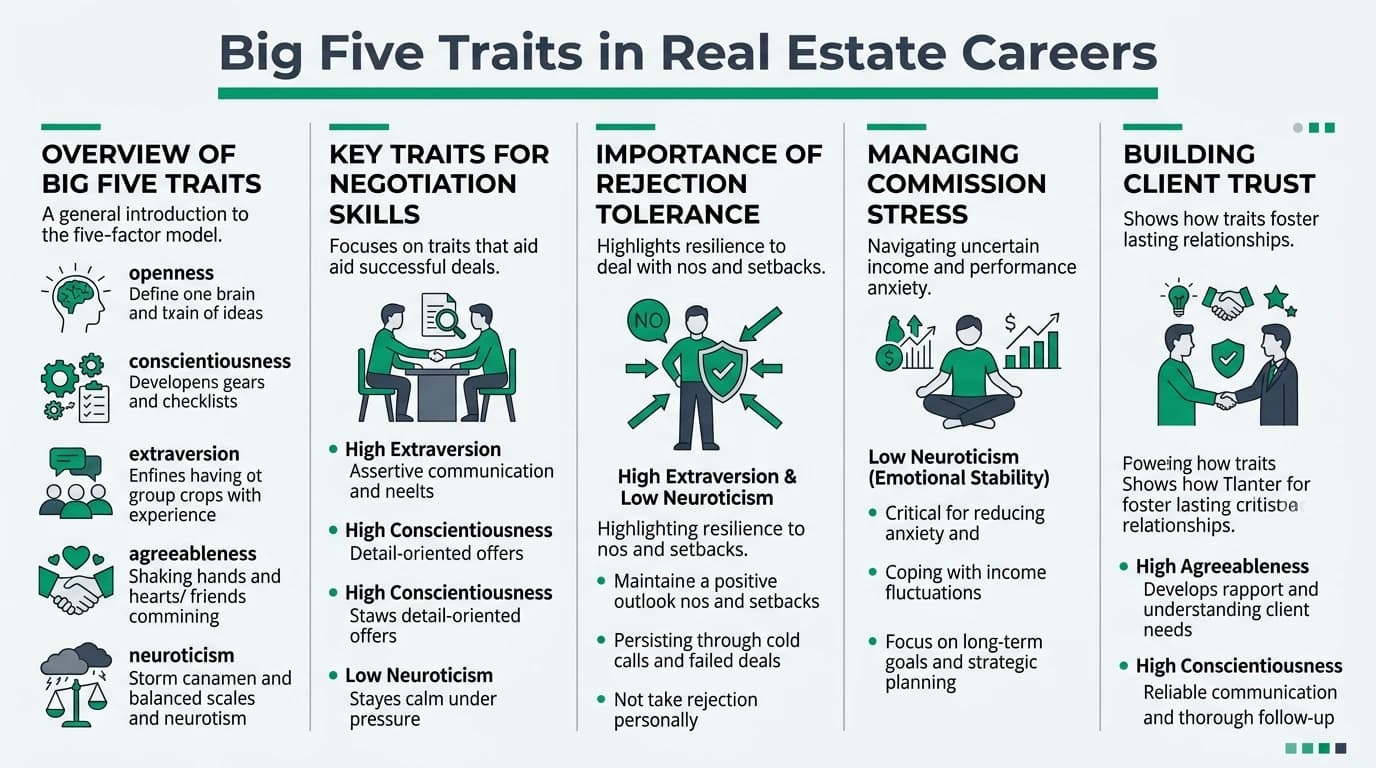
Are you curious about how personality affects success in real estate? The Big Five traits—openness, conscientiousness, extraversion, agreeableness, and neuroticism—play a crucial role. They influence how agents handle stress, negotiate deals, and build client trust.
The bottom line: Understanding your personality can help you thrive in real estate.
Critical Warning: While personality traits provide insights, success also depends on training and market conditions.
What Are the Big Five Personality Traits?
The Big Five traits are:
- Openness: Creativity and willingness to try new things.
- Conscientiousness: Being organized and dependable.
- Extraversion: Sociability and enthusiasm.
- Agreeableness: Being cooperative and compassionate.
- Neuroticism: Emotional stability and resilience.
Impact on Real Estate:
| Trait | Positive Impact | Evidence Source |
|---|---|---|
| Openness | Innovation and adaptability | [1] |
| Conscientiousness | Higher performance and reliability | [1] |
| Extraversion | Better networking and client relations | [1] |
| Agreeableness | Trust-building and client satisfaction | [1] |
| Low Neuroticism | Better stress management and resilience | [1] |
How Does Extraversion Help in Client Interactions?
Extraverts excel in real estate due to their ability to connect with clients and network effectively.
- Networking: Builds a broad client base.
- Communication: Enhances negotiation skills.
- Client Trust: Creates rapport quickly.
Balance Needed: Introverts can also succeed by focusing on one-on-one interactions and deep client relationships.
Why Is Conscientiousness Important for Real Estate?
Conscientious agents are often more successful due to their:
- Discipline: Manages tasks efficiently.
- Accountability: Ensures reliability in transactions.
- Performance: Correlates with higher sales outcomes.
Key Takeaways:
- Organized Work: Leads to fewer errors.
- Dependability: Builds client trust.
How Do Agents Handle Rejection and Stay Persistent?
Rejection is common in real estate. Successful agents often:
- Stay Positive: Maintain a hopeful outlook.
- Follow Up: Turn "no" into "maybe" or "yes."
- Learn from Mistakes: Use feedback to improve.
Rejection Handling Benchmarks:
| Scenario | Low-Trait Response | High-Trait Response |
|---|---|---|
| Lost Bid | Give up | Follow up and offer solutions |
| Client Criticism | Defensive | Use feedback constructively |
| Market Downturn | Panic | Adapt and find new strategies |
What Role Does Stress Tolerance Play in Commission-Based Work?
Real estate involves income variability, which can be stressful. Low neuroticism helps agents:
- Stay Calm: Manage stress effectively.
- Adapt Quickly: Pivot strategies as needed.
- Maintain Focus: Keep long-term goals in sight.
Stress Management Tips:
- Mindfulness Practices: Reduce anxiety.
- Time Management: Prioritize tasks.
How Do Personality Traits Influence Negotiation Skills?
Effective negotiation requires a mix of traits:
- Extraversion: Persuasive communication.
- Agreeableness: Builds rapport and trust.
- Moderate Dominance: Balances assertiveness with patience.
Negotiation Styles by Personality:
| Trait Combo | Strength | Weakness |
|---|---|---|
| High Extraversion/Agreeableness | Builds strong relationships | May concede too easily |
| Moderate Dominance | Assertive yet patient | Can be perceived as pushy |
How Do Agents Build Client Trust?
Trust is crucial in real estate. Key traits include:
- Honesty: Transparent communication.
- Empathy: Understanding client needs.
- Stability: Providing consistent service.
Client Trust Builders:
| Trait | Real Estate Application | Outcome |
|---|---|---|
| Honesty | Clear and truthful information | Long-term relationships |
| Empathy | Listening to client concerns | Higher client satisfaction |
| Stability | Reliable follow-through | Repeat business |
What Are the Differences Between Buyer’s and Seller’s Agents?
Different roles require different traits:
- Buyer’s Agents: Need high interactiveness and stability.
- Seller’s Agents: Benefit from higher dominance.
Buyer’s vs. Listing Agent DISC Profiles:
| Dimension (D/I/S/C) | Buyer’s Level | Listing Level | Benefit |
|---|---|---|---|
| Interactiveness (I) | High | Moderate | Builds client rapport |
| Stability (S) | High | Moderate | Calms stressed clients |
| Dominance (D) | Moderate | Higher | Drives aggressive sales |
How Do Personality Traits Predict Innovation in Real Estate?
Traits like openness and conscientiousness boost innovation:
- Openness: Encourages new ideas and solutions.
- Conscientiousness: Ensures execution of innovative strategies.
Innovation Predictors Quick Reference:
| Factor | Influence on Performance | Study Metric |
|---|---|---|
| Personality | Drives creativity and problem-solving | [1] |
| Social Capital | Enhances knowledge sharing | [1] |
| Knowledge Sharing | Fosters collaborative environments | [1] |
How Can Agents Assess Their Personality for Career Fit?
Using tools like Echovate scales can help agents understand their strengths:
- Systematic: Organized approach.
- Perseverance: Persistence in face of challenges.
- Results-oriented: Focus on achieving goals.
- Flexibility: Adapts to changes.
- Empathy: Connects with clients emotionally.
Echovate Success Scales:
| Scale | Description | Performance Link |
|---|---|---|
| Systematic | Structured and methodical | Higher efficiency |
| Perseverance | Persistent and resilient | Better sales outcomes |
| Results-oriented | Goal-focused | Drives success |
| Flexibility | Adapts to market changes | Maintains relevance |
| Empathy | Understands client needs | Builds strong relationships |
Action checklist
- Assess your personality traits using tools like Echovate.
- Focus on building trust with clients through honesty and empathy.
- Develop stress management techniques to handle commission variability.
FAQ
What Big Five traits predict real estate success?
How does extraversion help real estate agents in negotiations?
Can introverts succeed as real estate brokers?
What personality traits handle real estate rejection best?
How does neuroticism affect commission stress in agents?
Which traits build client trust in real estate?
Are persistent agents more successful in volatile markets?
Notes
Primary Sources
| Source | Type | URL |
|---|---|---|
| PMC/NCBI (Taiwan study) | Peer-reviewed | PMC Article |
| Echovate (Newswire) | Industry research | Newswire Article |
| Inman | Industry analysis | Inman Article |
Conclusion
Understanding the Big Five personality traits can significantly impact your success in real estate. By leveraging traits like extraversion, conscientiousness, and low neuroticism, agents can improve their negotiation skills, handle stress, and build lasting client relationships.