career
Personality and Physician Careers: Big Five Traits in Doctors
Explore how the Big Five personality traits influence physician careers, clinical decision-making, empathy, burnout, and malpractice risk.
Quick answer
How do personality traits affect physician careers?
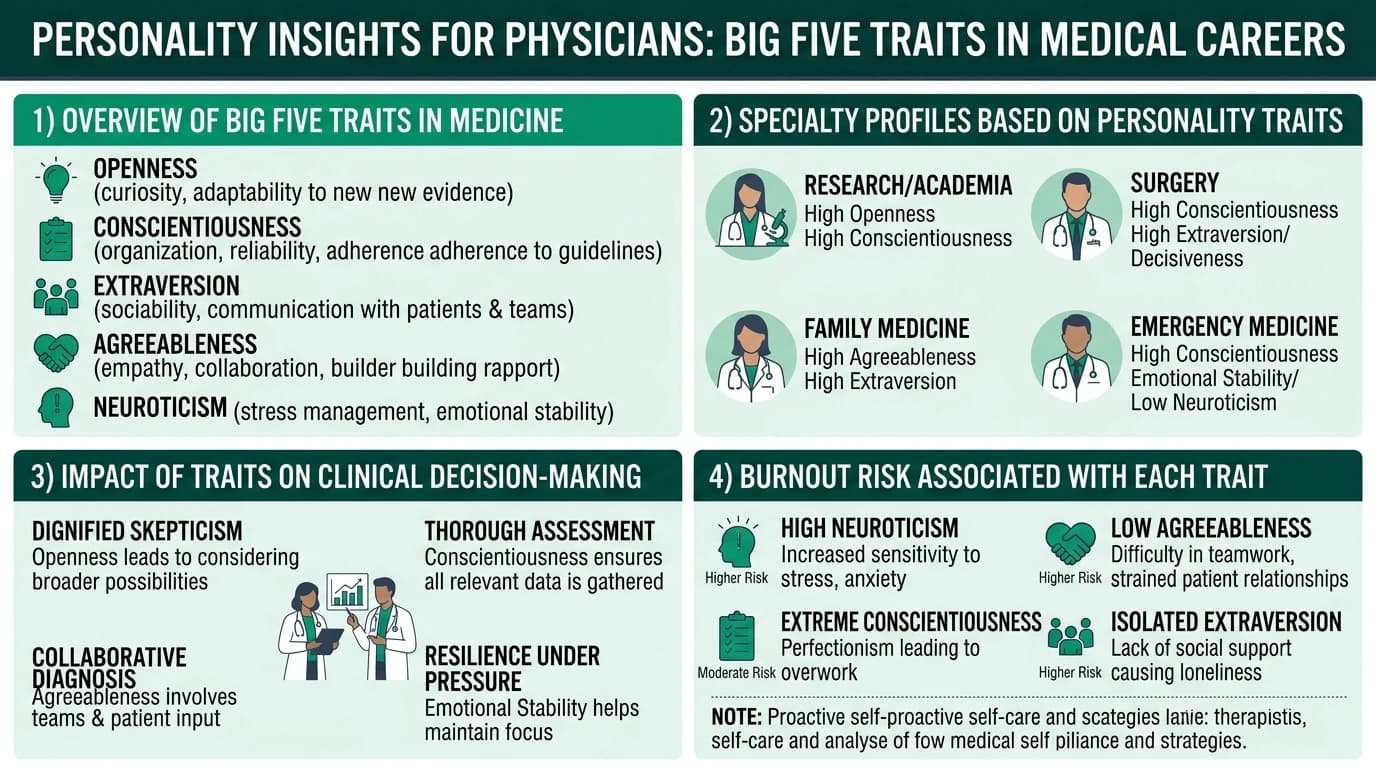
Personality traits, especially those in the Big Five model, influence medical specialty choice, clinical decision-making, empathy under pressure, burnout risk, and malpractice likelihood.
Source: NIH/PMC
Executive Summary
Personality traits, particularly the Big Five, play a crucial role in shaping physician careers. These traits influence specialty selection, decision-making, empathy, and burnout risk. Understanding these can help doctors make informed career choices and improve patient care.
The bottom line: Personality traits are key to understanding a physician's career path and well-being.
Critical Warning: Personality assessments should not be the sole criterion for career decisions or admissions.
What Are the Big Five Personality Traits?
The Big Five personality traits are:
- Openness to Experience: Imaginative and curious.
- Conscientiousness: Organized and ambitious.
- Extraversion: Talkative and active.
- Agreeableness: Trusting and cooperative.
- Neuroticism: Prone to worry and emotional.
Clinical Relevance:
| Trait | Clinical Impact | Specialty Association |
|---|---|---|
| Openness | Adopts new technologies | Psychiatry (highest)1 |
| Conscientiousness | Systematic protocols | Orthopedic surgery (high)2 |
| Extraversion | Strong patient communication | Diagnostic specialties (high)1 |
| Agreeableness | Empathy and patient care | Psychiatry (high)1 |
| Neuroticism | Burnout risk | Orthopedic surgery (low)2 |
How Do Personality Traits Influence Specialty Choice?
Personality traits can guide doctors toward specialties that match their strengths and preferences.
Key Insights:
- Openness: High in psychiatry, low in public health.
- Conscientiousness: High in surgery, supports systematic work.
- Extraversion: Suits diagnostic fields needing strong communication.
Specialty Profiles:
| Specialty | Openness | Conscientiousness | Extraversion | Agreeableness | Neuroticism |
|---|---|---|---|---|---|
| Psychiatry | High | Moderate | Moderate | High | Moderate |
| Orthopedic | Moderate | High | Moderate | Moderate | Low |
| Public Health | Low | Moderate | Moderate | Moderate | Moderate |
What Role Does Personality Play in Clinical Decision-Making?
Personality traits affect how doctors make decisions under pressure.
Decision-Making Traits:
- Conscientiousness: Leads to thorough, systematic decisions.
- Extraversion: Aids in quick, communicative decisions.
- Neuroticism: May cause anxiety and second-guessing.
Scenario Table:
| Scenario | High Extraversion | High Conscientiousness | High Neuroticism |
|---|---|---|---|
| High-pressure decision | Quick, may rush | Thorough, systematic | Anxious, delays |
| Patient interaction | Engaging | Professional | Reactive |
How Do Personality Traits Affect Empathy and Patient Care?
Empathy is crucial in medicine, and certain traits enhance this skill.
Empathy Traits:
- Agreeableness: High empathy and patient-centered care.
- Extraversion: Facilitates communication, but may overshare.
- Neuroticism: Can hinder empathy due to emotional reactivity.
Empathy Table:
| Trait | Empathy Level | Patient Interaction Style |
|---|---|---|
| Agreeableness | High | Warm, cooperative |
| Extraversion | Moderate | Engaging, communicative |
| Neuroticism | Low | Reactive, defensive |
Can Personality Traits Predict Burnout Risk?
Yes, particularly neuroticism, which is a significant predictor of burnout.
Burnout Risk Factors:
- High Neuroticism: Increases emotional exhaustion.
- Low Agreeableness: Reduces protective factors.
- High Conscientiousness: Offers resilience but risks perfectionism.
Burnout Table:
| Trait | Burnout Risk | Protective Mechanism |
|---|---|---|
| High Neuroticism | High | None |
| Low Agreeableness | Moderate | Task-focused resilience |
| High Conscientiousness | Moderate | Systematic control |
How Do Personality Traits Relate to Malpractice Risk?
Certain traits can influence malpractice risk through decision-making and patient interaction.
Malpractice Risk Factors:
- High Neuroticism: Linked to anxiety and errors.
- Low Agreeableness: May lead to poor patient relationships.
- High Conscientiousness: Reduces risk through careful practice.
Malpractice Table:
| Trait | Risk Level | Mitigation Strategy |
|---|---|---|
| High Neuroticism | High | Emotional regulation |
| Low Agreeableness | Moderate | Communication training |
| High Conscientiousness | Low | Protocol adherence |
Action checklist
- Understand your Big Five traits.
- Match traits with suitable specialties.
- Implement strategies to mitigate burnout risk.
FAQ
What are the Big Five personality traits?
How do these traits affect specialty choice?
Can personality traits predict burnout?
How does agreeableness affect patient care?
What role does conscientiousness play in decision-making?
Are personality traits stable in physicians?
How can medical schools use personality assessments?
Notes
Primary Sources
| Source | Type | URL |
|---|---|---|
| NIH/PMC | Peer-reviewed | pmc.ncbi.nlm.nih.gov/articles/PMC12355438/ |
| JMIR | Peer-reviewed | jmir.org/2024/1/e52085/ |
Conclusion
Understanding personality traits can greatly enhance a physician's career by aligning their strengths with suitable specialties and mitigating burnout risks. For more insights, explore our guide on personality in nursing and burnout prevention strategies.