relationships
Personality and Marriage Satisfaction: Big Five Traits, Longitudinal Marital Quality Research, Conflict Patterns, and Divorce Risk Factors
Explore how Big Five personality traits influence marriage satisfaction, conflict patterns, and divorce risk over time. Learn about longitudinal research and practical applications for relationship success.
Quick answer
Which Big Five traits predict higher marital satisfaction?
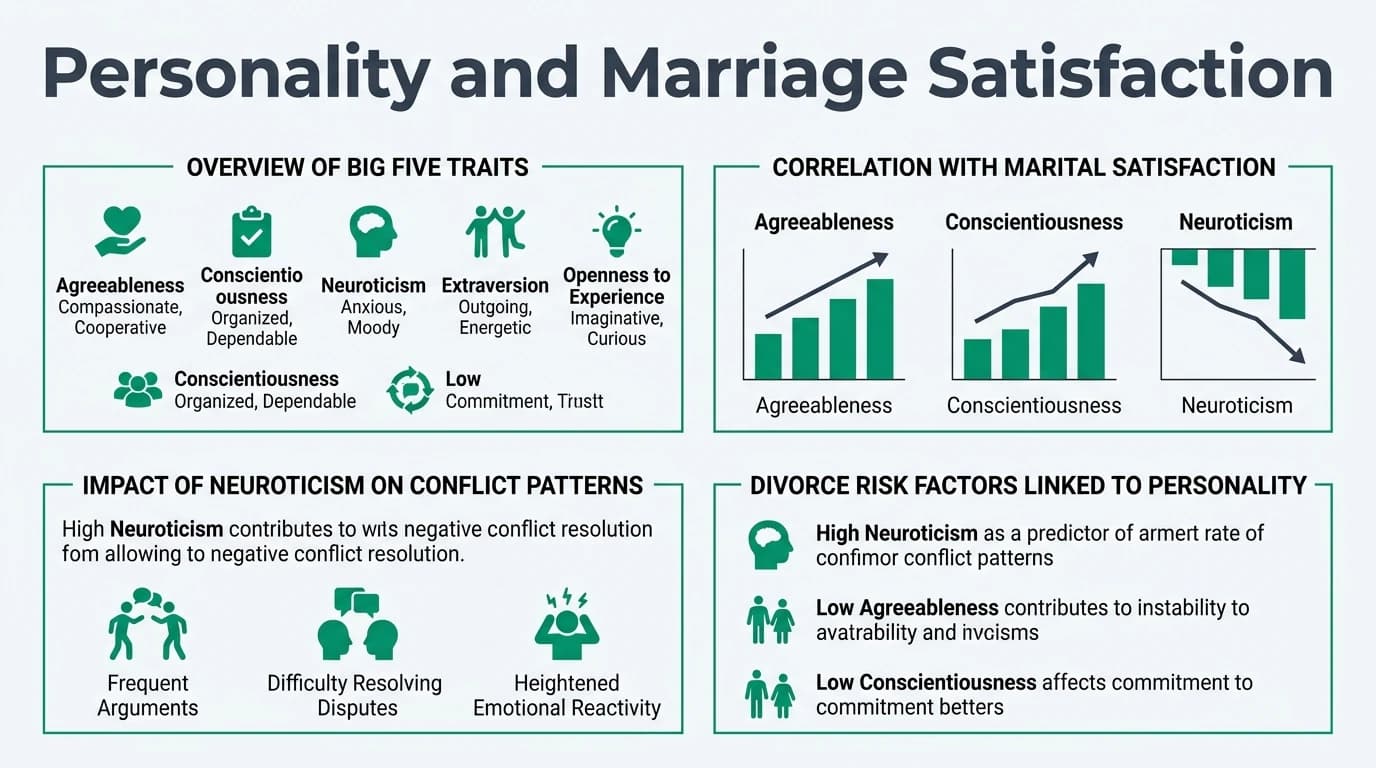
Agreeableness, Conscientiousness, and low Neuroticism are linked to higher marital satisfaction.
Source: Michigan State University
Executive Summary
Curious about how personality affects your marriage? The Big Five traits—Openness, Conscientiousness, Extraversion, Agreeableness, and Neuroticism—play a significant role in marital satisfaction. Research shows that traits like Agreeableness and Conscientiousness can boost relationship quality, while Neuroticism may lead to conflict and dissatisfaction.
The bottom line: Understanding these traits can help couples improve their relationship and navigate challenges.
Critical Warning: High Neuroticism is a known risk factor for marital dissatisfaction and divorce. Seek professional guidance if needed.
What Are the Big Five Traits?
The Big Five personality traits are a popular way to understand human behavior. Here's a quick overview:
- Openness: Creativity and willingness to try new things.
- Conscientiousness: Organization and dependability.
- Extraversion: Sociability and energy.
- Agreeableness: Compassion and cooperativeness.
- Neuroticism: Emotional instability and moodiness.
At a Glance: Big Five Traits
| Trait | Description | Impact on Marriage |
|---|---|---|
| Openness | Creativity, open to experiences | Modest positive link to satisfaction |
| Conscientiousness | Organized, dependable | Linked to lower conflict |
| Extraversion | Sociable, energetic | Positive but weaker effect |
| Agreeableness | Compassionate, cooperative | Strong predictor of satisfaction |
| Neuroticism | Emotional instability | Negative impact on satisfaction |
How Do These Traits Affect Marriage Satisfaction?
Research shows that personality traits significantly influence marriage satisfaction. Here's how:
- Agreeableness: Strongly linked to higher satisfaction. Couples with high Agreeableness tend to resolve conflicts amicably.
- Conscientiousness: Associated with lower conflict and better communication.
- Neuroticism: Correlates negatively with satisfaction, often leading to increased conflict and stress.
Big Five Traits vs. Marital Satisfaction
| Trait | Correlation with Satisfaction (r) | Studies (k) | Participants (N) |
|---|---|---|---|
| Agreeableness | 0.29 | 19 | 3,071 |
| Conscientiousness | 0.25 | 6 | 1,201 |
| Neuroticism | -0.29 | 40 | 7,640 |
What About Personality Similarity?
It's a common belief that similar personalities lead to happier marriages, but research paints a different picture. Similarity in Big Five traits doesn't significantly boost initial satisfaction and may even predict negative trajectories over time.
Personality Similarity Effects
| Similarity Type | Initial Satisfaction Link | 12-Year Trajectory Impact |
|---|---|---|
| Total Big Five | No significant link | More negative trajectories |
| Agreeableness | No significant link | More negative trajectories |
How Does Neuroticism Affect Marriage?
Neuroticism is a strong predictor of marital dissatisfaction. Here's why:
- Negative Correlation: High Neuroticism correlates with lower satisfaction (r=-0.29).
- Conflict Escalation: Increases emotional stress and conflict.
- Divorce Risk: Predicts lower marital quality and higher divorce risk.
Can Conscientiousness Reduce Marital Conflict?
Yes, Conscientiousness can help reduce marital conflict. Here's how:
- Organization: Promotes better communication and planning.
- Dependability: Builds trust and stability in the relationship.
Conflict Patterns by Traits
| Trait | Positive Effect | Negative Effect |
|---|---|---|
| Conscientiousness | Reduces disputes | None noted |
| Neuroticism | None noted | Escalates conflicts |
What Role Does Agreeableness Play in Relationship Quality?
Agreeableness is crucial for maintaining a healthy relationship. It encourages:
- Cooperation: Facilitates compromise and understanding.
- Empathy: Enhances emotional connection and support.
Are Extraversion and Openness Important for Marriage Success?
While Extraversion and Openness have positive effects, they are generally weaker compared to other traits:
- Extraversion: Linked to social activities and shared interests.
- Openness: Encourages trying new experiences together.
High vs. Low Trait Marriages
| Trait | High-Trait Outcomes | Low-Trait Risks |
|---|---|---|
| Extraversion | Shared social activities | Isolation |
| Openness | New experiences together | Stagnation |
What Are the Longitudinal Research Findings?
Long-term studies reveal that personality traits influence marital satisfaction over time. For example, Agreeableness and Conscientiousness predict positive trajectories, while Neuroticism predicts declines.
Longitudinal Trajectory Predictors
| Age Group | Key Similarity Predictor | p-value |
|---|---|---|
| Middle-Aged | Agreeableness | p < 0.05 |
| Older Couples | Conscientiousness | p < 0.05 |
What Are the Divorce Risk Factors?
Certain traits increase the risk of divorce:
- High Neuroticism: Leads to dissatisfaction and conflict.
- Low Agreeableness/Conscientiousness: Reduces relationship quality.
Quick Reference: Trait Divorce Risks
| High-Risk Trait | Correlation to Dissatisfaction | Mitigation Strategy |
|---|---|---|
| Neuroticism | High | Emotional stability |
| Low Agreeableness | Moderate | Communication training |
Action checklist
- Assess your Big Five traits with your partner.
- Identify areas of potential conflict based on personality.
- Explore counseling options if high-risk traits are present.
FAQ
Which Big Five trait is most linked to marital satisfaction?
Does personality similarity improve long-term marriage?
How does Neuroticism increase divorce risk?
Can Conscientiousness reduce marital conflict?
What role does Agreeableness play in relationship quality?
Are Extraversion and Openness important for marriage success?
How do Big Five traits predict marital trajectories over 12 years?
Notes
Primary Sources
| Source | Type | URL |
|---|---|---|
| UC Berkeley/Arizona State University | Peer-reviewed PDF | Link |
| Michigan State University | Peer-reviewed thesis PDF | Link |
| RSI International | Peer-reviewed journal | Link |
Conclusion
Understanding the Big Five personality traits can be a game-changer for marriage satisfaction. By recognizing how traits like Agreeableness and Conscientiousness enhance relationships, while Neuroticism poses risks, couples can work towards a more harmonious partnership.