relationships
Personality and Long-Distance Relationships: Big Five Traits, Attachment, Communication Patterns, Trust, and Relationship Satisfaction Research
Explore how personality traits, attachment styles, communication, and trust impact long-distance relationship satisfaction.
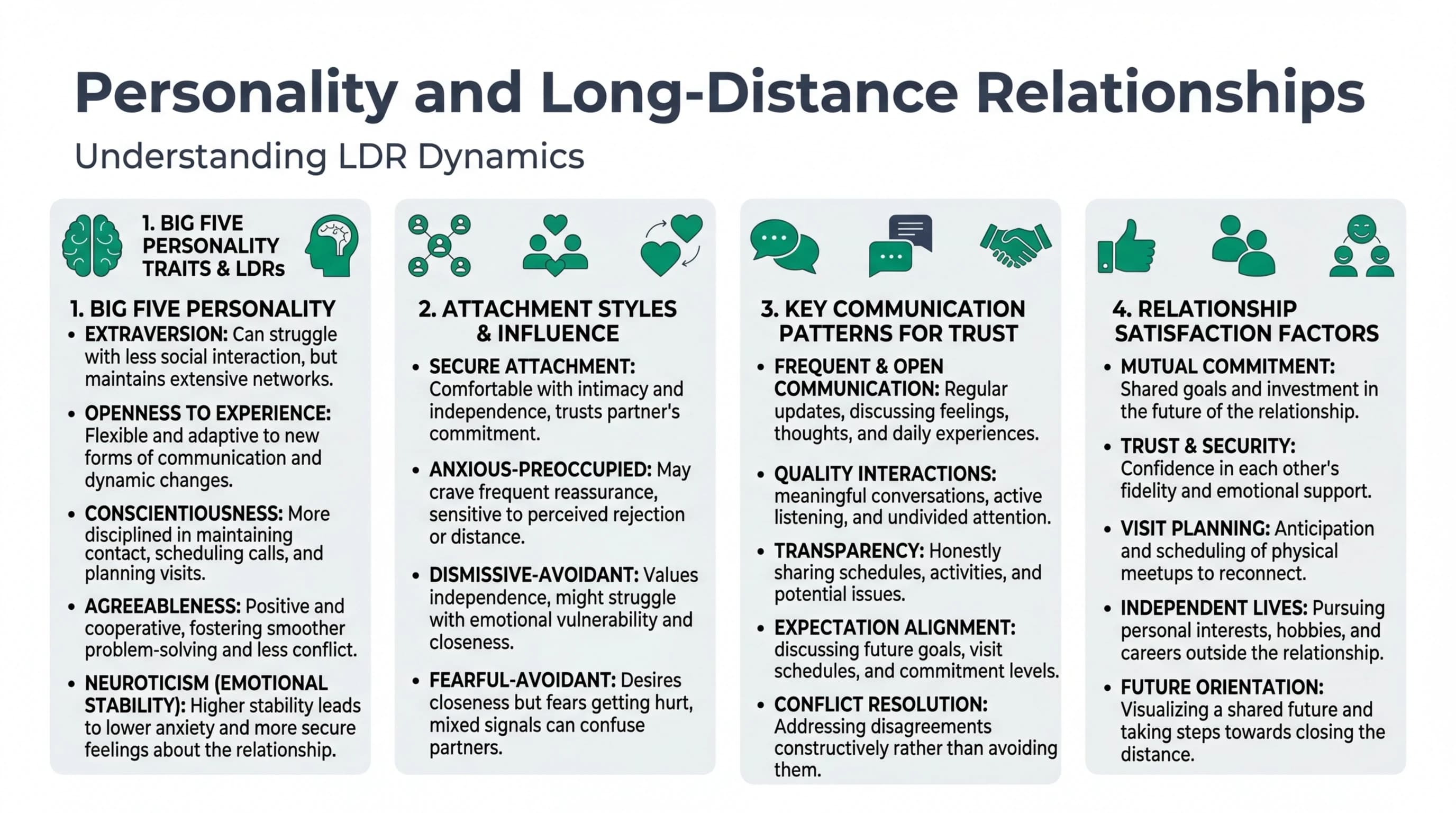
Quick answer
How do personality traits affect long-distance relationships?
Personality traits like conscientiousness and extraversion can enhance communication and commitment in long-distance relationships, while neuroticism may strain trust.
Source: Journal of Communication
Executive Summary
Long-distance relationships (LDRs) can be as satisfying as geographically close ones. Personality traits, attachment styles, and communication patterns play crucial roles in their success. Research shows that intentional communication and trust-building are key.
The bottom line:
Long-distance relationships thrive on intentional communication and trust, with personality traits influencing their dynamics.
What Are the Big Five Personality Traits?
The Big Five personality traits are a common framework used to understand human behavior. Here's how they impact long-distance relationships:
| Trait | Positive Effect in LDRs | Negative Effect in LDRs |
|---|---|---|
| Extraversion | Enhances communication and connection | May lead to loneliness without social interaction |
| Agreeableness | Promotes harmony and understanding | Can lead to avoidance of conflict |
| Conscientiousness | Increases commitment and reliability | May cause rigidity in plans |
| Neuroticism | Heightens emotional awareness | Strains trust and increases anxiety |
| Openness | Encourages adaptability and creativity | Can lead to unrealistic expectations |
Key takeaways:
- Extraversion aids in maintaining lively communication.
- Conscientiousness predicts commitment.
- Neuroticism might increase relationship stress.
How Do Attachment Styles Influence LDRs?
Attachment styles describe how people form emotional bonds. They significantly impact long-distance relationships:
| Attachment Style | Strength in LDRs | Challenge in LDRs |
|---|---|---|
| Secure | High trust and stability | Minimal issues |
| Anxious | Strong desire for closeness | Separation anxiety |
| Avoidant | Independence and self-reliance | Emotional unavailability |
Important:
Secure attachment fosters trust, while anxious attachment can lead to distress during separation.
Communication Patterns in Long-Distance Relationships
Effective communication is essential in LDRs. Here’s how different patterns affect relationships:
| Communication Pattern | Pros | Cons |
|---|---|---|
| Intentional Talks | Deepens emotional bonds | Requires time and effort |
| Casual Texts | Maintains daily connection | May lack depth |
| Video Calls | Provides visual and verbal cues | Can be affected by time zones |
Key takeaways:
- Intentional talks create deeper connections.
- Video calls enhance emotional presence.
Building Trust in Long-Distance Relationships
Trust is crucial in any relationship, especially in LDRs. Here's how to build it:
| Trust-Building Strategy | Outcome |
|---|---|
| Consistent Communication | Reinforces reliability |
| Vulnerability | Strengthens emotional bonds |
| Reassurances | Reduces insecurity |
Critical:
Consistency and openness are more important than physical proximity for trust.
What Makes Long-Distance Relationships Satisfying?
Long-distance relationships can be as satisfying, if not more, than close ones. Here's why:
| Satisfaction Factor | LDR Advantage |
|---|---|
| Dedication | Higher due to effort and intention |
| Passion | Sustained through creative methods |
| Quality Time | More meaningful interactions |
Key takeaways:
- LDRs often report higher dedication and passion.
- Quality time is prioritized, enhancing satisfaction.
Emotional Intimacy in Long-Distance Relationships
Emotional intimacy is often higher in LDRs. Here's how it develops:
| Factor | Impact on Intimacy |
|---|---|
| Empathy | Enhances understanding and support |
| Regulation Skills | Helps manage emotions effectively |
| Daily Habits | Builds consistent emotional support |
Important:
Daily emotional check-ins and empathy boost intimacy.
Challenges for College Students in LDRs
College students in LDRs face unique challenges:
| Location | Positive Affect | Loneliness |
|---|---|---|
| On-campus | Lower | Higher due to separation |
| Off-campus | Higher | Lower during reunions |
Key takeaways:
- On-campus environments may increase loneliness.
- Reunions boost positive emotions.
Independence and Personal Growth in LDRs
Long-distance relationships can foster personal growth and independence:
| Growth Aspect | Benefit |
|---|---|
| Separate Identities | Retains individuality |
| Community Ties | Strengthens local connections |
| Goal Support | Encourages personal development |
Critical:
Maintaining independence can enhance relationship quality.
Action checklist
- Identify your attachment style and its impact on your relationship.
- Develop a consistent communication schedule.
- Focus on building trust through openness and reassurance.
FAQ
Do long-distance relationships last longer than close ones?
Which Big Five personality trait helps most in LDRs?
How does attachment style impact long-distance success?
What communication patterns strengthen LDR trust?
Can LDRs have higher satisfaction than geographically close relationships?
How do military couples maintain LDRs?
What role does emotional intimacy play in LDRs?
Notes
Primary Sources
| Source | Type | URL |
|---|---|---|
| Utah State University (HDFS) | Academic blog (cites peer-reviewed) | Link |
| PMC/NIH | Peer-reviewed (longitudinal study) | Link |
| Psychology Today | Expert article (cites 2013 study) | Link |
Conclusion
Long-distance relationships can be deeply satisfying when personality traits, attachment styles, and communication patterns are understood and leveraged. By focusing on trust and emotional intimacy, couples can thrive despite the distance.