career
Personality and HR Careers: Big Five Traits in Human Resources Professionals
Explore how the Big Five personality traits impact HR careers, focusing on conflict mediation, employee relations, ethics, and burnout.
Quick answer
How do Big Five personality traits affect HR careers?
The Big Five traits—Openness, Conscientiousness, Extraversion, Agreeableness, and Neuroticism—impact HR roles by influencing conflict mediation, employee relations, ethical decision-making, and burnout resilience.
Source: Academy of Management
Executive Summary
The Big Five personality traits—Openness, Conscientiousness, Extraversion, Agreeableness, and Neuroticism—play a crucial role in HR careers. These traits influence how professionals handle conflict mediation, employee relations, ethical decisions, and burnout.
The bottom line: Understanding these traits can help HR professionals optimize their roles and improve workplace outcomes.
Critical Warning: Personality assessments should be part of a broader evaluation process, not the sole criterion for hiring or development.
What Are the Big Five Personality Traits?
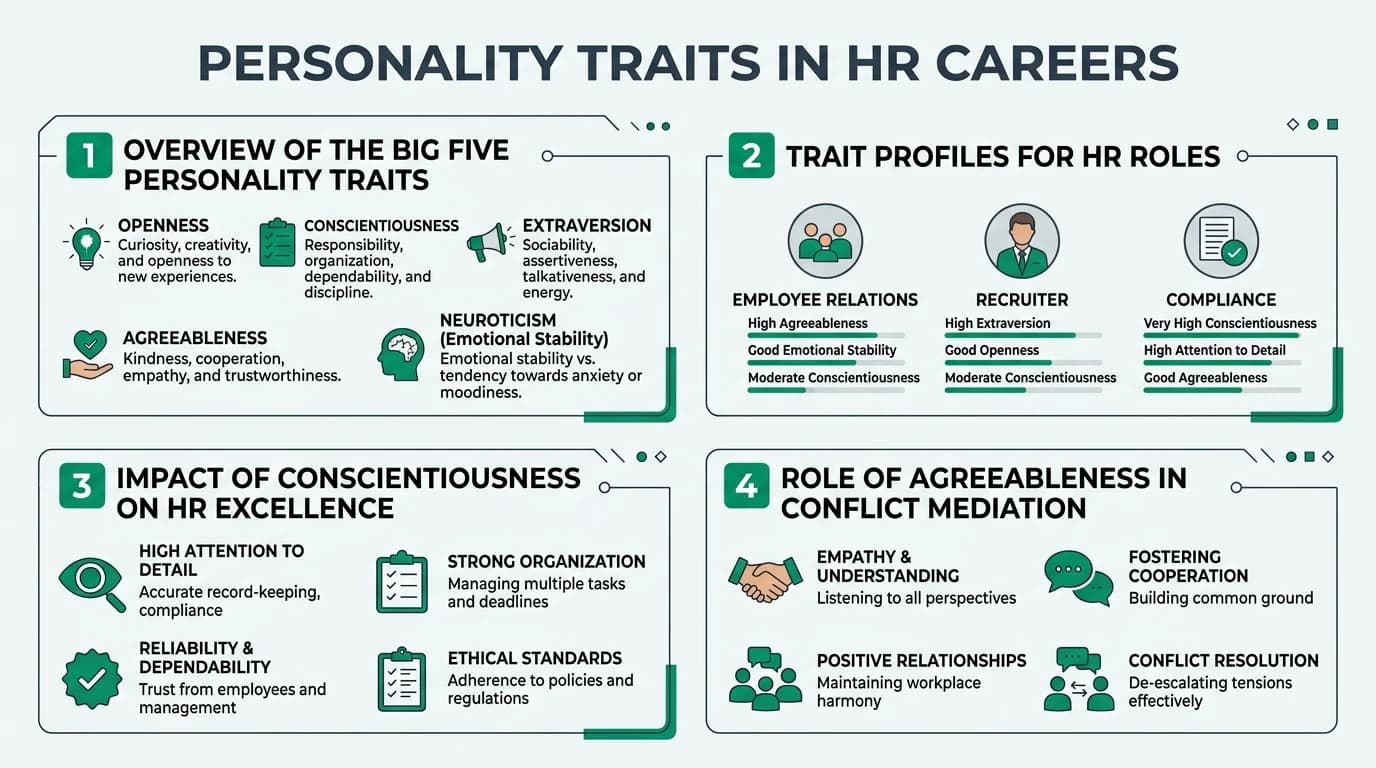
The Big Five model includes:
- Openness: Curiosity and adaptability.
- Conscientiousness: Organization and reliability.
- Extraversion: Sociability and assertiveness.
- Agreeableness: Cooperation and empathy.
- Neuroticism: Emotional sensitivity.
These traits exist on spectrums, and most people fall between extremes1.
Table 1: Big Five Trait Profiles Across HR Roles
| Trait | Employee Relations Manager | HR Recruiter | Compliance Specialist | HR Director |
|---|---|---|---|---|
| Openness | Moderate-High | High | Moderate | High |
| Conscientiousness | High | Moderate-High | Very High | High |
| Extraversion | High | Very High | Moderate | High |
| Agreeableness | Very High | High | Moderate | Moderate-High |
| Neuroticism | Low | Low-Moderate | Low | Low |
How Do These Traits Affect HR Roles?
Conscientiousness and HR Excellence
- Effect: Ensures accuracy in compliance and policy enforcement.
- Process: Detail-oriented approach aids in documentation and audits.
- Caveat: May lead to over-systematization, slowing adaptation.
Table 2: Big Five Traits and HR Competencies
| Trait | HR Competency | Application | Strength | Risk |
|---|---|---|---|---|
| Conscientiousness | Compliance & Accuracy | Policy enforcement, documentation | Reliable, detail-oriented | May over-systematize |
Agreeableness and Conflict Mediation
- Effect: Predicts mediation effectiveness.
- Process: Empathy and trust-building enhance employee relations.
- Caveat: May avoid difficult decisions.
Extraversion in HR Leadership
- Effect: Facilitates cross-functional partnerships.
- Process: Enhances recruitment and employer branding.
- Caveat: May prioritize visibility over depth.
Openness and HR Innovation
- Effect: Drives adoption of new HR technologies.
- Process: Supports organizational change management.
- Caveat: May lack follow-through.
Can Personality Traits Predict HR Burnout?
- Neuroticism: High levels increase burnout risk.
- Conscientiousness: Perfectionism can lead to over-commitment.
Table 3: Big Five Traits and Burnout Risk in HR
| Trait | High Level | Low Level | Burnout Risk | Mitigation Strategy |
|---|---|---|---|---|
| Neuroticism | Emotional reactivity | Emotional stability | Higher | Increase job discretion |
| Conscientiousness | Perfectionism | Relaxed approach | Higher | Set boundaries, delegate |
How Do Organizations Use Big Five Assessments?
Organizations like Procter & Gamble and IBM integrate Big Five assessments for:
- Recruitment and candidate profiling
- Employee development and role matching
- Team cohesion and conflict prediction
- Performance evaluation under stress
Table 4: Personality-Job Fit Matching Guide
| HR Function | Ideal Trait Profile | Why This Matters | Assessment Focus |
|---|---|---|---|
| Recruitment | High Extraversion, High Openness | Networking, candidate engagement | Sociability, innovation |
| Employee Relations | High Agreeableness, High Conscientiousness | Mediation, policy adherence | Empathy, reliability |
FAQ
What are the Big Five personality traits and why do they matter in HR?
The Big Five traits—Openness, Conscientiousness, Extraversion, Agreeableness, and Neuroticism—impact job performance and organizational outcomes by influencing behavior and decision-making2.
Which Big Five traits are most important for HR professionals?
Conscientiousness and Agreeableness are crucial for roles involving employee relations and conflict mediation1.
How does agreeableness affect conflict mediation in HR?
Agreeableness enhances mediation effectiveness through empathy and cooperation3.
Can personality traits predict HR burnout?
High neuroticism and perfectionism increase burnout risk; job discretion can mitigate this4.
What personality type makes the best HR manager?
A combination of high Conscientiousness, Extraversion, and moderate Agreeableness suits HR management5.
How do organizations use Big Five assessments in HR recruitment?
Companies like IBM use them for candidate profiling and role matching6.
Does high extraversion help or hurt HR professionals?
Extraversion aids in leadership and collaboration but may prioritize visibility over depth7.
Notes
Primary Sources
| Source | Type | URL |
|---|---|---|
| Academy of Management | Research | https://aom.org |
| Michigan State University Online | Educational | https://michiganstateuniversityonline.com/resources/leadership/ |
| MIDUS | Longitudinal Study | https://midus.wisc.edu |
| HIN International Strategy | Industry Resource | https://hinternationalstrategy.com |
| Velocity OKC | Industry Blog | https://velocityokc.com |
| KKG Publications | Research | https://kkgpublications.com |
Conclusion
Understanding the Big Five personality traits can significantly enhance HR functions like conflict mediation, employee relations, and burnout prevention. By aligning personality profiles with job roles, organizations can optimize HR performance and employee satisfaction.
Footnotes
-
Academy of Management research on Big Five traits in workplace settings. ↩ ↩2
-
Michigan State University Online resource on Big Five applications. ↩
-
KKG Publications study on agreeableness and mediation. ↩
-
MIDUS research on neuroticism and burnout. ↩
-
NIH/PMC study comparing HR and management profiles. ↩
-
HIN International Strategy resource on organizational use of Big Five. ↩
-
Velocity OKC overview of extraversion in HR roles. ↩