personality-tests
Big Five Across Generations: Personality Differences Among Gen Z, Millennials, Gen X, and Boomers
Explore how the Big Five personality traits vary across generations, examining cohort effects, age effects, and workplace implications.
Quick answer
How do Big Five personality traits differ across generations?
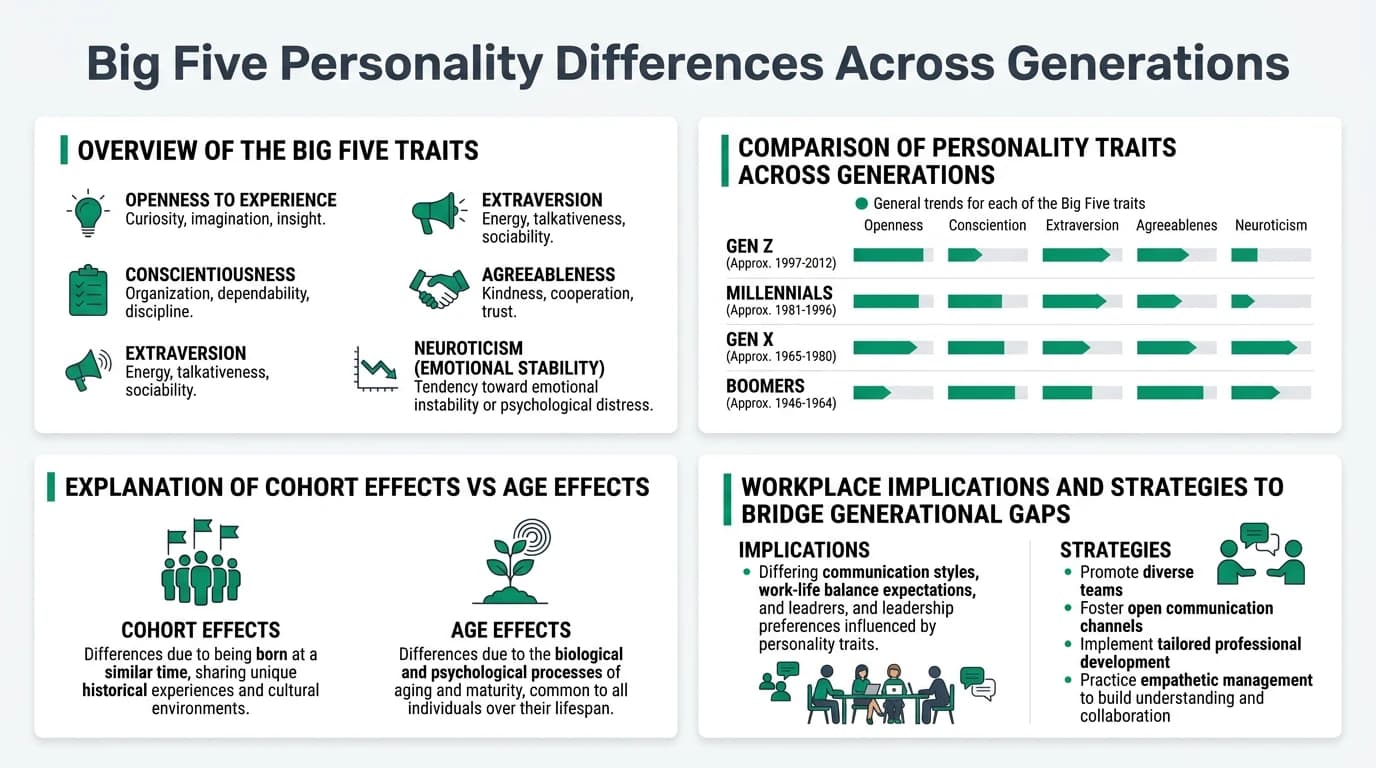
Later-born generations like Gen Z and Millennials generally exhibit higher extraversion and openness but lower agreeableness and neuroticism compared to Gen X and Boomers. These differences arise from cohort effects rather than age effects.
Source: Brandt et al.
Executive Summary
Understanding how personality traits differ across generations can enhance workplace dynamics. The Big Five traits—extraversion, agreeableness, conscientiousness, neuroticism, and openness—vary not only due to age but also due to cohort effects. This article explores these differences and their implications.
The bottom line: Recognizing these generational personality differences can bridge communication gaps and foster a more inclusive workplace.
Critical Warning: Avoid stereotyping individuals based on generational trends; focus on individual assessments.
What Are the Big Five Personality Traits?
The Big Five model is a widely accepted framework in psychology:
- Extraversion: Sociability and assertiveness.
- Agreeableness: Compassion and cooperation.
- Conscientiousness: Organization and discipline.
- Neuroticism: Emotional reactivity and anxiety.
- Openness: Intellectual curiosity and creativity.
Table 1: Big Five Traits — Definitions and Behavioral Anchors
| Trait | Definition | High Scorers | Low Scorers |
|---|---|---|---|
| Extraversion | Sociability, assertiveness, energy | Talkative, energetic | Reserved, quiet |
| Agreeableness | Compassion, cooperation | Empathetic, cooperative | Competitive, critical |
| Conscientiousness | Organization, discipline | Hardworking, orderly | Spontaneous, flexible |
| Neuroticism | Emotional reactivity, anxiety | Anxious, sensitive | Calm, stable |
| Openness | Intellectual curiosity, creativity | Creative, curious | Practical, traditional |
Age Effects vs. Cohort Effects
Age Effects: Personality changes as individuals mature. For example, conscientiousness increases with age.
Cohort Effects: Differences due to shared historical or cultural experiences. Later-born generations, like Gen Z, exhibit different baseline traits than Boomers.
Table 2: Age-Related Personality Change Across the Lifespan
| Trait | Ages 30–40 | Ages 40–50 | Ages 50–60 | Ages 60+ | Direction |
|---|---|---|---|---|---|
| Conscientiousness | Increasing | Peak | Plateau | Decline | ↑ then → |
| Agreeableness | Increasing | Increasing | Increasing | Increasing | ↑ |
| Extraversion | Moderate | Low | Lower | Lowest | ↓ |
| Openness | Moderate | Declining | Declining | Steep | ↓ |
| Neuroticism | Variable | Decline | Decline | Decline | ↓ (mixed) |
Generational Cohort Differences
Research shows distinct personality profiles across generations:
- Gen Z/Millennials: Higher extraversion and openness, lower agreeableness and neuroticism.
- Gen X/Boomers: Higher agreeableness and neuroticism, lower extraversion and openness.
Table 3: Generational Cohort Differences — Big Five Profiles at Age 58
| Trait | Later-Born Cohorts (Gen Z/Millennials) | Earlier-Born Cohorts (Gen X/Boomers) | Difference |
|---|---|---|---|
| Extraversion | Higher | Lower | More extraverted |
| Agreeableness | Lower | Higher | Less agreeable |
| Conscientiousness | No significant difference | No significant difference | No cohort effect |
| Neuroticism | Lower | Higher | Less neurotic |
| Openness | Higher | Lower | More open |
Source: Brandt et al., Psychological Science[3]
Workplace Implications
Generational personality differences impact team dynamics:
- Communication: Extraversion and openness influence collaboration styles.
- Conflict Resolution: Agreeableness affects conflict management.
- Innovation: Openness drives creativity and adaptability.
Table 4: Workplace Implications — Personality Traits and Team Dynamics
| Trait | High Scorers' Strengths | Challenges | Low Scorers' Strengths | Challenges |
|---|---|---|---|---|
| Extraversion | Networking, team engagement | May dominate discussions | Deep focus, listening | May withdraw |
| Agreeableness | Collaboration, empathy | May avoid confrontation | Directness, critical feedback | May seem harsh |
| Conscientiousness | Planning, execution | May resist flexibility | Adaptability, spontaneity | May lack follow-through |
| Neuroticism | Risk attention, detail-oriented | Anxiety, stress sensitivity | Calm under pressure | May miss warning signs |
| Openness | Innovation, adaptability | May over-complicate | Stability, focus | May resist change |
Bridging Generational Personality Differences
To bridge gaps:
- Avoid Stereotyping: Focus on individual assessments.
- Leverage Complementary Traits: Use diverse strengths for team success.
- Inclusive Practices: Design communication and management strategies that respect personality diversity.
Action checklist
- Conduct individual personality assessments.
- Encourage cross-generational mentorship.
- Foster an inclusive communication culture.
FAQ
What is the difference between age effects and cohort effects in personality?
Are Gen Z and Millennials more neurotic than Boomers?
Do personality traits change after age 30?
How stable is personality across the lifespan?
What workplace communication gaps exist between generations?
Can personality tests predict generational workplace behavior?
How do genetic and environmental factors shape generational personalities?
Notes
Primary Sources
| Source | Type | URL |
|---|---|---|
| Atherton et al. (2021) | Peer-reviewed research | PMC |
| Donnellan et al. (2008) | Peer-reviewed research | PMC |
| Brandt et al. | Peer-reviewed research | Psychological Science |
| Yale Medicine | Institutional research | Yale Medicine |
| EBSCO | Educational/reference | EBSCO |
Conclusion
Understanding generational personality differences through the Big Five framework can enhance workplace dynamics and communication. By recognizing both age and cohort effects, organizations can design strategies that leverage diverse strengths.