personality-tests
Personality and Eating Habits: Big Five Diet Guide
Learn how each Big Five personality trait shapes your food choices, emotional eating patterns, and nutrition outcomes, with research-backed dietary strategies.
Quick answer
How does personality affect what you eat?
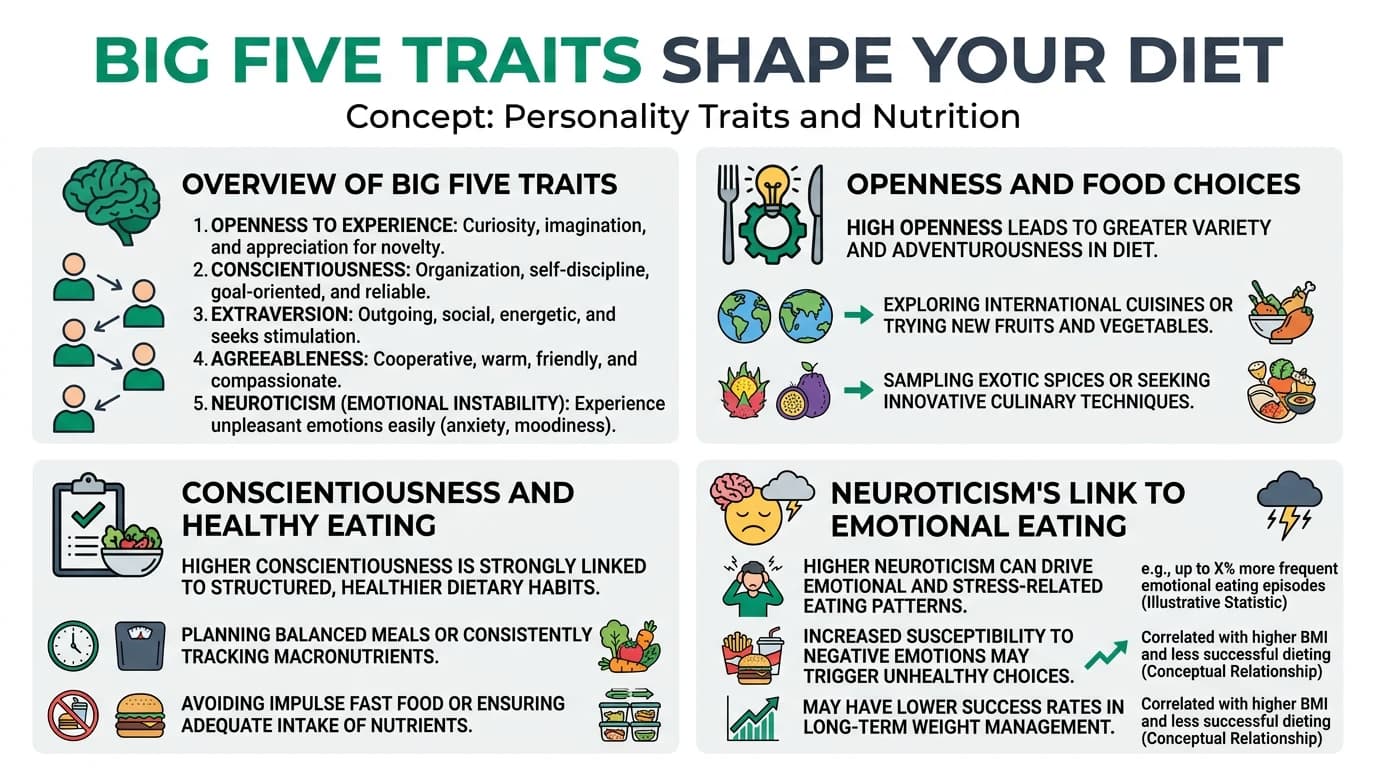
Conscientiousness is the strongest Big Five predictor of healthy eating, linked to higher fruit and vegetable intake and lower emotional overeating. Neuroticism drives comfort-food cravings and stress eating, while openness predicts willingness to try diverse foods. A 2015 systematic review of 29 studies confirmed that personality traits explain meaningful variance in dietary behavior.
Source: Lunn et al., 2014 — Appetite
Key Takeaways
- Conscientiousness is the most consistent positive predictor of healthy eating across dozens of studies.
- Neuroticism is the strongest risk factor for emotional eating and poor diet quality.
- Openness predicts dietary variety — both adventurous healthy choices and occasional indulgences.
- Extraversion links to larger social meals and higher alcohol consumption.
- Agreeableness is associated with cognitive restraint and preference for family-style meals.
- Personality-matched dietary strategies outperform generic nutrition advice.
The bottom line: Your Big Five profile is a reliable map of your eating strengths and vulnerabilities — use it to build a sustainable diet that works with your personality, not against it.
Disclaimer: This guide summarizes peer-reviewed nutritional psychology research for educational purposes. Consult a registered dietitian or healthcare provider for personalized dietary advice.
Why Personality Matters for Nutrition
Traditional nutrition advice assumes everyone responds the same way to dietary guidelines. Research tells a different story.
- A systematic review of 29 studies found that Big Five traits consistently predicted dietary patterns, food preferences, and eating behaviors1.
- Personality traits influence diet through three main channels: food choice, portion regulation, and emotional eating triggers.
| Channel | Description | Most Relevant Traits |
|---|---|---|
| Food choice | What you put on your plate | Openness, conscientiousness |
| Portion regulation | How much you eat per sitting | Conscientiousness, agreeableness |
| Emotional eating | Using food to manage mood | Neuroticism, low conscientiousness |
Understanding these channels helps explain why two people following the same meal plan can have wildly different outcomes. For broader lifestyle context, our guide on personality and sleep quality covers how traits shape another critical health behavior.
Conscientiousness: The Strongest Predictor of Healthy Eating
Conscientiousness emerges as the most reliable personality predictor of diet quality in virtually every large-scale study12.
- Fruit and vegetable intake: Conscientious individuals eat significantly more servings per day (odds ratio 1.10–1.25 across studies).
- Meal regularity: High conscientiousness predicts structured mealtimes and less snacking.
- Dietary adherence: Conscientious people stick to nutrition plans longer, whether for weight loss or chronic disease management.
| Conscientiousness Facet | Dietary Behavior | Effect Direction | Evidence Strength |
|---|---|---|---|
| Self-discipline | Resists junk food cravings | Positive | Strong (multiple meta-analyses) |
| Order | Plans meals in advance | Positive | Moderate |
| Dutifulness | Follows doctor dietary advice | Positive | Moderate |
| Achievement striving | Tracks macros and calories | Positive | Moderate |
| Deliberation | Reads nutrition labels | Positive | Strong |
| Competence | Cooks healthy meals at home | Positive | Moderate |
Mõttus et al. (2012) analyzed dietary data from 2,724 adults and found conscientiousness predicted higher consumption of fruits, vegetables, and fish while inversely predicting fried-food and fast-food intake2.
Practical strategies for low conscientiousness:
- Meal prep on Sunday to remove daily decision fatigue.
- Use grocery lists tied to a weekly menu.
- Set phone reminders for mealtimes.
- Keep healthy snacks visible and junk food out of sight.
Explore our complete conscientiousness guide for broader trait-development techniques.
Neuroticism: The Emotional Eating Risk Factor
Neuroticism is the trait most strongly associated with emotional eating — consuming food in response to negative emotions rather than hunger34.
- Comfort food seeking: High-neuroticism individuals gravitate toward calorie-dense, high-sugar, high-fat foods during stress.
- Binge patterns: Emotional eating episodes often involve larger quantities than intended.
- Weight outcomes: Meta-analyses link neuroticism to higher BMI (r = +0.07 to +0.12), with emotional eating as the primary mediating pathway3.
| Neuroticism Facet | Eating Behavior | Mediating Mechanism |
|---|---|---|
| Anxiety | Stress snacking | Cortisol-driven carb craving |
| Depression | Low motivation to cook | Reliance on convenience food |
| Self-consciousness | Eating alone, hiding consumption | Shame-avoidance cycle |
| Vulnerability | Feeling overwhelmed by meal planning | Decision paralysis |
| Impulsiveness (N-facet) | Impulse purchases at checkout | Weak inhibitory control |
Elfhag and Morey (2008) found that neuroticism was significantly associated with both uncontrolled eating (r = +0.29) and emotional eating (r = +0.32) in a sample of 282 obese patients4.
Practical strategies for high neuroticism:
- Identify emotional triggers with a food-mood journal before changing your diet.
- Keep a list of non-food comfort activities (walking, calling a friend, taking a bath).
- Practice mindful eating: pause before each bite, notice flavors and fullness cues.
- Address underlying stress through our stress management strategies guide.
Openness to Experience: The Adventurous Eater
People high in openness show the greatest dietary variety — they are willing to try unfamiliar cuisines, exotic ingredients, and novel food preparations12.
- Food neophilia: Openness is the inverse of food neophobia (fear of new foods). High scorers readily sample new dishes.
- Health trade-off: While openness predicts more fruit and vegetable exploration, it also predicts willingness to try calorie-dense gourmet foods.
- Cultural diet adoption: Open individuals more easily adopt Mediterranean, plant-based, or other structured diets from different cultures.
| Openness Level | Dietary Pattern | Typical Foods | Health Implication |
|---|---|---|---|
| High | Diverse, experimental | Sushi, quinoa salads, fermented foods | Generally positive, varied nutrient profile |
| Moderate | Selectively adventurous | Familiar cuisines with occasional novelty | Neutral |
| Low | Narrow, repetitive | Meat-and-potatoes, fast food staples | Potentially nutrient-deficient |
Practical strategies:
- High openness: Channel variety-seeking toward nutrient-dense foods. Create a "new healthy recipe" challenge each week.
- Low openness: Introduce one new healthy food per week alongside familiar favorites. Small, gradual changes build comfort without overwhelm.
Extraversion: Social Eating and Portion Size
Extraversion primarily influences eating through social context rather than food choice itself15.
- Social facilitation: Extraverts eat more when dining with others — a well-documented phenomenon where group meals increase consumption by 30–40 percent.
- Alcohol intake: Extraversion consistently predicts higher alcohol consumption across studies.
- Restaurant frequency: Extraverts eat out more often, which typically means higher calorie and sodium intake.
| Extraversion Aspect | Dietary Impact | Magnitude |
|---|---|---|
| Sociability | Larger portions in group settings | 30–40 percent increase |
| Assertiveness | More likely to order extras (appetizers, desserts) | Moderate |
| Positive emotions | Associates food with pleasure and reward | Moderate |
| Activity level | Higher energy expenditure may offset intake | Moderate protective factor |
Practical strategies:
- Before social meals, decide on a portion target and stick to it.
- Choose restaurants with clear calorie labeling when possible.
- Balance social eating nights with lighter individual meals.
- Use high activity levels as a natural caloric buffer.
Agreeableness: Restrained Eating and Family Meals
Agreeableness predicts higher cognitive restraint — the deliberate effort to control food intake — and a preference for communal, family-style meals16.
- Cognitive restraint: Agreeable individuals are more likely to monitor what they eat to maintain weight.
- Compliance: They follow dietary recommendations from authority figures (doctors, nutritionists) more readily.
- Social harmony: Meal choices may be influenced by what others want, sometimes at the expense of personal nutritional goals.
| Agreeableness Level | Eating Style | Benefit | Risk |
|---|---|---|---|
| High | Restrained, compliant | Follows health advice well | May suppress own preferences |
| Moderate | Balanced | Flexible approach | Minimal risk |
| Low | Independent, less restrained | Eats what they want | May ignore dietary advice |
Practical strategies:
- High agreeableness: Assert your own dietary needs in group settings. Practice ordering first at restaurants to avoid social influence.
- Low agreeableness: Reframe healthy eating as a personal achievement rather than compliance with external rules.
Emotional Eating: A Cross-Trait Analysis
Emotional eating sits at the intersection of multiple traits. The table below synthesizes findings from several key studies346.
| Trait | Correlation with Emotional Eating | Direction | Key Mechanism |
|---|---|---|---|
| Neuroticism | r = +0.32 | Increases risk | Mood repair via comfort food |
| Conscientiousness | r = −0.22 | Reduces risk | Self-regulation buffers impulse |
| Agreeableness | r = −0.17 | Reduces risk | Cognitive restraint |
| Extraversion | r = −0.05 | Negligible | Social context is more relevant |
| Openness | r = +0.03 | Negligible | No consistent direction |
The most vulnerable profile for emotional eating combines high neuroticism with low conscientiousness — the person feels intense negative emotion and lacks the self-regulatory resources to resist food as a coping mechanism.
Personality, BMI, and Weight Management
Several large-scale studies have examined the link between Big Five traits and body mass index35.
| Trait | Direction of BMI Association | Effect Size | Mediating Pathway |
|---|---|---|---|
| Conscientiousness | Negative (lower BMI) | r = −0.10 to −0.14 | Healthier eating, more exercise |
| Neuroticism | Positive (higher BMI) | r = +0.07 to +0.12 | Emotional eating |
| Extraversion | Mixed | r = ±0.03 | Social eating vs. higher activity |
| Agreeableness | Slightly negative | r = −0.04 | Restrained eating |
| Openness | Slightly negative | r = −0.04 | Greater food variety |
These effects are modest individually but compound over years. Sutin et al. (2011) showed that a one-standard-deviation increase in conscientiousness was associated with approximately 2 kg lower body weight over a ten-year period5.
Understanding how personality traits shift across the lifespan can help you anticipate changes in your eating patterns — our guide on personality changes across the lifespan covers this topic.
Measurement Tools for Research and Self-Assessment
Researchers use validated instruments to study personality–eating links. Understanding these tools helps you evaluate study quality.
| Tool | What It Measures | Items | Reliability (Cronbach alpha) |
|---|---|---|---|
| NEO-PI-R / NEO-FFI | Big Five traits and facets | 240 / 60 | 0.86–0.92 |
| TFEQ (Three-Factor Eating Questionnaire) | Cognitive restraint, disinhibition, hunger | 51 | 0.80–0.90 |
| DEBQ (Dutch Eating Behaviour Questionnaire) | Restrained, emotional, external eating | 33 | 0.79–0.95 |
| AEBQ (Adult Eating Behaviour Questionnaire) | Eight eating behavior dimensions | 35 | 0.75–0.90 |
| BES (Binge Eating Scale) | Binge eating severity | 16 | 0.85 |
| EAT-26 (Eating Attitudes Test) | Disordered eating risk | 26 | 0.83 |
Building a Personality-Matched Nutrition Plan
Generic diets fail because they ignore personality. The table below provides trait-specific starting points.
| Your Dominant Trait | Dietary Strength to Leverage | Dietary Vulnerability to Address | First Step |
|---|---|---|---|
| High conscientiousness | Natural planner, label reader | May be too rigid (orthorexia risk) | Add flexible "free meals" to prevent burnout |
| High neuroticism | Awareness of emotional states | Stress eating, comfort-food cravings | Start a food-mood journal this week |
| High openness | Willing to try anything | May lack consistency | Pick one healthy cuisine and eat it three times this week |
| High extraversion | Active lifestyle offsets intake | Overeating in social settings | Pre-decide portions before group meals |
| High agreeableness | Follows advice well | Suppresses own needs in groups | Practice ordering first at restaurants |
For a complementary angle on trait-matched lifestyle optimization, see our guide on exercise and fitness preferences.
Conclusion
Your Big Five personality profile is not a dietary sentence — it is a starting map. Conscientiousness helps you plan and stick to healthy habits, neuroticism warns you about emotional eating risks, and openness pushes you toward dietary variety. By understanding these patterns, you can design a nutrition strategy that leverages your strengths and guards against your vulnerabilities.
Personality-based nutrition action checklist
- Complete a Big Five personality assessment to identify your dominant traits.
- Identify your primary eating vulnerability (emotional eating, social overeating, narrow variety, or rigidity).
- Start a food-mood journal if you score high on neuroticism.
- Meal prep weekly if you score low on conscientiousness.
- Try one new healthy recipe this week if you score low on openness.
- Set a portion target before your next group meal if you score high on extraversion.
- Review your eating patterns after two weeks and adjust your strategy.
FAQ
Which personality trait is most linked to healthy eating?
Does neuroticism cause emotional eating?
Can personality predict obesity?
How does openness affect food choices?
Why do extraverts eat more in social settings?
What is cognitive restraint and which trait predicts it?
Can changing my personality improve my diet?
What measurement tools assess personality and eating behavior?
Notes
Primary Sources
| Source | Type | URL |
|---|---|---|
| Lunn et al. (2014) — Appetite | Systematic review (29 studies) | doi.org |
| Mõttus et al. (2012) — Health Psychology | Large-sample study (N = 2,724) | doi.org |
| Gerlach et al. (2015) — Obesity Reviews | Systematic review | doi.org |
| Elfhag & Morey (2008) — Eating Behaviors | Empirical study (N = 282) | doi.org |
| Sutin et al. (2011) — JPSP | Longitudinal study | doi.org |
Footnotes
-
Lunn, T. E., Nowson, C. A., Worsley, A., & Torres, S. J. (2014). Does personality affect dietary intake? Appetite, 82, 213–217. ↩ ↩2 ↩3 ↩4 ↩5
-
Mõttus, R., Realo, A., Allik, J., Deary, I. J., Esko, T., & Metspalu, A. (2012). Personality traits and eating habits in a large sample of Estonians. Health Psychology, 31(6), 806–814. ↩ ↩2 ↩3
-
Gerlach, G., Herpertz, S., & Loeber, S. (2015). Personality traits and obesity: A systematic review. Obesity Reviews, 16(1), 32–63. ↩ ↩2 ↩3 ↩4
-
Elfhag, K., & Morey, L. C. (2008). Personality traits and eating behavior in the obese: Poor self-control in emotional and external eating but personality assets in restrained eating. Eating Behaviors, 9(3), 285–293. ↩ ↩2 ↩3
-
Sutin, A. R., Ferrucci, L., Zonderman, A. B., & Terracciano, A. (2011). Personality and obesity across the adult life span. Journal of Personality and Social Psychology, 101(3), 579–592. ↩ ↩2 ↩3
-
Keller, C., & Siegrist, M. (2015). Does personality influence eating styles and food choices? Direct and indirect effects. Appetite, 84, 128–138. ↩ ↩2