personal-development
Personality and Boundaries: How Big Five Traits Affect Saying No and Protecting Your Energy
Explore how the Big Five personality traits influence your ability to set boundaries, say no, and protect your energy. Discover who struggles, who excels, and practical tips for healthier boundaries.
Quick answer
How do Big Five personality traits affect boundaries?
The Big Five traits influence how individuals manage boundaries, with Conscientiousness and Neuroticism playing significant roles in segmentation and energy protection.
Source: Cleveland State University
Executive Summary
Understanding how the Big Five personality traits affect your ability to set boundaries can help you protect your energy and say no when needed. Traits like Conscientiousness and Neuroticism significantly impact how you manage boundaries.
The bottom line: Knowing your personality traits can guide you in developing healthier boundaries and avoiding burnout.
Critical Warning: Traits are not deterministic. Consult professionals for mental health concerns.
What Are the Big Five Personality Traits?
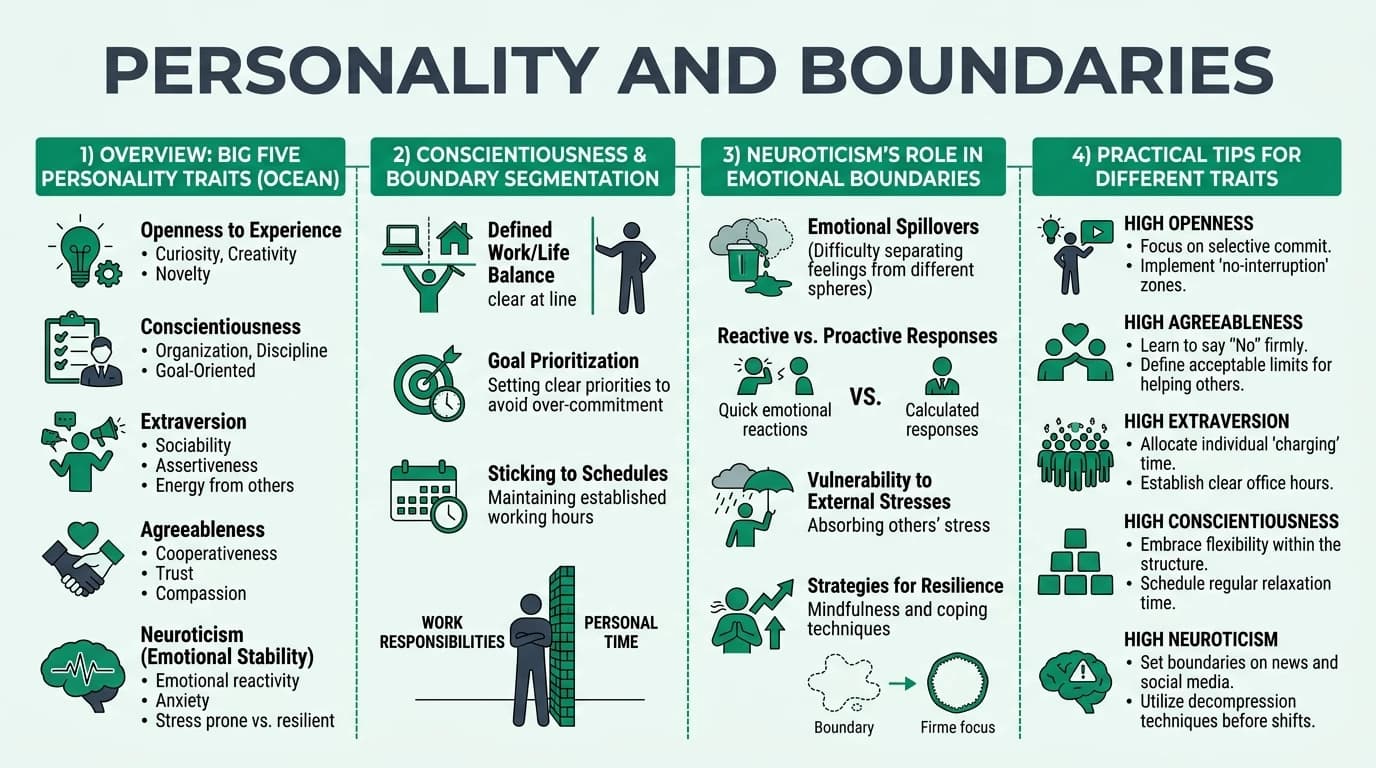
The Big Five personality traits, often remembered by the acronym OCEAN, include:
- Openness to Experience: Curiosity, novelty-seeking.
- Conscientiousness: Discipline, organization.
- Extraversion: Sociability, energy from others.
- Agreeableness: Compassion, cooperation.
- Neuroticism: Emotional sensitivity vs. resilience.
These traits exist on a continuum, meaning everyone has varying degrees of each trait1.
| Trait | High Description | Low Description |
|---|---|---|
| Openness | Imaginative, creative | Prefers routine, cautious |
| Conscientiousness | Organized, reliable | Spontaneous, flexible |
| Extraversion | Outgoing, energetic | Reserved, solitary |
| Agreeableness | Cooperative, empathetic | Competitive, skeptical |
| Neuroticism | Sensitive, anxious | Calm, stable |
How Do Traits Affect Boundary Management?
Conscientiousness and Segmentation
- Effect: High Conscientiousness leads to better boundary segmentation.
- Reason: These individuals are organized and goal-directed.
- Challenge: Can become too rigid.
Neuroticism and Emotional Boundaries
- Effect: High Neuroticism often results in stronger emotional boundaries.
- Reason: Sensitivity to stress leads to protective measures.
- Challenge: May lead to anxiety if boundaries are breached.
| Trait | Segmentation Preference | Evidence Source |
|---|---|---|
| Conscientiousness | High | CSU Ohio Thesis |
| Neuroticism | High | CSU Ohio Thesis |
| Extraversion | Moderate | Limited Evidence |
| Agreeableness | Moderate | Limited Evidence |
| Openness | Variable | CSU Ohio Thesis |
Who Struggles with Boundaries?
High Agreeableness
- Struggle: Difficulty saying no.
- Reason: Desire to please others.
- Tip: Use pre-planned "polite decline" scripts.
High Extraversion
- Struggle: Energy drain from social interactions.
- Reason: Need for social engagement.
- Tip: Schedule downtime to recharge.
High Neuroticism
- Struggle: Overwhelmed by emotions.
- Reason: High sensitivity.
- Tip: Practice journaling to manage stress.
Who Excels at Setting Boundaries?
High Conscientiousness
- Strength: Effective at saying no.
- Reason: Strong self-discipline.
- Tip: Set clear priorities to maintain focus.
Low Neuroticism
- Strength: Resilient to stress.
- Reason: Emotional stability.
- Tip: Maintain a balanced routine to avoid burnout.
Moderate Openness
- Strength: Balanced variety in life.
- Reason: Flexibility in approach.
- Tip: Use structured creativity to avoid chaos.
| Trait | Strength in Boundaries | Practical Tip |
|---|---|---|
| Conscientiousness | Saying no effectively | Set clear priorities |
| Neuroticism | Resilient to stress | Balanced routine |
| Openness | Balanced variety | Structured creativity |
Practical Tips for Healthier Boundaries
-
For High Agreeableness:
- Tip: Prepare scripts for saying no.
- Example: "I appreciate the offer, but I need to focus on my current commitments."
-
For High Extraversion:
- Tip: Block time for solitude.
- Example: Use calendar reminders for personal time.
-
For High Neuroticism:
- Tip: Engage in mindfulness practices.
- Example: Daily meditation or breathing exercises.
FAQ
Which Big Five trait struggles most with saying no?
High Agreeableness often struggles due to a strong desire to please others2.
Does high agreeableness mean weak boundaries?
Not necessarily, but it can make setting boundaries more challenging without practice3.
How does neuroticism affect energy protection?
High Neuroticism can lead to emotional exhaustion, making energy protection crucial4.
Can you improve boundaries if you're highly extraverted?
Yes, by scheduling regular downtime and setting social limits5.
What Big Five traits excel at work-life segmentation?
High Conscientiousness and low Neuroticism are linked to better segmentation6.
Is openness to experience linked to poor boundaries?
Openness can lead to blurred boundaries if not balanced with structure7.
How do conscientious people set boundaries?
They prioritize tasks and use structured planning to maintain boundaries8.
Notes
Primary Sources
| Source | Type | URL |
|---|---|---|
| Cleveland State University | Peer-reviewed thesis | Link |
| Simply Psychology | Expert summary | Link |
| Wikipedia | Consensus encyclopedia | Link |
| PMC/NCBI | Peer-reviewed | Link |
| PositivePsychology.com | Industry/expert | Link |
Conclusion
Understanding how your personality traits affect boundary setting can empower you to protect your energy and improve your well-being. By recognizing strengths and challenges, you can tailor strategies to your unique personality.
Footnotes
-
Simply Psychology overview of Big Five traits. ↩
-
PositivePsychology.com on Agreeableness. ↩
-
Cleveland State University thesis. ↩
-
PMC article on Neuroticism. ↩
-
Expert recommendations from PositivePsychology.com. ↩
-
CSU Ohio thesis findings. ↩
-
Simply Psychology insights on Openness. ↩
-
Conscientiousness strategies from PositivePsychology.com. ↩