education
Personality and Academic Integrity: Exploring the Big Five Traits
Discover how personality traits like Conscientiousness and Agreeableness influence academic integrity, including cheating and plagiarism, in university settings.
Quick answer
Which Big Five traits predict academic dishonesty?
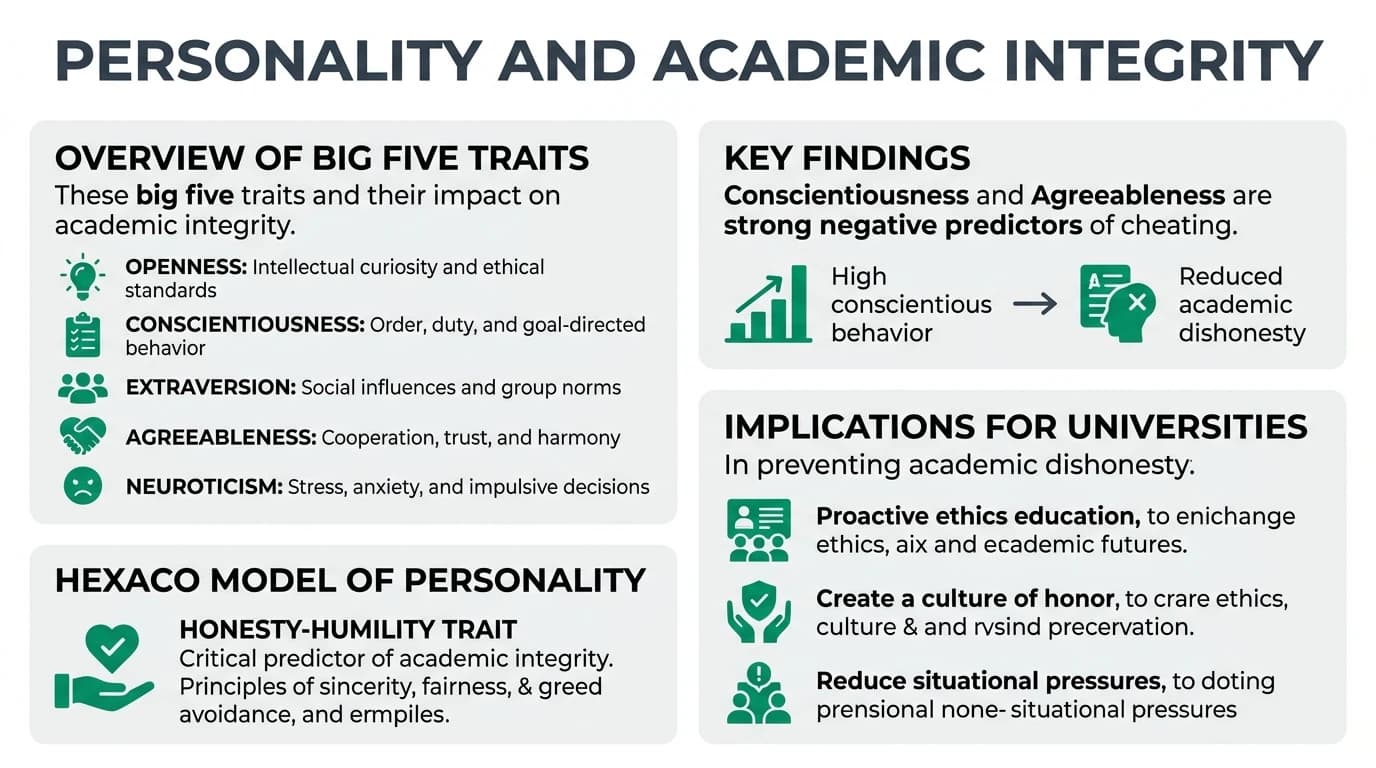
Conscientiousness and Agreeableness are strong negative predictors of academic dishonesty, while the HEXACO model's Honesty-Humility trait offers additional insights.
Source: PMC
Executive Summary
Understanding how personality traits influence academic integrity is crucial for educators and students. The Big Five personality traits, especially Conscientiousness and Agreeableness, play a significant role in predicting behaviors like cheating and plagiarism. Recent studies suggest that the HEXACO model, which includes the Honesty-Humility trait, provides even more robust insights.
The bottom line: Personality traits can significantly impact academic integrity, and understanding these influences can help universities develop better prevention strategies.
Critical Warning: While personality traits provide valuable insights, they are not the sole predictors of academic behavior. Contextual factors and institutional policies also play crucial roles.
What Are the Big Five Personality Traits?
The Big Five personality traits are a widely recognized framework in psychology. They include:
- Openness: Creativity and open-mindedness.
- Conscientiousness: Discipline and organization.
- Extraversion: Sociability and assertiveness.
- Agreeableness: Compassion and cooperation.
- Neuroticism: Emotional instability and anxiety.
Quick Reference Table: Big Five Traits
| Trait | Description | Impact on Integrity |
|---|---|---|
| Openness | Creativity, curiosity | Neutral |
| Conscientiousness | Discipline, rule-following | Strong negative predictor |
| Extraversion | Sociability, assertiveness | Mixed |
| Agreeableness | Compassion, cooperation | Reduces dishonesty |
| Neuroticism | Emotional instability | Potentially increases risk |
How Do These Traits Affect Cheating?
Research indicates that certain traits are linked to academic dishonesty:
- Conscientiousness: High levels discourage cheating due to a preference for rule-following.
- Agreeableness: Promotes honesty through cooperative behavior.
- Neuroticism: May increase susceptibility to cheating due to stress.
Key Takeaways
- Conscientiousness and Agreeableness are strong deterrents against cheating.
- Neuroticism can increase the likelihood of dishonest behavior under pressure.
What is the HEXACO Model?
The HEXACO model expands on the Big Five by adding a sixth trait:
- Honesty-Humility: Sincerity, fairness, and modesty.
Comparison Table: Big Five vs HEXACO
| Model | Key Traits for Integrity | Strengths |
|---|---|---|
| Big Five | Conscientiousness, Agreeableness | Widely used |
| HEXACO | Adds Honesty-Humility | Better cross-cultural replicability |
Why is Honesty-Humility Important?
Honesty-Humility uniquely predicts lower levels of cheating and plagiarism. It emphasizes sincerity and fairness, making it a critical factor in academic integrity.
Important:
The Honesty-Humility trait has shown stronger cross-cultural validity compared to the Big Five, making it a valuable tool in diverse educational settings.
How Do Honor Codes Influence Behavior?
Honor codes are formal statements that outline expectations for academic integrity. They often include:
- Pledges: Students commit to honesty.
- Peer Enforcement: Students monitor each other's adherence.
Honor Code Effectiveness Table
| Institution | Student Role | Outcomes |
|---|---|---|
| University of Virginia | Active participation | Reduced cheating incidences |
| Generic University | Passive awareness | Variable effectiveness |
What is Plagiarism in Academic Integrity?
Plagiarism involves using someone else's work without proper credit. It includes:
- Direct Quoting: Without quotation marks or citations.
- Paraphrasing: Without acknowledging the source.
- Submitting Others' Work: As your own.
Plagiarism Examples Table
| Type | Example | Violation Severity |
|---|---|---|
| Direct Quote | Using text verbatim without credit | High |
| Paraphrase | Rewriting ideas without citation | Moderate |
| Fabricated Sources | Citing non-existent references | High |
How Can Universities Promote Academic Integrity?
Universities can adopt several strategies to enhance academic honesty:
- Education Programs: Teach students about integrity.
- Surveys: Use tools like the Academic Integrity Survey (AIS) to assess attitudes.
- Policy Enforcement: Implement and enforce clear policies.
Academic Integrity Strategies Table
| Strategy | Target | Evidence of Success |
|---|---|---|
| Education Programs | Students | Increased awareness |
| Surveys | Faculty/Students | Better policy alignment |
| Policy Enforcement | Institution | Reduced misconduct |
Action checklist
- Understand the role of personality traits in academic integrity.
- Implement honor codes to reduce cheating.
- Utilize the HEXACO model for better cross-cultural integrity predictions.
FAQ
How does Conscientiousness affect cheating in college?
What is the HEXACO personality model?
Do honor codes reduce plagiarism in universities?
Which personality trait best predicts academic integrity?
Is Honesty-Humility more reliable than Big Five for dishonesty?
How do universities enforce academic honesty codes?
What are examples of plagiarism in student papers?
Notes
Primary Sources
| Source | Type | URL |
|---|---|---|
| PMC | Peer-reviewed | PMC Article |
| Inside Higher Ed | Industry | Inside Higher Ed |
| University of Scranton | Official | Scranton |
| UNL Digital Commons | Peer-reviewed | UNL Digital Commons |
Conclusion
Personality traits like Conscientiousness, Agreeableness, and Honesty-Humility significantly influence academic integrity. By understanding these traits, universities can better tailor their policies and educational programs to reduce dishonesty.