personality-tests
DISC vs. Enneagram: Choosing the Right Tool for Individual Coaching and Personal Growth
Explore the differences between DISC and Enneagram to find the best fit for your coaching and personal growth needs.
Quick answer
What is the difference between DISC and Enneagram?
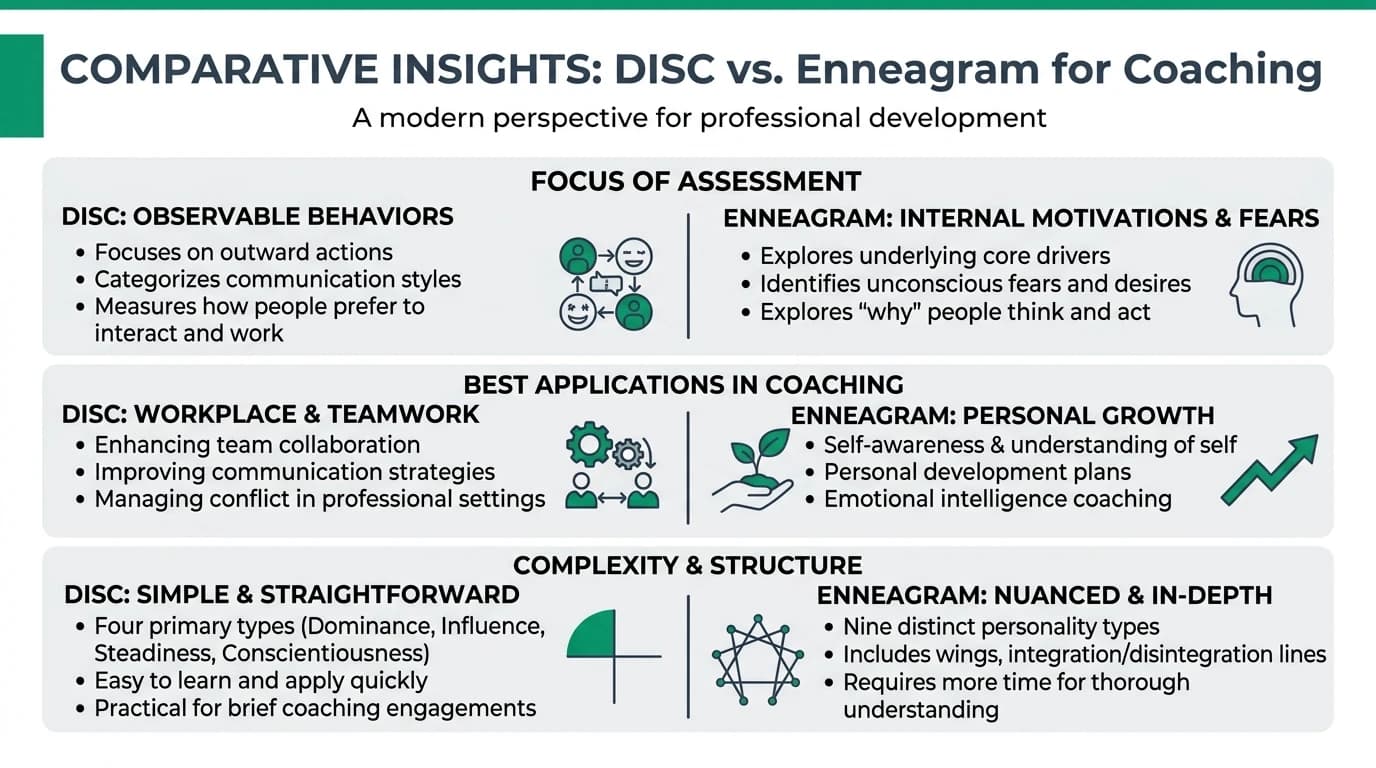
DISC focuses on observable behaviors in four styles (Dominance, Influence, Steadiness, Conscientiousness) for quick insights, while Enneagram explores deeper motivations and fears through nine types for personal growth.
Source: Capteer
Executive Summary
If you’re exploring personality tools for coaching or personal growth, you might wonder: DISC or Enneagram? Both offer unique insights but serve different purposes.
- DISC: Quick insights into behaviors, ideal for teamwork and communication.
- Enneagram: Delves into motivations, perfect for deep personal transformation.
The bottom line: Choose DISC for immediate action in professional settings and Enneagram for introspective personal growth.
Critical Warning: Neither tool is scientifically validated like the Big 5; results vary by individual. Consult certified coaches for best outcomes.
What is DISC?
DISC is a personality assessment focusing on observable behaviors. It categorizes people into four main types:
- Dominance (D): Assertive, results-driven.
- Influence (I): Outgoing, relationship-focused.
- Steadiness (S): Patient, supportive.
- Conscientiousness (C): Detail-oriented, analytical.
DISC Types Pros/Cons
| Type | Strengths | Weaknesses |
|---|---|---|
| Dominance (D) | Decisive, efficient | Impatient, insensitive |
| Influence (I) | Enthusiastic, sociable | Disorganized, impulsive |
| Steadiness (S) | Reliable, cooperative | Resistant to change |
| Conscientiousness (C) | Precise, systematic | Overly critical, perfectionist |
Key Takeaways:
- Quick Insights: Ideal for team settings.
- Simplicity: Easy to understand and apply.
- Workplace Fit: Enhances communication and teamwork.
What is the Enneagram?
The Enneagram is a personality model exploring deeper motivations, fears, and desires. It identifies nine distinct types, each with unique growth paths.
Enneagram Sample Types
| Type Number/Name | Key Traits | Growth Path |
|---|---|---|
| Type 8 (Challenger) | Confident, assertive | Embrace vulnerability |
| Type 9 (Peacemaker) | Easygoing, agreeable | Assert personal needs |
| Type 2 (Helper) | Caring, supportive | Develop self-care |
Key Takeaways:
- Introspection: Enhances self-awareness.
- Growth Paths: Offers personal development routes.
- Emotional Awareness: Deepens understanding of motivations.
Key Differences Between DISC and Enneagram
Comparison Table
| Feature | DISC | Enneagram |
|---|---|---|
| Focus | Observable behaviors | Motivations and fears |
| Best For | Workplace, teamwork | Personal growth |
| Types | 4 styles | 9 types |
| Complexity | Simple | Nuanced |
Key Takeaways:
- Behavior vs. Motivation: DISC is about what you do; Enneagram is about why you do it.
- Application: Use DISC for quick fixes; Enneagram for deep dives.
Applications in Coaching
Coaching Scenarios
| Client Need | Recommended Tool | Why |
|---|---|---|
| Team Building | DISC | Quick insights into dynamics |
| Personal Therapy | Enneagram | Deep exploration of self |
| Leadership | Both | Balance of behavior and motives |
Key Takeaways:
- Tailored Approaches: Match tool to client needs.
- Balanced Growth: Combine for comprehensive coaching.
Strengths of DISC
DISC shines in professional settings due to its simplicity and focus on behaviors. It’s especially useful for:
- Team Communication: Identifies styles for better collaboration.
- Leadership Development: Offers actionable insights for leaders.
Workplace Applications
| Role | DISC Fit | Enneagram Fit |
|---|---|---|
| Leader | Assertiveness (D) | Stress responses (Type 8) |
| Team Member | Collaboration (S) | Motivation (Type 9) |
Key Takeaways:
- Immediate Application: Ready-to-use insights.
- Team Dynamics: Enhances group effectiveness.
Strengths of Enneagram
The Enneagram excels in personal settings, offering deep insights into motivations and growth paths. It’s beneficial for:
- Self-Reflection: Encourages introspection and personal growth.
- Emotional Intelligence: Enhances understanding of emotional drivers.
Behavioral vs. Motivational Insights
| Aspect | DISC Example | Enneagram Example |
|---|---|---|
| Stress Response | Direct (D) | Avoidance (Type 9) |
| Motivation | Achievement (I) | Connection (Type 2) |
Key Takeaways:
- Depth: Uncovers underlying motivations.
- Personal Growth: Fosters long-term change.
Limitations and Criticisms
Both tools have their downsides:
- DISC: Lacks depth, focusing only on behaviors.
- Enneagram: Complex, requiring more introspection.
Important: Neither tool is scientifically validated like the Big 5; results vary by individual.
Combining DISC and Enneagram
For a comprehensive approach, consider using both tools:
- Hybrid Approach: Use DISC for immediate insights and Enneagram for deeper exploration.
- Case Studies: Coaches report success using both for balanced development.
Tool Selection Guide
| Goal | Primary Tool | Secondary Tool |
|---|---|---|
| Quick Insights | DISC | Enneagram for deeper follow-up |
| Deep Growth | Enneagram | DISC for practical application |
Key Takeaways:
- Comprehensive Insight: Balance short-term and long-term goals.
- Adaptability: Tailor to individual needs.
Choosing the Right Tool
To choose the right tool, assess your or your client’s needs:
- Identify Goals: Quick insights or deep growth?
- Consider Context: Professional or personal setting?
- Evaluate Complexity: Simplicity or depth?
Quick Reference: Flexibility
| Tool | Static/Dynamic | Situational Use |
|---|---|---|
| DISC | Static | Team settings |
| Enneagram | Dynamic | Personal growth |
| Combined | Both | Balanced coaching |
Key Takeaways:
- Client-Centric: Focus on individual requirements.
- Situational Fit: Match tool to context.
Action checklist
- Identify the primary goal: quick insights or deep growth.
- Choose the tool based on the setting: professional or personal.
- Consider combining tools for a balanced approach.
FAQ
What are the four DISC personality types?
How many types are in the Enneagram?
Is DISC or Enneagram better for team building?
Can you use DISC and Enneagram together?
What is the focus of DISC assessment?
Does Enneagram help with personal growth?
Which test is simpler: DISC or Enneagram?
Notes
Primary Sources
| Source | Type | URL |
|---|---|---|
| Capteer | Industry (coaching blog) | Capteer |
| Katie Gustafson | Industry (coaching blog) | Katie Gustafson |
Conclusion
Choosing between DISC and Enneagram depends on your goals. DISC offers quick, actionable insights for professional settings, while Enneagram provides deep, introspective growth paths for personal development.