personality-tests
Conscientiousness and Ethical Decision-Making: Fostering Fairness in the Workplace
Explore how conscientiousness influences ethical decision-making and promotes fairness in workplace environments.
Quick answer
How does conscientiousness affect ethical decision-making?
Conscientiousness enhances ethical decision-making by promoting fairness, reducing turnover, and improving job performance.
Executive Summary
Conscientiousness, a key personality trait, influences ethical decision-making by fostering fairness and reducing turnover in workplaces. It enhances job performance and builds trust, crucial for ethical climates.
The bottom line: Conscientiousness is essential for ethical leadership and fairness in the workplace.
Critical Warning: While conscientiousness generally promotes positive outcomes, rigid workplace structures may undermine its benefits.
What is Conscientiousness?
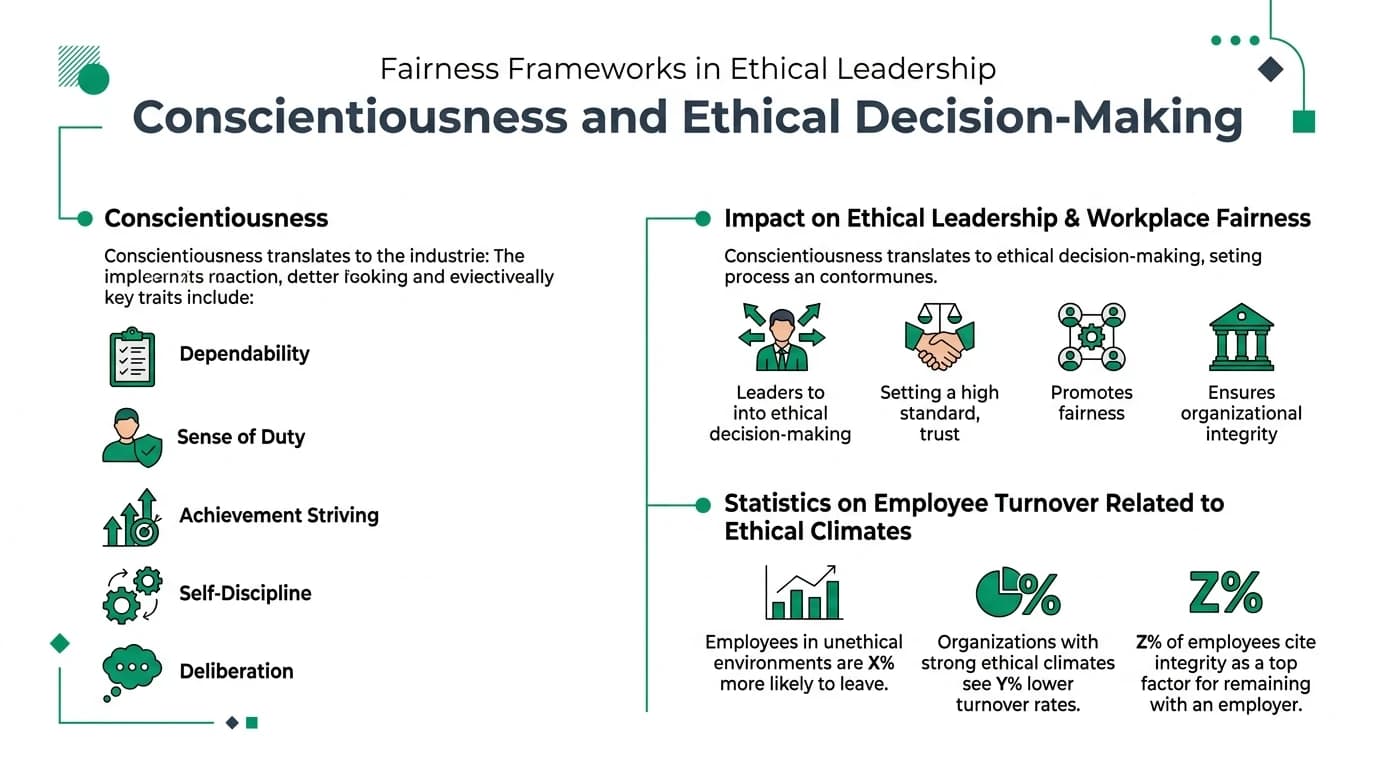
Conscientiousness is about being diligent, responsible, and ethical. It's one of the Big Five personality traits and plays a significant role in how people make decisions.
- Traits: Diligence, responsibility, integrity.
- Impact: Encourages ethical behavior, enhances job performance.
- Caveat: Rigid structures can hinder its effectiveness.
| Trait | Description | Workplace Impact |
|---|---|---|
| Diligence | Careful and persistent effort | Higher productivity |
| Responsibility | Accountability and reliability | Trust-building |
| Integrity | Adherence to moral principles | Ethical culture |
How Does Conscientiousness Influence Ethical Leadership?
Conscientious leaders often create ethical workplace climates. They lead by example, fostering environments where fairness and integrity are prioritized.
- Leadership Traits: Ethical, fair, trustworthy.
- Outcomes: Reduced turnover, improved morale.
- Mechanism: Social learning from leaders.
| Leadership Trait | Outcome | Mechanism |
|---|---|---|
| Ethical | Reduced turnover | Social learning |
| Fair | Improved morale | Role modeling |
| Trustworthy | Enhanced trust | Consistent behavior |
What is Fairness in Ethical Decision-Making?
Fairness involves making impartial, consistent, and transparent decisions. It ensures that opportunities and benefits are distributed equitably.
- Legitimate Expectations: Based on promises or practices.
- Procedural Fairness: Impartial and consistent decisions.
- Distributive Fairness: Equitable allocation of resources.
| Fairness Type | Description | Example |
|---|---|---|
| Legitimate Expectations | Based on promises | Transparent promotions |
| Procedural Fairness | Impartial decisions | Equal opportunity hiring |
| Distributive Fairness | Equitable resource allocation | Fair salary distribution |
How to Improve Ethical Decision-Making at Work?
Improving ethical decision-making involves creating a supportive environment and encouraging conscientious behavior.
- Promote Ethical Leadership: Encourage leaders to model ethical behavior.
- Foster Open Communication: Allow employees to voice concerns.
- Implement Fair Policies: Ensure policies are transparent and fair.
| Action | Description | Benefit |
|---|---|---|
| Promote Ethical Leadership | Model ethical behavior | Builds trust |
| Foster Open Communication | Encourage dialogue | Reduces misunderstandings |
| Implement Fair Policies | Transparent rules | Enhances fairness |
How Does Conscientiousness Affect Job Performance?
Conscientiousness predicts higher job performance by enhancing integrity and promoting an ethical climate.
- Performance Prediction: Conscientiousness leads to better job performance (β = 0.13).
- Integrity Enhancement: Promotes honesty and ethical behavior.
- Ethical Climate: Creates a supportive work environment.
| Outcome | Beta Value | Mediator |
|---|---|---|
| Job Performance | 0.13 | Ethical Climate |
| Integrity | Enhances honesty | Ethical Behavior |
| Ethical Climate | Supportive environment | Reduces turnover |
Why is Fairness Vital in Ethical Decision-Making?
Fairness is crucial for maintaining a positive workplace culture and preventing legal issues.
- Cultural Impact: Boosts morale and trust.
- Legal Compliance: Prevents discrimination lawsuits.
- Productivity: Encourages employee engagement.
| Impact | Description | Example |
|---|---|---|
| Cultural | Boosts morale | Inclusive policies |
| Legal | Prevents lawsuits | Non-discrimination |
| Productivity | Encourages engagement | Fair workload distribution |
How Do Ethical Climates Affect Emotional Exhaustion?
Ethical climates reduce emotional exhaustion by promoting fairness and trust.
- Climate Types: Self-interest, friendship, morality.
- Impact: Reduces stress, increases satisfaction.
- Mechanism: Fair treatment and support.
| Climate Type | Impact on Turnover | Mechanism |
|---|---|---|
| Self-Interest | Increases stress | Competitive |
| Friendship | Reduces stress | Supportive |
| Morality | Increases satisfaction | Ethical |
What Are Modern Equivalents of Cardinal Virtues?
Modern workplaces can benefit from the cardinal virtues: prudence, justice, fortitude, and temperance.
- Prudence: Critical thinking.
- Justice: Fairness.
- Fortitude: Resilience.
- Temperance: Self-control.
| Virtue | Modern Equivalent |
|---|---|
| Prudence | Critical thinking |
| Justice | Fairness |
| Fortitude | Resilience |
| Temperance | Self-control |
Action checklist
- Encourage ethical leadership.
- Implement transparent policies.
- Foster an open communication culture.
FAQ
How does leader conscientiousness reduce employee turnover?
What is procedural fairness in the workplace?
Why might conscientious employees seem less ethical?
How do ethical climates affect emotional exhaustion?
What role does fairness play in organizational culture?
Can rigid decision-making harm conscientious workers?
How does conscientiousness predict job performance?
Notes
Primary Sources
| Source | Type | URL |
|---|---|---|
| Harvard Business School Online | Industry/Educational | Link |
| PMC/NIH | Peer-reviewed | Link |
| University of Western Australia | Peer-reviewed | Link |
| SA Journal of Industrial Psychology | Peer-reviewed | Link |
Conclusion
Conscientiousness significantly impacts ethical decision-making by fostering fairness and improving workplace dynamics. Leaders who embody this trait create environments that enhance job performance and reduce turnover.